
多层次资本市场

Search documents
多地出台政策强化对企业金融支持
Zheng Quan Ri Bao· 2025-11-27 16:22
Core Viewpoint - Recent initiatives from regions like Shaanxi, Guangdong, Yunnan, and Guangxi aim to guide and support enterprises in better utilizing multi-level capital markets to enhance the effectiveness of financial empowerment for the real economy [1] Group 1: Financing Channels - Shaanxi Province introduced 16 measures to strengthen the cultivation of listed backup enterprises and support technology-based companies in listing and financing [2] - Guangdong's financial management departments issued a plan to broaden direct financing channels for enterprises, encouraging the establishment of comprehensive service platforms for listings [2] - Yunnan's government proposed actions to support private enterprises in listing and financing, including training and guidance for eligible companies [2] Group 2: Support for Refinance and Mergers - Policies in various regions provide support for enterprises in refinancing and mergers, such as Guangxi's incentive policy that offers financial subsidies for listed companies' refinancing efforts [4] - The support for refinancing aims to reduce direct financing costs and alleviate financial pressures on enterprises, thereby activating market transactions and innovation [4] Group 3: Targeted Support for Key Sectors - Policies are designed to guide financial support towards key sectors like information technology, artificial intelligence, and biotechnology, facilitating appropriate listings for these enterprises [5] - The introduction of these policies is seen as a timely boost for technology and innovation-driven companies, significantly lowering their financing costs [5] Group 4: Consumer Sector Support - Recent plans from multiple departments in Beijing focus on supporting the consumer sector by enabling quality enterprises to raise funds through listings and other means [6] Group 5: Future Outlook - The concentration of quality enterprises, especially technology-driven and industry-leading firms, in the capital market is expected to enhance overall listing quality and better serve the real economy [7] - Recommendations for improving the financing environment include strengthening policy coordination and creating a financing environment led by government guidance and market-driven initiatives [7]
同科技创新相适应的科技金融体制加快构建
Jin Rong Shi Bao· 2025-11-24 00:37
Group 1 - The core viewpoint of the articles emphasizes the importance of innovative financing mechanisms, particularly the issuance of technology innovation bonds, to support technological advancements and address financing challenges faced by tech enterprises [1][2]. - The issuance of technology innovation bonds has seen significant growth, with nearly 1.5 trillion yuan issued in the first half of the year, accounting for nearly 80% of the total issuance of innovation-related bonds [2]. - The financial resource allocation logic is shifting, allowing equity investment institutions to issue bonds, transforming short-term debt into long-term capital for hard tech companies in critical R&D phases [2]. Group 2 - The banking credit system is undergoing a transformation, with the loan approval rate for tech SMEs exceeding 50%, reflecting a 2.8 percentage point increase year-on-year [3]. - Banks are innovating their lending mechanisms, moving away from traditional collateral requirements to focus on the technological value and growth potential of enterprises [3]. - The establishment of specialized technology finance departments in major banks and the creation of over 2,000 technology branches nationwide are enhancing the support for tech innovation [3]. Group 3 - The multi-tiered equity market is being strengthened to better serve technological innovation, with ongoing reforms in the Sci-Tech Innovation Board and the establishment of the Beijing Stock Exchange [4]. - There are still deep-rooted contradictions in the financial system's support for tech innovation, particularly the tendency to favor mature high-tech enterprises over seed and startup companies that face financing difficulties [4]. - The lack of government risk compensation funds is a significant barrier to improving the financing accessibility for tech enterprises, leading to higher costs due to increased risk management measures by investors and banks [4]. Group 4 - Future development of a financial system that aligns with technological innovation requires patience, breakthroughs, and innovation [5]. - Recommendations include enhancing the foundational systems of multi-tiered capital markets, exploring high-yield bond markets for riskier tech enterprises, and strengthening the linkage between equity, debt, and loans [5][6]. - There is a call for the cultivation of patient and long-term capital, including the establishment of large-scale industrial mother funds to guide social capital towards strategic emerging industries [6].
福建省资本与产业对接会在深圳举办
Zheng Quan Shi Bao Wang· 2025-11-19 04:34
Core Insights - The event themed "Gathering Financial Capital to Empower the Real Economy" was held in Shenzhen, attended by over 250 financial institutions and more than 300 quality enterprises from Fujian Province and the Greater Bay Area [1][2] Group 1: Event Overview - The event featured speeches from key officials, including Lin Ruiliang, Vice Governor of Fujian Province, and Wang Hong, Vice Chairman of the Shenzhen Stock Exchange [1] - Financial institutions such as Fujian Jin Investment, Huafu Securities, and major banks presented their specialized financial services and highlighted key activities [1] - Five companies, including Xincheng Technology and Zongteng Network, showcased their latest project plans and financing needs during the roadshow [1] Group 2: Specialized Sessions - The event included five specialized matchmaking sessions focusing on themes like biomedicine and new materials, artificial intelligence and high-end equipment manufacturing, and integrated circuits and next-generation information technology [1] - Over 60 Fujian enterprises participated in the roadshows, generating enthusiastic responses from investment institutions [1] Group 3: Training and Workshops - Fujian Jin Investment and Huafu Securities organized a "Walk into Shenzhen Stock Exchange" activity, involving nearly 50 quality enterprises and local government departments to enhance understanding of multi-level capital markets [2] - A training session for companies aiming to list in Hong Kong was conducted, featuring experts from the Hong Kong Stock Exchange and other financial institutions, attracting over 200 enterprise representatives [2]
【专访】李寿双:建议设置澳门股票交易所,助中小企业境外融资 | 前瞻十五五⑳
Sou Hu Cai Jing· 2025-11-18 02:24
Group 1 - The core viewpoint of the article emphasizes the need to enhance the inclusiveness and adaptability of the capital market, ensuring it serves both the real economy and investors effectively [1][8] - The article discusses the importance of establishing rules that favor high-quality listed companies for refinancing while also implementing mechanisms to delist poor-performing companies [1][9] - It highlights the necessity of a legal environment that fosters confidence among market participants, which is crucial for the capital market to operate based on the rule of law [1][10] Group 2 - The article points out that the current capital market system has been overly focused on financing functions, neglecting investment functions, leading to a lack of investor satisfaction [8][9] - It mentions that since 2020, over 1,500 new companies have been listed, with financing amounts ranking first globally in 2022 and 2023, yet stock market indices have remained low, indicating an imbalance in investment and financing functions [8][9] - The article suggests that the establishment of a stock exchange in Macau could provide an alternative for companies unable to meet Hong Kong's listing requirements, thus enhancing the multi-tiered capital market system [5][12] Group 3 - The article discusses the need for a robust legal framework to support direct financing, which is seen as more beneficial for promoting innovation compared to indirect financing [10][11] - It emphasizes the importance of continuous reforms in capital market regulations, such as the shift from strict approval systems to more flexible registration systems for new stock issuances [6][7] - The article also notes that the regulatory environment has become more stringent, with a focus on combating illegal activities in the securities market to ensure a healthy market ecosystem [15][16]


北交所开市四周年:为中小企业提供更广阔的资本舞台
Ren Min Wang· 2025-11-15 04:44
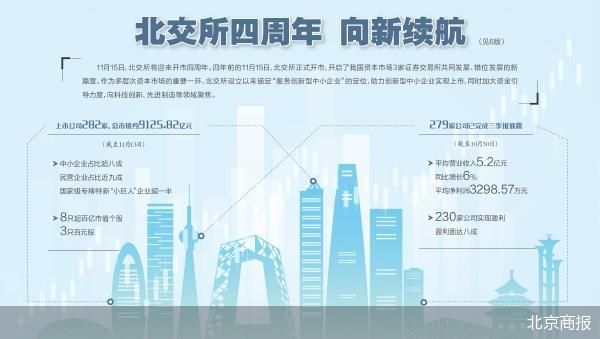
Core Insights - Beijing Stock Exchange (BSE) has marked its fourth anniversary, focusing on serving innovative small and medium-sized enterprises (SMEs) and becoming a crucial part of China's multi-tiered capital market [1][4] Group 1: Market Performance - As of November 14, BSE has 282 listed companies, with over 80% being SMEs and nearly 90% being private enterprises [1] - More than half of the listed companies are recognized as national-level specialized and innovative "little giant" enterprises [1] - The average revenue of 279 companies that disclosed their Q3 reports is 520 million yuan, reflecting a year-on-year growth of 6%, while the average net profit is approximately 32.99 million yuan [1] Group 2: Institutional Arrangements - BSE has established a set of institutional arrangements tailored to the characteristics of SMEs, including precise and inclusive market access, ongoing regulatory support, and diverse trading mechanisms [1][2] - The exchange has introduced market-making trading mechanisms and launched indices such as the BSE 50 Index and the Specialized and Innovative Index [1] Group 3: Bond Market Development - BSE has formed a stock-bond linkage market structure, issuing over 13 trillion yuan in national bonds and supporting local government bond issuance exceeding 990 billion yuan [2] - The exchange has launched various specialized bond products, including technology innovation bonds and green bonds, enhancing the bond market's support for technological innovation [2] Group 4: Financing and Investment Coordination - BSE aims to improve the quality of listed companies and strengthen the full-chain regulatory mechanism, ensuring strict listing standards and ongoing supervision [3] - The exchange encourages listed companies to utilize financing tools effectively and promotes long-term capital investment, targeting the development of public funds focused on small and medium-sized stocks [3] Group 5: Collaborative Ecosystem - BSE emphasizes collaboration with government departments and market institutions to create a supportive ecosystem for SMEs [4] - The exchange has actively guided the implementation of inclusive financial concepts, with over 90% of listed companies distributing dividends and a total of over 9.5 million qualified investors participating in the market [3][4]
北交所开市这四年
Bei Jing Shang Bao· 2025-11-13 15:58
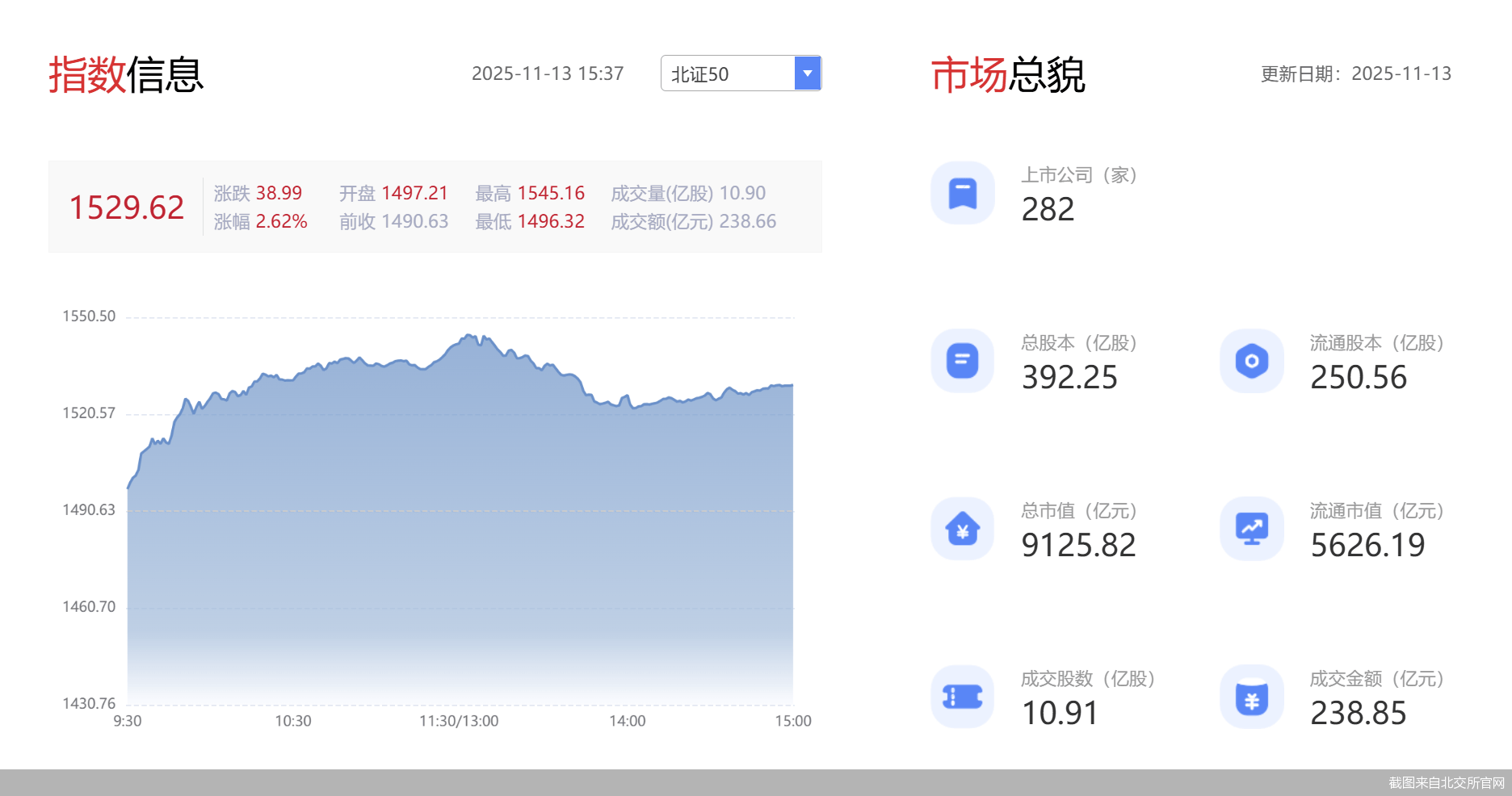
Core Insights - The Beijing Stock Exchange (BSE) is celebrating its fourth anniversary, having established itself as a key player in the multi-tiered capital market, focusing on serving innovative small and medium-sized enterprises (SMEs) [1][9] - As of November 13, 2023, the BSE has 282 listed companies with a total market capitalization exceeding 900 billion yuan, approaching the 1 trillion yuan mark [3][4] - There are currently 170 companies in the IPO pipeline for the BSE, indicating strong interest and activity in the market [6][7] Market Growth - The BSE has shown significant growth over four years, with the number of listed companies increasing from 81 at inception to 282 today [1][3] - The total market capitalization of listed companies reached approximately 912.58 billion yuan as of November 13, 2023 [3] - The number of new listings has also increased, with 25 new stocks listed in the fourth anniversary year and 20 new stocks listed in 2023 [3] Company Performance - Among the listed companies, Betterray leads with a market capitalization of 41.85 billion yuan, followed by Jinbo Biological at 27.42 billion yuan [3][4] - The average revenue for BSE companies in the third quarter was 520 million yuan, reflecting a year-on-year growth of 6%, with an average net profit of approximately 32.99 million yuan [4][5] - Betterray reported a revenue of about 12.38 billion yuan for the first three quarters of 2023, a 20.6% increase year-on-year, with a net profit of approximately 768 million yuan [5] IPO Pipeline - The BSE has a robust IPO pipeline with 170 companies at various stages of the IPO process, indicating a healthy interest in the exchange [6][7] - The IPO review process has accelerated, with multiple companies receiving approval in recent weeks, showcasing the BSE's efficiency in handling new listings [7][8] Policy Support - The China Securities Regulatory Commission (CSRC) has emphasized the importance of the BSE in supporting innovative SMEs and is committed to its high-quality development [9][10] - Continuous policy support has been provided to enhance the market's functionality and stability, contributing to the BSE's growth [9][10] Future Directions - Future initiatives include the introduction of the North Certificate 50 ETF and the exploration of after-hours fixed-price trading [1][10] - The BSE aims to strengthen its unique characteristics and attract high-quality enterprises by implementing a new securities code system [10][11]
北交所开市四周年!合计282家上市公司,总市值冲击万亿
Sou Hu Cai Jing· 2025-11-13 13:08
Core Insights - The Beijing Stock Exchange (BSE) is celebrating its fourth anniversary, having established itself as a key player in the multi-tiered capital market, focusing on serving innovative small and medium-sized enterprises (SMEs) [1][11] Market Growth - Over the past four years, the BSE has seen significant growth, with 282 listed companies and a total market capitalization exceeding 900 billion yuan, approaching the 1 trillion yuan mark [1][3] - As of November 13, 2023, the total market capitalization of listed companies on the BSE is approximately 912.58 billion yuan [3] - The number of listed companies has increased from 123 in 2022 to 282 in 2023, with 25 new listings in the fourth anniversary year [3] Company Performance - Among the listed companies, Beiterui leads with a market capitalization of 41.85 billion yuan, followed by Jinbo Biological at 27.42 billion yuan [3] - Jinbo Biological's stock price reached 238.31 yuan per share, marking it as one of the top-performing stocks [4][5] - The average revenue for BSE companies in the third quarter was 520 million yuan, reflecting a year-on-year growth of 6%, with 230 companies reporting profits [6][7] IPO Pipeline - Currently, there are 170 companies in the IPO pipeline for the BSE, indicating a robust interest in listing [8] - The IPO review process has accelerated, with multiple companies receiving approvals in recent weeks [9][10] Policy Support - The China Securities Regulatory Commission (CSRC) emphasizes the importance of the BSE in supporting innovative SMEs and plans to enhance its development [11][12] - The BSE has implemented various policies to improve market functionality and attract quality enterprises, including the introduction of the North Certificate Specialized Index [12] Investor Engagement - More than 90% of listed companies on the BSE have engaged in dividend distribution, with nearly 9.5 million qualified investors participating in the market [14]
资产配置权益市场系列研究报告:是否牛市可以脱离基本面而存在?
ZHESHANG SECURITIES· 2025-11-07 11:55
Group 1: Market Dynamics - The equity market can temporarily operate independently of the real economy due to policies, liquidity, and market sentiment, but long-term sustainability requires fundamental support[1] - Historical analysis shows that markets can deviate from fundamentals during specific periods, but ultimately return to fundamental values[1] - In the 2003-2005 bear market, despite strong GDP growth (cumulative increase of 69% from 2001 to 2005), the Shanghai Composite Index fell from 2245 points to 998 points, indicating a significant disconnect between market performance and economic growth[9][11] Group 2: Policy and Economic Conditions - The 2014-2015 bull market was driven by loose monetary policy and capital market reforms, despite weak economic fundamentals, with the A-share market rising by 52% in 2014[22][25] - In 2025, the market is expected to experience a "technology bull" phase, driven by structural transformation and risk preference improvements, despite potential challenges from US-China relations[35] - The report anticipates that by 2026, "extraordinary counter-cyclical policies" may gradually decline, focusing on high-quality development, while still supporting a bull market driven by risk preferences[35] Group 3: Risk Factors - Potential risks include unexpected US-China tensions that could disrupt market risk preferences, and external trade pressures that may lead to preemptive domestic demand policies[37] - A shift in monetary policy towards tightening could significantly suppress market liquidity, negatively impacting the bull market environment[37]

大消息,重大改革将启动!
中国基金报· 2025-11-02 13:49
Group 1 - The core viewpoint of the article emphasizes the launch of the reform of the ChiNext board, which aims to provide more precise and inclusive financial services for innovative enterprises in emerging industries, aligning with China's "14th Five-Year Plan" for technological self-reliance and innovation [2][4][5] - The reform is seen as a crucial step in enhancing the capital market's ability to support technological innovation and economic high-quality development, facilitating the gathering of resources towards innovation sectors [4][6] - The reform will establish listing standards that better match the characteristics of innovative enterprises, thereby improving financing channels for emerging industries [5][6] Group 2 - The article highlights that the ChiNext reform is part of a broader effort to improve the multi-tiered capital market system, which will enhance the efficiency of capital allocation and support the growth of high-quality innovative companies [6][10] - It is noted that the reform will help attract more patient capital and international investors, thereby increasing the international standing of China's capital market [6][10] - The article discusses the differentiation and complementary roles of various market segments, including the ChiNext, Sci-Tech Innovation Board, and Beijing Stock Exchange, which together will cover the financing needs of different types of technology enterprises [9][10][12] Group 3 - The investment value of the ChiNext is highlighted, with a significant recovery in earnings reported for the third quarter, particularly in emerging industries such as new energy, semiconductors, and biotechnology [14][16] - The article states that the ChiNext's net profit growth rate is the fastest among A-share segments, indicating strong resilience in growth-oriented companies [16][17] - The current valuation of the ChiNext is considered relatively low compared to historical levels, suggesting potential for long-term investment value as earnings improve and reform policies take effect [18][19] Group 4 - The article notes a significant increase in institutional investment in the ChiNext, with a reported allocation weight of 19.29% in the third quarter, reflecting a shift towards high-tech and strategic emerging industries [21][22] - It emphasizes that sectors such as artificial intelligence, semiconductors, and renewable energy are expected to drive future economic growth and investment opportunities [22][23] - The article also mentions the ongoing innovation in ChiNext-themed funds, which have shown strong performance, with an average return of 40% year-to-date [24][26]

政策联动市场,北交所改革迈向纵深 专家解读未来走向
Mei Ri Jing Ji Xin Wen· 2025-10-30 16:23
Core Viewpoint - The Beijing Stock Exchange (BSE) is experiencing significant market activity and reform momentum, with the BSE 50 Index showing a year-to-date increase of nearly 50% as of October 30, 2023, indicating the effectiveness of recent market reforms [2][5]. Group 1: Market Performance - The BSE 50 Index opened with an upward trend, rising over 2% during the day, following a substantial increase of 8.41% the previous day, with a trading volume approaching 35 billion yuan [1]. - The index's year-to-date performance reflects a broader recovery in the A-share market, showcasing a strong rebound in investor sentiment [2]. Group 2: Policy Support - Recent policies from Beijing aim to enhance mergers and acquisitions and promote long-term capital inflow, contributing to a more dynamic financial ecosystem [1][7]. - The China Securities Regulatory Commission (CSRC) is committed to the high-quality development of the BSE, positioning Beijing as a key hub for capital market reform [1][6]. Group 3: Institutional Developments - The BSE has focused on serving innovative small and medium-sized enterprises (SMEs), with over 80% of its listed companies being SMEs and nearly 90% being private enterprises [5]. - The BSE is exploring new pathways for supporting the development of startup and growth-stage companies, establishing a framework for transitioning companies through various market levels [5]. Group 4: Future Outlook - The BSE plans to enhance market functions and financial services for critical sectors, with an emphasis on long-term funding mechanisms to improve liquidity and market attractiveness [6][8]. - Key areas of anticipated reform include optimizing listing standards, particularly for unprofitable enterprises, and improving inter-market connectivity to reduce transaction costs [8].