大数据技术

Search documents
2024-2005年上市公司动态能力数据(吸收、创新、适用能力)
Sou Hu Cai Jing· 2025-07-27 04:01
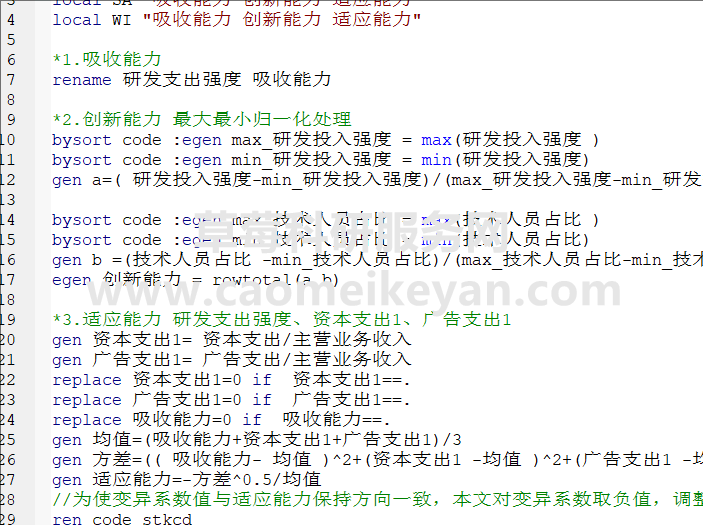
Core Insights - The document provides a comprehensive dataset on the dynamic capabilities of publicly listed companies from 2024 to 2005, focusing on innovation, absorption, and adaptation capabilities [1][2][3]. Group 1: Dynamic Capabilities - Dynamic capabilities include innovation capability, absorption capability, and adaptation capability, with adaptation measured by the coefficient of variation of R&D, advertising, and capital expenditure [1][3]. - A smaller coefficient of variation indicates stronger adaptation capabilities, allowing companies to better withstand external environmental changes [1][3]. Group 2: Data Integrity and Methodology - The dataset consists of over 60,000 sample observations from 5,688 companies, ensuring accuracy and reliability for research purposes [1][2]. - The data is meticulously organized and verified, emphasizing its originality and authenticity, with no profit-driven motives behind its compilation [2]. Group 3: Measurement of Capabilities - Innovation capability is measured using the intensity of R&D expenditure and the number of patents, while absorption capability is assessed through R&D expenditure relative to operating income [4][5]. - The document outlines the methodology for analyzing the impact of big data technology on real activity earnings management, indicating a negative correlation between big data application and earnings management [5]. Group 4: Sample Data - A sample table illustrates the absorption, innovation, and adaptation capabilities of a specific company (南玻A) from 2014 to 2024, showcasing variations in these capabilities over the years [6].


精准施策平衡供需 数字赋能服务升级
Liao Ning Ri Bao· 2025-07-19 01:43
Group 1 - The meeting emphasized the need to enhance accessibility and convenience of employment services, leverage digital empowerment, and align education supply with industry demand to address new challenges and opportunities in employment [1] - Recommendations included establishing a youth innovation support system and a cross-departmental coordination mechanism to optimize service innovation [1] - The proposal to create a "Red Employment Station" in community service centers aims to integrate various employment services, enhancing the effectiveness of grassroots public service systems [1] Group 2 - The importance of school-enterprise cooperation was highlighted as a key strategy for addressing economic structural adjustments and industrial upgrades, with suggestions for multi-dimensional incentive policies and practical training bases [2] - The use of big data technology to reshape employment service models and create a comprehensive employment service platform was recommended, aiming for real-time job information aggregation [2] - Strengthening the guidance for college graduates to pursue careers in rural and community services was suggested to expand employment channels [2] Group 3 - The need for differentiated policies to address labor shortages in new economy sectors was discussed, including flexible employment policies and the establishment of a monitoring system for new economy labor [3] - Fostering competitive emerging enterprises in fields like artificial intelligence was recommended to create new job opportunities and facilitate re-employment [3] - The proposal to dynamically adjust academic programs and vocational training to align with market demands was made to enhance graduates' practical skills and employability [3]
多地加码数字文化产业 推动企业“上云用数赋智”
Zheng Quan Ri Bao· 2025-07-06 16:20
Core Viewpoint - Multiple regions in China, including Chongqing, Jiangsu, and Inner Mongolia, are implementing policies to support the digital cultural industry, aiming to accelerate the scale and integration of digital cultural resources, thereby unlocking new cultural consumption scenarios and providing strong momentum for the industry's development [1][2]. Group 1: Policy Initiatives - Chongqing's recent policy offers a 15% subsidy for film projects that utilize local companies for digital content services, with a maximum subsidy of 5 million yuan for projects generating costs of 2 million yuan or more [1]. - Local governments are focusing on fostering enterprise growth in the digital cultural sector, promoting collaboration among cultural enterprises, and providing substantial subsidies for high-tech research and production in the film industry [1][2]. Group 2: Industry Characteristics and Growth - The digital cultural industry is crucial for enhancing cultural innovation and reshaping the global cultural supply and value chains, encompassing various segments such as online audio-visual, digital animation, and gaming [2]. - The industry is projected to generate approximately 48,684 billion yuan in revenue in 2023, with an expected annual compound growth rate of about 11% from 2024 to 2029, reaching 97,464 billion yuan by 2029 [3]. Group 3: Challenges and Recommendations - Current challenges in the digital cultural industry include fragmented technology application, weak industry clustering effects, and inadequate intellectual property protection mechanisms [3]. - Experts suggest establishing a collaborative mechanism involving policy guidance, platform empowerment, leading enterprises, and association services to address these shortcomings and encourage cultural enterprises to adopt cloud services and big data technologies [3].
数字引擎如何改写现代制造企业的竞争方式
Sou Hu Cai Jing· 2025-07-04 18:41
Core Insights - Digital transformation is redefining the survival rules of enterprises, evolving from mere technological upgrades to a comprehensive overhaul of strategic positioning, operational models, innovation capabilities, and cultural foundations [1] - The transformation is reshaping competitive advantages through four core dimensions, enhancing operational efficiency and fostering new business ecosystems [1] Group 1: Operational Efficiency - A global home appliance manufacturer improved its production planning by implementing a digital system that captures real-time sales data from 120 e-commerce platforms and 3,000 offline stores, resulting in a 40% increase in inventory turnover and a 58% reduction in stockout losses [2] - The application of digital twin technology in an aerospace engine manufacturer reduced the product development cycle from 8 months to 4 months and cut costs by 60% by simulating over 200 conditions in a virtual environment [2] - A fast-fashion brand compressed its design-to-shelf process from 90 days to 7 days by creating an agile supply chain platform that connects 120 upstream and downstream enterprises [3] Group 2: Innovation and Collaboration - A traditional medical equipment manufacturer established an open innovation platform that integrates internal and external resources, enhancing tumor detection accuracy from 85% to 97% and enabling real-time analysis during scans [6] - A tire manufacturer transformed into a service provider by embedding sensors in tires to collect real-time data, leading to a service revenue share exceeding 40% within three years [6] - A sports brand's virtual fitting lab allowed consumers to provide design feedback, resulting in a new shoe model selling over 500,000 pairs in its first month [7] Group 3: Customer Relationship Management - A high-end automotive brand created an owner ecosystem platform that increased customer engagement by offering personalized services, leading to a threefold increase in consumer frequency [9] - An industrial parts supplier implemented an intelligent inventory management system that improved order stability by 70% through real-time monitoring and automatic replenishment [10] - A restaurant chain enhanced customer satisfaction from 82 to 91 points by utilizing data analytics to address feedback on service delays [10] Group 4: Organizational Transformation - A technology group adopted a project-based unit structure that improved response time to market changes by six times and increased project delivery success rates from 75% to 92% [12] - The implementation of an intelligent knowledge graph in a manufacturing company improved knowledge reuse by 80% and reduced the skill development cycle by 50% [13] - A shift to a data-driven decision-making culture in an internet company led to a 40% increase in user retention rates through data-supported strategies [13] Group 5: Strategic Implications - Digital transformation is not merely a technological upgrade but a comprehensive redefinition of enterprise capabilities across various dimensions, necessitating the integration of digital DNA into every aspect of strategy, operations, and innovation [15]
高考志愿填报,能不能让AI“说了算”
Zhong Guo Qing Nian Bao· 2025-06-30 00:08
Core Viewpoint - The article discusses the increasing reliance on AI and big data technologies for college entrance examination (Gaokao) application guidance, highlighting both the benefits and limitations of AI-generated recommendations for students and parents [1][3][5]. Group 1: AI in College Application Guidance - Since June 25, 31 provinces have entered the college application period, following the Gaokao results, leading to a surge in demand for AI-based application guidance platforms [1]. - AI platforms consolidate public information on colleges and majors, allowing students to input their scores and preferences to generate personalized "application reports" [1][2]. - As of June 25, Alibaba's Quark AI model generated over 3 million application reports, indicating a peak in user demand coinciding with the release of exam scores [1][2]. Group 2: User Experience and Perception - Users report that AI can quickly analyze their scores and preferences to suggest suitable college options, making the process more convenient than manual research [2][4]. - Despite the convenience, many students still view AI recommendations as one of several references rather than a definitive guide [3][6]. - Some students opt for paid services to access more sophisticated AI algorithms, believing they may yield better recommendations [3][4]. Group 3: Limitations and Concerns - There are concerns about the accuracy of AI-generated reports, as they may not fully account for individual circumstances and preferences [5][7]. - Experts warn that many paid AI services vary in quality, and students should critically evaluate the information provided [6][9]. - AI's role is primarily in data collection and organization, but it lacks the ability to analyze and interpret data in a way that guarantees accurate recommendations [7][10]. Group 4: Regulatory and Advisory Measures - To enhance the scientific and precise nature of college application processes, regulatory bodies in Beijing are guiding AI service providers to comply with relevant regulations [8]. - Multiple platforms indicate that their reports are for reference only, urging students and parents to conduct thorough research before making final decisions [8][10]. - Experts emphasize the importance of personal judgment and direct communication with colleges to ensure informed decision-making [9][10].
探索向数据驱动软科学研究范式转型
Zhong Guo Dian Li Bao· 2025-06-26 03:05
Core Viewpoint - The article discusses the transition from expert-driven to data-driven research paradigms in soft science, emphasizing the importance of digital technologies in enhancing decision-making quality and efficiency through data analysis [1][2]. Group 1: Transition from Expert-Driven to Data-Driven Paradigm - The traditional expert-driven paradigm relies on literature review and theoretical analysis to formulate research hypotheses, while the data-driven paradigm focuses on analyzing large datasets to uncover underlying patterns and relationships [1]. - The shift to a data-driven approach faces challenges such as inertia from the expert-driven model and the need for collaboration among data methods, digital talent, and data resources [1][2]. Group 2: Pathways for Transition - The transition requires a dual-driven model that combines data analysis with expert knowledge to enhance research rigor and relevance [2]. - Establishing a consensus on data-driven approaches involves integrating data thinking into organizational strategies and fostering a culture that values data-driven insights [3]. Group 3: Building Research Capacity - Strengthening the research team is essential, focusing on developing data capabilities and attracting interdisciplinary talent with expertise in both data science and social sciences [3][4]. - A robust data management mechanism is necessary to support effective data utilization, including the creation of specialized databases and promoting data sharing across institutions [4]. Group 4: Innovation in Methods and Models - Accelerating the development of algorithms and intelligent analysis models is crucial for transforming research processes, integrating AI technologies to enhance quantitative and qualitative research [5]. - Promoting interdisciplinary methods and tools will help break down barriers between different fields, allowing for a more comprehensive approach to data analysis [5].
聚焦多条产业链,《济南优势工业产品目录》将持续扩充
Qi Lu Wan Bao Wang· 2025-06-16 14:36
Core Viewpoint - Jinan is enhancing its industrial supply to boost consumption by focusing on 13 iconic industrial chains and 34 key industrial chains, expanding the "Jinan Advantage Industrial Product Directory" to promote quality supply [1][2] Group 1: Industrial Product Directory - The "Jinan Advantage Industrial Product Directory" has been published six times since its first release in 2020, showcasing 3,997 advantageous industrial products from 978 enterprises across 11 major fields [1] - The directory includes various sectors such as electronic information (210 enterprises), machinery and equipment (394 enterprises), metallurgy and metals (116 enterprises), food and beverages (83 enterprises), chemicals and new materials (77 enterprises), and more [1] Group 2: Selection Standards - The selection criteria emphasize "qualification recognition, compliance preconditions, and dynamic management," focusing on new industrial products and quality enterprises to ensure market advantage and social responsibility [2] - The directory promotes innovative products that integrate AI, IoT, and big data technologies, including advanced items like bionic robots and digital management systems [2] Group 3: Promotion Channels - Promotion of the directory is conducted through various channels, including the "Qianhui Enterprise" online platform, media outlets, and social media, as well as offline events and exhibitions, distributing nearly 10,000 copies to assist enterprises in market expansion [2] Group 4: Future Plans - Jinan will continue to focus on the 13 iconic industrial chains and 34 key industrial chains, enhancing the selection of "chain boutique" products and improving supply-demand matching and market promotion efforts [2]
信通电子:拟首发募资4.75亿元用于输电线路立体化巡检与大数据分析平台等项目 6月20日申购
Sou Hu Cai Jing· 2025-06-12 06:02
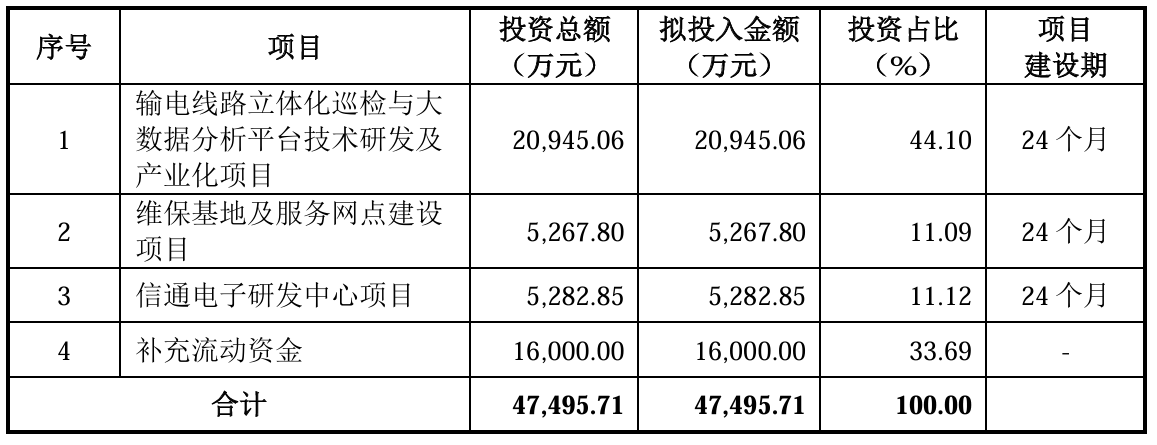
Core Viewpoint - The company, Xintong Electronics, plans to publicly issue 39 million shares, accounting for 25% of the total share capital after issuance, aiming to raise 475 million yuan for various projects including the development of a transmission line inspection and big data analysis platform, maintenance base construction, and R&D center establishment [1][2]. Group 1: Fundraising and Project Allocation - The total investment for the transmission line inspection and big data analysis platform project is 209.45 million yuan, which will receive the full amount raised [2]. - The maintenance base and service network construction project has a total investment of 52.68 million yuan, also fully funded by the raised capital [2]. - The R&D center project will receive 52.83 million yuan, representing 11.12% of the total investment [2]. - The project for supplementing working capital will account for 33.69% of the total funds raised, amounting to 160 million yuan [2]. Group 2: Company Overview and Market Position - Xintong Electronics specializes in providing industrial IoT smart terminals and system solutions, primarily targeting the power and communication sectors [2]. - The company has established long-term stable partnerships with major domestic enterprises such as State Grid, China Southern Power Grid, and China Unicom, expanding its market from Shandong to nationwide and some overseas regions [2][3]. Group 3: Strategic Goals - The overall strategic goal is to become a leading provider of industry IoT solutions, focusing on innovation in edge computing, artificial intelligence, and big data technologies [3]. - The company aims to enhance its manufacturing and customer service capabilities to solidify its market competitiveness and expand into other industries [3]. Group 4: Financial Performance - The company reported a significant increase in operating cash flow, with a net cash flow from operating activities of 152 million yuan in 2024, up 103.07% year-on-year [27]. - As of the first quarter of 2025, the company’s return on equity was 0.89%, while the return on invested capital was 0.86% [22]. - The company’s total assets turnover ratio has shown a consistent trend, indicating efficient asset utilization [34].
国网大同供电公司:AI员工重塑业扩报装新模式
Zhong Guo Neng Yuan Wang· 2025-06-03 08:58
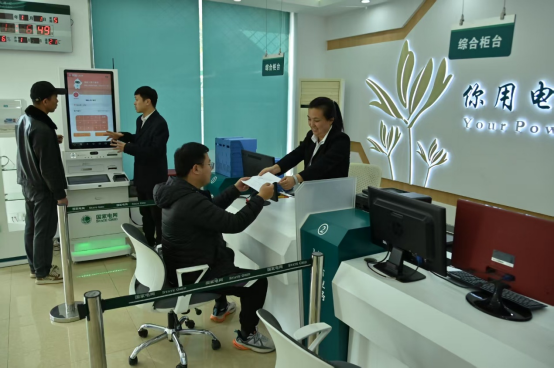
Core Viewpoint - The company has successfully launched an AI-driven solution for electricity supply planning, enhancing customer experience and operational efficiency in the Dazhong Yunzhou District [1][3][4]. Group 1: AI Implementation - The AI employee for electricity supply planning was developed to address customer concerns regarding proximity to power sources, time to access electricity, and associated costs [3][4]. - The AI system integrates artificial intelligence and big data throughout the electricity supply process, allowing for automated generation of supply plans based on user input and surrounding infrastructure [4][5]. Group 2: Operational Efficiency - The AI employee enables a "zero-contact" approach between different professional roles and users, streamlining the process and reducing the need for multiple personnel to be present during site assessments [4][5]. - The implementation of the AI system has resulted in a significant reduction in the time required to respond to supply requests, achieving responses within two working days for both low and high voltage users [5][6]. Group 3: Future Developments - The company plans to enhance user experience by adding intelligent recommendation features and expanding the range of services covered by the AI system, including high-frequency business types such as charging station installations and temporary electricity needs [6]. - The AI employee will also facilitate task assignment and ensure service quality, while providing users with easy access to information regarding the supply process and associated costs [5][6].
科技点亮千年文脉 2025京杭对话共探运河文化传承
Zhong Guo Xin Wen Wang· 2025-05-30 12:46
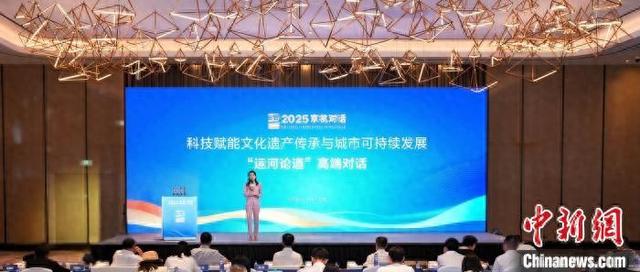
Group 1 - The 2025 Beijing-Hangzhou Dialogue focuses on "Empowering Cultural Heritage Transmission and Urban Sustainable Development through Technology" [1][3] - The event highlights the role of technology in preserving and utilizing the cultural heritage of the Grand Canal, contributing to urban sustainable development [1][3] - The Beijing-Tongzhou District is committed to annual progress in cultural tourism and technological innovation, aiming to enhance the development of the Beijing sub-center [3] Group 2 - The Tongzhou Grand Canal Cultural Tourism Scenic Area has successfully applied for a national 5A-level tourist attraction by creating a digital, networked, and intelligent experience space [3] - Hangzhou's cultural heritage protection and utilization methods are innovating with the development of AI and big data technologies [3][4] - The upgraded Grand Canal Museum in Hangzhou received 1.235 million visitors in 2024, a 73% increase year-on-year, showcasing the impact of technology on cultural tourism [3] Group 3 - The "Beijing Memory" team from Renmin University has explored offline cultural dissemination after finding limited online traffic for the Grand Canal knowledge [4] - The event is part of the ongoing efforts to promote the cultural belt of the Grand Canal and to connect it with global audiences [4]