
文化强国

Search documents
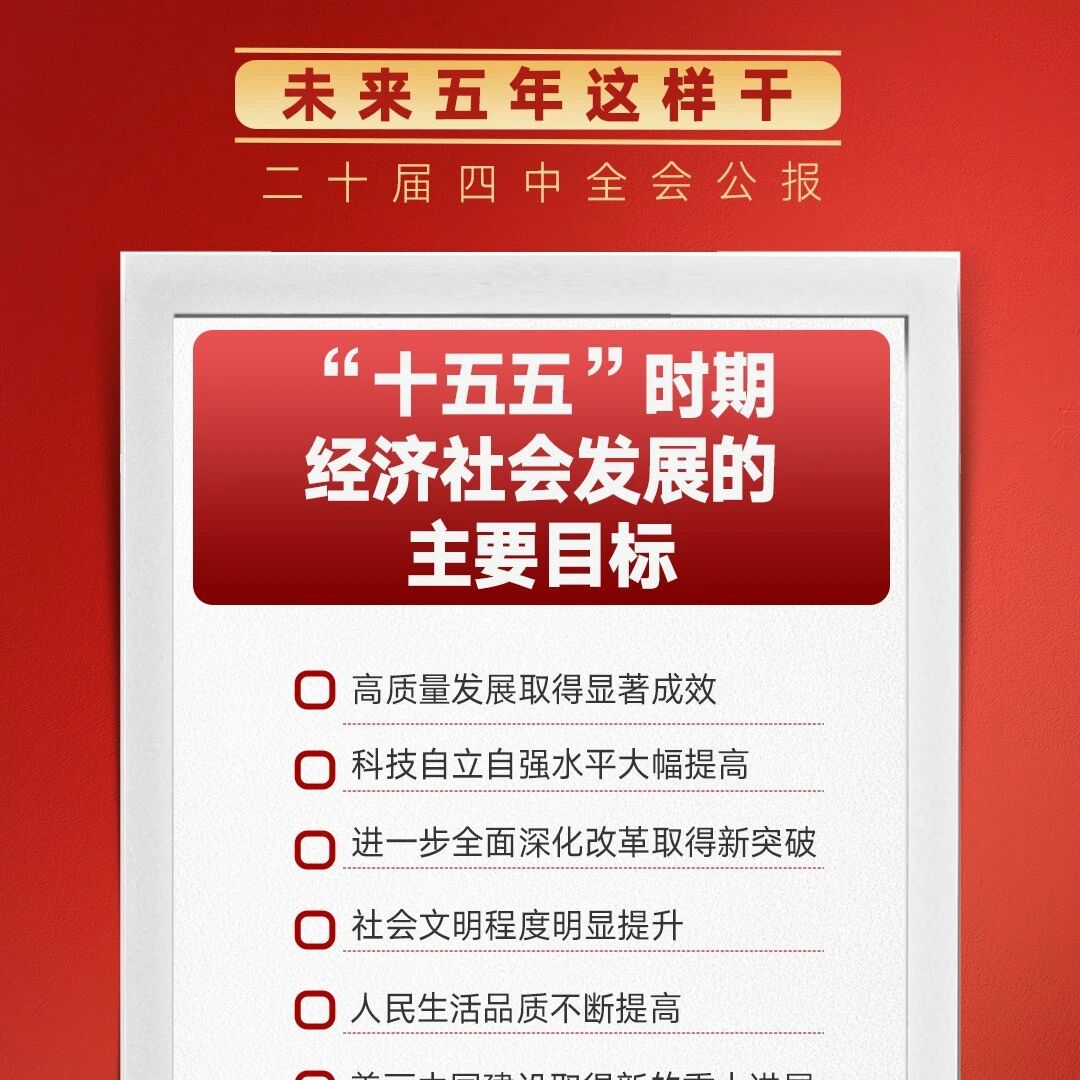
锚定“十五五”主要目标,未来五年这样干!
中汽协会数据· 2025-10-24 02:06
Core Viewpoint - The article outlines the strategic directions and key initiatives for the next five years as articulated in the 20th Central Committee's Fourth Plenary Session, emphasizing high-quality development, technological self-reliance, and the construction of a modern economic system. Group 1: High-Quality Development - Significant achievements in high-quality development have been noted, with improvements in social civilization and living standards [3] - The focus is on consolidating and expanding the foundation of the real economy, promoting intelligent, green, and integrated development [5] Group 2: Technological Self-Reliance - There is a strong emphasis on accelerating high-level technological self-reliance to lead new productive forces, enhancing the national innovation system, and fostering original innovation [7] - The integration of technology innovation with industrial innovation is prioritized to boost overall productivity [7] Group 3: Domestic Market and Economic Structure - The strategy aims to expand domestic demand, enhance consumption, and promote effective investment, ensuring a robust domestic circulation [9] - The construction of a high-level socialist market economy is essential for sustaining high-quality development [11] Group 4: Agricultural Modernization - Addressing agricultural and rural issues is a top priority, with efforts to promote urban-rural integration and enhance agricultural productivity [15][17] Group 5: Regional Development - The strategy includes optimizing regional economic layouts to promote coordinated regional development and enhance the effectiveness of urbanization [19] Group 6: Cultural Development - There is a commitment to invigorating cultural innovation and promoting socialist culture, enhancing the influence of Chinese civilization [21] Group 7: Social Welfare and Common Prosperity - The focus is on improving living standards and ensuring common prosperity through effective social policies and public services [23] Group 8: Green Transformation - A comprehensive green transformation is planned, emphasizing carbon neutrality and ecological safety, while promoting sustainable development practices [25] Group 9: National Security - Strengthening the national security system and enhancing public safety governance are critical components of the strategy [27][29] Group 10: Military Modernization - The modernization of the military is highlighted, focusing on enhancing combat capabilities and integrating advanced technologies [32]

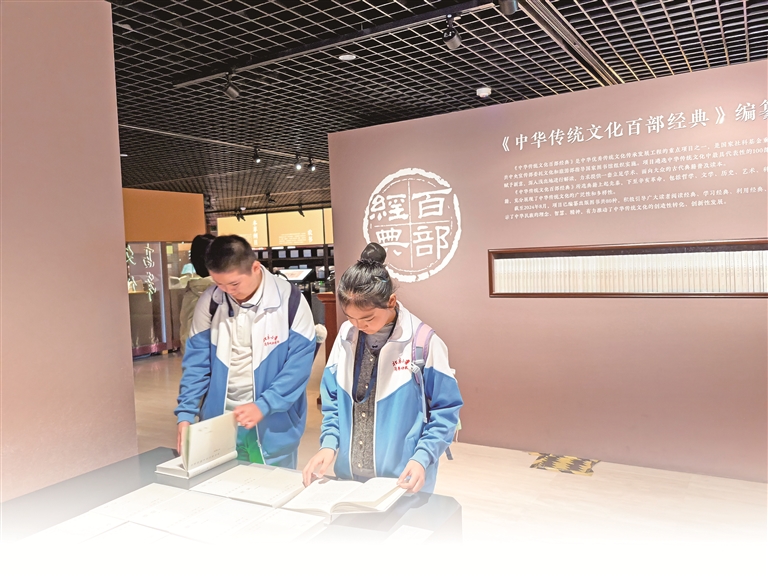
坚定文化自信 建设文化强国|典籍载文脉 一馆藏古今从“中华优秀传统文化典籍展”看文明传承
Zhong Yang Ji Wei Guo Jia Jian Wei Wang Zhan· 2025-10-24 00:47
Core Viewpoint - The exhibition "Ancient Masterpieces, Brilliant Cultural Heritage - Exhibition of Excellent Traditional Chinese Classics" showcases the depth and richness of Chinese historical and cultural texts, emphasizing their significance as a treasure of the Chinese nation and a vital part of its cultural identity [2][4]. Group 1: Cultural Significance - The exhibition highlights the importance of historical texts as carriers of national wisdom and as a continuation of the spiritual lineage of the Chinese people [3][4]. - The "Five Classics" such as "Yijing," "Shujing," "Shijing," "Liji," and "Chunqiu" are presented as foundational texts that embody the philosophical and ethical underpinnings of Chinese culture [4][5]. Group 2: Historical Context - The exhibition features artifacts from various historical periods, including oracle bones and bamboo slips, illustrating the evolution of Chinese civilization and its literary heritage [3][12]. - The "Great Unity" concept is explored through historical texts, emphasizing its role in maintaining the cultural cohesion of the Chinese nation [12]. Group 3: Modern Relevance - The initiative "Chinese Traditional Culture Hundred Classics" aims to make classical literature accessible to the public, promoting cultural confidence and understanding among the Chinese people [15][16]. - Digitalization efforts, such as the establishment of databases for ancient texts, are transforming the way these classics are studied and appreciated, making them more accessible to the general public [17]. Group 4: Public Engagement - The exhibition encourages public participation and feedback, reflecting a growing interest in traditional culture among diverse audiences across China [14][19]. - Various activities and programs are being implemented to promote the understanding and appreciation of ancient texts, ensuring their relevance in contemporary society [17][19].
四中全会公报火线解读
2025-10-23 15:20
Summary of Key Points from the Conference Call Industry and Company Overview - The conference call primarily discusses the implications of the Fourth Plenary Session of the 19th Central Committee of the Communist Party of China, focusing on the modernization of the economy and various sectors including manufacturing, culture, and rural development. Core Insights and Arguments 1. **Economic Growth and Policy Measures** The session emphasizes achieving a GDP growth target of around 5% for 2025, supported by fiscal and quasi-fiscal policies, including the introduction of 500 billion new policy financial tools and revitalizing local debt limits to boost economic growth in Q4 [5][12][16]. 2. **Focus on Advanced Manufacturing** The session highlights the importance of advanced manufacturing as a backbone of the modern industrial system, stressing the need for self-reliance in technology and innovation [2][14]. 3. **Rural Modernization and Infrastructure Investment** Plans to enhance rural living conditions and increase investment in public services and infrastructure are outlined, aiming for coordinated regional development in key areas like Beijing-Tianjin-Hebei, Yangtze River Delta, and Guangdong-Hong Kong-Macau [7][11]. 4. **Cultural Strengthening** The importance of cultural output and confidence is emphasized, with a focus on stimulating national cultural innovation, which presents opportunities for the cultural and media sectors [9][11]. 5. **Trade and Global Supply Chain Stability** China aims to maintain a multilateral trade system, implementing zero tariffs for least developed countries and enhancing trade cooperation with Africa and ASEAN, showcasing the advantages of Chinese manufacturing [6][16]. 6. **Investment in Human Capital** The principle of "investing in people" is highlighted, with increased support for social welfare programs such as childcare subsidies, aimed at reducing living costs and stimulating consumption [10][11]. 7. **Market Outlook for A-shares** The A-share market is expected to remain stable in the short term, with a focus on sectors like technology, data economy, and traditional industries such as steel and cement, reflecting a shift from risk to livelihood in real estate [13][16][21]. 8. **Structural Changes in the A-share Market** A structural divergence is noted within the A-share market, with significant differences in performance between new productivity sectors and traditional real estate, indicating varying investment opportunities [18][19]. 9. **New Structural Reforms** New structural reforms are anticipated to impact sectors such as photovoltaics, lithium batteries, and new energy vehicles, which are closely linked to the transition from old to new economic drivers [20]. Other Important Insights - **Short-term Economic Risks** Short-term risks in the A-share market are considered manageable, with a focus on specific themes and styles to capture potential opportunities [21]. - **Consumer Demand Expansion** The expansion of consumer demand is seen as crucial in the current policy environment, with certain stocks showing significant returns compared to traditional indices [19]. - **Future of Space Economy and Marine Industry** The development of the space economy and marine industry is viewed as having vast potential, driven by national priorities in aerospace and deep-sea technology [8]. This summary encapsulates the key points discussed in the conference call, providing insights into the strategic direction of China's economic policies and their implications for various sectors and the A-share market.
二十届四中全会与十九届五中全会公报核心内容对比
Guo Tai Jun An Qi Huo· 2025-10-23 13:41
1. Report Industry Investment Rating - No relevant content provided 2. Core Viewpoints of the Report - The report compares the core contents of the communiqués of the Fourth Plenary Session of the 20th CPC Central Committee and the Fifth Plenary Session of the 19th CPC Central Committee, covering aspects such as past achievements, development environment, guiding ideology, principles, main goals, and specific strategies for different fields [1] 3. Summaries According to Relevant Catalogs Past Achievements - The 2025 plenary session highly evaluated the great achievements in China's development during the "14th Five - Year Plan" period, with the economy, technology, and comprehensive national strength reaching new levels and a good start for the second - centenary goal. The 2020 plenary session highly evaluated the decisive achievements in building a moderately prosperous society in all respects [1] Development Environment - The "15th Five - Year Plan" period will face a complex and changing development environment with both strategic opportunities and risks. China's economy has a stable foundation, many advantages, strong resilience, and great potential, and the long - term positive trend remains unchanged. In 2020, China had shifted to a high - quality development stage with many advantages for continued development, but also faced problems such as unbalanced and insufficient development [1] Guiding Ideology - Both emphasize adhering to the Party's leadership, the new development concept, and the general keynote of making progress while maintaining stability. The 2025 session focuses on promoting high - quality development with reform and innovation as the driving force and meeting people's needs as the goal, and comprehensively and strictly governing the Party as the guarantee. The 2020 session emphasized deepening supply - side structural reform [1] Principles - Both stress adhering to the Party's overall leadership, the people - centered approach, high - quality development, and reform. The 2025 session also mentions the combination of an effective market and an active government, and coordinating development and security [1] Main Goals - In 2025, significant achievements are expected in high - quality development, reform, social civilization, ecological civilization, people's livelihood, and national governance. By 2035, China's economic, technological, and comprehensive national strength will be greatly enhanced, and basic socialist modernization will be achieved [1] Industry System - Both emphasize focusing on the real economy, building manufacturing, quality, and network powers. The 2025 session also mentions promoting digital China construction, developing strategic emerging industries, and optimizing traditional industries [1] Science and Technology - Both highlight the core position of innovation. The 2025 session focuses on seizing the opportunity of the technological revolution, promoting the integrated development of education, science and technology, and talents, and strengthening original innovation and key core technology research [1] Domestic Market - Both advocate expanding domestic demand and combining it with supply - side reform. The 2025 session emphasizes promoting consumption and investment through new demand and supply, and enhancing the internal dynamics of the domestic cycle [1] Economic System - Both stress improving the socialist market economic system, giving play to the market's decisive role and the government's role. The 2025 session also mentions establishing a modern fiscal and financial system and accelerating the transformation of government functions [1] Opening - up - Both advocate high - level opening - up. The 2025 session emphasizes expanding independent opening - up, promoting trade innovation, and high - quality construction of the Belt and Road Initiative [1] Rural Issues - Both prioritize solving "Three Rural Issues" and promoting rural revitalization. The 2025 session emphasizes promoting rural modernization, ensuring food security, and implementing rural construction actions [1] Regional Development - Both aim to optimize regional economic layout and promote coordinated development. The 2025 session focuses on leveraging the effects of relevant strategies and enhancing regional development coordination [1] Culture - Both adhere to the guiding position of Marxism in the ideological field and promote cultural development. The 2025 session emphasizes developing a new - era socialist culture with international influence [1] People's Livelihood - Both focus on improving people's livelihood and promoting common prosperity. The 2025 session emphasizes solving people's urgent problems, promoting high - quality employment, and improving the social security system [1] Green Development - Both uphold the concept of "lucid waters and lush mountains are invaluable assets" and promote green transformation. The 2025 session emphasizes carbon peaking and carbon neutrality and building a new energy system [1] National Security - Both adhere to the overall national security concept and strengthen national security construction. The 2025 session emphasizes integrating security into all fields of development and preventing various risks [1] National Defense - Both aim to modernize national defense and the military. The 2025 session focuses on accelerating the integration of mechanization, informatization, and intelligence, and improving combat capabilities [1] Party Building - Both emphasize the Party's overall leadership and strengthening Party building. The 2025 session focuses on enhancing the Party's leadership ability in economic and social development [1] National Reunification - Both aim to maintain the long - term prosperity and stability of Hong Kong and Macao, promote cross - strait relations, and achieve national reunification [1]
“十五五”时期 中国将着重办好这些事
Yang Shi Xin Wen· 2025-10-23 13:20
Core Points - The Fourth Plenary Session of the 20th Central Committee of the Communist Party of China was held from October 20 to 23, 2025, in Beijing, where a work report by Xi Jinping was discussed and the proposal for the 15th Five-Year Plan was approved [1] Economic Development - The session emphasized the construction of a modern industrial system, focusing on strengthening the real economy and promoting intelligent, green, and integrated development [2] - It highlighted the need to accelerate the establishment of a strong domestic market and create a new development pattern that enhances domestic circulation [4][5] Technological Innovation - There is a strong push for high-level self-reliance in technology, aiming to enhance the national innovation system and boost independent innovation capabilities [3] Market Economy - The session called for the establishment of a high-level socialist market economy system to enhance the momentum for high-quality development [6][7] International Cooperation - It stressed the importance of expanding high-level opening-up and creating a win-win cooperation environment, while promoting trade innovation and bilateral investment [8][9] Agricultural Modernization - The meeting underscored the importance of modernizing agriculture and rural areas, focusing on solving "three rural issues" and promoting urban-rural integration [10][11] Regional Development - There is a focus on optimizing regional economic layout and promoting coordinated regional development to enhance overall economic growth [12][13] Cultural Development - The session aims to stimulate cultural innovation and development, promoting socialist culture with strong ideological and spiritual influence [14] Social Welfare - It emphasized the need to improve people's livelihoods and promote common prosperity through various social policies [15] Environmental Sustainability - The meeting called for a comprehensive green transformation of economic and social development, aiming for carbon neutrality and ecological safety [16] National Security - There is a commitment to modernizing the national security system and enhancing public safety governance [17][18] Military Modernization - The session outlined goals for achieving high-quality military modernization and strengthening national defense capabilities [19][20]
四中全会公报划重点:目标明确,脚步坚定
Yin He Zheng Quan· 2025-10-23 12:24
Economic Growth and Development Goals - The "14th Five-Year Plan" aims for an economic growth target of around 5% during the period, aligning with the long-term goal of achieving modernization by 2035[2] - By 2024, China's per capita GDP is projected to be $13,303, indicating the need for further efforts to reach the level of middle-income developed countries[2] Modern Industrial System - The plan emphasizes the construction of a modern industrial system, with advanced manufacturing as a key focus, to ensure the stability of the manufacturing sector[3] - The strategy includes enhancing the safety of industrial supply chains and promoting high-end equipment and aerospace industries as main areas for growth[3] Technological Innovation - The report highlights the importance of self-reliance in technology, with a focus on original innovation and tackling key core technologies, particularly in semiconductors and industrial software[3] - Basic research funding is expected to increase from the current 6% to support these initiatives[3] Domestic Demand and Economic Circulation - The emphasis on domestic demand has shifted to a model where new demand leads to new supply, aiming to strengthen the domestic economic cycle[3] - The construction of a unified national market is prioritized to enhance the resilience and reliability of domestic circulation[3] Agricultural and Rural Modernization - The plan includes improving rural living conditions and services to reduce urban-rural disparities, with a focus on modernizing agriculture[4] - Key regions like the Greater Bay Area and Yangtze River Delta are expected to play significant roles in national development[4] Cultural Development - The "14th Five-Year Plan" stresses the strategic importance of cultural development in enhancing national strength and international influence[4] - It aims to foster cultural innovation and creativity to support the overall development of socialism[4] Social Welfare and Real Estate - The principle of "people first" is emphasized, indicating a commitment to social welfare and high-quality development in the real estate sector[4] - The report suggests that real estate will be treated as part of social welfare rather than a risk sector, indicating potential support for the industry[4] Economic Stability Measures - The meeting underscored the need to achieve annual economic and social development goals, with a focus on maintaining a 5% growth target for 2025[4] - Recent policies include the introduction of 500 billion yuan in new policy financial tools to support economic stability[4]
受权发布丨中国共产党第二十届中央委员会第四次全体会议公报
Xin Hua Wang· 2025-10-23 09:05
Core Points - The Fourth Plenary Session of the 20th Central Committee of the Communist Party of China was held from October 20 to 23, 2025, in Beijing, with 168 Central Committee members and 147 alternate members in attendance [1] - General Secretary Xi Jinping delivered an important speech, emphasizing the need for high-quality development and the implementation of the 15th Five-Year Plan [2][5] - The session highlighted significant achievements during the 14th Five-Year period, noting the resilience of the economy and the progress towards modernization [3][4] Economic Development - The 15th Five-Year period is deemed crucial for solidifying the foundation for socialist modernization, with a focus on high-quality development and addressing complex domestic and international challenges [4][6] - The session outlined principles for economic development, including the importance of the Party's leadership, prioritizing people, and ensuring high-quality growth [6][7] - Major goals for the 15th Five-Year period include significant improvements in high-quality development, technological self-reliance, and enhanced social welfare [6][8] Innovation and Market Development - Emphasis was placed on accelerating technological self-reliance and innovation, integrating education, technology, and talent development [7][8] - The session called for the construction of a strong domestic market and the promotion of a new development pattern, focusing on expanding domestic demand and enhancing supply [7][8] Social and Cultural Development - The session stressed the importance of cultural innovation and the promotion of socialist culture, aiming to enhance the influence of Chinese civilization [9] - It highlighted the need for improving people's livelihoods and promoting common prosperity, addressing urgent social issues and enhancing public services [9][10] Environmental and Security Measures - The session underscored the necessity of a green transformation in economic and social development, aiming for ecological safety and sustainable growth [10] - It emphasized the modernization of the national security system and the importance of maintaining social stability and safety [10][13] Party Leadership and Governance - The session reiterated the importance of the Party's self-revolution and strict governance to ensure effective leadership in economic and social development [11][12] - It called for unity among the Party and the people to achieve the goals set for the 15th Five-Year Plan, emphasizing the need for comprehensive governance and stability [11][12]
中国共产党第二十届中央委员会第四次全体会议公报
券商中国· 2025-10-23 09:01
Core Viewpoint - The Fourth Plenary Session of the 20th Central Committee of the Communist Party of China emphasizes the importance of achieving socialist modernization and outlines the strategic goals and principles for the upcoming "15th Five-Year Plan" period, focusing on high-quality development, technological self-reliance, and comprehensive reforms [3][4][5]. Summary by Sections Achievements and Challenges - The session highlights significant achievements during the "14th Five-Year" period, noting that China has faced complex international situations and domestic challenges, yet has made substantial progress in economic strength, technological capabilities, and overall national power [4]. - The leadership under Xi Jinping has effectively navigated through severe challenges, including the pandemic, leading to new major accomplishments in the party and national endeavors [4]. Strategic Goals for the "15th Five-Year Plan" - The "15th Five-Year Plan" is identified as a critical period for solidifying the foundation for socialist modernization, with a focus on high-quality development and addressing both opportunities and risks in a complex environment [5][6]. - The session sets ambitious goals for 2035, including significant improvements in economic, technological, and national defense capabilities, aiming for per capita GDP to reach the level of moderately developed countries [7]. Economic Development Principles - Key principles for economic and social development during the "15th Five-Year Plan" include maintaining the party's leadership, prioritizing high-quality development, and deepening reforms [7]. - The session emphasizes the need for a modern industrial system, focusing on the real economy, innovation, and sustainable development [8]. Technological and Market Development - The session calls for accelerating technological self-reliance and innovation, enhancing the national innovation system, and fostering a strong domestic market [8][9]. - It stresses the importance of expanding high-level opening-up and promoting international cooperation to create a win-win situation [9]. Social and Cultural Development - The session highlights the need to enhance cultural innovation and development, ensuring that socialist core values are promoted and that cultural industries are advanced [10]. - It emphasizes improving people's livelihoods and promoting common prosperity through effective social policies and public services [10]. Environmental and Safety Considerations - The session underscores the importance of green transformation and ecological protection, aiming for a beautiful China through sustainable practices [11]. - It also stresses the need for a robust national security system and effective governance to maintain social stability [11][12]. Party Leadership and Governance - The session reiterates the necessity of strong party leadership and the importance of self-reform within the party to ensure effective governance and economic development [12][13]. - It calls for a unified effort from all sectors of society to achieve the goals set forth in the "15th Five-Year Plan" [13][15].

文化强国:在创新创造中赓续中华文脉
Jing Ji Ri Bao· 2025-10-17 21:43
Core Viewpoint - The article highlights the significant progress made in building a culturally strong nation in China during the "14th Five-Year Plan" period, emphasizing the integration of culture into economic and social development, and the enhancement of people's quality of life through cultural experiences [1][2][4][9]. Group 1: Cultural Demand and Activities - During the National Day and Mid-Autumn Festival holidays, major museums experienced high visitor demand, showcasing a blend of traditional and contemporary cultural experiences [1][8]. - The variety of cultural activities has increased, with events like "village evenings" and community performances attracting over 262 million participants in 2024 [3]. - The public cultural service system is being improved to meet the diverse spiritual and cultural needs of the people, making cultural services more accessible and high-quality [2][3]. Group 2: Cultural Industry Growth - The cultural industry has seen substantial growth, with total assets reaching 34.4 trillion yuan and revenue exceeding 1.9 trillion yuan in 2024 [4][5]. - New cultural business models are emerging, with revenue from new cultural sectors reaching 5.9 trillion yuan, accounting for over 40% of the entire cultural industry [5]. - The integration of culture and tourism has become a trend, with over 60% of attendees at large events traveling across cities for performances, indicating a growing demand for cultural tourism [6]. Group 3: Cultural Heritage and Preservation - The number of registered museums in China has reached 7,046, with a national archaeological park count of 65, reflecting the commitment to cultural heritage preservation [8][9]. - Significant archaeological discoveries and the establishment of a comprehensive cultural heritage protection system have been achieved, enhancing national pride and cultural confidence [7][9]. - The promotion of intangible cultural heritage has led to the establishment of 12,900 non-heritage workshops, creating job opportunities for over 1.2 million people [8]. Group 4: International Cultural Influence - China's cultural soft power and influence have been bolstered, with 60 sites now listed as World Heritage sites and 44 items recognized by UNESCO as intangible cultural heritage [9]. - The cultural trade volume reached 1.4 trillion yuan in 2024, with over 370 billion yuan attributed to digital and intelligent cultural products, showcasing the global reach of Chinese culture [9].
新华社推出系列述评,深入阐释习近平文化思想的生动实践
Xin Hua She· 2025-10-12 13:33
Group 1 - The core idea of the articles is to highlight the achievements and practices of Xi Jinping's cultural thought, emphasizing its role in promoting cultural progress and national rejuvenation [1][2][3][4][5] - Xi Jinping's cultural thought is seen as a guiding principle for the Chinese Communist Party to foster historical and cultural confidence, integrating historical continuity with cultural innovation [2][4] - The construction of a cultural strong nation is crucial for China's modernization and national rejuvenation, focusing on meeting the growing spiritual and cultural needs of the people [3][4] Group 2 - The articles stress the importance of consolidating a common ideological foundation for unity and struggle among the Chinese people, particularly in the face of evolving social values [4] - There is an emphasis on the need for cultural exchange and mutual learning among civilizations to enhance global beauty and improve the lives of people worldwide [5] - The promotion of socialist core values is highlighted as essential for developing a strong mainstream culture and guiding public opinion [4]