
混合所有制改革

Search documents
中金岭南旗下中金科技引战落地 加速打造世界一流新材料制造商
Zheng Quan Shi Bao Wang· 2025-09-18 08:40
Core Viewpoint - The strategic investment signing ceremony for Zhongjin Technology, a subsidiary of Zhongjin Lingnan, marks the completion of its first round of capital increase and expansion, facilitating mixed-ownership reform and introducing several strategic partners with significant advantages in resources, technology, and capital [1][3][5]. Group 1: Capital Structure Optimization - Zhongjin Lingnan plans to transfer 16.12% of Zhongjin Technology's shares to Guangsheng Capital by December 2024 to support the company's full industry chain development [2]. - The transaction aims to optimize the capital structure, introduce strategic resources, achieve complementary advantages, and enhance management capabilities [2][3]. Group 2: Strategic Partnerships - The introduction of strategic investors is expected to inject new capital and bring valuable market resources, cutting-edge technology, and advanced management concepts to Zhongjin Technology [3][4]. - Southern Media Group and Guangsheng Capital, both state-owned enterprises in Guangdong, will leverage their unique advantages to support Zhongjin Technology's growth [5]. Group 3: Business Development and Performance - Zhongjin Technology has evolved from producing battery zinc powder to becoming a diversified company with three major sectors, including high-end battery zinc alloys and energy storage materials [8]. - The company has achieved significant growth, with revenue and net profit doubling in recent years, reaching 1.374 billion yuan in revenue and 36.68 million yuan in net profit in the first half of 2025 [8][9]. Group 4: Future Growth and Innovation - The company is focused on innovation-driven development, aiming to replace imports with high-end materials and maintain or exceed international standards in product quality and technology [8]. - Recent acquisitions, including the purchase of a leading domestic bimetal company, are part of Zhongjin Technology's strategy to strengthen its high-end composite metal materials sector [9].

东吴水泥股权结构重塑:苏州市国资委携港航集团入局 开启产业新纪元
Zheng Quan Ri Bao Wang· 2025-09-17 13:47
Core Viewpoint - Dongwu Cement International Limited is undergoing a significant ownership change, with Goldview Development Limited selling shares to Hong Kong Port Group and Suzhou Fenyuan Capital, marking a shift from private to state-led governance [1][3]. Group 1: Ownership Change - Goldview Development Limited has signed an agreement to sell shares to Hong Kong Port Group and Suzhou Fenyuan Capital, resulting in Hong Kong Port Group becoming the largest shareholder with a 28% stake and Suzhou Fenyuan Capital holding 9% [1]. - This transaction represents the first instance of Suzhou State-owned Assets Supervision and Administration Commission controlling a listed company through overseas capital channels, indicating a deep integration of state-owned assets in the Yangtze River Delta with international capital markets [1]. Group 2: Company Background - Dongwu Cement has been a benchmark enterprise in the cement industry in the Yangtze River Delta for over 20 years, focusing on cement manufacturing, new building materials research, and regional supply chain services, with production capacity primarily located in Jiangsu and Zhejiang [2]. Group 3: Strategic Implications - The new shareholders, backed by substantial state-owned resources, are expected to invigorate Dongwu Cement, leveraging their industrial resources and capital operation capabilities [3]. - Following the new ownership, there is widespread market expectation for the company to implement a comprehensive transformation strategy, moving beyond traditional industries to explore emerging sectors such as smart warehousing, modern logistics, and low-altitude economy [3]. - The company is anticipated to utilize its resource and geographical advantages to create a diversified and forward-looking industrial development pattern, injecting new vitality and sustainable growth momentum into the listed company [3].
巨星传奇战略入股鸟巢运营主体 迈向“资源+资本+内容”多维驱动新阶段
Zheng Quan Ri Bao Wang· 2025-09-16 09:41
Group 1 - The core point of the news is that Giant Star Legend Group Limited plans to acquire a 1.17% stake in National Stadium Co., Ltd. through its subsidiary, reflecting the government's encouragement for private capital to participate in major public facility operations [1][2] - National Stadium Co., Ltd. is the main entity responsible for the construction and operation of the National Stadium ("Bird's Nest"), which is a significant national project and an internationally recognized cultural landmark [1] - The acquisition aligns with the company's strategic development direction, leveraging the unique asset of the Bird's Nest to enhance collaboration in large-scale cultural and sports events and IP resource integration [2] Group 2 - The acquisition is seen as a positive attempt at mixed-ownership reform in the cultural and sports sector, indicating a shift towards greater involvement of private enterprises in public infrastructure [1] - Giant Star Legend has established a leading position in the creation, operation, and commercialization of celebrity IP, which will be further enhanced through this acquisition [2] - The partnership is expected to create positive benefits for the group's long-term development by improving its capabilities in IP value transformation and industry synergy [2]
国企与民企如何协同促就业?
Jin Rong Shi Bao· 2025-09-15 03:22
Core Viewpoint - Employment is a crucial indicator of economic development and social stability, and stabilizing and expanding employment is essential for improving people's livelihoods and supporting healthy economic growth [1] Group 1: Employment Strategy - The employment-first strategy should be deeply integrated into the mixed-ownership reform's top-level design, accelerating the classification management of state-owned enterprises (SOEs) and encouraging collaboration between SOEs and private enterprises (PEs) [2][3] - SOEs should leverage their influence and special functions to promote employment through partnerships with PEs, enhancing social responsibility awareness within PEs [2][3] Group 2: Role of State-Owned Enterprises - SOEs must not only enhance their own employment absorption capacity but also utilize their influence to encourage PEs to create more job opportunities through equity participation [3] - A "dual selection" mechanism should be established to focus on industry synergy and employment potential when selecting partners, while respecting the autonomy of PEs [3] Group 3: Collaborative Investment - SOEs can utilize their financial and resource advantages to participate in the development of PEs through equity investments and the establishment of industrial funds, while PEs should actively engage with SOEs to meet their demands [4] - Collaboration in mergers, acquisitions, and new project construction can optimize industrial chain layouts and create more job opportunities [4] Group 4: Government Guidance - The government should guide the formation of industry clusters suitable for employment needs through policies and planning, such as developing advanced manufacturing clusters and high-employment service industries [5] - Local SOEs should leverage their advantages to collaborate with PEs in optimizing supply chains and co-developing industrial parks and research centers [5] Group 5: Human Capital Development - SOEs should play a more active role in upgrading the human capital of PEs, which can enhance their core competitiveness and contribute to job creation [6] - A balance must be struck between increasing employment quantity and improving employment quality, ensuring that both enterprise development and social responsibility are addressed [6]
国有企业与民营企业促进就业的协同机制
Jin Rong Shi Bao· 2025-09-15 01:23
Employment Trends and Challenges - Employment is a crucial indicator of economic development and social stability, with the current economic transition in China posing challenges to job stability and growth [1] - From 2007 to 2023, the total number of employed persons in China decreased from 750 million to 740 million, indicating a declining trend in employment as a proportion of the economically active population [1] - The report highlights the importance of private enterprises in job creation, with over 53 million private enterprises accounting for 92.3% of all enterprises and providing over 90% of urban new jobs in 2023 [1] Policy Design for Employment Promotion - The collaboration between state-owned and private enterprises aims to address employment challenges through a complementary ownership structure, differing from Western welfare models and market laissez-faire approaches [2] - Key policies from 2015 and the 20th National Congress emphasize the encouragement of state capital to invest in private enterprises, optimizing the development environment for private businesses [2] Capital Collaboration - Capital collaboration enhances employment by leveraging state-owned enterprises' (SOEs) financial strength to support private enterprises, thus improving both the quantity and quality of jobs [3] - Financing challenges for private enterprises can lead to reduced hiring, as external financing constraints directly impact their ability to pay wages and invest in human resources [3] Governance Collaboration - Governance collaboration between SOEs and private enterprises can improve management efficiency and social responsibility, ultimately stabilizing and creating more jobs [5] - The introduction of SOEs can mitigate agency problems in private enterprises, enhancing transparency and reducing financing difficulties, which in turn supports job creation [6] Industrial Collaboration - Industrial collaboration between SOEs and private enterprises can optimize resource allocation and enhance competitiveness, leading to significant job creation across various sectors [7] - Collaborative projects can generate direct employment opportunities and stimulate related service industries, further enhancing job growth [8] Integrated Collaborative Mechanisms - The integration of capital, governance, and industrial collaboration can create a synergistic effect, providing new momentum for employment growth and economic stability [9][10] - Establishing joint mechanisms around key projects can maximize the strengths of both SOEs and private enterprises, fostering a cooperative environment that enhances job creation [10] Strategic Recommendations - The government should promote employment as a priority in mixed-ownership reforms, encouraging SOEs to leverage their influence to support private enterprises in job creation [12] - SOEs should actively participate in mixed reforms and joint investments, utilizing their resources to foster private enterprise growth and job opportunities [13] - Tailored industrial clusters should be developed to meet employment needs, with SOEs collaborating with private enterprises to optimize supply chains and create jobs [14]
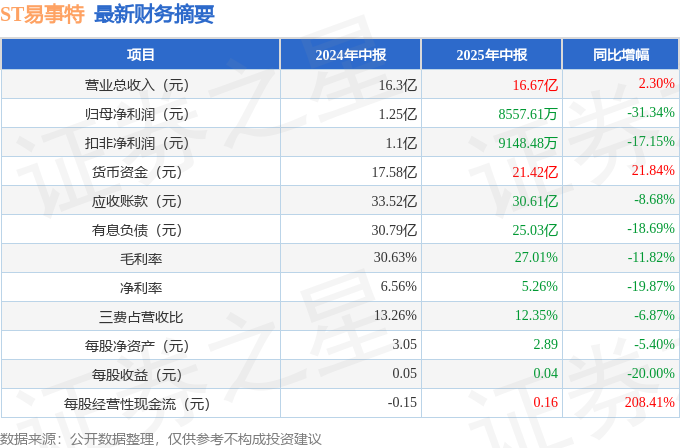
ST易事特2025年中报简析:增收不增利,公司应收账款体量较大
Zheng Quan Zhi Xing· 2025-08-29 22:41
Core Viewpoint - ST Yishite (300376) reported mixed financial results for the first half of 2025, with revenue growth but a significant decline in net profit, raising concerns about its financial health and operational efficiency [1][3]. Financial Performance - The total revenue for the first half of 2025 was 1.667 billion yuan, a year-on-year increase of 2.3% [1]. - The net profit attributable to shareholders was 85.576 million yuan, a decrease of 31.34% compared to the previous year [1]. - In Q2 2025, the revenue was 1.029 billion yuan, up 7.05% year-on-year, while the net profit dropped by 47.38% to 41.364 million yuan [1]. - The gross margin was 27.01%, down 11.82% year-on-year, and the net margin was 5.26%, a decline of 19.87% [1]. - The company reported a significant increase in operating cash flow per share to 0.16 yuan, up 208.41% year-on-year [1]. Financial Ratios and Metrics - The company's return on invested capital (ROIC) was 2.9%, indicating weak capital returns [3]. - The cash assets were reported as healthy, with a cash-to-current liabilities ratio of 72.02% [3]. - Accounts receivable reached 1617.95% of net profit, highlighting potential liquidity issues [3]. Business Model and Strategy - The company relies heavily on research and marketing for its business performance, necessitating a deeper analysis of these drivers [3]. - Following the introduction of state-owned assets, the company has seen improvements in credit status and financing costs, enhancing its ability to undertake large projects [4]. - The company is focusing on core business areas such as smart power, data centers, and new energy storage, aligning with the "dual carbon" development trend [4]. Future Developments - The company is in discussions to introduce Guangdong Province Guangwu Holdings Group as a future controlling shareholder, which is expected to further enhance its operational capabilities [5].


通用股份上半年营收超40亿元 同比增长30.39%
Zheng Quan Shi Bao Wang· 2025-08-27 12:54
Group 1 - The company reported a revenue of over 4 billion yuan for the first half of 2025, representing a year-on-year growth of 30.39%, while the net profit attributable to shareholders decreased by 77.56% to 64.29 million yuan [1] - The company specializes in the research, production, and sales of various types of tires, with manufacturing bases in China, Thailand, and Cambodia, and offers well-known brands such as CELIMO, CTM, HEIMA, TBBTIRES, and GOODTRIP [1] - The tire industry faced significant challenges in the first half of 2025 due to a complex global economic and political environment, with external pressures from fluctuating natural rubber prices and intense domestic market competition [1] Group 2 - The company successfully completed a mixed-ownership reform, with Jiangsu Suhao Holding Group becoming the controlling shareholder, marking the first instance of a state-owned enterprise acquiring a private listed company in Jiangsu [2] - The company aims to implement the "5X strategic plan" to create a development model that integrates "state-owned enterprise norms and private enterprise efficiency," focusing on breakthroughs in international market expansion, technological research and development, smart manufacturing, and supply chain integration [2] - The company is enhancing its cost reduction and efficiency improvement capabilities by leveraging its manufacturing bases and global channel networks, which will support its strategic transition and long-term stability during the globalization phase [2]

通用股份上半年营业收入同比增长30.39%
Zheng Quan Ri Bao Zhi Sheng· 2025-08-27 12:16
Core Viewpoint - Jiangsu General Technology Co., Ltd. (hereinafter referred to as "General Co.") reported significant growth in tire sales and revenue for the first half of 2025, driven by technological advancements and strategic reforms [1][2]. Group 1: Financial Performance - In the first half of 2025, General Co. achieved tire sales of 11.96 million units, a year-on-year increase of 48%, marking a historical high for the same period [1]. - The company generated operating revenue of 4 billion yuan, reflecting a year-on-year growth of 30.39% [1]. - The net profit attributable to shareholders reached 64.29 million yuan [1]. Group 2: Technological Advancements - General Co. made significant breakthroughs in key technologies, notably achieving mass production of core technology using Eucommia rubber, which has been successfully applied to semi-steel new energy tires [1]. - The company focuses on the "Super Eucommia Tire" series, emphasizing "super safety, super durability, and super comfort" to enhance product premiumization [1]. - The non-road tire series utilizes innovative materials with low heat generation and high thermal conductivity, gaining high trust from customers in domestic and overseas markets [1]. Group 3: Strategic Reforms - The company is advancing its mixed-ownership reform, with Jiangsu Suhao Holding Group Co., Ltd. acquiring a 24.5% stake, becoming the controlling shareholder [2]. - This reform is seen as a significant milestone, marking the first instance of a state-owned enterprise acquiring a private listed company in Jiangsu [2]. - The collaboration is expected to leverage Suhao Holding's resource advantages and global capabilities alongside General Co.'s industrial foundation and technological strength [2]. Group 4: International Expansion - General Co. is actively expanding into global emerging markets, with sales revenue in non-U.S. regions increasing by over 40% [2]. - The company has established overseas bases in Thailand and Cambodia, which are expected to support ongoing international market development [2]. - New production capacities from ongoing projects are anticipated to be fully released by the end of 2025, providing robust support for sustained performance growth [3].
"妖股"直击:成飞集成3连板,混改+军工+业绩改善,半月暴涨46%
Jin Rong Jie· 2025-08-22 05:49
Core Viewpoint - Chengfei Integration has experienced a strong stock price surge, reaching a maximum increase of 46.17% since June 13, driven by expectations of mixed-ownership reform, military industry support, and improved performance forecasts [1][2]. Group 1: Stock Performance - The stock price of Chengfei Integration hit a high of 48.79 yuan, up 10.01% from the previous trading day, with a trading volume of 4.501 billion yuan and a turnover rate of 26.78% [1]. - The stock exhibited a daily fluctuation of 12.27%, indicating intense market speculation [1]. Group 2: Key Catalysts - The market speculation is primarily based on three core logic points: 1. Expectations of mixed-ownership reform, which involves introducing market mechanisms while retaining a 68.5% controlling stake, leading to governance structure optimization and valuation re-evaluation [1][2]. 2. Continued enthusiasm for military industry concepts, as Chengfei Integration benefits from policy support in the military sector and the advancement of domestic large aircraft projects, enhancing its investment appeal [1]. 3. Performance improvement expectations, with a forecasted reduction in losses by 39.84%-58.64% for the first half of 2025, driven by growth in the production and sales of aviation components [1][2]. Group 3: Governance and Business Developments - The company is optimizing its governance structure by revising its articles of association, eliminating the supervisory board's audit committee, and ensuring the stability of military business through the confirmation of AVIC's controlling position [2]. - Business improvements are evident, with a significant increase in new orders and ongoing development in drone manufacturing processes [2]. - A second extraordinary shareholders' meeting is scheduled for August 25 to discuss amendments to the company's articles and the reappointment of the auditing firm for 2025 [2].

时代信息产业集团入主河南头部民营网络货运平台
Sou Hu Cai Jing· 2025-08-15 11:35
Core Viewpoint - The collaboration between Henan Shidai Information Industry Group and Henan Taoying Industrial Co., Ltd. aims to leverage the strengths of both state-owned and private enterprises to create a digital freight platform, enhancing market opportunities and resource integration [1][2]. Group 1: Investment and Ownership - Henan Shidai Information Industry Group has acquired a 51% stake in Henan Taoying Industrial Co., Ltd., increasing its registered capital from 50 million to 102.04 million yuan [1]. - The partnership is expected to combine the resources of the state-owned enterprise with the innovation and market sensitivity of the private sector, creating a "dual-engine" effect for industry upgrades [1][2]. Group 2: Technology and Platform Development - Taoying Industrial has developed the "Freight Express" platform, utilizing mobile internet, IoT, and cloud computing to address industry pain points such as matching freight and vehicles [2]. - Future plans include integrating the "Freight Express" platform with logistics infrastructure from Shidai Information Industry Group, exploring applications like smart warehousing and unmanned delivery [2]. Group 3: Management and Operational Structure - Despite Shidai Information Industry Group becoming the controlling shareholder, the original management team of Taoying Industrial will retain operational control, ensuring strategic oversight while maintaining market-driven operations [3]. - To address potential management integration challenges, measures such as establishing a market-oriented incentive system and a joint decision-making committee are being considered [3].