物联网(IoT)

Search documents
跨国企业PLM管理系统推荐TOP10
Sou Hu Cai Jing· 2025-10-09 19:24
Core Insights - The article emphasizes the critical importance of Product Lifecycle Management (PLM) systems for multinational companies, highlighting their role in overcoming complexities in global operations and enhancing core competitiveness [2][3]. Importance of PLM Systems - PLM systems are essential for multinational enterprises, serving as a unified platform that breaks down barriers across departments, regions, and time zones, facilitating real-time data sharing and centralized management throughout the product lifecycle [3]. - The seamless flow of information through PLM systems leads to significant improvements in R&D efficiency and cost reduction, addressing issues like version confusion and communication breakdowns that can result in design errors and project delays [3]. Core Functions of PLM Systems - A key function of PLM systems is the management of Bill of Materials (BOM), which includes various versions such as Engineering BOM (EBOM), Manufacturing BOM (MBOM), and Sales BOM (SBOM), ensuring consistency and timely updates across global teams [4]. - Change management is another critical aspect, with PLM systems providing standardized electronic change processes (ECN/ECO) that ensure rigorous tracking and approval of changes, enhancing compliance and traceability [5]. Cross-Border Collaboration Capabilities - The ability of PLM systems to support multilingual interfaces and localization is crucial for effective cross-border collaboration, allowing teams from different regions to communicate efficiently [6]. - Data security and collaboration are also significant challenges, with advanced PLM systems offering refined permission management to protect intellectual property while ensuring necessary data access for team members [6]. Industry-Specific Solutions - Different industries have unique PLM system requirements, with sectors like automotive and aerospace needing tailored solutions that address specific regulatory and operational challenges [7]. - Leading PLM providers often develop industry-specific solutions that include pre-configured templates and compliance reports, facilitating quicker deployment and effectiveness for businesses [7]. Recommended PLM Systems - A list of top PLM systems is provided, highlighting their core advantages and target industries, emphasizing that the best choice depends on the specific needs and strategies of the enterprise [8][12]. Summary and Future Outlook - Selecting and implementing an appropriate PLM system is a complex but rewarding endeavor for multinational companies, enabling them to optimize resource allocation and accelerate product innovation [13]. - Future PLM technologies are expected to integrate advancements in cloud computing, AI, IoT, and digital twins, leading to more intelligent and flexible systems that enhance collaboration and operational efficiency [13].


三星和LG要反攻被中企席卷的扫地机器人市场
日经中文网· 2025-09-21 00:33
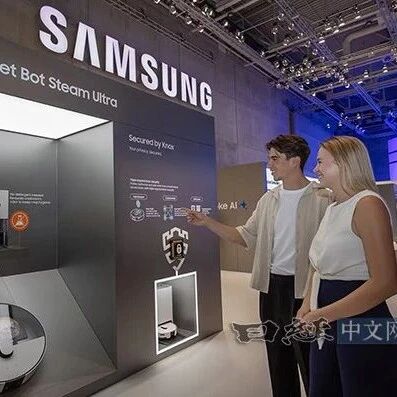
Core Viewpoint - The article highlights the competitive landscape of the global vacuum robot market, emphasizing the dominance of Chinese companies and the strategic responses from South Korean firms like Samsung and LG to regain market share through advanced technology and product differentiation [1][9][10]. Group 1: Market Dynamics - In the first half of 2025, four out of the top five companies in the global vacuum robot market are Chinese, with leading firms like Beijing Stone Technology, Ecovacs Robotics, and Dreame Technology each holding over 10% market share [1][9]. - iRobot, which once held over 30% market share in the 2010s, has seen its share drop to 5.8%, placing it in fifth position [9]. - The price range for Chinese vacuum robots is approximately 20,000 to 30,000 yen (about 965 to 1,448 RMB), while South Korean products are priced between 100,000 to 200,000 yen (about 4,826 to 9,653 RMB), indicating a significant price disparity [9]. Group 2: Product Innovations - Samsung and LG are launching new vacuum robots equipped with advanced AI and sensor technologies to enhance cleaning quality and user safety [1][5]. - LG's new product features a unique design that reduces the height of the robot's workstation from 50 cm to 15 cm and includes steam functionality for sanitization [3][6]. - Samsung's model incorporates the "Knox" technology for data protection, improving the recognition of both colored and colorless liquids, allowing for flexible cleaning options [5][10]. Group 3: Strategic Responses - South Korean companies are focusing on high-value-added products to compete with the cost-effective Chinese alternatives, as they face challenges in pricing and performance [10][13]. - The emphasis on safety, high-end features, and ease of use is a strategic move to differentiate from Chinese products, which have been gaining market share due to their affordability and improved performance [13]. - The success of Samsung and LG in the vacuum robot sector is seen as a critical test for their ability to reclaim their status in the global home appliance market [13].
乐鑫科技:二季度业绩显示,随着物联网(IoT)上升,持续增长
2025-09-04 15:08
Summary of Espressif Systems Conference Call Company Overview - **Company**: Espressif Systems - **Industry**: Greater China Technology Semiconductors - **Ticker**: 688018.SS Key Financial Results - **2Q25 Revenue**: Rmb688 million, up 23% quarter-over-quarter (Q/Q) and 29% year-over-year (Y/Y), slightly above the midpoint of preliminary revenue [1] - **Net Profit**: Rmb168 million, up 79% Q/Q and 71% Y/Y, in line with the midpoint of preliminary net profit [1] - **Net Margin**: 24.4%, an increase of 7.6 percentage points (ppts) Q/Q and 6.0 ppts Y/Y [1] - **Gross Profit**: Rmb321 million, with a gross margin (GM) of 46.7%, up 3.3 ppts Q/Q and 2.6 ppts Y/Y [1] Market Position and Valuation - **Market Capitalization**: Rmb34,189.4 million [4] - **Current Share Price (as of Sep 1, 2025)**: Rmb218.18, with a price target of Rmb211.00, indicating a downside of 3% [4] - **52-Week Price Range**: Rmb225.60 - Rmb63.09 [4] - **Earnings Per Share (EPS)**: Projected EPS for 2025 is Rmb3.05, with estimates for 2026 and 2027 at Rmb4.38 and Rmb5.29 respectively [4] Analyst Ratings and Industry View - **Stock Rating**: Overweight [4] - **Industry View**: Attractive [4] Growth Projections - **Revenue Growth Estimates**: Expected to reach Rmb2,671.9 million in 2025, Rmb3,498.3 million in 2026, and Rmb4,561.7 million in 2027 [4] - **EBITDA Projections**: Forecasted EBITDA of Rmb454.8 million in 2025, Rmb698.6 million in 2026, and Rmb845.3 million in 2027 [4] Risks and Opportunities - **Upside Risks**: - Faster-than-expected localization of China's MCU [9] - Gaining traction from new customers [9] - Significant margin expansion [9] - **Downside Risks**: - Slower-than-expected MCU localization [9] - Less traction from new customers than anticipated [9] - Erosion of margins due to increased competition [9] Private Placement Update - The company has received regulatory approval for a private placement and plans to launch the issuance at an appropriate time [2]

2025年Q2全球智能手表市场增长;华为智能手表出货量首次夺冠超越苹果
Counterpoint Research· 2025-09-04 01:04
Core Insights - The global smartwatch shipment volume has increased by 8% year-on-year, marking a return to growth after five consecutive quarters of decline [3][4]. - Huawei has surpassed Apple for the first time in smartwatch shipments, becoming the global leader in Q2 2025, driven by a 52% year-on-year growth [4][6]. - The Chinese market plays a crucial role in this recovery, with rising consumer demand and a focus on multifunctional, ecosystem-integrated devices [4][8]. Market Performance - Huawei's global shipment share reached a historic high of 20% in Q2 2025, benefiting from strong performance in the Chinese market and strategic expansion overseas [8]. - China has become the largest high-end smartwatch market globally, surpassing North America for the first time [8][11]. - The overall smartwatch market is expected to continue its recovery in 2025, with an estimated growth rate of around 7% [8][11]. Competitive Landscape - Apple has experienced a decline in global smartwatch shipments for seven consecutive quarters, losing its top position, but remains a leader in the high-end segment due to its iOS ecosystem and strong user loyalty [9][11]. - Xiaomi and Little Genius have seen significant growth in shipments, with Xiaomi excelling in the budget smartwatch market and Little Genius dominating the children's smartwatch segment [9]. - Samsung's shipments have decreased by 3%, reflecting a broader trend of consumer hesitation in purchasing, as many are waiting for new product releases expected in Q3 2025 [9][11]. Regional Insights - The strong performance of domestic brands and a loyal user base have propelled China to become the largest market for high-end smartwatches in Q2 2025 [11]. - The growth in the Chinese market is supported by affordable options, government subsidies, and deep integration with local application ecosystems [11]. - The global smartwatch market is entering a new innovation cycle, with health and AI becoming core differentiators for long-term competitive advantage [11].


监管铁幕落下又升起,谁能掌握“稳定币”的话语权?
3 6 Ke· 2025-09-03 03:13
Group 1: Overview of Stablecoins - Stablecoins are blockchain-based digital currencies that maintain a stable value, typically pegged to the US dollar at a 1:1 ratio, aimed at facilitating daily transactions [2][4] - The largest stablecoin by market share is USDT (Tether), while USDC is another prominent stablecoin issued by Circle and Coinbase [2] - The appeal of stablecoins lies in their price stability compared to volatile cryptocurrencies like Bitcoin, providing users with predictability in value [4] Group 2: Market Developments - Circle's stock surged 750% following its NYSE listing in June, and the US government has recognized stablecoins as legitimate financial instruments through the signing of the "Genius Act" [1][14] - Hong Kong has taken the lead in regulating stablecoins with the introduction of the "Stablecoin Ordinance," prompting major companies like Ant Group and JD.com to explore the stablecoin market [1][9] - The global trend shows increasing adoption of stablecoins in countries facing currency devaluation, such as Argentina and Venezuela, where stablecoins are used for domestic transactions [8] Group 3: Regulatory Landscape - The "Genius Act" in the US establishes a legal framework for stablecoin issuance, requiring that only licensed financial institutions can issue stablecoins and mandating a 100% reserve requirement [15] - In contrast, Hong Kong's regulatory approach emphasizes functional regulation, allowing stablecoins to be pegged to multiple currencies, potentially facilitating the internationalization of the Renminbi [17] - The regulatory environment for stablecoins is evolving, with significant scrutiny on their use in illicit activities, leading to a complex landscape of compliance and innovation [11][17] Group 4: Technological and Economic Implications - Stablecoins enable efficient and low-cost transactions, operating 24/7 and significantly reducing friction in cross-border payments compared to traditional banking systems [6] - The integration of stablecoins with real-world assets (RWA) is becoming more prevalent, as seen in recent cross-border financing projects involving renewable energy assets [10] - The potential for stablecoins to create a Web 3.0 version of the Bretton Woods system is being explored, highlighting their role in reshaping global financial dynamics [8]
双碳研究 | 2030前瞻:可再生能源强势赋能全球电网新生态
Sou Hu Cai Jing· 2025-08-27 15:44
Core Viewpoint - The future of renewable energy is accelerating, reshaping the production and consumption of electricity globally, with clean energy set to dominate the grid by 2030 as fossil fuels gradually phase out [3][4]. Group 1: Driving Forces Behind Renewable Energy - Multiple powerful forces are reshaping the world, ensuring the inevitability of renewable energy's future, which is arriving faster than most expect [4]. - Economic factors show that in many regions, the costs of renewable technologies like solar panels and wind turbines are now lower than fossil fuels [6]. - Governments and businesses are committed to reducing carbon emissions and promoting green energy development [6]. - Local production of clean electricity enhances energy security by reducing dependence on foreign oil and gas resources [6]. Group 2: Key Technologies in Renewable Energy - Solar and wind energy are the core pillars of future renewable energy development, with large-scale solar installations and residential rooftop systems expanding globally [7]. - Advanced storage systems are addressing the intermittency issues of renewable energy, ensuring stable power supply even during low sunlight or wind conditions [9]. - The future of renewable energy relies heavily on smart grids, utilizing AI and IoT to balance supply and demand while minimizing energy waste [10]. Group 3: Consumer and Corporate Demand - The growth of renewable energy is driven by consumer demand, with households opting for rooftop solar systems and businesses signing large-scale renewable energy procurement contracts to meet climate goals and reduce costs [11]. - Over 130 countries globally have committed to decarbonization targets, indicating a strong trend towards electrification in the transportation sector, particularly with electric vehicles increasing the demand for clean electricity [12][13]. Group 4: Business Advantages of Adopting Renewable Energy - Forward-thinking companies are investing in commercial solar installation projects, reducing operational costs while turning sustainability into a competitive advantage [14]. - Companies adopting renewable energy can enhance their brand reputation and demonstrate industry leadership and social responsibility [17]. Group 5: Future Outlook for Renewable Energy - By 2030, renewable energy will fundamentally alter the global electricity landscape, characterized by decentralization, digitalization, and sustainability [15]. - It is projected that 70% to 80% of new power generation capacity will come from renewable sources, with solar and wind dominating the generation sector supported by storage solutions [17]. - The rise in fossil fuel costs and stricter regulations will lead to a gradual reduction in fossil fuel power plants [17]. Group 6: Challenges Ahead - Despite rapid growth, renewable energy must overcome challenges such as infrastructure upgrades and ensuring a stable supply chain for solar panels, batteries, and turbines [16][21]. - Community acceptance is crucial to address concerns related to land use and visual impacts [21].
2024年全球液体软管卷盘市场Top10生产商排名及市场占有率调查
QYResearch· 2025-08-27 08:59
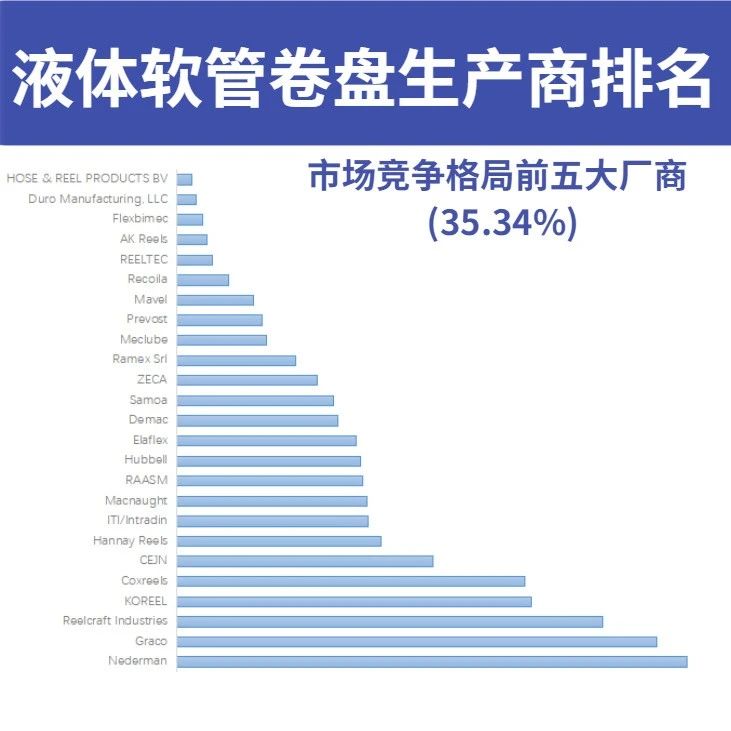
Core Insights - The liquid hose reel market is projected to reach a size of $569.73 million by 2030, with a compound annual growth rate (CAGR) of 4.5% in the coming years [2] Market Overview - The open-type liquid hose reel holds a significant market share of 71.45% due to its versatility in various environments [5] - The mechanical manufacturing sector remains the primary downstream market for liquid hose reels, accounting for 37.04% of applications in 2024 [7] - Key global manufacturers include Nederman, Graco, Reelcraft Industries, KOREEL, and Coxreels, with the top five companies holding approximately 35.34% of the market share [11] Market Drivers - Strengthening industrial safety regulations and environmental standards are driving demand for liquid hose reels, particularly in industries like chemicals and oil that require compliance with ATEX and OSHA standards [12] - The need for automation and efficiency in manufacturing, firefighting, and agriculture is a core driver for technological upgrades in liquid hose reels, with IoT integration expanding high-end market opportunities [13] - Emerging applications in new industries, such as lithium battery production, and infrastructure investments are providing additional market growth opportunities [14] Market Challenges - High technical barriers and material costs pose challenges, particularly for high-end applications requiring specialized materials and components, leading to a market structure of "low-end surplus and high-end reliance on imports" [16] - Fragmented industry standards and certification barriers across different regions complicate market entry and increase compliance costs for companies [17] - Traditional user habits and competition from alternative technologies hinder market adoption, with approximately 40% of industrial customers satisfied with existing hose management methods [18]
资金动向 | 北水豪买腾讯18.71亿港元,小米连续3日获净买入
Ge Long Hui A P P· 2025-08-21 11:23
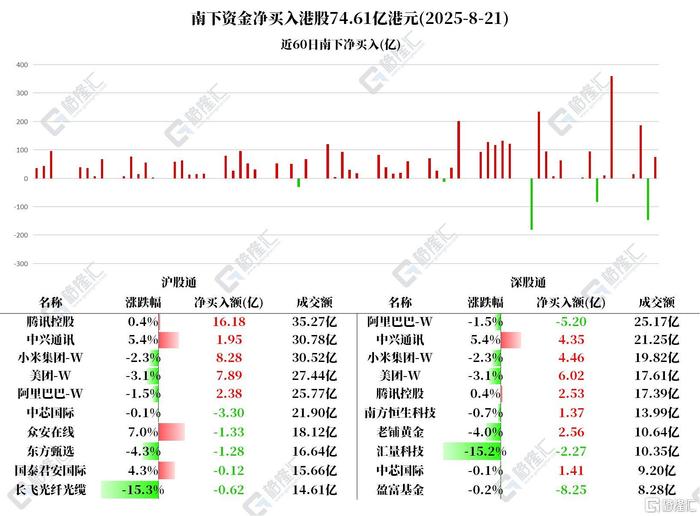
Group 1 - Southbound funds net bought Hong Kong stocks worth 74.61 billion HKD on August 21, with notable net purchases in Tencent Holdings (18.71 billion HKD), Meituan-W (13.91 billion HKD), and Xiaomi Group-W (12.74 billion HKD) [1] - Southbound funds have continuously net bought Tencent for 5 days, totaling 55.7254 billion HKD, and Xiaomi for 3 days, totaling 21.9847 billion HKD [1] Group 2 - Tencent's mobile game "Fearless Contract" launched strongly, attracting 1 million USD in player spending on its first day, with approximately 170,000 downloads, matching the performance of its previous game [3] - Meituan's international food delivery brand Keeta launched in Doha, Qatar, marking a significant expansion in the Middle East following its success in Saudi Arabia [3] - Analysts from DBS expect Xiaomi Group-W's valuation to increase due to market share growth across its business segments, driven by IoT and EV business expansion [3] Group 3 - Lao Pu Gold's CFO reported an increase in inventory from 40.88 billion to 86.85 billion, primarily to support new store openings, with inventory turnover days decreasing from 195 to 150 days [4]
大行评级丨星展银行:小米集团估值有望上调,受益于其在各业务板块持续提升的市场份额
Ge Long Hui· 2025-08-21 08:30
Core Viewpoint - DBS analysts believe that Xiaomi Group-W (1810.HK) is likely to see an increase in valuation due to its continuous market share growth across various business segments [1] Group 1: Business Performance - The company's profit margin expansion driven by the Internet of Things (IoT) business and steady growth in the electric vehicle (EV) sector is expected to offset the drag from the sluggish global smartphone growth in the long term [1] - IoT has become a structural profit driver for the company, showing widespread growth [1] - Xiaomi's market share in smart home appliances (air conditioners, refrigerators, washing machines, etc.) continues to increase [1] Group 2: Cost Management - The company is achieving cost savings through its own manufacturing and automation capabilities, which, combined with economies of scale, will continue to support structural improvements in its gross margin [1] Group 3: Analyst Rating - DBS maintains a "Buy" rating on Xiaomi [1]

孙正义逆向投资“过气”企业英特尔的真意
3 6 Ke· 2025-08-20 03:25
Group 1 - SoftBank Group has decided to invest in Intel, which is seen as part of a semiconductor strategy centered around artificial intelligence (AI) [1][2] - The investment amount is $2 billion, with SoftBank purchasing shares at $23 each, significantly lower than Intel's previous price of over $50 [1][2] - There are three main questions regarding this investment: Intel's status as a manufacturer, the low ownership stake of 2%, and Intel's failure to keep up with innovation [2][4][5] Group 2 - Son Masayoshi, the chairman of SoftBank, has a history of seeking long-term investments rather than short-term gains, indicating a strategic vision for Intel's potential revival [1][6] - The investment may enable collaboration between ARM, owned by SoftBank, and Intel, potentially addressing Intel's power consumption issues while leveraging ARM's low-power technology [12] - The partnership could signify a shift in the semiconductor landscape, allowing Intel to regain relevance in the AI era by collaborating with ARM, which has historically viewed Intel as a competitor [14][15]