稳就业政策

Search documents
国办:扩大稳岗扩岗专项贷款支持范围,加大失业保险稳岗返还政策力度
news flash· 2025-07-09 09:09
Core Viewpoint - The State Council's notice emphasizes the need to enhance support for employment stability through various financial measures aimed at businesses [1] Group 1: Employment Support Measures - Expansion of special loans for stabilizing and increasing employment positions, with a focus on deepening cooperation between government and banks to improve loan accessibility [1] - Increased unemployment insurance refund policy, allowing regions with over one year of surplus in the unemployment insurance fund to raise the refund ratio for small and medium enterprises from a maximum of 60% to 90%, and for large enterprises from 30% to 50%, effective until the end of December 2025 [1] - Implementation of a phased social insurance fee deferral policy, enabling companies facing operational difficulties to apply for deferral of contributions to pension, unemployment, and work injury insurance without incurring late fees during the deferral period [1]
49.7%、50.5%、50.7%! 6月PMI三大指数均回升
Mei Ri Jing Ji Xin Wen· 2025-06-30 13:44
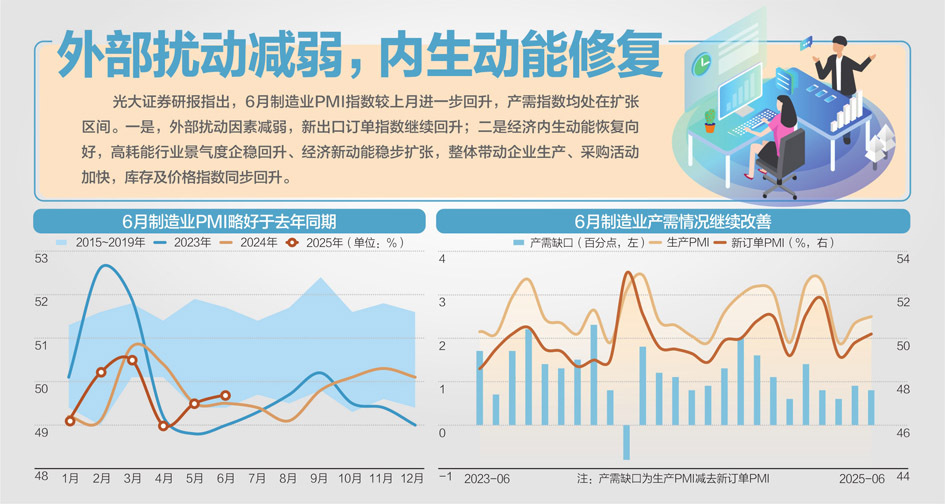
Group 1: Economic Indicators - In June, China's manufacturing PMI, non-manufacturing business activity index, and comprehensive PMI output index were 49.7%, 50.5%, and 50.7%, respectively, indicating a slight recovery with increases of 0.2, 0.2, and 0.3 percentage points from the previous month, suggesting overall economic expansion [1] - The production index, new orders index, and supplier delivery time index for manufacturing were 51.0%, 50.2%, and 50.2%, all above the critical point, with increases of 0.3, 0.4, and 0.2 percentage points from the previous month [3] - The non-manufacturing business activity index remained at 50.5%, reflecting continued expansion, while the service industry index was at 50.1%, down 0.1 percentage points from the previous month [5] Group 2: Sector Performance - The equipment manufacturing, high-tech manufacturing, and consumer goods industry PMIs were 51.4%, 50.9%, and 50.4%, respectively, all remaining in the expansion zone for two consecutive months [4] - The high-tech manufacturing PMI remained stable at 50.9%, indicating strong growth and resilience in the face of market demand and policy support [4] - The small enterprise PMI fell by 2 percentage points to 47.3%, indicating lower economic sentiment in this sector, which is crucial for employment [3] Group 3: Policy and Future Outlook - Economists suggest accelerating the issuance and use of local government special bonds and new policy financial tools to support domestic demand and stabilize foreign trade [2] - The macroeconomic policy is focusing on promoting service consumption as a key point to boost domestic demand, with various supportive measures being implemented [5] - Future projections indicate that the manufacturing PMI may remain around 49.7% in July, with potential downward risks due to cooling export momentum [6]

青年失业率三连降!三大有利因素支撑就业形势总体稳定
Hua Xia Shi Bao· 2025-06-17 14:02
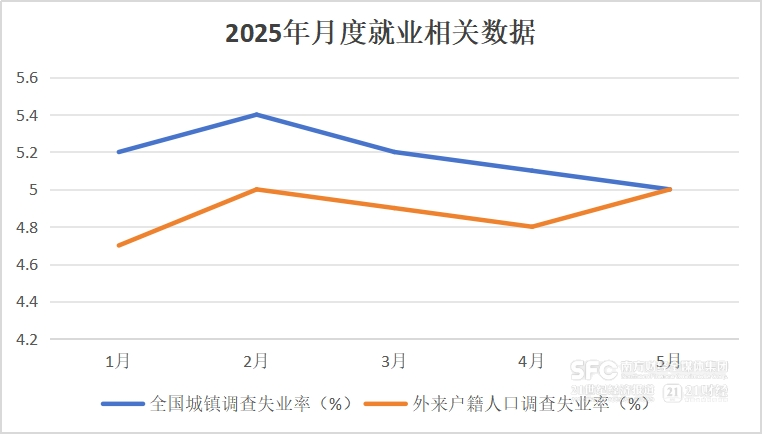
Core Viewpoint - The overall employment situation in China remains stable, with a slight decrease in the urban survey unemployment rate to 5.0% in May, reflecting the resilience of the job market amid economic challenges [1][2][4]. Employment Situation - The average urban survey unemployment rate from January to May was 5.2%, with May's rate showing a 0.1 percentage point decrease from the previous month [1]. - The unemployment rate for local and migrant workers was both recorded at 5.0%, while the rate for migrant agricultural workers was slightly lower at 4.9% [1]. - The unemployment rate in 31 major cities was also 5.0%, indicating a consistent trend across urban areas [1]. Economic Factors Supporting Employment - Economic growth and favorable industrial development have contributed to the stability of employment, supported by effective employment policies [2][4]. - In May, the industrial added value and service production index grew by 5.8% and 6.2%, respectively, maintaining overall stability compared to April [4]. - The retail and accommodation sectors showed significant growth, with production indices increasing by 8.4% and 6.2%, respectively, compared to the previous month [4]. Policy Measures - The government has implemented robust employment stabilization policies, focusing on both enterprise support for job creation and individual employment subsidies [5]. - These policies aim to balance labor supply and demand by incentivizing companies to hire and enhancing individual employability [5]. - Future efforts will focus on vocational training and improving labor market matching to promote full employment and enhance job quality [5]. Youth Employment - The youth unemployment rate has shown a continuous decline for three months, indicating a positive trend in youth employment [6]. - Despite this progress, challenges remain regarding the overall pressure on youth employment and structural issues that need ongoing policy attention [6][7]. - Initiatives targeting college graduates have been intensified, with various measures introduced to support their employment [7]. Importance of Stable Employment - Stable employment for youth is crucial for personal development, family financial security, and overall economic sustainability [8].

外部环境冲击劳动力市场,5月就业形势总体稳定
2 1 Shi Ji Jing Ji Bao Dao· 2025-06-16 11:02
Employment Situation - In May, the national urban survey unemployment rate was 5.0%, a decrease of 0.1 percentage points from the previous month, indicating continued improvement and overall stability in employment [1] - The unemployment rate for the youth demographic has been declining for three consecutive months, reflecting a stable employment situation [1] Economic Factors Supporting Employment - Economic growth has been stable, supported by proactive macro policies that have effectively countered negative external factors, thus stabilizing labor demand [3] - In May, the industrial added value and service production index grew by 5.8% and 6.2% respectively, maintaining overall stability compared to April [3] Industry Performance - Certain industries with significant employment capacity, such as wholesale retail and accommodation catering, have shown positive growth, with production indices increasing by 8.4% and 6.2% respectively in May [3] - The implementation of consumption policies and holiday economic activities has contributed to market expansion, further stabilizing employment [3] Policy Support for Employment - The government has intensified efforts to implement employment stabilization policies, including support for enterprise job expansion and individual employment subsidies [3] - Social security and employment expenditures in the general public budget increased by 8.5% from January to April, outpacing overall budget growth [4] Challenges and Future Actions - Despite the overall stability, challenges remain due to complex external environments affecting the labor market, with mismatches in labor supply and demand persisting [6] - The government plans to enhance vocational training and improve labor market matching to promote full employment and improve employment quality [6] Educational Initiatives - The "100-day sprint" initiative for the 2025 college graduates is being implemented nationwide to enhance employment opportunities [6] - Collaborative projects between universities and enterprises have been established to align educational outcomes with market needs, with over 2000 universities and 2300 enterprises participating [7]
失业率连续两月下降!劳动力市场需求回暖,重点群体就业形势好转
Hua Xia Shi Bao· 2025-05-20 08:09
Core Points - The national urban surveyed unemployment rate has decreased, with April's rate at 5.1%, down 0.1 percentage points from the previous month [2][3][4] - The government has implemented policies to support employment, particularly for key groups such as youth and migrant workers, which has contributed to the stabilization of the job market [2][5][8] Employment Trends - The average urban surveyed unemployment rate for January to April was 5.2%, consistent with the same period last year, but down from 5.3% in the first quarter [3][4] - The unemployment rate saw a rise in January and February due to the Spring Festival, but it has declined in March and April as economic activities resumed [4][5] Economic and Policy Factors - Economic recovery and supportive policies have jointly contributed to the decrease in unemployment, with manufacturing and service sectors leading job creation [5][6] - Policies such as tax reductions and vocational training subsidies have alleviated burdens on businesses, enabling them to hire more workers [5][6] Structural Employment Issues - Despite the overall decline in unemployment, structural issues remain, particularly for youth and skilled labor shortages in certain industries [6][7] - There is a mismatch between educational programs and market demands, leading to difficulties for graduates in finding jobs [7][8] Key Group Employment Improvements - The unemployment rate for migrant workers decreased to 4.7% in April, down 0.3 percentage points from the previous month, indicating improvements for this demographic [8] - The unemployment rate for non-student individuals aged 16-24 has also seen a decline over the past two months [8]

为企业聚精英、为人才建舞台 政策红利“助”企“惠”民 加大岗位释放力度
Yang Shi Wang· 2025-05-08 05:15
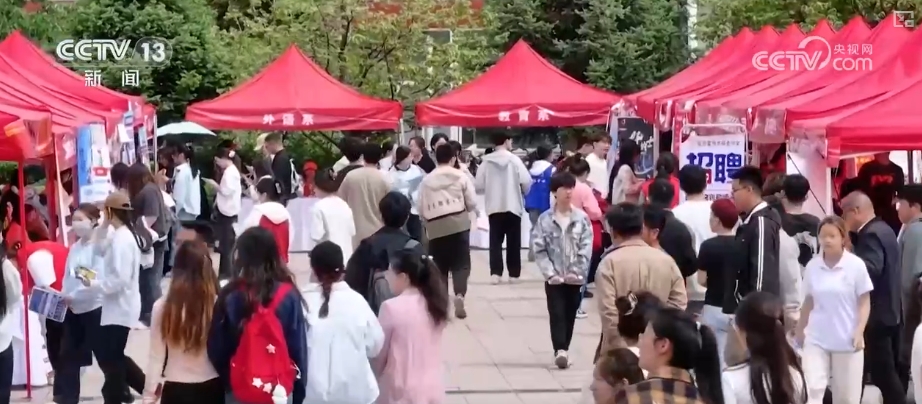
Core Viewpoint - The Chinese government emphasizes stabilizing employment, enterprises, markets, and expectations to respond to external uncertainties with high-quality development [1] Group 1: Employment Initiatives - The target for urban new employment in 2025 is set at over 12 million, with enhanced public employment services and support for key groups [1] - A series of recruitment events have been launched, with over 1,000 events and 697,000 job postings from more than 350,000 employers, attracting nearly 7.42 million job-seeking graduates [2][4] - Various specialized service zones have been established at job fairs to provide policy consultation and career guidance [4] Group 2: Policy Support and Financial Aid - The government has implemented incentive policies to expand job opportunities in key sectors, including new productivity development and basic livelihood services [6] - Employment support policies have been enhanced, with a cumulative issuance of over 640 billion yuan in loans to stabilize and expand employment positions [13] - In the first quarter, 35.2 billion yuan in stabilization funds were distributed to 588,000 enterprises, reducing costs by 45.6 billion yuan through lowered unemployment insurance rates [15] Group 3: Skills Training and Development - The "Skills Illuminate the Future" training initiative aims to address structural employment issues by increasing the supply of skilled labor in high-demand sectors [20] - Over 1 million people are expected to receive subsidies for vocational skills training, focusing on advanced manufacturing and modern services [26] - Specialized training programs for sectors like elderly care and domestic services have been initiated to support workforce stability [30]