绿电交易

Search documents
西藏前三季度全社会用电量增速全国第一
Zhong Guo Dian Li Bao· 2025-11-10 03:29
Core Insights - In the first three quarters of this year, Tibet's total electricity consumption reached 12.453 billion kilowatt-hours, marking a year-on-year increase of 13.44%, the highest growth rate in the country [1] - The electricity consumption by different sectors from January to September was 168 million kilowatt-hours for the primary industry, 6.27 billion kilowatt-hours for the secondary industry, and 4.191 billion kilowatt-hours for the tertiary industry, with respective year-on-year growth rates of 20.05%, 18.36%, and 12.84% [1] - Daily average electricity supply and consumption reached 44.605 million kilowatt-hours, reflecting an 11.46% year-on-year increase [1] Group 1: Electricity Supply and Infrastructure - The rapid growth in electricity consumption is supported by robust supply capabilities and stable guarantees [1] - Key infrastructure projects such as the expansion of the Qinghai-Tibet DC II and the Lhaze-Yulong 220 kV substation have been successfully completed, strengthening the electricity grid [1] - A total of 15 major maintenance operations on the main grid and over 590 non-power outage operations have been conducted to ensure uninterrupted power supply [1] Group 2: Green Energy Initiatives - Tibet has organized 10 transactions for cross-regional and cross-provincial green electricity sales, delivering 1.307 billion kilowatt-hours of clean energy [1] - These initiatives have contributed to a reduction in standard coal usage by approximately 400,000 tons and a decrease in carbon dioxide emissions by about 1 million tons [1] Group 3: Customer Service and Support - The promotion of the "three zeros and three reductions" electricity service model has saved customers 30.036 million yuan, benefiting 13,332 households and small enterprises [2] - Since the beginning of the year, significant efforts have been made in disaster relief and power supply support in response to events such as the earthquake and heavy snowfall in Shigatse [2]
进博会第三次实现全绿电办展 绿色能源点亮“四叶草”
Ren Min Ri Bao· 2025-11-09 22:52
Group 1 - The China International Import Expo has achieved a fully green electricity exhibition for the third consecutive year, highlighting the commitment to sustainable energy [1] - The Jinshan offshore wind farm, with a capacity of 306 megawatts, has reached full capacity grid connection, providing approximately 1 billion kilowatt-hours of clean energy annually [1] - Shanghai's total installed capacity of wind and solar energy has reached 7.086 million kilowatts, accounting for 21.4% of the city's total installed capacity [1] - Shanghai has engaged in green electricity cooperation with 15 provinces, completing over 300 green electricity transactions with a total transaction volume of 9 billion kilowatt-hours, setting historical records [1] Group 2 - A virtual power plant in Shanghai has been established to manage electricity load intelligently, with a resource pool size of 2.28 million kilowatts, doubling from the previous year [1] - The Shanghai Power Supply Company has migrated old transformers and utilized electric vehicles to provide power to residents, demonstrating a cost-effective and green approach to energy supply [2] - The company is enhancing its coordination and management of renewable energy integration to ensure the safety and greenness of electricity from the source [2]
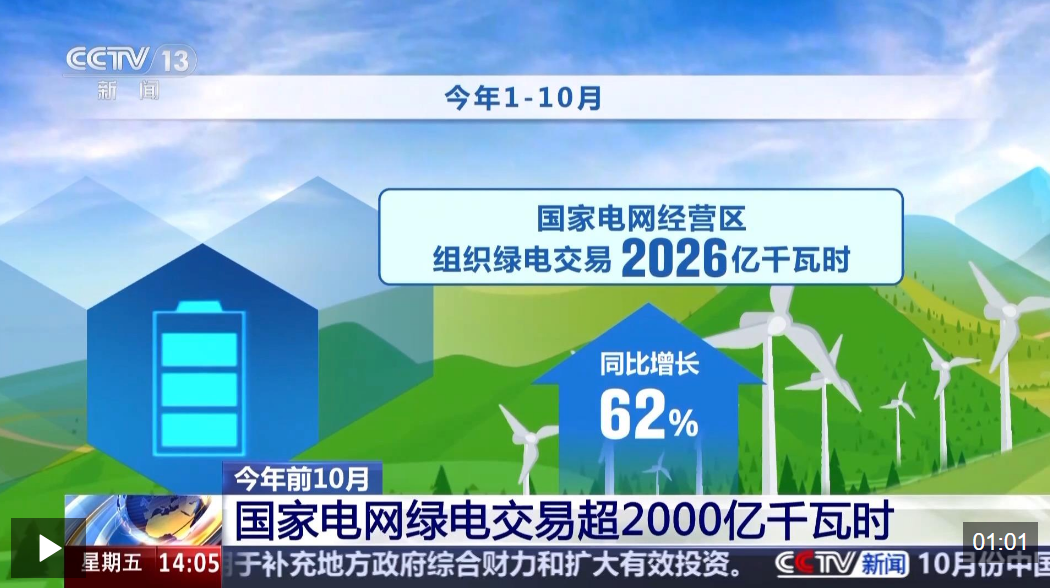
视频丨今年前10个月国家电网绿电交易超2000亿千瓦时
Yang Shi Xin Wen Ke Hu Duan· 2025-11-01 05:00
Core Insights - The scale of green electricity trading in the State Grid's operating area has exceeded 200 billion kilowatt-hours in the first ten months of this year, marking a historical high with a year-on-year growth of 62% [1][3]. Group 1: Green Electricity Trading - The total green electricity trading volume reached 202.6 billion kilowatt-hours from January to October, reflecting a significant increase compared to the previous year [1]. - The growth in trading volume is attributed to the continuous expansion of new energy installations and the improvement of market mechanisms [3]. Group 2: New Energy Installations - The installed capacity of wind and solar energy in the State Grid's operating area has reached 136.4 million kilowatts, representing a year-on-year increase of 33% [3]. - The establishment of inter-provincial electricity trading models has optimized the allocation of electricity resources across provinces [3]. Group 3: Market Mechanisms - The introduction of long-term green electricity agreements has resulted in over 30 billion kilowatt-hours of agreements, providing stable revenue for new energy companies and reliable green electricity sources for users [5]. - The current market systems are facilitating the optimization of green electricity distribution, ensuring large-scale grid connection and high proportion consumption of new energy [7].

中闽能源(600163)季报点评:项目储备与绿电交易支撑长期增长
Xin Lang Cai Jing· 2025-10-31 06:22
Core Viewpoint - The company reported a significant decline in net profit for Q3 due to asset impairment and lower-than-expected power generation, despite a slight increase in revenue year-over-year [1][2]. Financial Performance - Q3 revenue reached 286 million yuan, representing a year-over-year increase of 3.2% and a quarter-over-quarter increase of 2.1% [1]. - Net profit attributable to shareholders was 13.55 million yuan, down 80% year-over-year and down 79% quarter-over-quarter, falling short of Huatai's forecast [1]. - For the first three quarters of 2025, revenue totaled 1.08 billion yuan, a decrease of 1.4% year-over-year, with net profit down 20% to 328 million yuan [1]. Asset Impairment and Power Generation - The company recorded an asset impairment of 63.44 million yuan in Q3, which accounted for 60% of the quarterly gross profit, leading to a substantial decline in net profit [2]. - Q3 power generation was 516 million kWh, showing a year-over-year increase of 7.6%, with wind power in Fujian being a key contributor [2]. - However, power generation from Heilongjiang wind and Xinjiang solar dropped by 23% and 32% year-over-year, respectively, due to regional resource impacts [2]. Project Pipeline and Asset Injection - The company has a robust pipeline of projects, including offshore wind farms and solar power stations, which are expected to enhance future performance [3]. - Progress is being made on asset injections, with plans to incorporate pumped storage assets, although some projects are pending final subsidy verification [3]. - The establishment of a power market trading team aims to improve market analysis and trading strategies in response to the marketization of renewable energy pricing [3]. Profit Forecast and Target Price Adjustment - The company has revised its profit forecasts for 2025-2027, reducing net profit estimates by 12.3%, 11.8%, and 10.4% to 582 million, 626 million, and 740 million yuan, respectively [4]. - The adjustments are primarily due to changes in wind power VAT policies and reduced other income [4]. - The target price has been lowered to 6.27 yuan, reflecting a 19x PE for 2026, considering the strong profitability of offshore wind and potential performance boosts from asset injections [4].

合康新能韧性增长 前三季度净利润同比增长584.4%
Zheng Quan Ri Bao Wang· 2025-10-25 03:44
Core Viewpoint - Beijing Hekang New Energy Technology Co., Ltd. reported significant growth in revenue and net profit for the first three quarters of 2025, indicating a robust business performance [1]. Financial Performance - The company achieved total revenue of 6.182 billion yuan, representing a year-on-year increase of 98.61% [1]. - The net profit attributable to shareholders reached 73.9959 million yuan, showing a substantial year-on-year growth of 584.4% [1]. - In Q3 alone, the company generated revenue of 1.685 billion yuan, which is a 20.08% increase compared to the same quarter last year [1]. - The net profit for Q3 was 2.8122 million yuan, reflecting a year-on-year growth of 24.18% [1]. Business Developments - Hekang New Energy secured multiple orders for its high-voltage variable frequency business from nuclear power projects [1]. - The company participated in the world's first "dual-tower single machine" solar thermal storage power station project, which has received recognition for its products and technology [1]. - Hekang New Energy's subsidiary completed its first batch of green certificate applications and green electricity transactions, indicating a shift towards a stable and reliable renewable energy supply platform [1]. - The company has begun ramping up production of its first-generation overseas household energy storage products since June, with installations in Europe occurring in Q3 [1]. - New products, including the second-generation household energy storage integrated machine and separate machine series, are expected to be launched in Q4 [1].

新疆年内绿电消纳首破200亿千瓦时
Xin Hua She· 2025-10-24 03:34
Core Insights - Xinjiang has consumed over 20.5 billion kilowatt-hours (kWh) of green electricity by October 23, 2023, marking a 58% increase compared to the total consumption in the previous year, and this is the first time the annual green electricity consumption has exceeded 20 billion kWh [1] Group 1: Green Electricity Consumption - The consumption of over 20.5 billion kWh includes approximately 2.8 billion kWh from green electricity trading and about 17.7 billion kWh from green certificate trading [1] - Xinjiang has implemented weekly green electricity trading since January 2025, establishing a multi-level green electricity trading system that includes annual, monthly, and intra-month trading [1] Group 2: Infrastructure and Market Development - The region is integrating independent energy storage and other flexible adjustment resources into the medium and long-term market trading to enhance system consumption and peak regulation capabilities [1] - A comprehensive green consumption service network has been developed, with the State Grid Xinjiang Electric Power Company establishing 28 green electricity and green certificate service stations, along with 5 micro-service stations located in government service centers, banks, and integrated energy companies [1] Group 3: Renewable Energy Capacity - Xinjiang boasts abundant wind and solar resources, with a cumulative installed capacity of renewable energy reaching 129 million kW by the end of August 2023, accounting for approximately 60% of the total installed power capacity, placing it among the top in the country [1]
光伏产业或将再迎反内卷新政,光伏ETF(159857)冲击四连阳,近1周涨幅同类居首!
Sou Hu Cai Jing· 2025-10-16 05:36
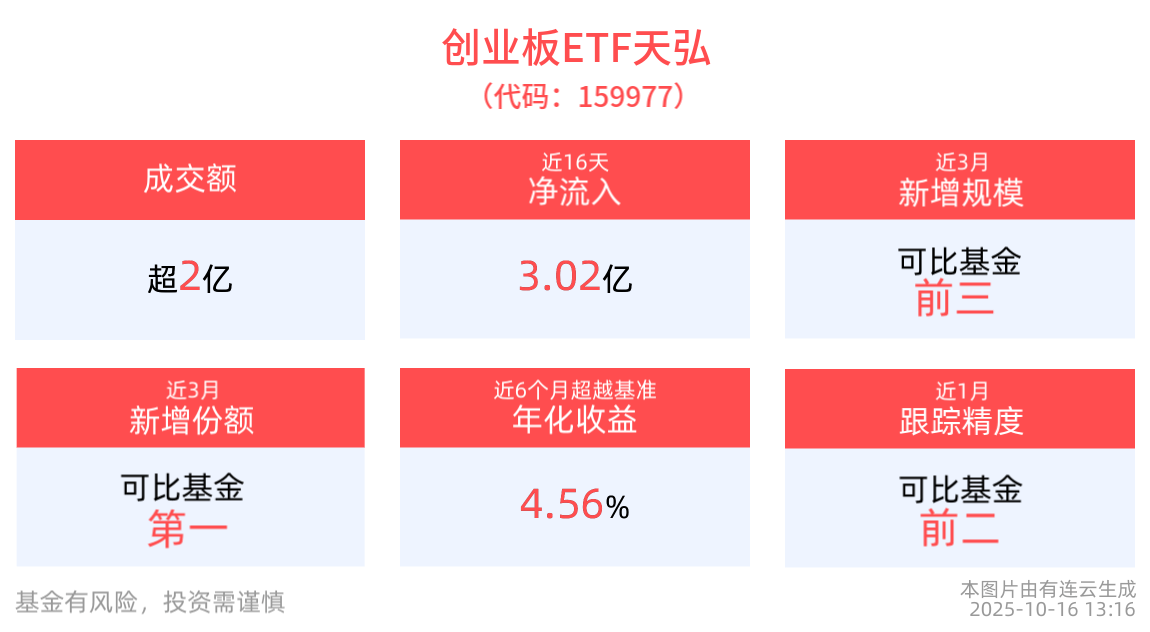
Group 1 - The core viewpoint of the news highlights the performance of the photovoltaic ETF (159857) and the entrepreneurial board ETF Tianhong (159977), indicating significant growth and investor interest in these funds [3][4]. - As of October 15, the photovoltaic ETF (159857) has seen a weekly increase of 0.49%, with a notable trading volume of 1.79 billion yuan and a net inflow of 6.36 million yuan [3]. - The photovoltaic ETF (159857) has achieved a one-year scale growth of 706 million yuan, reflecting strong market demand [3]. Group 2 - The entrepreneurial board ETF Tianhong (159977) has experienced a scale growth of 797 million yuan over the past three months, with a significant increase in share volume [4]. - The latest net inflow for the entrepreneurial board ETF Tianhong (159977) is 6.19 million yuan, contributing to a total inflow of 302 million yuan over the last 16 trading days [4]. - The photovoltaic ETF (159857) closely tracks the CSI Photovoltaic Industry Index, which includes representative companies across the photovoltaic industry chain [4]. Group 3 - Recent reports indicate that regulatory authorities may soon release a document to strengthen photovoltaic capacity control, aiming to balance supply and demand in the industry [4]. - The National Development and Reform Commission has issued a draft on renewable energy consumption targets, which aligns with global climate change initiatives and aims to enhance green energy consumption [5].




迪卡侬:全面推动零碳重卡的应用|2025华夏ESG实践节能降耗案例
Hua Xia Shi Bao· 2025-09-24 09:36
Company Overview - Decathlon Group was founded by Michel LECLERCQ in 1976 in France, currently operating 1,817 stores in 79 countries with a workforce of 101,100 and achieving a revenue of €16.2 billion [1] - Decathlon entered China in 1989 for procurement and production, officially launching retail operations in 2003, establishing a full supply chain including product design, production, logistics, branding, and retail [1] - The company has 4 owned factories, 3 logistics parks, 11 industrial procurement offices, and 200 physical stores across over 100 cities in China, with more than 44% of its procurement sourced from China [1] Sustainability Initiatives - Decathlon aims to reduce absolute greenhouse gas emissions from scopes 1, 2, and 3 by 42% from a 2021 baseline by 2030, with a commitment to achieve net-zero emissions across its value chain by 2050 according to SBTi standards [2] - In 2023, Decathlon began implementing Smart Meters in its energy management systems, with 69 stores successfully installed by the end of 2024, allowing precise monitoring of electricity usage [2] - The rooftop solar photovoltaic project initiated in 2019 has generated nearly 3 GWh of electricity by 2023, saving over ¥140,000 in electricity costs and reducing CO2 emissions by more than 1,800 tons [2] - By 2024, Decathlon plans to have 124 fast charging stations, expected to reduce carbon emissions by approximately 620-992 tons annually, equivalent to the emissions of 400-600 gasoline vehicles [2] Logistics and Green Energy - In 2024, Decathlon China will promote the application of zero-carbon heavy trucks, having tested long-range intelligent heavy trucks with over 600 kilometers of endurance [3] - The green electricity trading project in China has seen participation from over 140 suppliers responding to Decathlon's supply chain decarbonization initiative, with coverage expected in several provinces by 2024 [3] - Decathlon's renewable energy usage exceeds 84%, with a reduction of single-use plastic packaging by over 53%, achieving revenue growth while decoupling from carbon emissions for three consecutive years [3]
调研速递|圣元环保接受福建省产业股权投资基金等19家机构调研 透露多项业务关键进展
Xin Lang Cai Jing· 2025-09-18 13:44
Group 1 - The company hosted a research event with 19 institutions and individual investors, showcasing the operations of its waste-to-energy plant and discussing its business strategy and financial performance for the first half of 2025 [1] - The company has received multiple national subsidies, contributing positively to its third-quarter profits, with the Ministry of Finance allocating a budget of 46.183 billion yuan for renewable energy subsidies, including 3.942 billion yuan for biomass power generation [1] Group 2 - The company is actively expanding its steam supply and heating business, with contracts signed for new projects at prices starting from 205 yuan per ton, and has supplied 56,200 tons of steam and 508,600 GJ of heat in the first half of 2025 [2] - The company anticipates significant profit growth from its waste-to-energy projects through various initiatives, including technological upgrades, improved receivables collection, and green electricity trading [2] Group 3 - The company is constructing a taurine production project with an annual capacity of 40,000 tons, expected to rank among the top three in China upon completion, with stable raw material supply secured through a partnership with a local petrochemical company [2] - The company has established a marketing department for taurine derivatives, launching various "taurine+" products and utilizing both online and offline marketing strategies to promote them [3] Group 4 - The company is developing a hotel project in Xiamen, which has reached the structural completion stage and is on track for completion and trial operation by the end of 2026, with plans for professional management by a subsidiary of Marriott International [3]

内蒙古:坚持煤电油气风光并举 扛牢能源保供责任
Nei Meng Gu Ri Bao· 2025-09-17 07:17
Group 1: Coal Supply and Production - Inner Mongolia focuses on high-standard construction of coal supply bases, optimizing coal mining layout and implementing immediate review processes for coal mine resumption, aiming to stabilize coal production capacity at over 1.2 billion tons per year [1] - In the first half of the year, coal production reached 640 million tons, a growth of 0.7%, with approximately 60% of the coal transported to major consumption areas in Northeast, North, and East China [1] Group 2: Electricity Supply and Green Energy - Inner Mongolia accelerates the construction of existing power projects, controls non-scheduled maintenance, and promotes full output of operational units, while implementing 12 measures to optimize long-term electricity trading rules [2] - In the first half of the year, the total installed power capacity reached 270 million kilowatts, with a generation of 4,167 billion kilowatt-hours, an increase of 4.7%, and electricity exports of 1,656 billion kilowatt-hours, a growth of 7.7%, accounting for over one-sixth of the national cross-regional electricity exports [2] - The proportion of green electricity in total exports reached 29.6%, an increase of 9 percentage points compared to the same period last year [2] Group 3: Oil and Gas Supply - Inner Mongolia enhances oil and gas supply capabilities by coordinating with major companies to increase exploration and development efforts, focusing on unconventional resources like coalbed methane [3] - In the first half of the year, crude oil production was 1.657 million tons, a growth of 2.9%, while natural gas production remained stable at 16.88 billion cubic meters, and coalbed methane production increased by 30.4% to 263.5 million cubic meters [3] - Over 60% of natural gas production is supplied externally, effectively meeting the demand for gas in the region and the Beijing-Tianjin-Hebei area [3] Group 4: Infrastructure Development - Inner Mongolia is advancing the construction of a robust and flexible power grid to accommodate a high proportion of renewable energy, with the approval of a new high-voltage electricity export channel [3] - In the first half of the year, ten new 500 kV projects and five intelligent substations of 110 kV and above were put into operation, enhancing the clean energy transmission capacity [3]