
AI医疗

Search documents
AI立功了!百元早筛“癌症之王”
财联社· 2026-01-07 02:08
Core Viewpoint - The article highlights the successful application of Alibaba's AI model for early detection of pancreatic cancer, showcasing its potential to save lives by identifying tumors that may be missed by traditional methods [1][4][17]. Group 1: AI Model and Its Impact - The AI model, named DAMO PANDA, has analyzed over 180,000 CT scans, leading to the detection of 24 cases of pancreatic cancer, with 14 being in early stages [17]. - The model demonstrated a 93% accuracy rate in identifying pancreatic lesions from non-contrast CT scans, which are commonly used in routine checks [10][17]. - The cost of the screening using the AI model is approximately $25, making it accessible for many patients [15]. Group 2: Clinical Implementation and Results - The AI tool was tested at the Affiliated People's Hospital of Ningbo University, where it flagged cases that had previously shown no alarms, leading to timely interventions [6][10]. - Dr. Zhu Kelei, a key figure in the implementation, stated that the AI has unequivocally saved lives by detecting cancers that would have otherwise gone unnoticed [10][17]. - The model has issued alerts for about 1,400 scans, with around 300 requiring follow-up, indicating its effectiveness in clinical settings [11]. Group 3: Broader AI Healthcare Landscape - The article notes that Alibaba's AI technology is being promoted globally, covering nine countries and serving 20 million people, indicating a significant expansion of its application [18]. - Other major Chinese tech companies are also investing in AI healthcare, with initiatives from Ant Group, Huawei, and JD.com, reflecting a competitive landscape in AI medical applications [19]. - The Chinese AI healthcare market is projected to grow significantly, with estimates suggesting a rise from 8.8 billion yuan in 2023 to 315.7 billion yuan by 2033, indicating a compound annual growth rate of 43.1% [26].



金融界财经早餐:央行部署今年工作!继续实施适度宽松的货币政策;中方正研究收紧对日稀土出口许可审查;国晟科技、嘉美包装等多只高位股停牌核查;(1月7日)
Sou Hu Cai Jing· 2026-01-07 00:43
Economic Policy and Market Overview - The People's Bank of China emphasized the importance of promoting high-quality economic development and reasonable price recovery in its monetary policy, utilizing various tools like reserve requirement ratio cuts and interest rate reductions to maintain liquidity and support balanced credit growth [1] - The Ministry of Commerce announced strengthened export controls on dual-use items to Japan, citing recent provocative statements from Japanese leaders regarding Taiwan, which are seen as a serious violation of China's sovereignty [1] Capital Market Developments - The China Securities Index announced adjustments to the CSI 1000, CSI 500, and CSI A500 indices, effective January 9, 2026, with companies like Chipone Technology and Mingyue Optical being added to the indices [3] - In December 2025, A-share new account openings reached 2.6 million, a 9% increase from November, with a total of 27.44 million new accounts opened throughout the year, marking a 10% year-on-year growth [3] Industry Insights - AI in healthcare is gaining traction, with Alibaba's AI model for early pancreatic cancer screening highlighted as a significant innovation, indicating a growing trend in AI applications across various medical fields [6] - The semiconductor industry is experiencing price increases, with Samsung and SK Hynix raising DRAM prices for servers, PCs, and smartphones by 60%-70% in Q1 2026 compared to Q4 2025 [7] Company Highlights - iFlytek reported extensive collaborations with over 500 robot manufacturers, leveraging its AI service platform for various types of robots [8] - BYD outperformed Tesla in sales across Europe's two largest electric vehicle markets, with a sevenfold increase in sales in Germany to 23,306 units, while Tesla's sales dropped to 19,390 units [9] - FiconTEC, a subsidiary of Robotech, signed a significant contract worth approximately €770,000 (about ¥63.08 million), which is expected to have a positive impact on the company's revenue [11] - MiniMax's IPO received overwhelming interest, with a subscription amount exceeding HK$253.3 billion and a public offering oversubscription rate of 1,209 times [13]

正股驱动下转债市场创10年新高
Zhong Guo Jin Rong Xin Xi Wang· 2026-01-07 00:21
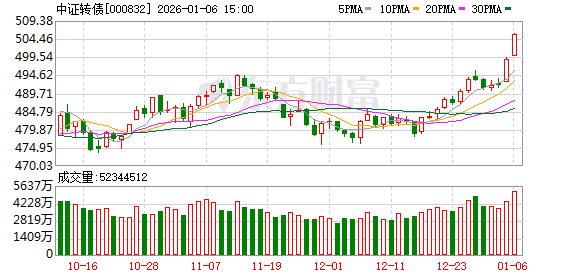
转自:证券时报 在A股市场持续走强并刷新10年新高的同时,中证转债指数1月6日也攀升走高,创下自2015年6月以来 的逾10年高点。 中证转债指数近期表现不仅延续了自2025年以来的强势格局,更凸显其在权益市场波动中"进可攻、退 可守"的独特价值。 中证转债指数刷新逾10年高点 1月6日,在权益市场强势走高,并刷新10年新高的背景下,中证转债指数也大涨1.35%,报505.77点, 创2015年6月以来高点。 此次行情的核心催化剂是脑机接口行业的商业化突破。特斯拉CEO埃隆·马斯克于2025年12月31日宣 布,旗下脑机接口公司Neuralink将于2026年启动设备大规模生产,并推进几乎完全自动化的手术方案。 这一表态被市场视为脑机接口从实验室走向大众消费的关键转折点。与此同时,国内政策支持力度持续 加码:国家药监局近期召开脑机接口医疗器械工作推进会,明确将加快相关产品审评审批流程;上海等 地出台专项行动方案,提出到2027年推动5款以上侵入式、半侵入式产品完成临床试验。 除塞力转债外,嘉美转债、联创转债等亦表现亮眼。嘉美包装股价大涨带动嘉美转债在1月5日涨 10.94%后,1月6日再度上涨14.95%,2 ...

A股晚间热点 | 央行部署今年工作!继续实施适度宽松的货币政策
智通财经网· 2026-01-06 15:33
Group 1: Monetary Policy and Economic Development - The People's Bank of China plans to continue implementing a moderately loose monetary policy, focusing on promoting high-quality economic development and reasonable price recovery [1] - The central bank will flexibly and efficiently use various monetary policy tools such as reserve requirement ratio (RRR) cuts and interest rate reductions to maintain ample liquidity and relatively loose social financing conditions [1] - The policy aims to keep the comprehensive financing costs low and prevent excessive exchange rate fluctuations [1] Group 2: Rare Earth Export Controls - China is considering tightening the export license review for medium and heavy rare earths to Japan due to recent negative actions by Japan [2] - The Ministry of Commerce of China announced plans to strengthen export controls on dual-use items to Japan, which are goods and technologies that can be used for both civilian and military purposes [2] Group 3: Financial Regulation and Investment - Regulatory authorities conducted research on several bank wealth management companies to identify barriers to increasing investments in A-shares and to understand industry expectations for future policies [3] - The aim is to address the bottlenecks in long-term capital entering the market and enhance the enthusiasm for wealth management investments in A-shares [3] Group 4: Investment Opportunities in AI and Technology - Strong Brain Technology, a unicorn in the brain-computer interface sector, completed approximately 2 billion RMB financing, marking the second-largest financing in this field after Neuralink [4] - The investor lineup includes prominent institutions and companies, indicating strong market interest in brain-computer interface technology [4] - AI in healthcare is gaining attention, with Alibaba's AI model for early pancreatic cancer screening demonstrating significant potential in medical applications [9] - The application of AI in healthcare is expected to accelerate, presenting investment opportunities in this sector [9] Group 5: Stock Market Activity - A-shares have seen active trading, with over 2 trillion RMB in transaction volume for six consecutive trading days, indicating a robust market environment [7] - Key sectors attracting investment include non-bank financials, pharmaceuticals, and media, with several stocks achieving significant trading volumes [7] - New account openings in A-shares reached 2.5967 million in December 2025, a 9% month-on-month increase and a 31% year-on-year increase [7] Group 6: Corporate Announcements - Robotech's subsidiary signed a contract worth approximately 7.7 million euros for an automated optical switch packaging line [15] - Times New Material signed a sales contract for wind turbine blades worth about 3.32 billion RMB [15] - WuXi AppTec faced a 2% stake reduction from 18 shareholders, indicating potential concerns regarding shareholder confidence [15]

港通医疗:公司致力于解决医用气体供应及医疗感染问题
Zheng Quan Ri Bao Zhi Sheng· 2026-01-06 14:09
Group 1 - The company focuses on providing medical gas equipment and systems, as well as medical clean equipment and systems for various medical institutions [1] - Medical gas and clean equipment systems are part of the smart hospital construction [1] - The company is paying continuous attention to the development of AI in healthcare, aiming to enhance the intelligence level of its products to meet the growing demands of modern hospital construction [1]
中证转债指数刷新逾10年高点!“春季躁动”行情逐步展开
Zheng Quan Shi Bao· 2026-01-06 11:16
Group 1 - The core point of the news is that the China Convertible Bond Index has reached a new high not seen in over 10 years, driven by strong performance in the equity market and specific stocks like Seli Medical [2][3][4] - The China Convertible Bond Index rose by 1.35% to 505.77 points on January 6, marking the highest level since June 2015 [3] - Seli Convertible Bond has seen a significant increase, with a 20% rise over two consecutive trading days, benefiting from the strong performance of its underlying stock, Seli Medical, which is focused on AI and medical big data [3][4] Group 2 - The catalyst for this market trend is the commercialization breakthrough in the brain-computer interface industry, with Neuralink planning to start large-scale production in 2026 [4] - Domestic policy support for the brain-computer interface sector is increasing, with the National Medical Products Administration accelerating the review process for related products [4] - Other convertible bonds like Jiamei and Lianchuang have also performed well, indicating a structural rally in the convertible bond market [4] Group 3 - The strong performance of the convertible bond market is closely linked to the performance of underlying stocks, with the China Convertible Bond Index showing a rise of 18.66% in 2025, closely following the 18.41% increase in the Shanghai Composite Index [6][7] - The valuation recovery in the convertible bond market has been a significant driver, especially after a period of low valuations due to risks like defaults and delistings [7] - The current market sentiment is characterized by a preference for high-growth sectors such as AI healthcare and advanced manufacturing, which are driving the performance of specific convertible bonds [4][8] Group 4 - Analysts suggest that the current market conditions may lead to a "spring rally," driven by seasonal capital inflows and policy expectations [9] - Institutional investors may have a renewed interest in convertible bonds as they adjust their equity asset risk factors, potentially leading to increased demand [9] - The performance of convertible bonds may also depend on the specific terms of the bonds and the strategies employed by investors [9]
10年新高!转债市场火了
证券时报· 2026-01-06 11:06
Core Viewpoint - The A-share market continues to strengthen, reaching a 10-year high, while the China Convertible Bond Index has also risen, hitting its highest point since June 2015 [1][3]. Group 1: Market Performance - The China Convertible Bond Index has shown a strong performance since 2025, highlighting its unique value in the equity market's volatility, characterized by "offensive and defensive" capabilities [2]. - On January 6, the China Convertible Bond Index surged by 1.35% to 505.77 points, marking a high not seen since June 2015 [4]. - The recent strong performance of convertible bonds is driven by the underlying stocks, with notable examples including the Seer Medical bond, which saw a 20% increase due to the stock's performance [5]. Group 2: Key Catalysts - The core catalyst for the current market rally is the commercialization breakthrough in the brain-computer interface industry, with significant announcements from companies like Neuralink [4]. - Domestic policy support for the brain-computer interface sector is also increasing, with initiatives aimed at expediting the approval processes for related medical devices [4]. Group 3: Structural Trends - The recent rally in convertible bonds is characterized by two main features: strong performance of underlying stocks and concentrated thematic interest in sectors like brain-computer interfaces and AI healthcare [5]. - Despite some convertible bonds experiencing declines due to falling stock prices, the overall market sentiment remains positive, driven by high-growth sectors [6]. Group 4: Historical Context - The last time the China Convertible Bond Index reached a historical high was in June 2015, during a peak in the A-share bull market [8]. - Since 2019, the convertible bond market has gradually recovered, with a notable resurgence in 2025, reflecting a strong correlation with the performance of underlying stocks [9]. Group 5: Future Outlook - Analysts suggest that the upcoming "spring rally" in the A-share and convertible bond markets may be influenced by seasonal capital inflows and policy expectations [12]. - The performance of convertible bonds in the near term will depend on institutional investment behavior and the release of annual performance forecasts for A-shares [12].

港股概念追踪|大厂纷纷涉足AI医疗 机构看好产业链成长空间(附概念股)
Zhi Tong Cai Jing· 2026-01-06 00:52
Group 1 - Huawei officially launched the Huawei AI Data Platform for the medical field on December 7, 2025, based on the OceanStor A800 storage, aiming to address the cost, quality, and accessibility challenges in healthcare [1] - Ant Group's C-end AI medical application "AQ" has been rebranded as "Ant Afu," completing a brand strategy upgrade, and signed a strategic cooperation agreement with Sichuan University West China Hospital to advance research and innovation in "AI + healthcare" [2] - Citic Securities reports that Ant Afu APP has three highlights: structured multimodal precise diagnosis capability, long-term health data accumulation enhancing user stickiness, and promising commercialization prospects within the Alibaba ecosystem [2] Group 2 - Citic Jin Invest notes that AI healthcare in China is progressing in policy, technology, products, and applications, with a shift from individual products to full-chain scenarios and from large hospitals to grassroots and individual applications [3] - The application value of AI in healthcare is significant across various fields, including enhancing medical device functions, interpreting test results, assisting clinical decision-making, and health management, making it a crucial innovation direction for healthcare enterprises and hospitals [3] - The AI healthcare market is expected to accelerate its application with ongoing policy and technological support, suggesting investment opportunities in the industry [3] Group 3 - Yidu Technology, a leading AI healthcare company, has been invited to the Henan Health Industry Development Conference and signed as a partner in the national AI application pilot base for healthcare [4] - iFlytek Medical Technology is recognized for its extensive coverage in the AI healthcare sector and is seen as a key player benefiting from policy incentives and national projects [4] - JD Health is consolidating its leading position in the pharmaceutical e-commerce sector through expanded insurance coverage, offline service development, and deepening AI healthcare applications [4] Group 4 - Alibaba Health is actively exploring AI applications in healthcare, focusing on optimizing e-commerce search, supply chain management, and enhancing efficiency for professional users with AI medical assistants [4] - Guosheng Tang is a leader in traditional Chinese medicine services, developing AI avatars and health assistants to advance AI healthcare [5] - Ping An Good Doctor's stock performance is attributed to advancements in AI healthcare and improved profit prospects, with expectations for growth driven by AI empowerment and the flourishing of commercial health insurance [5]
大厂纷纷涉足AI医疗 机构看好产业链成长空间(附概念股)
Zhi Tong Cai Jing· 2026-01-06 00:41
Group 1: Huawei AI Data Platform - Huawei officially launched its AI data platform for the medical field on December 7, 2025, based on the OceanStor A800 storage system [1] - The platform includes three core technologies: knowledge generation and retrieval, memory extraction and recall, and UCM inference acceleration, aimed at overcoming the cost, quality, and accessibility constraints in healthcare [1] Group 2: Ant Group's AI Medical Application - Ant Group's C-end AI medical application "AQ" has been rebranded as "Ant Afu," completing a brand strategy upgrade [2] - A strategic cooperation agreement was signed between Sichuan University West China Hospital and Ant Group to advance research and service system construction in chronic diseases, particularly respiratory diseases [2] - The "Ant Afu" app is noted for its structured multimodal precise consultation capabilities, long-term health data accumulation, and promising commercialization prospects within the Alibaba ecosystem [2] Group 3: AI Medical Industry Trends - CITIC Securities reports that AI medical applications are entering a commercialization acceleration phase, with companies that have technological barriers and clear commercialization paths expected to achieve rapid expansion and improved profitability [2] - Continuous progress in policies, technology, products, and applications in the domestic AI medical sector is anticipated, with applications moving from large hospitals to grassroots and individual levels [3] - AI medical applications are expected to accelerate in various fields, including enhancing medical device functions and assisting clinical decision-making [3] Group 4: Key Players in AI Medical Sector - Yidu Tech (医渡科技) has been invited to participate in the Henan Health Industry Development Conference and has signed as a partner in the national AI application pilot base for medical direction [4] - iFlytek Medical Technology (讯飞医疗科技) is recognized for its extensive coverage in the AI medical field and is seen as a major beneficiary of policy incentives and national projects [4] - JD Health (京东健康) is consolidating its leading position in pharmaceutical e-commerce through expanded insurance payment coverage and deepening AI medical applications [4] - Alibaba Health (阿里健康) is actively exploring AI applications in medical e-commerce and is currently refining its AI medical assistant product [4] Group 5: Other Notable Companies - Guoshengtang (固生堂) is a leader in traditional Chinese medicine services, developing AI health assistants and AI medical avatars [5] - Ping An Good Doctor (平安好医生) is expected to see growth driven by advancements in AI medical capabilities and improving profitability prospects [5]
券商晨会精华 | 关注脑机接口及其拓展应用
智通财经网· 2026-01-06 00:36
Market Overview - The market opened strongly, with the ChiNext Index leading the gains, and the Shanghai Composite Index returning above 4000 points, recording twelve consecutive days of gains. The total trading volume in the Shanghai and Shenzhen markets reached 2.55 trillion, an increase of 501.1 billion compared to the previous trading day. The Shanghai Composite Index rose by 1.38%, the Shenzhen Component Index by 2.24%, and the ChiNext Index by 2.85% [1]. Industry Insights - CITIC Securities highlighted that the nuclear fusion sector is entering a period of intensive catalytic release, with significant technological advancements expected to drive a synchronized market trend between domestic and international markets early next year. The long-term growth trend of the industry has been established, with domestic capital expenditure progressing steadily and overseas developments likely to exceed expectations [2]. - Open Source Securities noted that gaming could serve as a significant application scenario for brain-computer interfaces (BCIs) and AI. The recent launch of China's first fully implanted, wireless BCI product by Shanghai Brain Tiger Technology marks a critical breakthrough in core BCI technology, enabling previously disabled individuals to engage in gaming through brain control. Elon Musk's Neuralink plans to mass-produce BCI chips by 2026, with a streamlined and automated implantation process expected to accelerate the maturity of various application scenarios, including gaming and medical rehabilitation [3]. - CITIC Construction Investment pointed out that the AI medical sector is expected to see continuous progress in policy, technology, products, and applications by 2025. The application of AI in healthcare is anticipated to expand from large hospitals to grassroots and individual levels, enhancing medical device functionality, interpreting test results, assisting clinical decision-making, and health management. The ongoing support from national policies and industry technologies is likely to accelerate the implementation of AI medical applications, presenting investment opportunities in the sector [4].