
中证转债指数

Search documents
债市平论-市场要选择方向了
2026-03-24 01:27
Summary of Conference Call Records Industry Overview - The records primarily discuss the bond market, focusing on convertible bonds and government bonds, with insights into the broader financial market dynamics as of March 2026. Key Points and Arguments Market Performance - The China Convertible Bond Index fell by 7.1% in March, reversing all gains for the year, indicating high volatility in the market [1][2] - The Shanghai Composite Index dropped by 3.6% on March 23, 2026, marking a significant decline, with historical comparisons showing similar drops in previous years due to external factors [2] Institutional Fund Flows - There was a notable net redemption of fixed-income products, particularly from wealth management subsidiaries, which significantly impacted high-volatility products [2] - Institutions primarily sold off sectors such as electronics, power equipment, banking, non-ferrous metals, and pharmaceuticals, while showing interest in automotive, basic chemicals, and machinery sectors [2] Future Market Scenarios for Convertible Bonds - Three potential scenarios for the convertible bond market were outlined: 1. **Optimistic Scenario**: A short-term rebound leading to price increases in equity-type and mid-to-low priced convertible bonds [3] 2. **Volatile Scenario**: A period of market fluctuation with limited new capital inflow, delaying overall valuation increases [4] 3. **Pessimistic Scenario**: A shift in market sentiment leading to significant risks, particularly for lower-quality convertible bonds [4] Investment Strategies - Emphasis on identifying convertible bonds with strong debt support and a high likelihood of conversion success, targeting a price of 130 yuan to trigger strong redemption [5] - Recommendations to maintain cautious positions and focus on structural allocations, particularly in mid-to-low priced convertible bonds with favorable conversion prospects [5] Government Bond Market Insights - The yield on 10-year government bonds is expected to fluctuate between 1.78% and 1.85%, while 30-year bonds may reach up to 2.3% [6] - The market is anticipated to experience a directional choice soon, with significant attention on the upcoming special government bond issuance plan [6][10] Monetary Policy Outlook - The likelihood of the central bank actively withdrawing MLF (Medium-term Lending Facility) is low, with a supportive monetary policy stance expected to continue [7] - Key signals to watch for include the wording in MLF announcements and the potential impact of external geopolitical factors on domestic monetary policy [7] Credit Bond Market Dynamics - Funds are the primary players in the credit bond market, with significant net purchases observed, particularly in the 1-3 year maturity range [9] - The trend of funds heavily investing in credit bonds is expected to persist into the second quarter, despite potential risks associated with concentrated positions [10] Key Variables to Monitor - Upcoming special government bond issuance plans and their market impact [8] - Economic data releases in early April to assess ongoing economic trends [10] - Fluctuations in oil prices and their implications for monetary policy [10] Additional Important Content - The records highlight the importance of structural investment strategies in a volatile market environment, emphasizing the need for careful monitoring of both domestic and international economic indicators [5][10]
大类资产配置周报20260306-20260308
East Money Securities· 2026-03-08 13:08
Group 1 - The overall equity market experienced adjustments during the week from March 2 to March 6, with the Shanghai Composite Index falling by 0.93% to close at 4124.19 points, and the Shenzhen Component Index declining by 2.22% to 14172.63 points [9][11] - The convertible bond market also saw a decline, with the China Convertible Bond Index dropping by 2.07% and the Shanghai Convertible Bond Index decreasing by 2.21% during the week [16] - The bond market showed a general strengthening trend, with the 1-year China government bond yield decreasing by 3.58 basis points, and the 10-year yield down by 0.67 basis points [20] Group 2 - In the commodity market, performance was mixed, with WTI crude oil rising significantly by 35.63%, while COMEX gold and silver fell by 2.17% and 10.27% respectively [10][28] - The South China Commodity Index overall strengthened, with a 6.43% increase, driven by strong performance in energy and chemical sectors, which rose by 15.45% [28] - The market saw active trading in both convertible bonds and underlying stocks, with transaction volumes of 3674.49 billion and 7711.56 billion respectively, indicating a recovery in trading activity [16]
大类资产配置周报-20260303
East Money Securities· 2026-03-03 05:46
1. Report Industry Investment Rating No relevant content provided. 2. Core View of the Report The report analyzes the performance of various asset classes in the week from February 24th to February 27th, 2026. The equity market showed overall recovery, the convertible bond market declined, the bond market mostly weakened, and commodity futures mostly strengthened. Different market segments were affected by various factors such as policy changes, external trade environment, and geopolitical risks [9][10]. 3. Summary by Directory 3.1 This Week's Performance of Major Asset Classes - The equity market showed overall recovery. The Shanghai Composite Index rose 1.98% to 4162.88 points, the Shenzhen Component Index rose 2.8% to 14495.09 points, and the ChiNext Index rose 1.05% to 3310.3 points. The trading volume of the Shanghai and Shenzhen stock exchanges totaled 9.69 trillion yuan. The Hang Seng Index rose 0.82% to 26630.54 points, while the Hang Seng Tech Index fell 1.41% to 5137.84 points [9]. - The convertible bond market declined. The CSI Convertible Bond Index fell 0.24% in the past week, and the Shanghai Stock Exchange Convertible Bond Index fell 0.34%. In the past month, the CSI Convertible Bond Index rose 0.9%, and the Shanghai Stock Exchange Convertible Bond Index rose 0.26% [9]. - The bond market mostly weakened. The yields of 1-year, 3-year, 5-year, 7-year, and 30-year China Bond Treasury bonds increased by 0.71bp, 0.84bp, 1.33bp, 2.36bp, and 4.36bp respectively, while the 10-year yield decreased by 0.22bp [9]. - Commodity futures mostly strengthened, with silver performing strongly. COMEX gold rose 3.24%, COMEX silver rose 11.61%, LME copper rose 2.28%, LME aluminum rose 1.16%, WTI crude oil rose 0.81%, SHFE rebar rose 0.98%, CBOT soybeans rose 1.41%, and CBOT corn rose 1.88% [10]. 3.2 Performance of the Equity Market - Stocks - The equity market rose this week, with small and medium-cap stocks outperforming. Most industries rose, with cyclical sectors such as steel and non-ferrous metals leading the gains. The media, consumer services, and non-bank financial sectors led the declines. The media sector fell 5.21%, consumer services fell 4.14%, and non-bank financials fell 3.21%. The steel sector rose 9.52%, and the comprehensive financial sector rose 2.17% [14]. - Market rotation was still active this week. The market style switched again. Benefiting from post-holiday resumption of work and production, cyclical and resource sectors led the gains, while the consumer sector was relatively weak. In addition, technology growth sectors such as semiconductors and chips also performed well [14]. - The reasons for the market performance are that the trading volume increased in the first week after the holiday, and the trading activity improved. Since the beginning of this year, the prices of many commodities have continued to rise. On the one hand, driven by the expansion of AI-related demand, the prosperity of sub - sectors such as chips and electronic cloth has increased, and prices have strengthened. On the other hand, the prices of resources such as gold and silver have also risen to varying degrees. Under the combined effect of rising product prices and improved profit expectations, relevant fields have strengthened synchronously. In the steel sector, many steel enterprises announced a "good start" in production in the first month of this year, and the production and sales indicators of some steel enterprises performed well, enhancing the investment confidence in the sector [14]. 3.3 Performance of the Equity Market - Convertible Bonds - The equity market rose this week, while the convertible bond market fell. As of February 27, 2026, the CSI Convertible Bond Index fell 0.24%, and the Shanghai Stock Exchange Convertible Bond Index fell 0.34%. In the past month, the CSI Convertible Bond Index rose 0.9%, and the Shanghai Stock Exchange Convertible Bond Index rose 0.26%. The trading volumes of convertible bonds and underlying stocks this week were 2945.06 billion yuan and 5968.85 billion yuan respectively, and the trading activity of both underlying stocks and convertible bonds declined compared with before the holiday [16]. - The convertible bond market was weak this week, lagging behind the overall stock market performance. The resource and pro - cyclical sectors of A - shares showed obvious upward trends, while some high - valuation technology and growth stocks were under pressure. At the same time, the trading volume of convertible bonds decreased, which may have had a certain impact on the convertible bond market [16]. 3.4 Performance of the Fixed - Income Market - The bond market yields generally increased this week, with the 10 - year Treasury bond yield slightly decreasing. The yields of 1 - year, 3 - year, 5 - year, 7 - year, and 30 - year China Bond Treasury bonds increased by 0.71bp, 0.84bp, 1.33bp, 2.36bp, and 4.36bp respectively, while the 10 - year yield decreased by 0.22bp [18]. - During the Spring Festival, the US tariff policy fluctuated again, increasing the uncertainty of the external trade environment and affecting the market risk appetite, which had a certain impact on the short - term bond market. On February 25th, Shanghai issued the "Seven Measures for Shanghai" real estate optimization policy, which adjusted the purchase restrictions, housing provident fund use, and property tax, etc. The policy was aimed at stabilizing the real estate market and expectations. Affected by the policy's boost to the real estate chain sentiment, the risk appetite for equities was marginally repaired, and the bond market was under pressure [18]. - In terms of the capital side, on February 25th, the central bank conducted 600 billion yuan of MLF operations. From the perspective of the operation intensity and reverse repurchase scale, the monetary policy continued to be relatively loose, and the attitude of maintaining liquidity was stable. Especially before the Two Sessions, the policy orientation of stabilizing the capital side is expected to continue, and the capital price is likely to remain in a reasonable range and be generally stable. In the future, although the bond market sentiment has improved compared with before, there are not enough incremental factors to drive the yield to break through the oscillation range effectively. Before there is a new dominant variable, the market's long and short forces are still relatively balanced, and the bond market is expected to continue the range - bound pattern in the short term [19]. 3.5 Performance of the Commodity Market - The Nanhua Commodity Index strengthened overall this week, with precious metals performing strongly. The index rose 3.56% in total. Precious metals led the gains, rising 8.55% compared with the week before the Spring Festival. Metals rose 3.06%, industrial products rose 2.47%, energy and chemicals rose 2.14%, and agricultural products rose 1.19% [27]. - The gold price continued to rise this week and remained at a high level. The uncertainty of the US - Iran situation and the variable policy orientation of the Trump administration have increased the external geopolitical risk premium. At the same time, the short - term rebound of international oil prices and the creation of a new stage high have strengthened the market's re - pricing expectations for inflation and the energy supply - demand pattern, driving the precious metal and energy sectors to strengthen synchronously. In the future, the evolution of the geopolitical situation is still uncertain, and there are also significant differences in the Fed's policy path. It is expected that gold will maintain a high - level oscillation pattern in the short term [28][30].
中东突变,大类资产如何演绎
HUAXI Securities· 2026-03-01 09:41
Geopolitical Risk and Market Impact - On February 28, 2026, the U.S. and Israel launched a preemptive military strike against Iran, escalating geopolitical tensions in the Middle East[1] - The duration of the conflict is a key variable influencing asset performance, with historical precedents indicating outcomes can range from quick victories to protracted wars[2] Historical Context and Asset Behavior - Historical conflicts show that asset prices typically rise on expectations but may fall once the reality of war sets in, exemplified by the "buy the rumor, sell the news" phenomenon[2] - Oil prices are the most sensitive to conflict changes, with significant price fluctuations observed during past conflicts, such as a 13% increase in WTI crude oil prices prior to the June 2025 conflict[11] Current Conflict Analysis - The current U.S.-Iran conflict is characterized by a stronger Iranian response compared to previous conflicts, with potential scenarios ranging from internal leadership changes in Iran to escalated military actions[3] - The market's risk appetite is expected to fluctuate based on the conflict's duration and intensity, impacting oil prices and other assets significantly[3] Asset Class Reactions - Oil prices could rise by 10%-20% if the Strait of Hormuz is blocked, which is critical for global oil supply, as it accounts for approximately 20% of daily oil transport[40] - Gold and silver are expected to react positively to the conflict, with gold's price logic being stronger than in previous conflicts due to the current monetary policy environment[39] Stock Market Dynamics - U.S. stock markets may experience short-term volatility but are likely to maintain a bullish trend in the long run, as seen in past conflicts where markets recovered after initial shocks[41] - A-share markets showed a cumulative decline of 2.16% during the conflict escalation phase but rebounded by 3.84% following the de-escalation announcement[21] Bond Market Considerations - The domestic bond market is expected to be less affected by geopolitical tensions, with movements primarily driven by domestic economic factors and market sentiment[22] - If inflation expectations rise due to increased oil prices, the bond market may face downward pressure, but the primary focus will remain on domestic economic indicators and policy responses[43]

中证转债指数低开0.12%
Jin Rong Jie· 2026-02-27 01:47
Group 1 - The convertible bonds of Guanzhong increased by 4.36%, while Aiwei's convertible bonds rose by 4.23% [1] - Jiaze's convertible bonds saw an increase of 3.27%, and Yanpai's convertible bonds grew by 2.94% [1] - Conversely, Jiali's convertible bonds decreased by 3.40%, and Ruike's convertible bonds fell by 2.45% [1] - Dazhong's convertible bonds dropped by 1.95%, and Dinglong's convertible bonds declined by 1.94% [1]
四点半观市 | 机构:2026年企业提价意愿增强 材料、金融等板块有望受益
Xin Lang Cai Jing· 2026-02-26 10:21
Market Performance - On February 26, various ETFs showed mixed performance, with the South Korea-China Semiconductor ETF (513310) rising by 9.64%, while the Hang Seng Medical ETF (159892) fell by 3.89% [1][3] - Domestic commodity futures exhibited varied results, with lithium carbonate leading gains, and several commodities like rapeseed and tin rising over 3% [1][3] - Government bond futures closed lower across the board, with the 30-year main contract down by 0.53% [1][3] - The China Convertible Bond Index decreased by 1.03%, with notable gains in certain convertible bonds like Jiali and Aofei, while others like Ruichuang and Weida saw significant declines [1][3] Fund Flow - On February 26, the top ten stocks by net inflow included Hu Dian Co., Shenghong Technology, and Hengtong Optic-Electric, each receiving over 1 billion yuan in net inflow [5] Institutional Insights - UBS's China equity strategy report indicated a projected 9% increase in global commodity prices by 2025, with a potential re-inflation environment in China by 2026 [2][6] - During a re-inflation period, sectors such as materials, finance, and real estate are expected to perform best, with some consumer sectors also likely to benefit due to low expectations and positioning [2][6]
债市日报:2月26日
Xin Hua Cai Jing· 2026-02-26 09:44
Market Overview - The bond market continues to face pressure, with yields on medium to long-term bonds rising by over 2 basis points, and the main contracts for government bond futures closing lower, with the 30-year contract down by 0.53% [1][2] - The overall liquidity in the market is expected to stabilize, with cash returning after the holiday and the central bank providing support [1] Bond Yield Movements - The 10-year government bond yield rose by 2.4 basis points to 1.9810%, while the 30-year government bond yield increased by 2.2 basis points to 2.2530% [2] - The China Convertible Bond Index fell by 1.03%, with significant declines in several convertible bonds, while others saw notable increases [2] International Bond Market Trends - In North America, U.S. Treasury yields rose across the board, with the 10-year yield increasing by 2.1 basis points to 4.052% [3] - In the Eurozone, the 10-year French bond yield decreased by 1.2 basis points, while the German bond yield rose slightly [3] Primary Market Activity - The China Development Bank issued financial bonds with yields of 1.6295% for 3-year bonds and 1.8327% for 7-year bonds, with bid-to-cover ratios of 3.3 and 2.2 respectively [4] Liquidity and Funding Conditions - The central bank conducted a reverse repurchase operation of 320.5 billion yuan at a rate of 1.40%, with a net withdrawal of 79.5 billion yuan for the day [5] - Short-term Shibor rates mostly declined, with the overnight rate down by 1.0 basis point to 1.368% [5] Institutional Insights - Long-term strategies involving leveraged investments in the bond market are being discussed, emphasizing the importance of market conditions [6] - There is a focus on convertible bonds, with a recommendation to pay attention to sectors like chemicals, construction materials, and power equipment due to potential recovery opportunities [6]
债市日报:2月25日
Xin Hua Cai Jing· 2026-02-25 08:22
Core Viewpoint - The bond market is experiencing fluctuations with a general downward trend, as government bond futures and interbank cash bonds show weakness, while the market awaits policy direction from an upcoming important meeting [1][2]. Market Performance - Government bond futures closed lower across the board, with the 30-year main contract down 0.47% to 112.7, the 10-year down 0.13% to 108.48, the 5-year down 0.10% to 106.065, and the 2-year down 0.06% to 102.458 [2]. - The yield on the 10-year government bond "25附息国债22" increased by 2 basis points to 1.81%, while the 30-year bond "25超长特别国债06" saw a yield rise of 1.25 basis points to 2.2330% [2]. International Market Trends - In North America, U.S. Treasury yields showed mixed results, with the 2-year yield rising by 2.73 basis points to 3.461% and the 10-year yield falling by 0.38 basis points to 4.031% [3]. - In Asia, Japan's long-term bond yields increased significantly, with the 30-year yield rising by 5 basis points to 3.325% [3]. - In the Eurozone, yields on 10-year bonds from France, Germany, Italy, and Spain all decreased slightly [3]. Primary Market Activity - The Ministry of Finance's recent bond auctions saw lower yields than market estimates, with the weighted average yield for the 91-day and 5-year bonds at 1.2110% and 1.4877%, respectively [4]. - Agricultural Development Bank's financial bonds also showed competitive yields, with the 10-year yield at 1.9490% [4]. Liquidity Conditions - The central bank conducted a 7-day reverse repurchase operation with a total of 4095 billion yuan at a rate of 1.40%, resulting in a net injection of 95 billion yuan for the day [5]. - Short-term Shibor rates mostly declined, with the overnight rate rising slightly by 1.6 basis points to 1.378% [5]. Institutional Insights - According to Everbright Futures, the liquidity in the market is expected to remain stable but slightly tighter as the month-end approaches, with significant government bond issuance planned [7]. - Xingzheng Fixed Income suggests that while the bond market may continue to see single-sided trends, the overall support from stable liquidity and slow economic recovery will influence market dynamics [7].
中证转债指数收涨0.82%,287只可转债收涨
2 1 Shi Ji Jing Ji Bao Dao· 2026-02-24 07:40
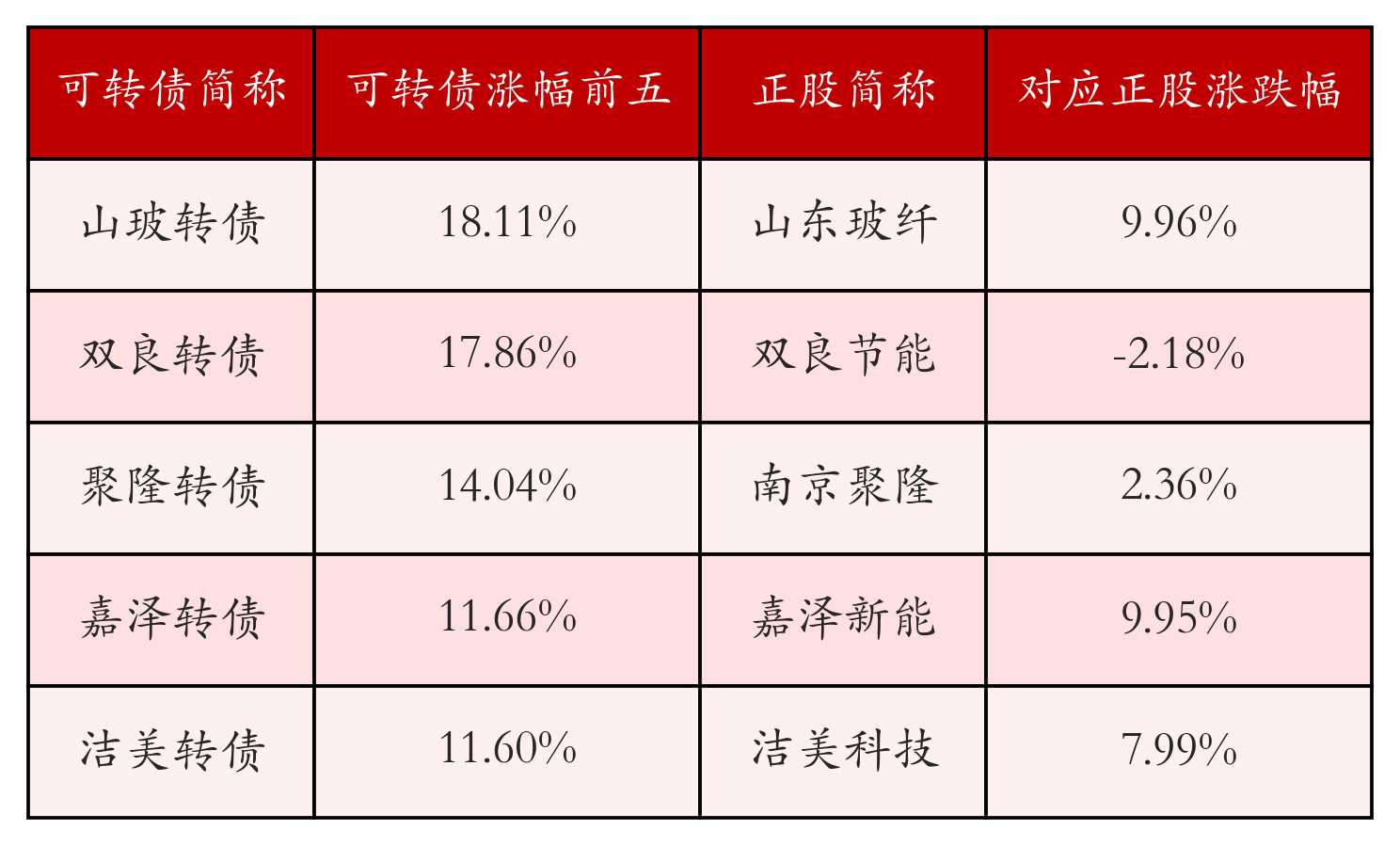
Core Viewpoint - The convertible bond market showed positive performance with the China Convertible Bond Index rising by 0.82% to 530.76, and a total trading volume of 61.523 billion yuan on the day [1]. Group 1: Convertible Bond Performance - A total of 370 convertible bonds were traded, with 287 rising, 0 remaining flat, and 83 declining [1]. - Notably, 59 convertible bonds had gains exceeding 2%, with Shandong Glass Fiber Convertible Bond (111001) up by 18.11%, Shuangliang Energy Convertible Bond (110095) up by 17.86%, and Nanjing Julong Convertible Bond (123209) up by 14.04% [2]. - Conversely, 13 convertible bonds experienced declines over 2%, with Deepin Technology Convertible Bond (123210) down by 13.86%, Yongchuang Intelligent Convertible Bond (113654) down by 6.36%, and Dingjie Intelligent Convertible Bond (123263) also down by 6.36% [2]. Group 2: Corresponding Stock Performance - Among the stocks corresponding to the traded convertible bonds, 270 stocks rose, 5 remained flat, and 95 declined [1]. - Specifically, 24 convertible bonds had corresponding stocks that increased by more than 5%, with Hebang Biological (603077) hitting the daily limit and rising by 10.08%, while its corresponding convertible bond, Hebang Convertible Bond (113691), rose by 6.33% [1]. - There were 3 convertible bonds linked to stocks that fell by more than 5%, but no stocks hit the daily limit down [1].

中证转债指数午盘上涨1.05%
Mei Ri Jing Ji Xin Wen· 2026-02-24 05:23
Core Viewpoint - The China Convertible Bond Index rose by 1.05% to 531.98 points on February 24, indicating a positive market trend for convertible bonds [1] Group 1: Market Performance - The top gainers in the convertible bond market included Shuangliang Convertible Bond, Julong Convertible Bond, Shanbo Convertible Bond, Jiazhe Convertible Bond, and Jiemei Convertible Bond, with increases of 16.79%, 14.26%, 13.43%, 10.53%, and 10.43% respectively [1] - The largest decliners were Xinfeng Convertible Bond, Yong02 Convertible Bond, Aofei Convertible Bond, Haohan Convertible Bond, and Hengshuai Convertible Bond, with decreases of 13.07%, 7.34%, 6.43%, 4.69%, and 3.80% respectively [1]