AI医疗

Search documents
中信建投:关注AI医疗产业链投资机遇
Xin Lang Cai Jing· 2026-01-06 00:28
Core Viewpoint - The domestic AI healthcare sector is expected to see continuous advancements in policy, technology, products, and applications by 2025, with a shift from individual products to a full-chain scenario and from large hospitals to grassroots and individual applications [1] Group 1: Policy and Technology - Continuous catalysis from national policies and industry technologies is anticipated to accelerate the implementation of AI healthcare applications [1] - Other regions are expected to introduce related policies in the future, indicating a broader trend in the industry [1] Group 2: Application Value - AI healthcare holds significant application value in enhancing medical device functions, interpreting examination results, assisting clinical decision-making, and health management [1] - Medical enterprises and hospitals must prioritize AI healthcare as an innovative direction and competitive trend [1]

晒炒股成绩单!紫金陈:我太菜了
Shang Hai Zheng Quan Bao· 2026-01-05 15:11
过去几个月没发声的知名小说家紫金陈,近日晒出了自己的账户收益,面对2025年超30%的收益,紫金 陈直言,"收益不好,感觉太菜了"。 面对紫金陈的自谦,多位网友表示,"紫老师在凡尔赛"。 如果将紫金陈的2025年收益率和公募基金相比,紫金陈处于中等水平。据统计,衡量公募基金投资能力 的主动偏股型基金,2025年度平均收益率为32%。其中,年度收益率超过50%的基金约为800只,年度 净值翻倍的基金超过70只。 有意思的是,2024年12月27日,紫金陈也曾晒出炒股成绩单,彼时其年内收益率约为30%。虽然与2025 年收益率相仿,但是市场已发生明显变化,紫金陈的心境出现明显不同,对自己的评价从"还行"变 成"太菜了"。 知名投资人反思 除紫金陈外,近期,多位知名投资人也在复盘2025年操作得失,并展望2026年投资机遇。 紫金陈称自己"太菜了" 从紫金陈晒出的账户情况看,2025年收益率为31.17%,超过同期上证指数涨幅12.74个百分点。虽然该 收益击败了81%的股民,但紫金陈坦言,2025年收益不好,感觉太菜了,所以很少说话。 谈及2025年的操作,紫金陈表示:"年初重仓港股联通,很高兴地卖掉后半个月又涨 ...
AI医疗板块1月5日涨4.68%,伟思医疗领涨,主力资金净流入24.71亿元
Sou Hu Cai Jing· 2026-01-05 09:36
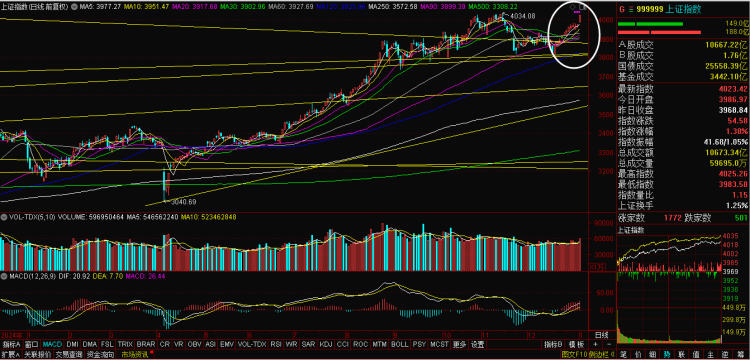
从资金流向上来看,当日AI医疗板块主力资金净流入24.71亿元,游资资金净流出18.2亿元,散户资金 净流出6.51亿元。AI医疗板块个股资金流向见下表: 以上内容为证券之星据公开信息整理,由AI算法生成(网信算备310104345710301240019号),不构成 投资建议。 证券之星消息,1月5日AI医疗板块较上一交易日上涨4.68%,伟思医疗领涨。当日上证指数报收于 4023.42,上涨1.38%。深证成指报收于13828.63,上涨2.24%。AI医疗板块个股涨跌见下表: ...


开门红!上证指数12连阳重返4000点
Sou Hu Cai Jing· 2026-01-05 09:04
Group 1 - The A-share market experienced a "good start" on January 5, with the Shanghai Composite Index closing at 4023.42 points, up 54.58 points, a rise of 1.38% [1] - The Shenzhen Composite Index rose significantly by 50.56 points, or 2.00%, while the Sci-Tech Innovation Index surged by 3.61% [1] - Total trading volume in the A-share market reached 25,672.40 billion yuan, an increase of 24.27% compared to the previous period [1] Group 2 - The stock rise-to-fall ratio on that day was 4185:1168, with 139 stocks rising over 10% and 381 stocks rising over 5% [3] - Sectors such as brain engineering, healthcare, blood oxygen monitors, immunotherapy, AI healthcare, CXO, weight loss drugs, and assisted reproduction saw gains exceeding 3.5% [3] - Analysts express optimism about classic blue-chip stocks, noting that the "good start" was achieved through widespread gains, which is relatively rare [3]
国投证券港股晨报-20260105
国投证券(香港)· 2026-01-05 08:53
Core Insights - The report highlights a strong start for the Hong Kong stock market in 2026, with the Hang Seng Index rising by 2.76% and the Hang Seng Tech Index increasing by 4% on the first trading day, driven by positive market sentiment and broad sector gains [2][3] - The semiconductor sector is noted as a key driver in the US market, with significant gains in companies like Nvidia and Micron Technology, while software stocks showed weakness [4] - The report discusses the geopolitical impact of US military actions in Venezuela, suggesting potential long-term implications for oil prices and market stability [5] Company Overview - The specific company under review, 精锋医疗 (Jingfeng Medical), was established in 2017 and specializes in surgical robots, being the first in China and the second globally to receive regulatory approval for multiple types of surgical robots [7] - Financial projections indicate revenues of 48.04 million yuan in 2023, 160 million yuan in 2024, and 150 million yuan in the first half of 2025, with net losses projected at 210 million yuan, 220 million yuan, and 89.09 million yuan respectively [7] Industry Status and Outlook - The surgical robot market in China is projected to grow from 2.71 billion yuan in 2019 to 7.18 billion yuan by 2024, reflecting a compound annual growth rate of 21.5%, with expectations to reach 102.02 billion yuan by 2033 [8] Advantages and Opportunities - The company holds a unique position as the first in China and second globally to gain approval for various types of surgical robots, which enhances its competitive edge [9] - The product portfolio is comprehensive, allowing for strong synergies and collaboration within the company [9] - The company has robust research and development capabilities and has attracted significant cornerstone investors, indicating strong industry recognition and support [9] Fundraising and Use of Proceeds - The IPO is set to raise funds with approximately 42% allocated for the research and development of core products, 20% for commercialization, and 10% for capacity expansion, among other uses [13] Investment Recommendation - The report suggests that the company, with its leading position and strong investor backing, has a projected market capitalization of approximately 16.8 billion HKD at the IPO price, with a price-to-sales ratio of about 50 times, comparable to its peers [14]
港股创新药ETF(159567)涨超5%,2025年中国创新药商务拓展(BD)出海授权达到了历史新高!
Jin Rong Jie· 2026-01-05 06:02
Group 1 - The core viewpoint of the news highlights a significant increase in the biopharmaceutical sector within the Hong Kong stock market, with the innovative drug ETF (159567) rising by 5.21% and achieving a trading volume exceeding 1.3 billion HKD [1] - The NextPharma database indicates that by December 31, 2025, the total transaction amount for China's innovative drug business development (BD) overseas authorization is projected to reach 135.655 billion USD (approximately 948.3 billion RMB), with an upfront payment of 7 billion USD and a total of 157 transactions, marking a historical high compared to 51.9 billion USD and 94 transactions in 2024 [1] - Southwest Securities predicts that the innovative drug sector will experience a surge starting in May 2025, driven by the 1.25 billion USD upfront payment for PD1/VEGR dual antibodies, leading to a bullish market for innovative drugs [1] Group 2 - The Hong Kong innovative drug ETF (159567) closely tracks the National Index for Hong Kong Stock Connect Innovative Drugs, featuring leading stocks such as BeiGene, Innovent Biologics, and 3SBio, with a notable inclusion of several AI-driven pharmaceutical leaders, indicating a high proportion of innovative drug companies [2] - The ETF is expected to exhibit high elasticity as the market for AI-enabled innovative drugs gains momentum [2]
创新药ETF国泰(517110)涨超2.6%,创新疗法与国际化进程成关注焦点
Mei Ri Jing Ji Xin Wen· 2026-01-05 03:49
Group 1 - The innovative drug ETF Guotai (517110) rose over 2.6%, with a focus on innovative therapies and internationalization progress [1] - The chemical pharmaceutical sector performed moderately, while the innovative drug field saw multiple advancements, including Heng Rui Medicine's cMET ADC new drug SHE-1826 being proposed for breakthrough therapy designation [1] - Innovent Biologics' CTLA-4 biosimilar Daborhizumab is priced at 13,100 yuan per unit, and Zai Lab's DLL3/DLL3/CD3 tri-antibody received a $1.235 billion licensing deal with AbbVie, including an upfront payment of $100 million and up to $1.075 billion in milestone payments [1] Group 2 - Technological advancements in ADC, IO dual antibodies, GLP-1 weight loss, and small nucleic acid drugs are progressing, enhancing China's innovative drug internationalization capabilities [1] - The policy environment shows stabilization in medical insurance negotiations, with the introduction of a "commercial insurance innovative drug catalog" in 2025 to expand market opportunities, and the optimization of rules in the 11th batch of centralized procurement to alleviate fierce competition [1] - The CXO sector is experiencing growth in overseas orders and a recovery in domestic demand, with rapid increases in demand for ADC and peptide drugs [1] Group 3 - The medical device sector is focusing on performance recovery and overseas opportunities, with Hong Kong stocks highlighting the profit release of leading companies in niche segments, and new technologies like brain-computer interfaces and AI medical applications gaining investment interest due to policy support [1] - The traditional Chinese medicine sector is influenced by respiratory diseases and progress in the basic drug catalog, while the biopharmaceutical field is paying attention to the expectations of innovative pipeline authorizations and sales improvements for vaccine companies [1]
港股医药领跑市场,持续看好创新药及创新产业链,2026年仍将是创新药的“数据验证年”
Mei Ri Jing Ji Xin Wen· 2026-01-05 03:16
Group 1 - The core viewpoint of the articles highlights a significant surge in the Chinese innovative drug sector, with license-out transactions exceeding $130 billion, marking a year-on-year increase of over 150% and surpassing 50% of the global total for the first time [1] - The cash flow generated from business development (BD) and the IPO boom is providing ample funding for research and development, which is crucial for the industry's future growth [1] - Three main driving forces for the industry in 2026 are identified: commercialization realization, clinical data validation, and improvement of payment systems, which are expected to usher in a new era of "value realization" [1] Group 2 - The Hang Seng Medical ETF (159892) focuses on innovative drugs, CXO, and related industries, benefiting from the advantages of the Hong Kong Stock Exchange's 18A system, which covers numerous innovative targets [2] - The ETF is expected to continue its valuation recovery trend under the catalysts of innovative drug exports and commercial insurance directories [2]
AI医疗领域迎重磅BD
Sou Hu Cai Jing· 2026-01-05 01:26
Group 1 - The core point of the article is that Insilico Medicine has entered into a multi-year R&D collaboration with Sihuan Pharmaceutical, valued at $888 million, focusing on AI-driven drug development in oncology [1] - Insilico Medicine is eligible for an upfront payment of up to $32 million and milestone payments related to recent R&D achievements as part of the agreement [1] - The collaboration aims to combine Insilico's Pharma.AI platform with Sihuan's global expertise in oncology drug development, targeting challenging oncology targets to identify and develop new therapeutic drugs [1] Group 2 - Huafu Securities indicates that the AI healthcare industry has entered a critical phase of commercialization, driven by the resonance of strategy and market demand, with catalysts from policy, hospital end, and product aspects [1] - The current timing is seen as a golden opportunity for a new round of AI healthcare application deployment [1] - The Hong Kong Stock Connect Medical ETF (520510) tracks the Hong Kong Stock Connect Medical Theme Index, with over 30% weight in CXO and over 20% in AI healthcare, providing a convenient tool for market investment in CXO and AI healthcare concepts [1]
蚂蚁阿福1500万月活背后,中国AI医疗真正成立的是哪三层结构
GLP1减重宝典· 2026-01-04 13:47
AI医疗观察 . 响应《关于深入实施"人工智能+"行动的意见》,推动AI在医疗领域的应用,本账号发布权威资讯 以下文章来源于AI医疗观察 ,作者关注AI医疗的 蚂蚁阿福月活用户规模已超过 1500 万,成为国内首个月活突破千万的健康管理类 AI 应用,其意义并不仅在规模本身,而在于验证了消费端长 期健康管理的可行性。 而这只是 C 端 AI 医疗商业化的起点。未来真正决定产品能否走向长期增长的,并非单点能力,而是能否把用户的健康行为持续组织起来。基于 大量过往投资案例和长周期验证,我们认为其核心有三层: 高频 刚性 的 场景、大量用户以及用户主动上传的数据 。本文将通过 分析中国 AI 医疗 格局 ,进一步展开这一判断。 为什么是现在:从试点条件走向系统条件 在 通用 AI 2C 产品中,模型足够好,或在某个高频场景中解决了明确痛点,用户规模便可以迅速放大。 但在医疗领域,这一关系长期是倒置 的。医疗模型的有效性高度依赖两类基础条件:一类是来自医疗体系内的历史就诊与检查数据,用以覆盖真实人群与疾病阶段;另一类是来自真 实使用者的长期交互与连续健康记录,用以 解答高度个体化和针对性的健康问题。 所以, AI 医 ...