
网络安全

Search documents
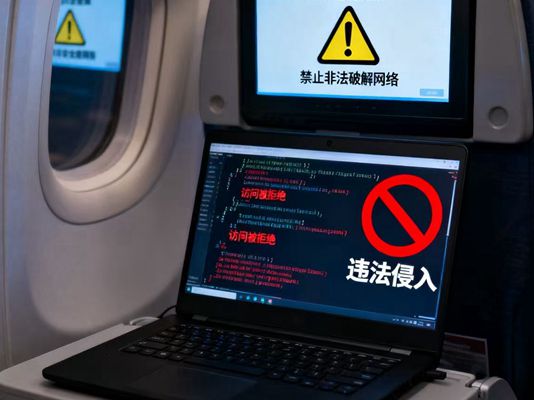
飞机上为免费蹭网竟试图侵入航司网络服务器,一旅客被罚
Bei Jing Ri Bao Ke Hu Duan· 2025-11-18 08:19
11月18日,智通财经记者从上海机场公安获悉,一家负责某航司网络运营维护的网络科技服务公司10月 29日通过系统监测发现,当日飞行中的墨尔本飞上海浦东航班上,有一旅客正对机上无线网络的后台服 务器进行漏洞扫描及尝试侵入。公司迅速识别并阻止了上述行为,避免了实际损失的发生,公司搜集相 关信息后报警。 转自:北京日报客户端 为免费上网,一旅客竟在飞机飞行途中尝试侵入航司机上无线网络后台服务器。上海机场公安对违法人 员给予治安处罚。 艾某侵入计算机信息系统的行为已违反了相关法律,其行为可能造成网络服务公司切断服务器,导致航 司在飞的所有航班上的无线网络停止服务。如果侵入成功,甚至会造成航班乘客信息泄露。根据《治安 管理处罚法》,上海机场公安已对艾某依法进行查处。 来源:@智通财经 通过对后台数据梳理分析,发起攻击行为的人员被锁定为乘客艾某,上海机场公安随即依法传唤艾某接 受调查。 据艾某交代,从澳大利亚墨尔本飞往上海浦东国际机场,全程大约6个小时,在飞行期间听闻旁人说起 可在飞机上连接机上付费的无线网络,便起了免费蹭网的想法。于是,艾某通过电脑软件进行网络环境 监测、系统漏洞扫描、IP地址搜集等方法,试图绕过限制, ...
为在飞机上免费上网,有旅客试图侵入航司网络服务器被罚
Bei Ke Cai Jing· 2025-11-18 07:35
Core Points - A passenger attempted to hack into the in-flight wireless network during a flight from Melbourne to Shanghai, leading to legal action by airport police [1][2][3] - The passenger, identified as Ai, used software to scan for vulnerabilities and collect IP addresses in an effort to bypass restrictions for free internet access [3] - The actions of the passenger could have resulted in significant disruptions, including the potential for all flights' wireless services to be cut off and the risk of passenger information leakage [3] Company and Industry Summary - The incident highlights the importance of cybersecurity measures in the aviation industry, particularly regarding in-flight internet services [1][3] - The network technology service company responsible for the in-flight network quickly identified and prevented the unauthorized access, showcasing the effectiveness of their monitoring systems [1][2] - Authorities have emphasized the need for passengers to use in-flight internet services through legitimate channels to avoid legal repercussions [4]
违法!为在飞机上免费上网 留学生竟试图侵入航司网络服务器
Zhong Guo Min Hang Wang· 2025-11-18 06:58
Core Points - A student attempted to hack into an airline's in-flight wireless network during a flight from Melbourne to Shanghai, leading to legal consequences [1][2] - The incident was detected by a network technology service company responsible for the airline's network operations, which prevented potential damage [2] Group 1: Incident Details - On October 29, a passenger was found scanning for vulnerabilities and attempting to breach the in-flight wireless network's backend server [2] - The individual, identified as a student named Ai, used software to monitor the network environment and scan for system vulnerabilities in an attempt to access free internet [2] - The actions of Ai violated laws related to computer information systems, potentially risking the disruption of wireless services for all passengers on the flight [2] Group 2: Legal and Safety Implications - The Shanghai airport police took legal action against Ai under the Public Security Administration Punishment Law [2] - Authorities emphasized the importance of using in-flight wireless networks through legitimate channels and warned against illegal access attempts [2]

广州“护苗·绿书签行动”——“清风侠网络行”掀起护苗热潮
Huan Qiu Wang· 2025-11-18 00:14
来源:环球网 11月15日,越秀公园五羊雕像广场前,暖意融融、活力满满。"清风e路护苗 网络安全'童'行"——2025 广州"护苗·绿书签行动"之"清风侠网络行"主题活动在此启动。知识宣讲、文艺演出、互动问答、倡议 宣誓、漫画展览等沉浸式活动轮番上演,社会各界嘉宾、师生代表与超人气动漫IP天团齐聚一堂,以多 元形式传递文明上网理念,为青少年筑牢网络安全防线,让护苗正能量在羊城大地持续传递。 本次活动由广州市"扫黄打非"办、广州市委网信办、广州市教育局主办;信息时报社、越秀区"扫黄打 非"办承办;广州市林业和园林局(越秀公园、人民公园管理中心)、广州新华出版集团(广州出版 社、广州市图批创新中心)、广州市版权保护中心、广州地铁、广州邮政、广州互联网协会、广州市游 戏行业协会、广东人民出版社、广州城市职业学院甘泉书院等协办。多方力量的深度联动,不仅为活动 顺利开展提供了坚实保障,更彰显了全社会同心聚力守护未成年人健康成长的坚定共识。 创新赋能IP,构建"大护苗"协同格局 近年来,广州市在"扫黄打非"工作中深耕创新路径,不断完善正面宣传机制与多元化宣教模式,持续丰 富"清风侠"动漫IP的内涵外延,系统推进"6+6" ...
入侵30家大型机构、Claude自动完成90%?Anthropic 被质疑,Yann LeCun:他们利用可疑的研究来恐吓所有人
3 6 Ke· 2025-11-17 08:24
上周,来自 Anthropic 的研究人员表示,他们最近观察到"首个由 AI 协同操作的网络攻击行动",在一次针对数十个目标的攻击活动中,他们检测到有黑客 使用该公司的 Claude AI 工具参与行动。不过,外部研究人员对 Anthropic 这一发现的评价要谨慎得多。 Anthropic 于上周四发布了两份报告称,早在 9 月份,Anthropic 发现了一场"高度复杂的攻击活动",该组织使用 Claude Code 自动化完成多达 90% 的工 作。人类只需在少量关键节点干预,"每个黑客行动中仅有约 4–6 次关键决策点"。Anthropic 表示,这些黑客利用 AI Agent 化能力的程度达到了"前所未 有"的水平。 但 Anthropic 表示:"这次行动对 AI Agent 时代的网络安全具有重大启示意义,这些系统可以在长时间内自主运行,并在较少人类参与的情况下完成复杂 任务。Agent 对日常工作和生产力非常有价值,但在错误的人手中,它们能够显著提升大规模网络攻击的可行性。" "说实话,整篇文章给我的感觉就像是'Claude 太厉害了,黑客都用它'之类的营销噱头。"有海外网友表示,"这让我想起 ...

荣联科技涨2.09%,成交额1.22亿元,主力资金净流入364.69万元
Xin Lang Cai Jing· 2025-11-17 06:44
Core Viewpoint - Ronglian Technology's stock has shown a year-to-date increase of 22.80%, despite a slight decline in the recent trading days, indicating potential volatility in its performance [1][2]. Group 1: Stock Performance - As of November 17, Ronglian Technology's stock price reached 8.78 yuan per share, with a trading volume of 1.22 billion yuan and a turnover rate of 2.12%, resulting in a total market capitalization of 58.09 billion yuan [1]. - The stock has experienced a net inflow of 364.69 million yuan from main funds, with significant buying activity from large orders, indicating investor interest [1]. - The stock has appeared on the "龙虎榜" three times this year, with the latest instance on September 15, where it recorded a net purchase of 1.54 billion yuan [1]. Group 2: Company Overview - Ronglian Technology, established on March 12, 2001, and listed on December 20, 2011, specializes in providing comprehensive solutions and professional services for data centers of large and medium-sized enterprises [2]. - The company's revenue composition includes 60.67% from system integration, 26.76% from technical development and services, 11.83% from system products, and 0.75% from other sources [2]. - As of September 30, 2025, the number of shareholders increased by 34.69% to 101,700, while the average circulating shares per person decreased by 25.75% to 6,505 shares [2]. Group 3: Financial Performance - For the period from January to September 2025, Ronglian Technology reported a revenue of 1.056 billion yuan, reflecting a year-on-year decrease of 23.14%, and a net profit attributable to shareholders of 6.404 million yuan, down 38.87% year-on-year [2]. - The company has cumulatively distributed 1.57 billion yuan in dividends since its A-share listing, with no dividends paid in the last three years [3]. - As of September 30, 2025, the top ten circulating shareholders included significant institutional investors, indicating a shift in ownership dynamics [3].

网络安全前沿科技与创新发展论坛举办 为AI时代划定网安红线
Shen Zhen Shang Bao· 2025-11-17 06:31
Group 1: Core Themes of the Forum - The forum focused on "new defense systems, AI security, and data security" in the context of digital transformation challenges and opportunities [1] - Experts from various companies discussed the need for a proactive defense model to address asymmetric threats in cybersecurity [1][2] Group 2: Innovations in Cybersecurity - Pengcheng Laboratory introduced the "Shield Cube" cybersecurity defense system, which employs a four-dimensional layout for threat perception [1] - Deepin Technology emphasized the shift from "tool stacking" to "systematic collaboration" in cybersecurity, aiming for AI to autonomously handle over 95% of security tasks under human supervision [2] - Extreme Networks showcased its VROS 5.0 virtual robot operating system, which supports a closed-loop process for network security operations through collective intelligence [2] - Aisino Security launched the AI XDR linked defense system, transitioning from isolated defenses to intelligent, collaborative security measures [2] Group 3: Data Governance - Shixi Technology highlighted the importance of data as a new production factor, advocating for precise control over data flow and presenting a three-dimensional governance framework [3]


亨通光电跌2.02%,成交额6.55亿元,主力资金净流出8679.25万元
Xin Lang Cai Jing· 2025-11-17 06:29
Company Overview - Hengtong Optic-Electric Co., Ltd. is located in Suzhou, Jiangsu Province, China, and was established on June 5, 1993. The company was listed on August 22, 2003. Its main business involves high-end technology, product research and development, and system integration services in the fields of communication networks and energy interconnection, as well as the construction of global submarine cable communication networks [1]. Financial Performance - For the period from January to September 2025, Hengtong Optic-Electric achieved operating revenue of 49.621 billion yuan, representing a year-on-year growth of 17.03%. The net profit attributable to the parent company was 2.376 billion yuan, an increase of 2.64% year-on-year [2]. - The company has cumulatively distributed 2.614 billion yuan in dividends since its A-share listing, with 1.121 billion yuan distributed over the past three years [3]. Stock Performance - As of November 17, Hengtong Optic-Electric's stock price decreased by 2.02%, trading at 19.89 yuan per share, with a total market capitalization of 49.063 billion yuan. The stock has increased by 17.07% year-to-date but has seen a decline of 6.88% over the past five trading days [1]. - The stock's trading volume on November 17 was 655 million yuan, with a turnover rate of 1.33%. The net outflow of main funds was 86.7925 million yuan, with large orders accounting for 21.46% of buy and 25.24% of sell [1]. Shareholder Structure - As of September 30, 2025, the number of shareholders of Hengtong Optic-Electric was 191,800, an increase of 18.60% from the previous period. The average number of circulating shares per person was 12,747, a decrease of 15.68% [2]. - Among the top ten circulating shareholders, Hong Kong Central Clearing Limited held 78.7403 million shares, an increase of 14.2357 million shares compared to the previous period. The Southern CSI 500 ETF held 28.7342 million shares, a decrease of 600,500 shares [3].

国民技术涨2.02%,成交额2.07亿元,主力资金净流出1274.58万元
Xin Lang Cai Jing· 2025-11-17 05:42
今年以来国民技术已经2次登上龙虎榜,最近一次登上龙虎榜为4月9日,当日龙虎榜净买入2.00亿元; 买入总计3.40亿元 ,占总成交额比18.81%;卖出总计1.40亿元 ,占总成交额比7.75%。 资金流向方面,主力资金净流出1274.58万元,特大单买入565.03万元,占比2.73%,卖出579.64万元, 占比2.80%;大单买入3396.66万元,占比16.40%,卖出4656.63万元,占比22.48%。 分红方面,国民技术A股上市后累计派现2.11亿元。近三年,累计派现0.00元。 国民技术今年以来股价跌8.85%,近5个交易日跌3.64%,近20日跌3.64%,近60日跌16.81%。 资料显示,国民技术股份有限公司位于广东省深圳市南山区西丽街道松坪山社区宝深路109号国民技术 大厦,香港铜锣湾希慎道33号利园1期19楼1910室,成立日期2000年3月20日,上市日期2010年4月30日, 公司主营业务涉及安全芯片和通讯芯片产品及解决方案的开发和销售。主营业务收入构成为:集成电路 和关键元器件等50.98%,负极材料46.02%,其他(补充)3.00%。 11月17日,国民技术盘中上涨2.02 ...

浙大网新涨2.11%,成交额2.42亿元,主力资金净流入1618.55万元
Xin Lang Cai Jing· 2025-11-17 02:57
Core Viewpoint - Zhejiang University Network New Technology Co., Ltd. has shown a significant increase in stock price and trading activity, indicating positive market sentiment and potential growth opportunities in the technology sector [1][2]. Company Overview - Zhejiang University Network New was established on January 8, 1994, and listed on April 18, 1997. The company is based in Hangzhou, Zhejiang Province, and its main business includes network equipment and terminals, software outsourcing and services, and comprehensive internet services [2]. - The revenue composition of the company is as follows: industrial digitalization 64.26%, government digitalization 13.59%, infrastructure digitalization 10.98%, intelligent computing cloud services 9.54%, and others 1.63% [2]. - The company belongs to the Shenwan industry classification of Computer - IT Services II - IT Services III and is associated with concepts such as smart healthcare, DeepSeek, cybersecurity, domestic software, and Xinchuang [2]. Financial Performance - For the period from January to September 2025, the company achieved operating revenue of 2.389 billion yuan, representing a year-on-year growth of 3.89%. The net profit attributable to the parent company was 31.1936 million yuan, showing a significant year-on-year increase of 162.90% [2]. - The company has distributed a total of 460 million yuan in dividends since its A-share listing, with 71.9268 million yuan distributed in the last three years [3]. Shareholder Information - As of September 30, 2025, the number of shareholders reached 211,700, an increase of 13.37% compared to the previous period. The average circulating shares per person decreased by 11.79% to 4,853 shares [2]. - Among the top ten circulating shareholders, Hong Kong Central Clearing Limited is the third-largest shareholder, holding 11.1544 million shares, an increase of 5.2064 million shares from the previous period [3].
