养老投资

Search documents
养老规划进行时,谁是我们的长期伙伴?
Shang Hai Zheng Quan Bao· 2025-11-09 15:26
Core Viewpoint - The article emphasizes the importance of pension planning in the context of an aging population, highlighting the potential of pension target Fund of Funds (FOF) as a reliable long-term investment partner [2][3]. Group 1: Investment Strategy - The current market has over 13,000 funds, making it challenging for ordinary investors to select long-term high-performing funds. FOF products utilize professional teams to conduct quantitative and qualitative analyses, selecting optimal fund combinations to address the difficulty of fund selection [2]. - FOF products invest in multiple funds, indirectly holding stocks, bonds, and other assets, which helps to diversify risks associated with individual stocks and funds. This "secondary smoothing" mechanism reduces portfolio volatility, aligning with the stability requirements of pension funds [2]. - Pension target FOF strategies are clear, with target date funds automatically reducing equity positions as retirement approaches, transitioning from aggressive to conservative investments, thus matching clients' life cycles [2]. Group 2: Tax Benefits and Cost Efficiency - Investors can enjoy a maximum annual tax deduction of 12,000 yuan when investing in pension target FOF through personal pension accounts, and investment returns are not taxed, leading to significant long-term compounding effects [3]. - The management fees and subscription fees for Y-class shares of pension target FOF are typically 50% lower than those of ordinary shares, further reducing long-term investment costs [3]. - Pension target FOF encourages long-term holding, mitigating the behavioral tendency to chase market trends by setting holding periods of 1 to 5 years, which helps investors avoid irrational investment decisions [3]. Group 3: Selection Criteria for Pension Target FOF - Investors should match their age with appropriate strategies, prioritizing target date funds such as 2030, 2040, or 2050 for those born in the 1970s, 1980s, and 1990s, respectively, to align retirement plans with investment trajectories [4]. - Investors with clear risk preferences can directly choose target risk funds labeled as "conservative," "balanced," or "aggressive." It is advisable to select institutions with rich FOF management experience and balanced capabilities in fixed income and equity investments [4]. - Stability of performance is a crucial evaluation metric for FOF products, with a focus on drawdown control rather than short-term rankings [4]. Group 4: Timing and Strategy for Investment - The fourth quarter is identified as an optimal time for pension investment, allowing for strategic tax planning and market valuation adjustments, encouraging gradual participation in pension FOF products [5]. - Pension investment is characterized as a long-term journey, and pension target FOFs, through scientific allocation, long-term constraints, and professional management, assist investors in transforming current savings into future financial security [5].

每日钉一下(想通过基金来做养老投资,有哪些品种可以考虑呢?)
银行螺丝钉· 2025-11-04 14:03
Group 1 - The article emphasizes that fund investment is a suitable method for lazy investors and discusses how to effectively plan for fund investment [2] - It introduces a free course that helps individuals understand fund investment strategies and planning [2] Group 2 - For retirement investment, the article suggests considering various fund types due to the decreasing replacement rate of social security pensions [7] - It outlines three main types of funds suitable for retirement investment: 1. Pension-targeted funds, such as pension FOF funds, which can be accessed through personal pension accounts or regular accounts with different fee structures [8] 2. High-dividend funds, like dividend index funds, which provide higher dividend yields for long-term holding [9] 3. Monthly salary treasure advisory combinations, designed for higher cash flow frequency and lower volatility compared to traditional high-dividend funds [12]

鹏华基金践行“一司一省一高校”,携手央财共话养老投资新趋势
Zhong Guo Jing Ji Wang· 2025-11-04 05:09
Group 1 - The core viewpoint of the news is that Penghua Fund, in collaboration with Central University of Finance and Economics, is actively engaging in investor education focused on retirement planning and asset allocation for university students [1][2] - The event featured a presentation by fund manager Sun Bofei, who discussed the necessity of diversified asset allocation from a macro hedging perspective, emphasizing the importance of a China-specific all-weather strategy [1] - Sun Bofei highlighted that equities are the only asset class with high certainty of long-term returns, stressing the need to consider local market conditions and fundamental factors for effective domestic equity investment [1] Group 2 - Penghua Fund has been actively involved in investor education in universities since September 2022, launching a series of educational activities aimed at enhancing investor awareness and integrating financial literacy into the national education system [2] - The company plans to continue its efforts in investor education, using initiatives like "One Company, One Province, One University" to promote rational investment concepts and contribute to the high-quality development of the industry [2]
每日债券市场要闻速递(2025-10-31)
Sou Hu Cai Jing· 2025-10-31 08:21
Group 1 - New policy financial instruments worth 500 billion yuan have been deployed, expected to drive total project investment exceeding 7 trillion yuan [1] - China Merchants Securities has raised the upper limit of margin financing from 150 billion yuan to 250 billion yuan [2] - The National Development and Reform Commission has added 200 billion yuan in special bond quotas specifically to support investment construction in certain provinces [8] Group 2 - The U.S. Federal Reserve is expected to end its balance sheet reduction and may become a net buyer of government bonds again next year [3] - U.S. mortgage rates have decreased to 6.17%, marking the fourth consecutive week of decline [5] - Meta's bond issuance has achieved a record subscription of 125 billion dollars [6] Group 3 - Vanke has redeemed the "22 Vanke 07" corporate bond, with a redemption amount of 2.5 billion yuan and interest payment of 86.25 million yuan [9] - Muyuan Foods continues to push for debt reduction, aiming to lower its asset-liability ratio to below 50% [10] - Chipone Technology has completed the first issuance of technology innovation bonds for private integrated circuit enterprises in China [11] Group 4 - The National Financial Regulatory Administration supports wealth management companies to invest in pension-related assets through various means including bonds, stocks, non-standard debt assets, and derivatives [12]
财富观 | 个人养老金基金收益全线翻红,叫好不叫座难题如何破局?
Sou Hu Cai Jing· 2025-10-21 09:49
Core Insights - The average return of pension fund Y shares has reached 15.46% year-to-date, with 96% of the 132 products established at the end of 2022 showing positive cumulative returns [1][3] - Despite the positive performance, over half of the products have a scale of less than 10 million yuan, and several have been forced to liquidate due to not meeting scale requirements [1][7] Performance Overview - As of October 17, nearly all existing pension fund Y share products have increased in value, with only one product showing a slight decline of 0.77% [2] - Eight products have achieved returns exceeding 40%, with the top performer being Tianhong Zhongzheng Kechuang Chuangye 50 ETF, which has risen by 46.37% [2] - The number of products with positive returns since inception has increased significantly, from 70 to 127, with an average return rising from -0.48% to 11.58% [3] Market Dynamics - The total scale of pension fund Y shares reached 12.405 billion yuan by the end of the second quarter, marking a 35.65% increase from the end of the previous year [5] - The market has seen a diversification of products, with over 300 pension fund products now available, including various types such as index-enhanced funds and ETFs [6] Challenges and Opportunities - Despite the positive performance, the challenge of low participation remains, with many investors still hesitant due to past losses and a lack of understanding of the long-term value of pension investments [9][10] - There is a need for improved marketing strategies and educational initiatives to enhance investor confidence and participation in pension funds [10][11]
平均净值增长超15% 个人养老金基金再扩容
经济观察报· 2025-10-20 11:56
Core Viewpoint - The article discusses the increasing differentiation among personal pension fund products as they achieve both performance and scale, highlighting the need for investors to make informed choices as the year-end investment window approaches [5]. Group 1: Expansion of Personal Pension Funds - The personal pension fund catalog expanded again in the third quarter, reaching a total of 302 products by the end of September, with 8 new additions compared to the end of the second quarter [3][4]. - The new entrants predominantly feature index-enhanced funds, with five out of the eight new products focusing on tracking the CSI 500 and CSI 300 indices [6][7]. Group 2: Performance of Personal Pension Funds - Personal pension funds have shown impressive performance this year, with an average net value growth exceeding 15% and the highest return reaching 46% [4][10]. - As of October 17, only one out of 302 personal pension funds reported negative returns this year, while the average unit net value increase was 15.13% [10]. Group 3: Market Dynamics and Investor Behavior - The growth in personal pension fund scale is accompanied by a notable differentiation among products, with only one fund exceeding 1 billion yuan in scale, while most remain below 200 million yuan [12]. - Investors are increasingly favoring funds with lower risk levels and shorter holding periods, reflecting a preference for more flexible or conservative allocations [12]. Group 4: Investment Strategies and Future Outlook - As the fourth quarter approaches, it is considered a critical period for personal pension account funding and product allocation, prompting investors to reassess their portfolios [14]. - Analysts suggest a balanced allocation between stocks and bonds, focusing on sectors aligned with national long-term development strategies, such as technology innovation and high-end manufacturing [14][15]. - The personal pension market is expected to continue evolving, with potential inclusion of more diverse asset classes like public REITs in the future [15][16].

个人养老金基金收益全线翻红,超半数规模仍不足千万
Di Yi Cai Jing· 2025-10-20 11:13
Core Insights - The average return of pension fund Y shares has reached 15.46% year-to-date, with 96% of the 132 products established at the end of 2022 showing positive cumulative returns [1][2][3] - Despite the positive performance, over half of the products have a scale of less than 10 million yuan, and several have been forced to liquidate due to not meeting scale requirements [1][6][7] Performance Overview - As of October 17, 2023, nearly all pension fund Y share products have increased in value, with only one product showing a slight decline of 0.77% [2] - Eight products have achieved returns exceeding 40%, with the highest being Tianhong Zhongzheng Kechuang Chuangye 50 ETF, which has risen by 46.37% [2] - The number of products with positive returns since inception has increased significantly, from 70 to 127, indicating a recovery in early investments [3] Market Dynamics - The total scale of pension fund Y shares reached 12.405 billion yuan by the end of Q2 2023, marking a 35.65% increase from the end of 2022 [5] - Despite the overall positive market changes, the average scale of pension fund Y shares remains below 50 million yuan, with many products below 10 million yuan [7][8] Challenges and Opportunities - The industry faces challenges in scaling and attracting investors, with many products struggling to gain traction despite positive performance [6][9] - There is a need for improved investor education and experience to enhance participation in pension funds, as many investors lack understanding of the long-term value of these products [9][11] Strategic Recommendations - The industry is encouraged to focus on long-term investment strategies and enhance product design to emphasize sustained contributions and long-term growth [10] - Simplifying the account opening process and integrating pension investment into life planning scenarios could improve investor engagement [11]
302只!个人养老金基金再扩容
Sou Hu Cai Jing· 2025-10-19 12:46
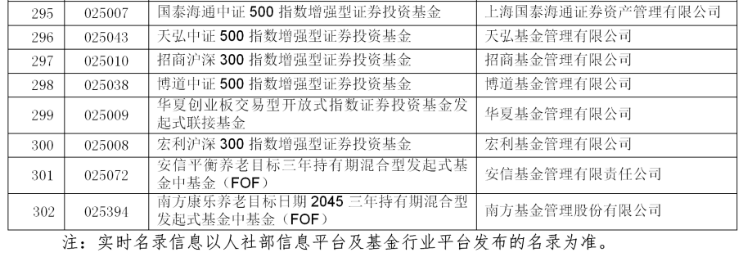
Core Insights - The latest update from the China Securities Regulatory Commission (CSRC) reveals an increase in the number of personal pension funds to 302, with 8 new products added, including 5 enhanced index funds, 2 funds of funds (FOFs), and 1 ETF linked fund [1][2]. Fund Expansion - The expansion of personal pension funds reflects a "precise adaptation" characteristic, with the new products focusing on large-cap indices such as the CSI 500 and CSI 300, which are seen as stable and suitable for long-term pension investments [2][3]. - The newly added funds include: - Guotai Haitong CSI 500 Enhanced Index Fund - Tianhong CSI 500 Enhanced Index Fund - CMB CSI 300 Enhanced Index Fund - Bodao CSI 500 Enhanced Index Fund - Huaxia ChiNext ETF Linked Fund - Manulife CSI 300 Enhanced Index Fund - Anxin Balanced Pension Target Fund of Funds - Southern Happy Pension Target Date 2045 Fund of Funds [2][3]. Performance and Growth - The performance of personal pension funds has been strong, with only 1 out of 302 funds showing negative returns year-to-date, while the average net asset value increased by 15.13% [5][6]. - Notable performers include Tianhong CSI Sci-Tech Innovation 50 ETF Linked Fund, which leads with a 46.37% year-to-date increase, followed by several other funds with returns exceeding 40% [5][6]. - Over 98% of personal pension funds have positive returns since inception, with nearly 20% of products achieving over 20% net value growth [6]. Market Recognition - The total scale of personal pension funds reached 124.05 billion yuan by the end of Q2, marking a 35.7% increase from the previous year, with the number of products growing by 10.27% [7]. - The first batch of personal pension index funds has seen its total scale exceed 1.5 billion yuan within just six months, indicating a significant increase in investor recognition and acceptance of these products [7].
指数基金波动这么大,真的能养老吗?
Sou Hu Cai Jing· 2025-10-17 10:37
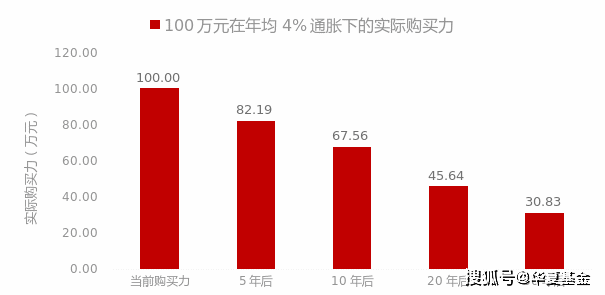
Core Insights - The article highlights the misconception that "stability" equates to "zero volatility," leading investors to allocate retirement funds into low-risk savings, which ultimately exposes them to hidden risks of purchasing power erosion [1] - It emphasizes the importance of achieving a long-term annualized return of at least 4%-5% to counteract inflation, despite the current low interest rate environment posing challenges [3] Group 1: Inflation and Purchasing Power - The "real inflation rate" indicator, derived from the difference between M2 money supply growth and GDP growth, reveals the reality of monetary overexpansion, with China's real inflation rate fluctuating between 0.4% and 8.7% from 2014 to 2025, with median and average values at 4.3% and 4.0% respectively [1] - Assuming a moderate inflation rate of 4%, the actual purchasing power of 1 million yuan will decrease to approximately 330,000 yuan over 30 years, indicating that relying solely on low-risk savings products will struggle to withstand this gradual erosion [1] Group 2: Asset Allocation Trends - In response to the low interest rate environment, many countries have adjusted their pension asset allocations, with the National Pension Service of Korea allocating 43.5% to equity assets and Japan's GPIF increasing its equity asset target allocation from 20% in 2006 to 50% in 2020, with over 90% of investments being passive [3] Group 3: Investment Strategies in Equity Assets - Investing in broad-based index funds can achieve long-term profitability by capitalizing on market fluctuations through buying low and selling high, as illustrated by the "smile curve" in systematic investment plans [7] - Broad-based indices represent a basket of quality listed companies, which benefit from national economic growth, ensuring that these representative industry leaders will appreciate over time [8] - Dividend income from core broad-based indices provides cash flow and compounding benefits, as stable companies tend to distribute profits as dividends, which can be reinvested to enhance overall returns [10] Group 4: Historical Performance of Indices - Historical performance data shows significant returns for various indices from 2004 to 2025, with the CSI A500 index achieving a total return of 592.97% when considering reinvested dividends [11]
泰康基金持续举办“金融知识进社区”健康财富知识竞赛活动 助力居民守护钱袋子
Xin Lang Ji Jin· 2025-10-17 02:45
Core Points - The event "Financial Knowledge into Communities" aims to enhance financial literacy and fraud prevention awareness among community residents [3][7] - The competition is part of the "New Era, New Fund, New Value" initiative to promote high-quality development in the public fund industry [7][9] Group 1: Event Overview - The competition is organized by Taikang Fund in collaboration with several financial institutions, including Harvest Fund and Postal Savings Fund [1][3] - The event consists of preliminary and final rounds, with the preliminary round in the Shaoyaoju area featuring 16 community residents forming 4 representative teams [3][5] Group 2: Competition Structure - The competition includes mandatory questions, quick-answer questions, and risk-related questions covering topics such as financial knowledge, fraud prevention, and retirement investment [5] - A "help" segment is included where staff from Taikang Fund and Guolian Fund provide guidance and explanations to enhance participants' understanding of financial concepts [5] Group 3: Objectives and Future Plans - The initiative aims to disseminate professional financial knowledge to ordinary investors, improve financial investment knowledge, and enhance risk awareness among the public [7] - Future activities will focus on more diverse content and formats to further promote financial literacy and support families in safeguarding their financial well-being [9]