
南下资金

Search documents

南下资金连续第4日净买入港股超百亿港元,加仓小米、腾讯和美团
Xin Lang Cai Jing· 2025-08-01 10:10
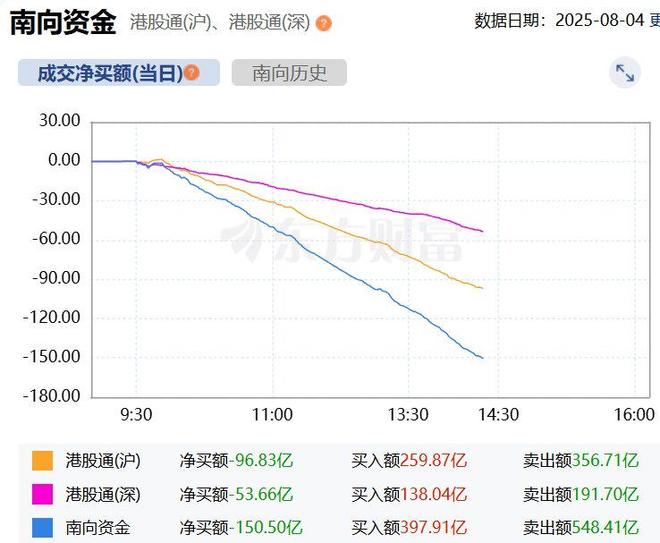
南下资金今日净买入122.07亿港元,为连续第四日净买入额超百亿港元。其中:净买入盈富基金37.44 亿、恒生中国企业17.2亿、小米集团-W 10.99亿、南方恒生科技8.55亿、腾讯控股8.36亿、美团-W 7.66 亿、英诺赛科3.63亿、石药集团2.52亿、快手-W 2.02亿;净卖出信达生物4.02亿、阿里巴巴-W 2.02亿、 中芯国际1.77亿。据统计,南下资金已连续7日净买入腾讯,共计35.42亿港元;连续6日净买入小米,共 计41.35亿港元;连续3日净买入美团,共计26.12亿港元。 ...

南下资金今年以来净流入金额创历史新高
Xin Lang Cai Jing· 2025-07-29 22:36
Core Viewpoint - Southbound capital has significantly increased its investment in the Hong Kong stock market this year, marking it as the largest source of incremental funds for the market in 2023 [1] Group 1 - As of July 29, 2023, the cumulative net inflow of southbound capital has exceeded 840 billion HKD, setting a new historical high for annual net inflows [1] - The net inflow for 2023 has already surpassed the previous record of 807.87 billion HKD for the entire year of 2024 [1]
年内南下资金净买入8420亿港元 净买入额刷新历史纪录,配置重心逐步向创新药和大消费倾斜
Shen Zhen Shang Bao· 2025-07-29 17:22
【深圳商报讯】(记者钟国斌)今年以来,南下资金持续加仓港股。据数据统计,今年1月1日至7月29 日,南下资金净买入8420亿港元,超越2024年全年8079亿港元,刷新历史纪录。自开通以来,南下资金 累计净买入达45397.93亿港元。 业内人士指出,在今年港股市场"赚钱效应"明显增强的背景下,南下资金仅用7个月便完成对历史峰值 的突破,表明内地资金对港股市场的配置需求进入爆发式增长阶段。 值得注意的是,今年以来南下资金单日净流入超百亿港元的现象频繁出现。数据显示,今年以来的135 个交易日中,南下资金单日净流入超百亿港元的交易日有33天,占比24.44%。其中,有9个交易日南向 资金单日净流入超200亿港元,4月9日南下资金净买入港股355.86亿港元,为史上单日净买入最高金 额。 从净买入股票来看,近3个月,南下资金净买入前十名分别为美团-W、建设银行、盈富基金、中芯国 际、信达生物、中国移动、中国人寿、石药集团、比亚迪、众安在线,净买入金额介于358.72亿港元至 25.17亿港元之间。 记者统计发现,截至7月29日,南下资金持股比例超过10%的个股404只,南下资金持股比例超过30%的 个股139只, ...
港股通数据统计周报2024.2.12-2024.2.18-20250728
Zhe Shang Guo Ji Jin Rong Kong Gu· 2025-07-28 08:26
Group 1: Top Net Buy/Sell Companies - The top net buy company is China Life (2628.HK) with a net buy amount of 40.30 billion CNY, acquiring 177,142,212 shares[8] - The second highest net buy is China Construction Bank (0939.HK) with a net buy of 25.53 billion CNY, acquiring 307,628,796 shares[8] - The top net sell company is China Mobile (0941.HK) with a net sell amount of -29.03 billion CNY, selling 33,535,578 shares[9] Group 2: Industry Distribution of Net Buy/Sell - The financial sector shows significant net buying activity, led by China Life and China Construction Bank, indicating strong investor confidence in financial stocks[8][9] - The technology sector, represented by Kuaishou (1024.HK) and SMIC (0981.HK), also sees substantial net buying, with Kuaishou netting 19.03 billion CNY[8] - Conversely, the telecommunications sector, particularly China Mobile, experienced notable net selling, reflecting potential investor concerns in this area[9] Group 3: Active Stocks - The most active stock in the Shanghai-Hong Kong Stock Connect is the盈富基金 (2800.HK) with a total trading volume of 49.37 billion CNY and a net buy of 49.02 billion CNY[18] - SMIC (0981.HK) is also among the top active stocks with a trading volume of 40.80 billion CNY but a net sell of -6.84 billion CNY, indicating volatility[18] - Tencent Holdings (0700.HK) shows significant trading activity with a total volume of 22.47 billion CNY and a net buy of 2.48 billion CNY, suggesting ongoing interest[18]
港股通数据统计周报2024.2.12-2024.2.18-20250716
Zhe Shang Guo Ji Jin Rong Kong Gu· 2025-07-16 00:02
Group 1: Top Net Buy/Sell Companies - Meituan-W (3690.HK) had the highest net buy amount of ¥34.74 billion with a holding change of 28,948,209 shares[8] - Alibaba-W (9988.HK) recorded the largest net sell amount of -¥20.13 billion with a holding change of -19,157,265 shares[9] - Construction Bank (0939.HK) saw a net buy of ¥26.31 billion, ranking second in net buys[8] Group 2: Industry Distribution - The financial sector was prominent in net buys, with Construction Bank and ZhongAn Online contributing significantly[8] - The consumer discretionary sector, led by Meituan-W and Li Auto-W, also showed strong net buying activity[8] - In net sells, the financial sector, including Alibaba-W and China Merchants Bank, dominated the list[9] Group 3: Active Stocks - Guotai Junan International (1788.HK) was the most active stock in the Shanghai-Hong Kong Stock Connect with a total trading volume of ¥103.99 billion[19] - Alibaba-W (9988.HK) had a significant trading volume of ¥37.09 billion but recorded a net sell of -¥9.13 billion[19] - Meituan-W (3690.HK) was also active with a trading volume of ¥23.18 billion and a net buy of ¥4.02 billion[19]
金融工程定期:港股量化:南下资金累计流入达2024年91%,7月增配成长
KAIYUAN SECURITIES· 2025-07-02 12:15
- Model Name: Hong Kong Stock Selection 20 Portfolio; Model Construction Idea: The model selects the top 20 stocks with the highest scores based on four types of factors (technical, capital, fundamental, and analyst expectations) from the Hong Kong Stock Connect sample stocks and constructs an equal-weighted portfolio at the end of each month; Model Construction Process: The model uses the Hong Kong Composite Index (HKD) (930930.CSI) as the benchmark. The specific construction process involves selecting the top 20 stocks with the highest scores based on the four types of factors and constructing an equal-weighted portfolio at the end of each month[3][37][39]; Model Evaluation: The model has shown excellent performance in the Hong Kong Stock Connect sample stocks[37] - Factor Name: Technical Factors; Factor Construction Idea: Technical factors are constructed based on the price and volume data of stocks; Factor Construction Process: The specific construction process involves calculating various technical indicators such as moving averages, relative strength index (RSI), and moving average convergence divergence (MACD) to evaluate the stock's price trend and momentum[37][38]; Factor Evaluation: Technical factors have shown good performance in the Hong Kong Stock Connect sample stocks[37] - Factor Name: Capital Factors; Factor Construction Idea: Capital factors are constructed based on the capital flow data of stocks; Factor Construction Process: The specific construction process involves calculating the net capital inflow and outflow of stocks to evaluate the stock's capital flow trend[37][38]; Factor Evaluation: Capital factors have shown good performance in the Hong Kong Stock Connect sample stocks[37] - Factor Name: Fundamental Factors; Factor Construction Idea: Fundamental factors are constructed based on the financial data of stocks; Factor Construction Process: The specific construction process involves calculating various financial ratios such as price-to-earnings (P/E) ratio, return on equity (ROE), and total market value to evaluate the stock's financial health and valuation[37][38]; Factor Evaluation: Fundamental factors have shown good performance in the Hong Kong Stock Connect sample stocks[37] - Factor Name: Analyst Expectation Factors; Factor Construction Idea: Analyst expectation factors are constructed based on the analyst ratings and target prices of stocks; Factor Construction Process: The specific construction process involves collecting and analyzing the analyst ratings and target prices of stocks to evaluate the stock's future performance expectations[37][38]; Factor Evaluation: Analyst expectation factors have shown good performance in the Hong Kong Stock Connect sample stocks[37] Model Backtest Results - Hong Kong Stock Selection 20 Portfolio, Annualized Excess Return: 13.3%, Excess Return Volatility Ratio: 1.0[4][40][41] Factor Backtest Results - Southbound Capital, Average Return: 25.7%[32][36] - Foreign Capital, Average Return: 13.5%[32][36] - Domestic Capital, Average Return: 14.0%[32][36] - Hong Kong Capital and Others, Average Return: 10.2%[32][36]
港股通数据统计周报2024.2.12-2024.2.18-20250623
Zhe Shang Guo Ji Jin Rong Kong Gu· 2025-06-23 08:50
Group 1: Top Net Buy/Sell Companies - The top net buy company is China Construction Bank (0939.HK) with a net buy amount of 34.80 billion CNY, increasing holdings by 450,164,470 shares[8] - Meituan-W (3690.HK) ranks second with a net buy of 24.87 billion CNY, with 19,338,868 shares added[8] - Tencent Holdings (0700.HK) is the top net sell company, with a net sell amount of -48.10 billion CNY, reducing holdings by 9,515,111 shares[9] Group 2: Industry Distribution of Net Buy/Sell - Financial sector shows significant net buying, led by China Construction Bank and China Life Insurance, indicating strong investor confidence in financial stocks[8][9] - The technology sector, represented by Tencent and Xiaomi, experienced substantial net selling, reflecting potential investor concerns about growth prospects in this industry[9] - The consumer discretionary sector, including Meituan and BYD, also saw mixed results with both net buying and selling activities, suggesting varied investor sentiment[8][9] Group 3: Active Stocks - The most active stock in the Shanghai-Hong Kong Stock Connect is Pop Mart (9992.HK) with a total trading volume of 40.19 billion CNY and a net sell of -6.40 billion CNY[18] - In the Shenzhen-Hong Kong Stock Connect, Meituan (3690.HK) had a trading volume of 34.09 billion CNY with a net sell of -4.31 billion CNY[19] - The trading activity indicates high volatility in these stocks, with significant fluctuations in net buying and selling over the week[18][19]
谁在买港股新消费和创新药?
2025-06-18 00:54
Summary of Conference Call Records Industry or Company Involved - The records focus on the Hong Kong stock market, specifically the new consumption and innovative pharmaceutical sectors. Core Points and Arguments - **Capital Inflows**: Southbound funds have been the primary driver of the rise in the new consumption and innovative pharmaceutical sectors. From April 8 to June 9, net inflows into the innovative pharmaceutical sector exceeded 28.8 billion HKD, while the new consumption sector saw net inflows of over 6.3 billion HKD. In contrast, international intermediaries (foreign capital) experienced a net outflow of 22.6 billion HKD during the same period [1][3]. - **Year-to-Date Performance**: As of mid-June, southbound funds have contributed over 55 billion HKD to the innovative pharmaceutical sector and over 18 billion HKD to the new consumption sector. Cumulatively, over 660 billion HKD has flowed into the Hong Kong stock market through southbound trading, marking it as a significant support for the market [5][7]. - **Market Trends**: The Hong Kong stock market has entered a technical bull market since the low on April 7, with the new consumption and innovative pharmaceutical sectors averaging over a 50% increase from April 7 to June 11, outperforming other sectors [2][9]. - **Investment Strategies**: Southbound funds typically follow a right-side trend-following strategy, while foreign capital tends to buy in early and take profits at market peaks. For instance, during the period from February 20 to March 7, the new consumption sector rose over 20%, with foreign capital buying 3.6 billion HKD while southbound funds reduced their positions by 300 million HKD [6][11]. Other Important but Possibly Overlooked Content - **Sector Performance**: The sectors with the most significant capital increases included software services, pharmaceutical research and biotechnology, automotive, professional retail, and industrial engineering. Conversely, sectors that saw the most reductions included banking, other financial services, oil and gas, insurance, and general metals and minerals [4][10]. - **Differentiation of Capital Types**: The most impactful capital this year has been from southbound funds, which have consistently shown net inflows, contrasting with the lack of significant foreign capital return. Despite some inflows earlier in the year, foreign capital has generally been in a state of outflow since March [8][9]. - **Individual Stock Strategies**: Southbound funds have adopted a "barbell" strategy, significantly increasing positions in growth stocks like Meituan and Alibaba while also investing in high-dividend stocks such as China Construction Bank and China Mobile. They have reduced holdings in Tencent, Xiaomi, and other stocks [11][12][13].
南下资金年内买卖总额达11.52万亿港元,已超去年全年
news flash· 2025-06-17 08:46
Group 1 - The total trading volume of southbound funds has reached 11.52 trillion HKD this year, surpassing the total for the entire year of 2024, which was 11.23 trillion HKD [1] - The trading volume for Shanghai Stock Connect is 7.13 trillion HKD, while Shenzhen Stock Connect is 4.39 trillion HKD, contributing to the overall total [1] - The net buying amount for Shanghai Stock Connect is 493.1 billion HKD, and for Shenzhen Stock Connect, it is 193.9 billion HKD, both significantly exceeding the levels from the same period last year [1]