
数智融合

Search documents
虚拟拍摄、AI创作成为必备技能 虎鲸文娱系统培养“技术+艺术”型人才
Sou Hu Cai Jing· 2025-10-29 00:47
Core Insights - The cultivation of talent in the film and television industry is crucial for its development, as there is a shortage of top creators and industry veterans are struggling to keep up with technological advancements [1][2] Group 1: Industry Challenges - The Chinese film and television industry is undergoing profound changes, with short videos dominating user attention and traditional long-form content facing significant challenges [2] - The lack of talent is identified as a key constraint on industry upgrades, necessitating innovative breakthroughs in talent development [2] - The industry requires professionals who can integrate creative and operational capabilities, as well as those who can navigate the intersection of culture and technology [2][5] Group 2: Talent Development Initiatives - Tiger Whale Entertainment Group is exploring a new model centered on talent, culture, and technology to systematically cultivate hybrid talents that combine technical and artistic skills [1][5] - The "Spring Seed Screenwriter Program" aims to discover and nurture new talent by providing comprehensive support, including funding and mentorship [5] - The "Haina International Young Director Development Program" seeks to find young directors with both local and international perspectives, offering various forms of support [6] Group 3: Technological Integration - New technologies are reshaping content creation and necessitating a rethinking of talent training logic, with a focus on how technology can enhance artistic expression [9][13] - Tiger Whale's digital production initiatives, such as the use of virtual shooting technology, have significantly improved production efficiency and expanded creative possibilities [11][13] - The integration of AI in the filmmaking process is being explored to streamline various stages from pre-production to post-production [13] Group 4: Regional Collaboration - Cross-regional cooperation is becoming essential for breaking down resource barriers and stimulating creative vitality, with successful examples emerging from collaborations between mainland China and Hong Kong [14][16] - The success of "News Queen" exemplifies the benefits of regional collaboration, blending distinct narrative styles to appeal to a broader audience [16][19]

中国联通扣非增速10.9%领跑同行 新引擎发力算力业务实现规模突破
Chang Jiang Shang Bao· 2025-10-24 00:08
Core Insights - China Unicom's operating performance continues to show steady growth, with a revenue of 292.985 billion yuan and a net profit of 8.772 billion yuan for the first three quarters of 2025, reflecting a year-on-year growth of 1% and 5.2% respectively [2][3] - Despite a slowdown in growth rates compared to the same period in 2024, China Unicom's net profit growth remains the fastest among the three major telecom operators, with a significant acceleration in its non-recurring net profit growth of 10.9% [2][4] Financial Performance - For the first three quarters of 2025, China Unicom's revenue and net profit growth rates have slowed compared to 2024, where the revenue was 290.123 billion yuan and net profit was 8.338 billion yuan, showing growth rates of 2.99% and 10.04% respectively [3][4] - The non-recurring profit for China Unicom was 1.149 billion yuan, down from 1.462 billion yuan in the previous year, while the non-recurring net profit reached 7.623 billion yuan, marking a 10.9% increase from 6.876 billion yuan in the previous year [4][5] Research and Development - China Unicom increased its R&D investment to 5.761 billion yuan, a growth of 5.9% year-on-year, continuing a trend of rising R&D expenditures over the past few years [2][9] - The company is focusing on next-generation internet technologies, big data, artificial intelligence, and other key areas, enhancing its capabilities in 6G, low-altitude smart networks, satellite internet, and quantum technology [8][9] Market Position and Strategy - The traditional telecom market is nearing saturation, with a slowdown in user growth for mobile and broadband services, prompting the need for digitalization and innovative business models to drive growth [4][7] - China Unicom's mobile user base reached 356 million, with a net increase of 12.48 million users, while its broadband user base grew to 129 million, with a net increase of 6.79 million users [7] - The company is also expanding its cloud services, reporting a revenue of 52.9 billion yuan from cloud services and 21.4 billion yuan from data centers, reflecting an 8.9% year-on-year increase [7][8] Financial Health - As of September 30, 2025, China Unicom's debt-to-asset ratio improved to 43.45%, a decrease of 1.74 percentage points from the end of 2024, indicating a strengthening financial position [2][9] - The company reported a net operating cash flow of 58.363 billion yuan for the first three quarters of 2025, showing slight growth compared to the previous year, and maintained a strong cash position with 52.075 billion yuan in cash compared to 16.244 billion yuan in interest-bearing debt [9][10]


中国联通前三季度净赚200亿,净利润增速超营收
Zhong Guo Jing Ying Bao· 2025-10-23 02:08
Core Insights - China Unicom reported a net profit of 20 billion RMB for the first three quarters of 2025, reflecting a significant year-on-year increase of 5.1% [1][2] - The company's operating revenue reached 293 billion RMB, showing a modest growth of 1.0% year-on-year, with service revenue accounting for over 90% of total revenue [1][2] Financial Performance - Net profit attributable to equity holders increased to 20 billion RMB, with a pre-tax profit rising to 24.7 billion RMB, indicating enhanced profitability [1] - Service revenue grew to 261.6 billion RMB, marking a 1.1% increase year-on-year [1] User Growth - The total number of mobile users reached 356 million, with a net addition of 12.48 million users [1] - Fixed broadband users increased to 129 million, with a net addition of 6.79 million users, achieving the highest net growth in recent years [1] - The number of IoT connections surpassed 700 million [1] Business Structure and Growth Areas - The cloud and data center business segments emerged as key growth drivers, with cloud revenue reaching 52.9 billion RMB and data center revenue increasing by 8.9% to 21.4 billion RMB [2] - The company is focusing on deepening the integration of 5G, AI, and industrial internet, serving over 20,000 customers with 5G virtual private networks [2]

净利润增速跑赢营收 中国联通前三季度净赚200亿
Zhong Guo Jing Ying Bao· 2025-10-22 13:28
Core Insights - China Unicom reported a revenue of 293 billion yuan for the first three quarters of 2025, reflecting a year-on-year increase of 1.0% [1] - Service revenue reached 261.6 billion yuan, up 1.1% year-on-year, accounting for over 90% of total revenue, indicating an ongoing optimization of the business structure [1] - The company achieved a net profit attributable to equity holders of 20 billion yuan, a significant increase of 5.1% year-on-year, with pre-tax profit rising to 24.7 billion yuan, showcasing enhanced profitability [1] Business Performance - As of the first three quarters of 2025, China Unicom's mobile user base reached 356 million, with a net increase of 12.48 million users; fixed broadband users totaled 129 million, with a net increase of 6.79 million users, marking the highest net increase in recent years [1] - The number of IoT connections surpassed 700 million, and the average revenue per user (ARPU) for bundled packages remained above 100 yuan [1] Growth Drivers - The company's cloud and data center services continued to be growth highlights, with cloud revenue reaching 52.9 billion yuan and data center revenue increasing by 8.9% year-on-year to 21.4 billion yuan [1] - China Unicom is focusing on deepening the integration of 5G, AI, and industrial internet to empower various industries, with over 20,000 customers served by its 5G virtual private network [1] - The management has indicated a commitment to advancing "fusion innovation" and increasing investments in cloud networks, industry digitization, and 5G+ industrial internet to cultivate new revenue and profit growth points [2]
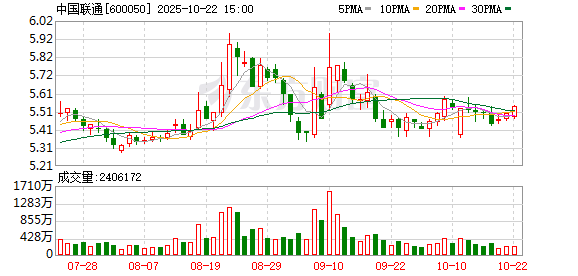
中国联通:前三季度归母净利润同比增长5.2%
Xin Lang Cai Jing· 2025-10-22 11:44
Core Insights - China Unicom reported a revenue of 292.985 billion yuan for the first three quarters of 2025, reflecting a year-on-year increase of 1.0% [1] - The net profit attributable to shareholders for the same period was 8.772 billion yuan, up 5.2% year-on-year [1] - In Q3, the company achieved a revenue of 92.783 billion yuan, showing no growth compared to the previous year, while the net profit attributable to shareholders was 2.423 billion yuan, marking a 5.4% increase year-on-year [1] Financial Performance - Total revenue for the first three quarters reached 292.985 billion yuan, with a 1.0% increase year-on-year [1] - Net profit attributable to shareholders was 8.772 billion yuan, representing a 5.2% year-on-year growth [1] - Q3 revenue stood at 92.783 billion yuan, with a year-on-year growth rate of 0.0% [1] - Q3 net profit attributable to shareholders was 2.423 billion yuan, reflecting a 5.4% increase year-on-year [1] Business Segments - The company's computing power business achieved a significant scale breakthrough, with cloud revenue reaching 52.9 billion yuan [1] - Revenue from data centers was 21.4 billion yuan, showing an 8.9% year-on-year increase [1] - The company is focusing on deepening the integration of digital intelligence and real economy, promoting the combination of 5G, AI, and industrial internet to empower various industries [1] - The cumulative number of customers served by 5G virtual private networks exceeded 20,000 [1]
在数智融合中 做强服务型制造
Zheng Quan Shi Bao· 2025-10-13 23:28
Core Viewpoint - The "Implementation Plan" aims to promote service-oriented manufacturing innovation and development from 2025 to 2028, with specific targets for standard formulation, brand creation, and innovation hubs [1] Group 1: Policy Directions - The plan emphasizes three main policy directions: enhancing R&D for key common technologies in service-oriented manufacturing, encouraging enterprises to increase innovation investment, and promoting the application of research results in key scenarios [2][3] - It encourages the establishment of stable collaborative relationships among leading enterprises and their supply chains, while also supporting the digital transformation of small and medium-sized enterprises [3] Group 2: Technological Integration - The plan highlights the importance of integrating digital intelligence and physical manufacturing, advocating for the construction of new information infrastructure and the application of AI technologies in service-oriented manufacturing [3][4] - It calls for the development of high-quality industry data sets and the enhancement of network and data security capabilities [3] Group 3: Global Manufacturing Trends - The global manufacturing sector is shifting from merely providing products to offering a combination of products and services, with service-oriented manufacturing being a key to enhancing value and competitiveness [4] - The implementation of this plan is seen as a roadmap for Chinese manufacturing to ascend the value chain and improve its global competitiveness [4]
【发展之道】 在数智融合中做强服务型制造
Zheng Quan Shi Bao· 2025-10-13 21:03
Core Viewpoint - The implementation plan aims to promote service-oriented manufacturing innovation and development from 2025 to 2028, with specific targets for standard formulation, brand creation, and innovation hubs [1][4]. Group 1: Policy Directions - The plan emphasizes three main policy directions: enhancing R&D for key common technologies, encouraging increased innovation investment by enterprises, and promoting the application of research outcomes in key scenarios [2][3]. - It encourages the establishment of a technology list for service-oriented manufacturing and supports enterprises in addressing common technology challenges [2]. Group 2: Role of Enterprises - Enterprises are identified as the core entities for developing service-oriented manufacturing, with a focus on fostering collaboration along the supply chain and supporting the digital transformation of small and medium-sized enterprises [3]. - The plan encourages large enterprises to deepen cooperation with small and medium-sized enterprises through open platforms and aims to cultivate specialized "little giant" companies and high-tech enterprises [3]. Group 3: Technological Integration - The plan highlights the importance of integrating digital and physical aspects, advocating for the construction of new information infrastructure and the application of AI technologies in service-oriented manufacturing [3]. - It calls for the enhancement of industrial data supply and the establishment of high-quality industry data sets to support innovation [3]. Group 4: Global Manufacturing Trends - The global manufacturing sector is undergoing a transformation from merely providing products to offering "products + services," with service-oriented manufacturing being a key to enhancing value and competitiveness [4]. - The implementation plan serves as a roadmap for Chinese manufacturing to ascend the value chain and improve global competitiveness [4].
中国移动杨杰:把握数智时代机遇 合创AI+时代
Ren Min Wang· 2025-10-11 06:22
Core Insights - The 2025 China Mobile Global Partner Conference was held in Guangzhou from October 10 to 12, with Chairman Yang Jie delivering a keynote speech titled "Carbon-Silicon Symbiosis: Co-creating the AI+ Era" [1][3] Group 1: Industry Development - This year marks the conclusion of the "14th Five-Year Plan," during which China's information and communication industry has accelerated the construction of intelligent and comprehensive digital information infrastructure, achieving "gigabit access in every county, 5G access in every town, and broadband access in every village" [4] - China Mobile has become the world's largest in terms of network scale, customer scale, and revenue scale, and is globally leading in innovation capability, brand value, market capitalization, and profitability [4] Group 2: AI and Digital Transformation - The company is focusing on the "5G+" development strategy, which includes 5G and 4G collaborative development, 5G and AI integration, and the establishment of a "dual-gigabit" network [4] - China Mobile aims to create over 50,000 applications for 5G, positioning it as a key driver for information flow, industrial transformation, and digital society construction [4] Group 3: Future Vision and Strategic Plans - Looking ahead to the "15th Five-Year Plan," China Mobile aims to become a world-class information service technology innovation company, leveraging opportunities in the digital age [6] - The company plans to upgrade its "AI+" action plan and "BASIC6" innovation program, focusing on becoming a provider, aggregator, and operator of AI solutions [6] Group 4: Key Areas of Focus - China Mobile will enhance digital infrastructure, strengthen AI capabilities, and promote the application of AI across various sectors [7] - The company emphasizes the importance of AI safety and governance, aiming to create a dynamic and collaborative AI governance framework [7] - Collaboration with global partners is a priority, with a focus on building an open ecosystem for AI development [7][8]

南大发布“中华古城数字图谱集成” 数智科技破解老城保护难题
Zhong Guo Jing Ji Wang· 2025-09-24 05:28
Core Insights - The article discusses the importance of protecting and utilizing ancient cities in China, highlighting the challenges in preserving their traditional features and historical context [1][2] - A significant initiative, the "Digital Atlas Integration of Chinese Ancient Cities," was launched by Nanjing University to leverage interdisciplinary digital technologies for the protection of ancient cities [1][2] Group 1: Project Overview - The project aims to create a digital platform for nearly 3,000 ancient cities, providing a historical geographic information system that illustrates the spatial changes of cities over the past century [1] - It includes a historical image compilation for about 500 ancient cities across four provinces, identifying the outlines of historical urban areas and analyzing urban features such as ancient streets and waterways [2] Group 2: Technological Integration - The initiative employs satellite imagery, GIS, image enhancement, and AI methods to address traditional preservation challenges systematically [2] - A digital restoration platform is being developed to reconstruct the appearance of typical ancient cities using drones, laser radar, and AI technology, generating multidimensional cultural maps [2] Group 3: Community Engagement - The project has launched the "Guardians of Ancient Cities" initiative to encourage public participation in cultural heritage preservation through mobile applications and QR code promotions [2] - The goal is to explore a "Chinese paradigm" for cultural transmission, contributing to the global heritage protection efforts with Eastern wisdom [2]
南大“中华古城数字图谱集成”工程在京发布
Xin Hua Ri Bao· 2025-09-23 23:45
Core Insights - The "Chinese Ancient City Digital Atlas Integration" project was launched by Nanjing University, aiming to empower ancient city preservation through interdisciplinary digital methods [1][2] - The project establishes a comprehensive historical image platform and a protection area identification platform, providing a "Chinese standard" and "Chinese solution" for global ancient city cultural resource protection [1] - The initiative includes a 3D multimodal database representing significant ancient cities, utilizing AI technology for gene identification and intelligent restoration [1] Summary by Sections - **Project Overview** - The project covers nearly all ancient cities in China, creating a historical image library that integrates geographic information [1] - It employs a "collect-intelligence-model" technical path for digital restoration and data management of ancient cities [1] - **Technological Implementation** - The project utilizes AI to identify cultural genes and conduct intelligent repairs, establishing a systematic evaluation system for ancient city protection [1] - It involves a comprehensive survey of nearly 3,000 ancient cities, collecting data from multiple dimensions including spatial and multimodal information [1] - **Social Engagement** - The project has initiated the "Ancient City Guardians" social practice activity, using small satellites and drones to develop a three-dimensional protection plan [2] - The project is currently collaborating with the National Cultural Heritage Administration for the fourth census of immovable cultural relics [2] - **Vision and Goals** - The project aims to explore a "Chinese paradigm" for the transmission of civilization, contributing Eastern wisdom to the protection of global historical heritage [2]