注册制

Search documents
国金证券保荐项目频现“业绩变脸” *ST天微IPO前净利激增百倍上市后掉头向下直到触发退市风险|科创板6周年
Xin Lang Zheng Quan· 2025-07-25 09:08
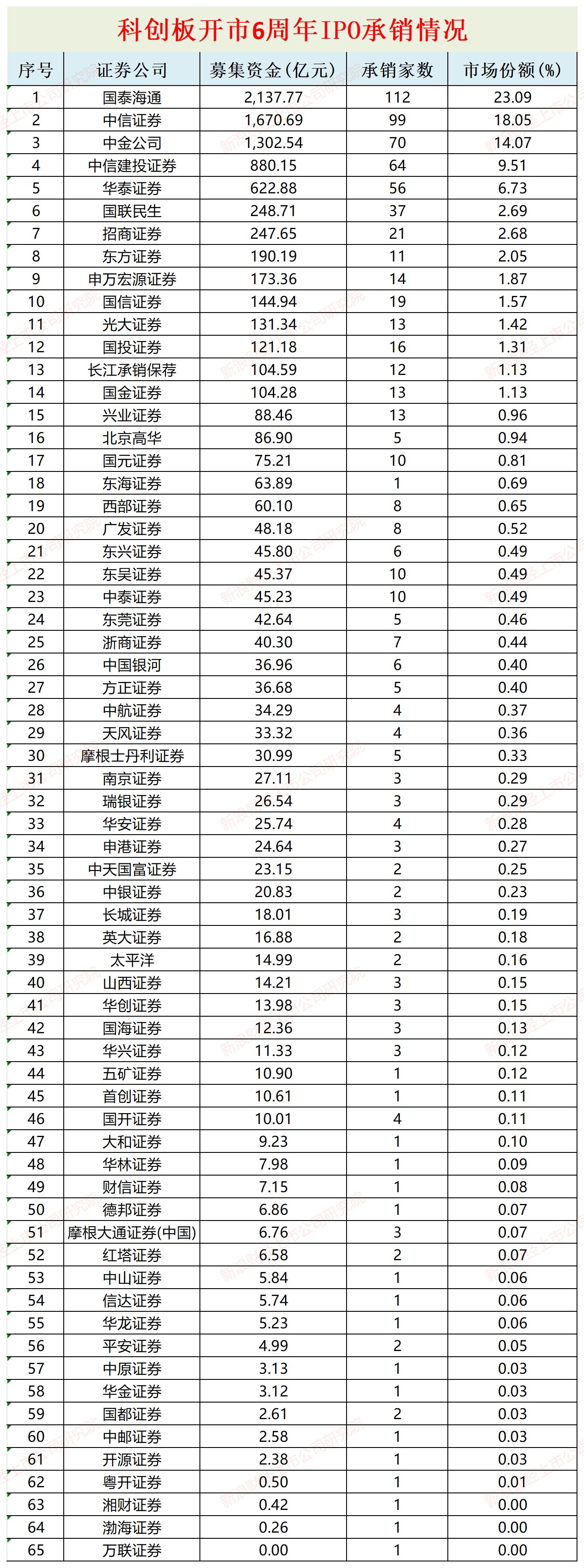
Group 1 - The Sci-Tech Innovation Board (STAR Market) was officially launched on July 22, 2019, marking the implementation of the registration system, with a total of 591 companies listed by July 22, 2025, including two that have been delisted [1] - The total funds raised through IPOs on the STAR Market amount to 927.156 billion yuan, with a total market capitalization exceeding 7 trillion yuan [1] - The STAR Market has significantly optimized the industry structure of the A-share market and serves as an important platform for tackling key core technologies under a new type of national system [1] Group 2 - Among the 591 companies listed on the STAR Market, two have been delisted, and three have been subjected to other risk warnings [5] - The underwriting situation shows that Guotai Junan and Haitong Securities lead with a total of 213.777 billion yuan raised through 112 underwriting cases [4][5] - CITIC Securities ranks second with 167.069 billion yuan raised through 99 underwriting cases, while China International Capital Corporation follows with 130.254 billion yuan from 70 cases [4][5] Group 3 - Guojin Securities has underwritten 13 STAR Market IPO projects over six years, with a total underwriting amount of 10.428 billion yuan, ranking 14th in the industry [5] - The company *ST Tianwei, which Guojin Securities sponsored, faced delisting risk due to a significant drop in revenue and net profit [5][6] - The financial performance of *ST Tianwei showed a drastic decline post-IPO, with revenue falling to 0.78 billion yuan in 2024, a year-on-year decrease of 44.65% [6][7] Group 4 - Six out of the 12 IPO projects sponsored by Guojin Securities experienced a decline in revenue or net profit in the year of listing, indicating potential issues with the performance of these companies [7] - The last IPO project sponsored by Guojin Securities, Jiuzhou Yitui, also reported a loss in its first year, raising concerns about the underwriting practices [7]


湖南大学股权与创业投资研究院院长刘健钧—— 加快完善创投体制 更好支持创业创新
Zheng Quan Shi Bao· 2025-07-24 18:25
Core Viewpoint - The current operation of the venture capital (VC) industry in China faces several challenges, including difficulties in fundraising, investment, exit strategies, and tax improvements. To address these issues, it is essential to enhance the VC system to better support entrepreneurship and innovation [1]. Fundraising Challenges - The capital introduction mechanism needs improvement to diversify long-term capital sources. This includes encouraging the development of mother funds, which should be fully market-oriented and attract high-net-worth individuals, insurance funds, and corporate idle funds [2]. - There is a need to distinguish between policy-oriented VC guiding funds and state-owned commercial mother funds to avoid overlapping functions and ensure that guiding funds focus on early-stage investments [2]. - Insurance funds should be allowed to operate in a market-oriented manner, with an initial focus on lower-risk investments before gradually moving to higher-risk early-stage investments. Additionally, an incentive and error-correction mechanism based on fund performance should be established for insurance institutions [2]. Investment Strategies - VC institutions should shift their focus from chasing potential IPO projects to identifying early-stage projects, particularly innovative ones during economic downturns. Policy-oriented guiding funds should emphasize early investments to naturally lead to long-term investments in technology [3]. - There should be minimal restrictions on industry selection, except for critical sectors, to provide sub-funds with the autonomy to choose their investments [3]. Exit Strategies - The exit process is crucial for maintaining a healthy cycle of fundraising, investment, management, and exit. The core of this process is to advance the registration system to facilitate multiple exit channels [3]. - A well-implemented registration system would create stable expectations for listing and financing for quality enterprises, allowing VC institutions to have predictable capital exit options through mergers or public offerings. This would also establish a fair price reference system for equity transactions [3].

一图速览|科创板开市六周年
证券时报· 2025-07-22 00:00
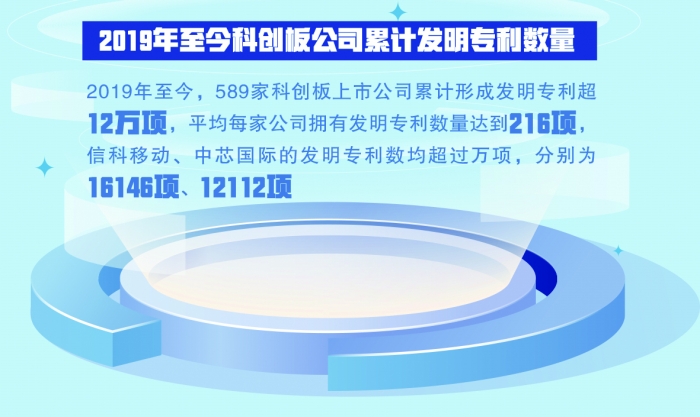
Core Viewpoint - The article highlights the six-year anniversary of the Sci-Tech Innovation Board (STAR Market), emphasizing its commitment to "hard technology" and its role as a "testing ground" for capital market reforms, showcasing significant growth and development in the sector since its inception in 2019 [1]. Group 1: Hard Technology Focus - The STAR Market supports high-tech industries such as new generation information technology, biomedicine, high-end equipment, new energy, new materials, and energy conservation and environmental protection [2][3]. - A total of 589 companies have been listed on the STAR Market, with a combined market capitalization exceeding 7 trillion yuan, and IPO fundraising reaching 925.7 billion yuan [3]. Group 2: Company Performance and Growth - From 2019 to 2024, the compound annual growth rate (CAGR) for operating revenue and net profit attributable to shareholders of STAR Market companies is projected to be 19% and 9%, respectively [8]. - The total R&D investment by STAR Market companies from 2019 to 2024 is expected to reach 709 billion yuan, with 2024 alone seeing an investment of 168.1 billion yuan, which is over three times the net profit for that year [10][12]. Group 3: Innovation and R&D Achievements - Over 30% of STAR Market companies have products or projects that are innovative within their industries, and more than 80% of core products aim for import substitution and self-control [13]. - STAR Market companies have collectively formed over 120,000 invention patents, averaging 216 patents per company, with some companies like SMIC and Xinke Mobile exceeding 10,000 patents [13]. Group 4: Investment and Market Dynamics - Approximately 90% of companies listed on the STAR Market received investment from venture capital institutions before going public, with an average investment of about 930 million yuan per company [24]. - Since the introduction of the "STAR Market Eight Articles" in June 2024, there have been over 110 new industry mergers and acquisitions, with disclosed transaction amounts exceeding 140 billion yuan [21]. Group 5: Shareholder Returns - From 2019 to 2024, the total annual dividends distributed by STAR Market companies reached 176.8 billion yuan, with over 60% of companies implementing annual cash dividend plans [27].
星耀科创板:从一块试验田到满园繁花
Shang Hai Zheng Quan Bao· 2025-07-21 19:58
Core Insights - The STAR Market has successfully transformed from a blueprint to reality, with 589 companies listed and significant contributions to innovation and capital markets [4][5] - Over 30% of STAR Market companies have pioneering products or projects, and more than 80% focus on import substitution and self-control [5] - The STAR Market has facilitated over 1.1 trillion yuan in equity financing, with over 60% of founding teams composed of scientists or engineers [5] - The STAR Market has become a model for reform in other markets, enhancing the legal framework and institutional improvements in capital markets [5][10] Company and Industry Developments - Junshi Biosciences, listed on the STAR Market, has raised over 8 billion yuan, accelerating the development of clinical and R&D projects, with its core products approved in over 35 countries [7][8] - The STAR Market has seen the launch of 20 innovative drugs since 2018, accounting for approximately 12% of all domestic innovative drugs approved during the same period [8] - The semiconductor industry on the STAR Market includes 120 companies, creating a complete and collaborative innovation ecosystem, enhancing the autonomy of the industry [10][11] - The STAR Market has significantly improved the financing environment for companies like Tuojing Technology, which achieved profitability in its first year post-IPO [9][11] Institutional Innovations - The STAR Market has established a multi-tiered and inclusive listing standard, allowing companies to go public even before achieving profitability [12][14] - Recent reforms include the introduction of a growth tier and the reactivation of the fifth set of listing standards, aimed at enhancing support for quality technology companies [17][18] - The STAR Market's ecosystem has been enhanced through precise institutional designs that facilitate the efficient flow and integration of technology, capital, and talent [16][17]
科创板开市六周年:以“新”为题 书写资本市场科创答卷
Zheng Quan Ri Bao· 2025-07-21 17:16
Core Insights - The establishment of the Sci-Tech Innovation Board (STAR Market) in Shanghai represents a significant institutional innovation aimed at enhancing China's multi-tiered capital market system and supporting technological innovation [1][2] - Over the past six years, the STAR Market has successfully nurtured nearly 600 "hard tech" companies, facilitating over 1.1 trillion yuan in financing and creating a positive cycle of technology breakthroughs, capital enhancement, and industrial growth [2][6] - The introduction of the "1+6" reform plan aims to further enhance the STAR Market's role in supporting technology innovation and new productivity by establishing a growth tier for companies and introducing professional institutional investors [8][11] Institutional Innovations - The STAR Market has implemented a registration-based system focusing on information disclosure, allowing unprofitable companies to go public and facilitating the return of red-chip companies [2][4] - Key innovations include streamlined financing conditions, optimized listing standards, and the introduction of a second type of restricted stock for equity incentives, enhancing flexibility and inclusivity [4][5] - The reforms have not only addressed the financing challenges faced by tech companies but have also contributed to the overall improvement of the capital market's legal framework [5][6] Financial Performance - As of now, the STAR Market has supported 589 companies in going public, raising a total of 925.7 billion yuan through IPOs and 191.7 billion yuan through refinancing, totaling over 1.1 trillion yuan [6][7] - The compound annual growth rates for revenue and net profit of STAR Market companies over the past five years are 19% and 9%, respectively, indicating sustained growth [7][8] - Notably, 22 out of 54 previously unprofitable companies have achieved profitability post-listing, showcasing the effectiveness of the STAR Market in nurturing potential [7] Future Outlook - The STAR Market is set to continue its role as a "testbed" for capital market reforms, focusing on the integration of capital and technology, and fostering new productivity [3][12] - The "1+6" reform plan is expected to enhance the adaptability of the capital market to the needs of tech companies throughout their lifecycle, particularly during their growth phases [9][10] - The introduction of professional institutional investors is anticipated to improve the market's ability to identify and support innovative companies, thereby enhancing the overall efficiency of capital allocation [10][14]
北交所明确申报前业务咨询注意事项
Zhong Guo Zheng Quan Bao· 2025-07-17 21:03
Core Insights - The Beijing Stock Exchange (BSE) has disclosed its listing review dynamics for the first half of 2025, indicating that 115 companies submitted applications, with 12 approved by the listing committee and 7 registered by the CSRC, resulting in 6 companies listed and raising 1.923 billion yuan [1] - The introduction of the new "National Nine Articles" has led to an increase in the awareness of responsibilities among issuers and intermediaries, with a rapid growth in pre-application business consultations [1][2] - The BSE aims to enhance the standardization and normalization of the pre-application consultation mechanism, focusing on the purpose, content, and discipline of consultations to ensure that companies' listing applications are based on their own compliance levels and the professional capabilities of intermediaries [1][2] Pre-Application Consultation Mechanism - The pre-application consultation is designed to eliminate information asymmetry and facilitate smoother listing applications for companies, allowing them to decide whether to seek consultation based on their circumstances and understanding of the rules [1] - The BSE emphasizes that engaging in pre-application consultations does not affect the submission of listing application documents and does not imply a substantive judgment or guarantee regarding the issuer's compliance with listing conditions [1][2] Focus on Genuine Issues - The BSE has clarified that the content of pre-application consultations should adhere to specific guidelines, focusing on significant issues related to industry policies, listing conditions, and information disclosure, while avoiding basic or common knowledge inquiries [2][3] - Issuers and intermediaries are encouraged to concentrate their consultation resources on resolving genuine issues to navigate the new regulatory environment effectively [3] Consultation Discipline and Supervision - The BSE has established clear rules for consultation discipline, requiring written communications to be conducted through the BSE's online communication system, with all communications recorded [3]
2025年7月11日,财联社报道证券业即将迎来全方面自律规则的修订或
Great Wall Securities· 2025-07-14 07:48
Investment Rating - The industry rating is "Outperform the Market" with expectations for the industry to perform better than the market over the next six months [21]. Core Insights - The report emphasizes the importance of self-regulation in the securities industry, highlighting the release of the "Implementation Opinions on Strengthening Self-Regulation and Promoting High-Quality Development of the Securities Industry" by the China Securities Association, which outlines 28 measures for future industry focus and tasks [1][2]. - The report indicates that with the advancement of the registration system, regulatory scrutiny on underwriting and sponsorship will intensify, aiming to protect the interests of investors, particularly small and medium-sized investors [3][4]. - The report suggests that long-term funds, such as social security and insurance funds, should play a more significant role in new stock pricing, addressing the imbalance between financing and investment [4]. Summary by Sections Regulatory Changes - The report discusses the need to refine self-regulatory rules for underwriting and sponsorship, including clearer standards for project selection, due diligence, and ongoing supervision [2]. - It highlights the importance of enhancing the quality of pricing reports and regulating underwriting fees to prevent unfair competition [2]. Market Trends - The report notes a significant increase in net profits for several securities firms, with some firms expecting profit growth exceeding 100% year-on-year [10]. - It mentions that the average daily trading volume for stock funds increased by 63.87% year-on-year in the first half of 2025, indicating a positive market trend [10]. Cross-Border Business - The report identifies cross-border business as a core strategic direction for securities firms, with leading firms achieving notable growth through global expansion and business innovation [9]. - It emphasizes that Hong Kong remains a strategic hub for Chinese securities firms, particularly in IPO sponsorship and underwriting [9]. Wealth Management and M&A - The report anticipates continued support for mergers and acquisitions, urging securities firms to invest more in this area to differentiate themselves [8]. - It also discusses the potential expansion of wealth management services and the need for compliance and risk management in this sector [8].
重磅文件出炉!影响33万证券从业者
中国基金报· 2025-07-11 12:00
Core Viewpoint - The article discusses the recent implementation opinions issued by the China Securities Association aimed at enhancing self-regulation and promoting high-quality development in the securities industry [1][3]. Summary by Sections Strengthening Self-Regulation and Administrative Supervision - The implementation opinions emphasize the need for collaboration between self-regulation and administrative supervision to support the deepening of the registration system [2][3]. Promoting High-Quality Development - The opinions outline a focus on risk prevention, strong regulation, and promoting high-quality development, with an emphasis on building first-class investment banks and institutions [3][5]. Guidelines for Development - Nine key areas are identified for guiding the development of the securities industry: 1. Establishing a long-term work mechanism for the construction of first-class investment banks and institutions [6]. 2. Encouraging securities companies to support the development of new productive forces and integrate this into their long-term strategies [6]. 3. Enhancing the comprehensive financial service capabilities of investment banks [6]. 4. Promoting the development of bond business and improving the quality of practice across various stages [6]. 5. Accelerating wealth management business development and supporting the transformation of investment advisory services [6]. 6. Advancing the construction of the over-the-counter market and ensuring compliance [6]. 7. Encouraging internationalization of securities companies and facilitating cross-border business [7]. 8. Strengthening investor rights protection and enhancing investor education [7]. 9. Improving management and training of industry personnel [7]. Enhancing Compliance and Risk Management - The opinions call for multiple measures to strengthen compliance and risk management, including improving risk monitoring and enhancing transparency in over-the-counter transactions [9]. Industry Culture and Social Responsibility - The implementation opinions stress the importance of industry culture and social responsibility, advocating for a positive social image and adherence to integrity and ethical practices [10]. Overall Impact - The opinions are seen as a design plan for industry transformation, aiming to shift securities firms from being mere financing intermediaries to value creators through differentiated development and technological empowerment [10].

不要猜了!A股继续创新高,情况却不同了
Sou Hu Cai Jing· 2025-07-10 05:37
Group 1 - The Shanghai Composite Index has surpassed 3500 points again, indicating a strong market performance, although 70% of stocks are declining, highlighting a structural market trend under the registration system [1][3] - The index is expected to continue rising, with a potential breakout above 3674 points leading to a short-term bull market, driven by rotation among heavyweight sectors [3][5] - The current market environment is characterized by institutional dominance, with retail investors struggling to compete against large funds, which now account for the majority of trading volume [5][7] Group 2 - The strategy recommended is index investing, as the belief in the index's upward trajectory remains strong, emphasizing the importance of adapting to the current institutional market dynamics [7] - The market is experiencing a shift from a retail-driven to an institution-driven landscape, necessitating a change in trading strategies to align with institutional behaviors [5][7] - The presence of large funds, including foreign and quantitative funds, has significantly altered the trading environment, making it increasingly challenging for individual investors to succeed [5][6]

宋志平、施卫东、李迅雷等联合推荐!揭秘上市公司“超级连接者”——董秘的核心价值!
Sou Hu Cai Jing· 2025-07-09 10:21
Group 1 - The role of the board secretary (董秘) is crucial in connecting companies with the capital market and ensuring compliance and governance [2][13] - The board secretary is a senior management position appointed by the board of directors, serving as the official liaison with the stock exchange [4][5] - Key responsibilities include ensuring accurate and timely information disclosure, managing investor relations, overseeing corporate governance, and participating in major capital operations [5][6] Group 2 - The value of a board secretary includes safeguarding compliance, enhancing corporate image, enabling growth through efficient capital operations, and supporting strategic decision-making [7][8][9][10] - A strong investor relationship can improve company transparency and market trust [8] - The board secretary's role is evolving with stricter regulations and increased demands for ESG compliance, requiring a broader skill set including legal, financial, strategic, and technological knowledge [12]