现代农业

Search documents
河北新河:平原农业求“新”记
Xin Hua She· 2025-09-16 13:56
Core Insights - Hebei Province's Xinhe County is transforming its traditional agriculture by addressing challenges such as small scale, low efficiency, and lack of brand recognition, showcasing modern agricultural development [1] Group 1: Technological Empowerment - The establishment of "5G smart micro-factories" in Xinhe County allows for precise control of environmental parameters, leading to significant yields and profits from crops like golden mushrooms [2] - The integration of IoT systems enables the cultivation of southern wild mushrooms in Xinhe, benefiting over 400 local households with an average income increase of 3,000 yuan per mu [3] Group 2: Scale Expansion - Family farms in Xinhe are expanding operations, with one farm managing over 2,000 mu of land and employing over 300 villagers for flower harvesting [4] - A major agricultural project by Sinochem Modern Agriculture in Xinhe plans to invest 52 million yuan to develop a 15,000 mu crop demonstration base, aiming for a yield increase of over 20% for corn through advanced irrigation systems [4] Group 3: Water System Connectivity - The implementation of a water system connectivity project, with an investment exceeding 500 million yuan, has improved irrigation conditions for 110,000 mu of farmland in Xinhe [5] - The introduction of lotus planting has turned previously disadvantageous land into a profitable venture, generating approximately 280,000 yuan annually for the village collective [5] Group 4: Economic Growth and Future Plans - Xinhe County is experiencing significant growth in disposable income, with urban and rural residents seeing increases of 5.3% and 7.1% respectively [6] - The county aims to explore new paths for modern agricultural development, focusing on project attraction and promoting the agricultural industry towards scale, standardization, and branding [6]
广东菜心大迁徙 种全国卖全国
Nan Fang Nong Cun Bao· 2025-09-16 08:05
Core Viewpoint - The article discusses the migration of Guangdong vegetable farmers to Ningxia, highlighting how they have transformed their lives and the agricultural landscape through the cultivation of Guangdong vegetable heart, which has become a staple in the Guangdong-Hong Kong-Macau Greater Bay Area [1]. Group 1: Migration and Transformation - The migration of farmers from Guizhou to Ningxia has led to the establishment of a significant vegetable heart industry, with a planting area of 270,000 acres and sales exceeding 3.6 billion yuan [34]. - The farmers, primarily from the impoverished Ma Mountain area, have improved their living standards, with many owning houses and cars, reflecting a dramatic shift from their previous economic conditions [46][54]. - The journey of these farmers, spanning over 1,700 kilometers from Guizhou to Ningxia, symbolizes their commitment to cultivating high-quality vegetables for consumers across China [42][44]. Group 2: Agricultural Practices and Economic Impact - The article emphasizes the evolution of agricultural practices, noting that modern technology, such as drones and machinery, has significantly reduced labor intensity while increasing productivity [100][96]. - The logistics of transporting vegetables have improved, with costs dropping from 25 yuan to 12 yuan per 30-kilogram box, and total costs decreasing from 100 yuan to 75 yuan, facilitating faster delivery to consumers [105][106]. - The success of the vegetable heart industry illustrates a broader trend of regional economic development, where the wealth generated in agriculture is being reinvested into local communities, creating a cycle of prosperity [70][88]. Group 3: Entrepreneurial Spirit and Future Prospects - The article highlights the entrepreneurial spirit among the second generation of farmers, who are increasingly taking leadership roles and starting their own businesses, contributing to the growth of the industry [74][81]. - The narrative of these farmers reflects a shift from mere survival to thriving, as they leverage their skills and experiences to create sustainable livelihoods [66][110]. - The ongoing development of the vegetable heart industry serves as a model for other regions, showcasing how agricultural innovation and hard work can lead to significant economic advancement [109][68].


中国—上海合作组织科技创新合作中心在青岛挂牌启动
Qi Lu Wan Bao Wang· 2025-09-04 05:46
Core Points - The China-Shanghai Cooperation Organization (SCO) Technology Innovation Cooperation Center was established in Qingdao, Shandong Province, on September 4, aiming to promote international technological cooperation and innovation [1][3][5] - The center will focus on various fields including biomedicine, high-end equipment, and modern efficient agriculture, with 10 key international cooperation projects initiated [3][5] - The center aims to create an open and mutually beneficial international innovation cooperation ecosystem, enhancing regional collaborative innovation and providing new momentum for the economic and social development of member countries [5][6] Summary by Categories Establishment and Purpose - The SCO Technology Innovation Cooperation Center is established to facilitate academic exchanges in the humanities and promote joint project selection [1][5] - It will encourage cross-border technology transfer and establish an international think tank for member countries to support international technological cooperation [5] Key Activities and Focus Areas - The center will host various events such as the China-SCO Technology Innovation Cooperation Conference, youth innovation and entrepreneurship competitions, and technology achievement exhibitions [5] - It will prioritize joint innovation in fields like artificial intelligence, digital economy, healthcare, modern agriculture, and climate change, promoting bilateral and multilateral joint research and development [5] Future Development - Qingdao aims to enhance the center's role in deepening technological exchanges and cooperation with SCO member countries and globally, striving to make it a high-level platform for international innovation [6]
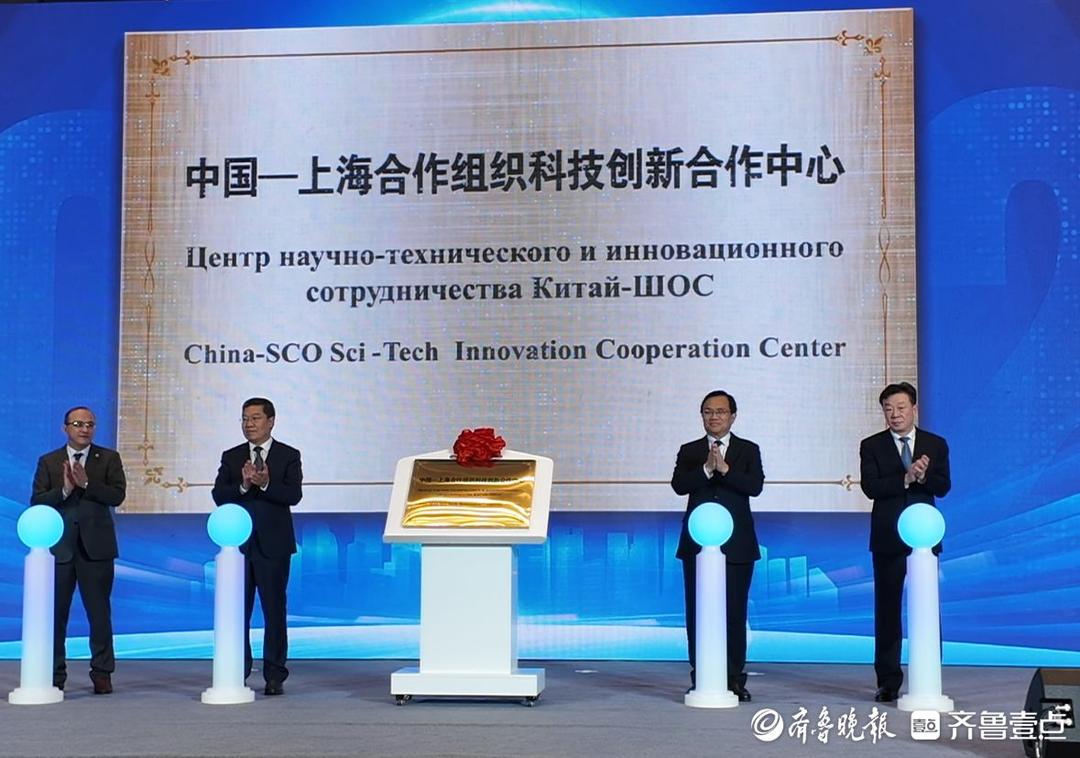
中国—上海合作组织科技创新合作中心在青岛挂牌成立
Yang Shi Xin Wen· 2025-09-04 01:09
Core Points - The China-Shanghai Cooperation Organization (SCO) Technology Innovation Cooperation Center was established in Qingdao, Shandong on the morning of the 4th, with 10 key international cooperation projects targeting SCO member countries launched simultaneously [1] - The center aims to promote regional collaborative innovation and build an open, inclusive, and mutually beneficial international innovation cooperation ecosystem, injecting new momentum into the economic and social development of member countries [1] Summary by Categories International Cooperation Projects - The launched projects cover various fields including biomedicine, high-end equipment, and modern efficient agriculture [1] - The center will focus on priority areas such as artificial intelligence, digital economy, healthcare, modern agriculture, and climate change, promoting joint innovation through bilateral and multilateral research and development [1] Innovation and Academic Exchange - The center will facilitate cultural and academic exchanges in the innovation field, actively hosting events like the China-SCO Technology Innovation Cooperation Conference, Youth Innovation and Entrepreneurship Competition, and technology achievement exhibitions [1] Technology Transfer and Support - The center encourages cross-border technology transfer and aims to establish an international technology transfer platform, enhancing services related to technology transfer management and intellectual property [1] - An international think tank for SCO member countries will be established, forming a think tank alliance to deepen exchanges on technology innovation policies and practical experiences, providing intellectual support for international technological cooperation [1]
中方介绍上合组织农业合作项目:推动地区国家现代农业共同发展
Zhong Guo Xin Wen Wang· 2025-08-31 02:53
Core Points - The article discusses the achievements of agricultural cooperation projects under the Shanghai Cooperation Organization (SCO), highlighting China's commitment to deepen agricultural collaboration with member countries [1][2]. Group 1: Agricultural Training and Projects - The agricultural technology training program in Pakistan aims to train 1,000 agricultural science personnel, with the first batch of 292 students completing their training and returning home [1]. - In Uzbekistan, a modern agricultural technology demonstration park and a water-saving demonstration park have been established, with Chinese experts providing technical services and promoting various agricultural technologies [1]. - The China-Kazakhstan agricultural cooperation project involves the establishment of a technology demonstration park for grain and oil crops, with an "order agriculture" planting area of 1.5 million acres, stabilizing farmers' income and grain purchase expectations [1]. Group 2: Future Cooperation - The SCO agricultural base aims for mutually beneficial cooperation, focusing on future-oriented projects to enhance the quality of life in the region [2]. - China plans to continue leveraging the SCO agricultural base to deepen various agricultural projects with more member countries, promoting modern agricultural development across the region [2].
外交部:中阿博览会已成为中阿共建“一带一路”的重要平台
Zhong Guo Xin Wen Wang· 2025-08-29 09:40
Core Points - The China-Arab Expo has become an important platform for the joint construction of the "Belt and Road" initiative since its establishment in 2013 [1] - The current expo focuses on themes of "innovation, green, and prosperity," covering hot areas such as digital economy, clean energy, artificial intelligence, modern agriculture, water resources, and smart meteorology [1] - The expo has introduced new activities in areas like China-Arab financial integration, "Silk Road e-commerce," meteorology, standardization, and intellectual property, adding new momentum to cooperation [1] - The second China-Arab summit will be held in China next year, with China expressing willingness to promote practical cooperation and develop a new chapter in China-Arab common development [1]
“宁”聚一堂看中阿|毛里塔尼亚驻华大使:毛中关系稳固发展造福人民
人民网-国际频道 原创稿· 2025-08-29 05:21
Group 1 - The seventh China-Arab States Expo opened in Yinchuan, focusing on practical economic cooperation between China and Arab countries, with participation from all 22 Arab countries and 31 Chinese provinces [3] - Mauritania's Ambassador to China, Abdellahi Vellali, praised the Expo's innovation and participation, emphasizing the importance of strengthening trade cooperation between Mauritania and China [3][4] - China announced a 100% zero-tariff policy on products from 53 African countries, which Vellali highlighted as a significant step to enhance trade and economic development for African nations, including Mauritania [3][4] Group 2 - The year 2024 marks the 60th anniversary of diplomatic relations between Mauritania and China, with significant cooperation achieved across various fields [4] - Mauritania actively participates in the Belt and Road Initiative, with multiple cooperation agreements expected to be signed during the Mauritanian President's visit to China in 2024, covering areas such as artificial intelligence, clean energy, and modern agriculture [4] - In 2024, trade between China and Arab countries reached $407.4 billion, a 2.3% increase year-on-year, with China maintaining its position as the largest trading partner of Arab countries [4] Group 3 - Mauritania, with over 80% of its territory covered by desert, has urgent needs in desertification control and development, seeking to learn from China's innovations and achievements in this area [5] - The collaboration between Mauritania and regions like Ningxia and Xinjiang in desertification control is aimed at adopting Chinese wisdom and experience [5] - China's practices in environmental quality improvement and green development provide a replicable model for combating desertification and promoting sustainable development in sub-Saharan Africa [5]

从田间到“指尖”:陕西渭南打造现代农业“智慧样板间”
Zhong Guo Xin Wen Wang· 2025-08-26 22:19
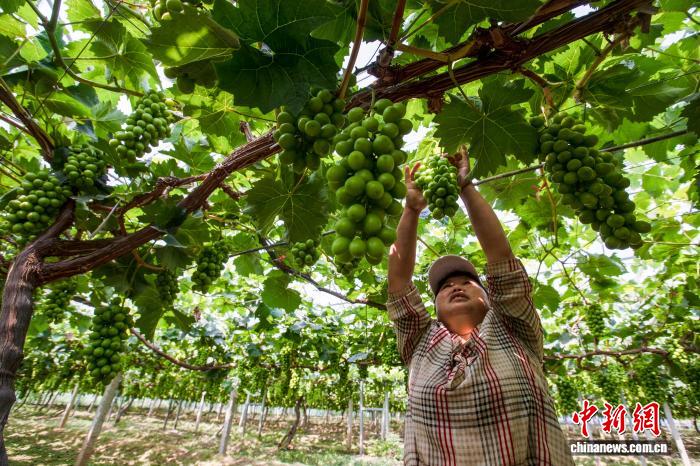
Group 1 - The core viewpoint of the article highlights the advancements in modern agriculture in Weinan, showcasing the successful cultivation and export of high-quality agricultural products like the Sunshine Rose grapes, which are now reaching international markets [1][3] - Weinan's unique natural conditions and innovative agricultural practices, including rain-sheltered cultivation and integrated water and fertilizer management, have contributed to the successful breeding of superior grape varieties [1][3] - The region has established 11 experimental stations in collaboration with research institutions to promote new apple varieties, indicating a strong focus on diversifying and enhancing the agricultural product portfolio [1][3] Group 2 - The introduction of the "Blue Hero" AI winter jujube harvesting robot has significantly improved harvesting efficiency, achieving an 85% success rate in fruit picking while reducing damage to less than 8% [3][5] - The smart greenhouse in Dali County utilizes automated systems for temperature and humidity control, demonstrating the integration of technology in agricultural production [5][7] - A full-service platform from production to sales has been established, with over 30 direct sales stores opened in Xi'an and Weinan, facilitating the distribution of agricultural products [5][7] Group 3 - The training program for farmers from Central Asia in Weinan aims to share advanced agricultural techniques, reflecting the region's commitment to agricultural education and international collaboration [5][7] - Participants from Kazakhstan and Uzbekistan expressed interest in applying the learned agricultural technologies back in their home countries, indicating the potential for knowledge transfer and regional agricultural development [7]
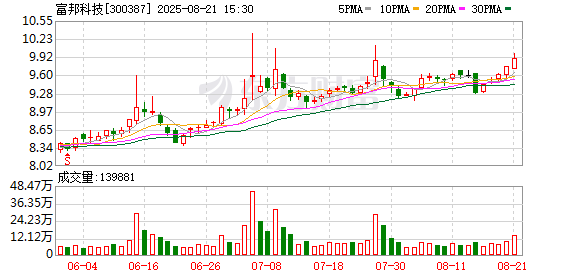
富邦科技2025年中报简析:增收不增利,公司应收账款体量较大
Zheng Quan Zhi Xing· 2025-08-22 23:19
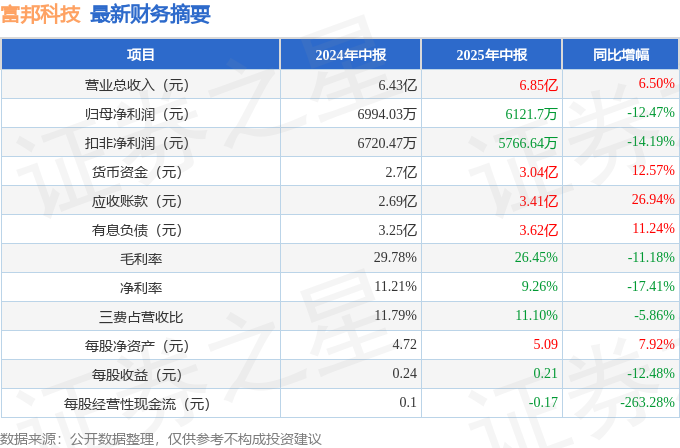
Core Viewpoint - Fubon Technology (300387) reported mixed financial results for the first half of 2025, with revenue growth but a decline in net profit, indicating potential challenges in profitability despite increased sales [1][3]. Financial Performance Summary - Total revenue for the first half of 2025 reached 685 million yuan, a year-on-year increase of 6.5% compared to 643 million yuan in 2024 [1]. - Net profit attributable to shareholders was 61.22 million yuan, down 12.47% from 69.94 million yuan in the previous year [1]. - The second quarter saw revenue of 380 million yuan, reflecting a 16.1% increase year-on-year, while net profit for the quarter was 38.09 million yuan, a decrease of 12.91% [1]. - Gross margin decreased to 26.45%, down 11.18% year-on-year, and net margin fell to 9.26%, down 17.41% [1]. - Total receivables increased significantly, reaching 341 million yuan, which is 364.42% of the latest annual net profit, indicating potential liquidity concerns [1][4]. Key Financial Metrics - Operating expenses (sales, management, and financial expenses) totaled 75.99 million yuan, accounting for 11.1% of revenue, a decrease of 5.86% year-on-year [1]. - Earnings per share (EPS) dropped to 0.21 yuan, down 12.48% from 0.24 yuan [1]. - Cash flow from operating activities showed a negative value of -0.17 yuan per share, a significant decline of 263.28% year-on-year [1]. Changes in Financial Items - Accounts receivable increased by 44.22% due to sales growth, while contract assets decreased by 60.37% due to reduced warranty deposits [3]. - Long-term borrowings rose by 50.9% as a result of increased bank loans [3]. - Cash and cash equivalents saw a net decrease of 353.3%, attributed to increased purchases of raw materials and financial products [3]. Business Evaluation - The company's return on invested capital (ROIC) was 6.16%, indicating average capital returns, with a historical median ROIC of 5.62% over the past decade [4]. - The company has established a robust research and development mechanism to ensure continuous investment and innovation in agricultural microbiology [5].

现代农业业务打开增长空间 富邦科技上半年实现营收6.85亿元
Zheng Quan Shi Bao Wang· 2025-08-21 14:15
Core Viewpoint - Fubon Technology (300387) reported a revenue of 685 million yuan for the first half of 2025, marking a year-on-year growth of 6.50%, with a net profit attributable to shareholders of 61.217 million yuan. The company's new business in modern agriculture showed significant performance, achieving a revenue of 122 million yuan, up 13.31% year-on-year [2]. Group 1: Business Performance - The overall modern agriculture market in China is expected to experience rapid growth, prompting the company to seize opportunities in biological and digital agriculture, launching products such as nitrogen-fixing agents, root-knot nematode control agents, and digital agriculture support services [2]. - The agricultural additive business, which primarily serves nitrogen, phosphorus, potassium, and compound fertilizer companies, generated a revenue of 496 million yuan, reflecting a year-on-year increase of 5.62%. The business was recognized as the "global leader in fertilizer additive sales" by a reputable international consulting firm [4]. Group 2: Market Potential - Longcheng Securities highlighted the significant market potential for nitrogen-fixing products, estimating a potential market space of approximately 28.935 billion yuan based on a unit price of 15 yuan per mu for the nitrogen-fixing products, with the national arable land area projected to be around 1.929 billion mu in 2024 [2]. - The biological nematicide market is projected to grow at a compound annual growth rate of 14.6%, reaching a market size of 2.1 billion USD by 2030, indicating a promising research direction in ecological pest control [2]. Group 3: Technological Development - Fubon Technology has established partnerships with research teams from Huazhong Agricultural University and the Chinese Academy of Agricultural Sciences to advance projects in nitrogen-fixing agents and root-knot nematode control [3]. - The company has introduced five new microbial nematode control products and three new nitrogen-fixing products during the reporting period, enhancing market conversion efficiency [4].