私募股权

Search documents
卡塔尔经济论坛第二天活动的要点回顾:科威特称“低配美股”需要自担风险
news flash· 2025-05-21 23:03
Group 1 - The Kuwait Investment Authority's Managing Director, Sheikh Saud Salim Abdulaziz Al Sabah, emphasizes a commitment to long-term investments in the U.S. but warns about the diminishing time for capital returns to investors [1] - Donald Trump Jr. defends the tariffs imposed by his father as a means to promote U.S. economic growth and hints at a potential future presidential run [1] - Former U.S. Treasury Secretary Steven Mnuchin expresses greater concern over the U.S. budget deficit than trade issues, urging for "fiscal repair" [1]
耶鲁、哈佛两大超级LP决定:抛售500亿PE投资组合
Sou Hu Cai Jing· 2025-05-10 01:11
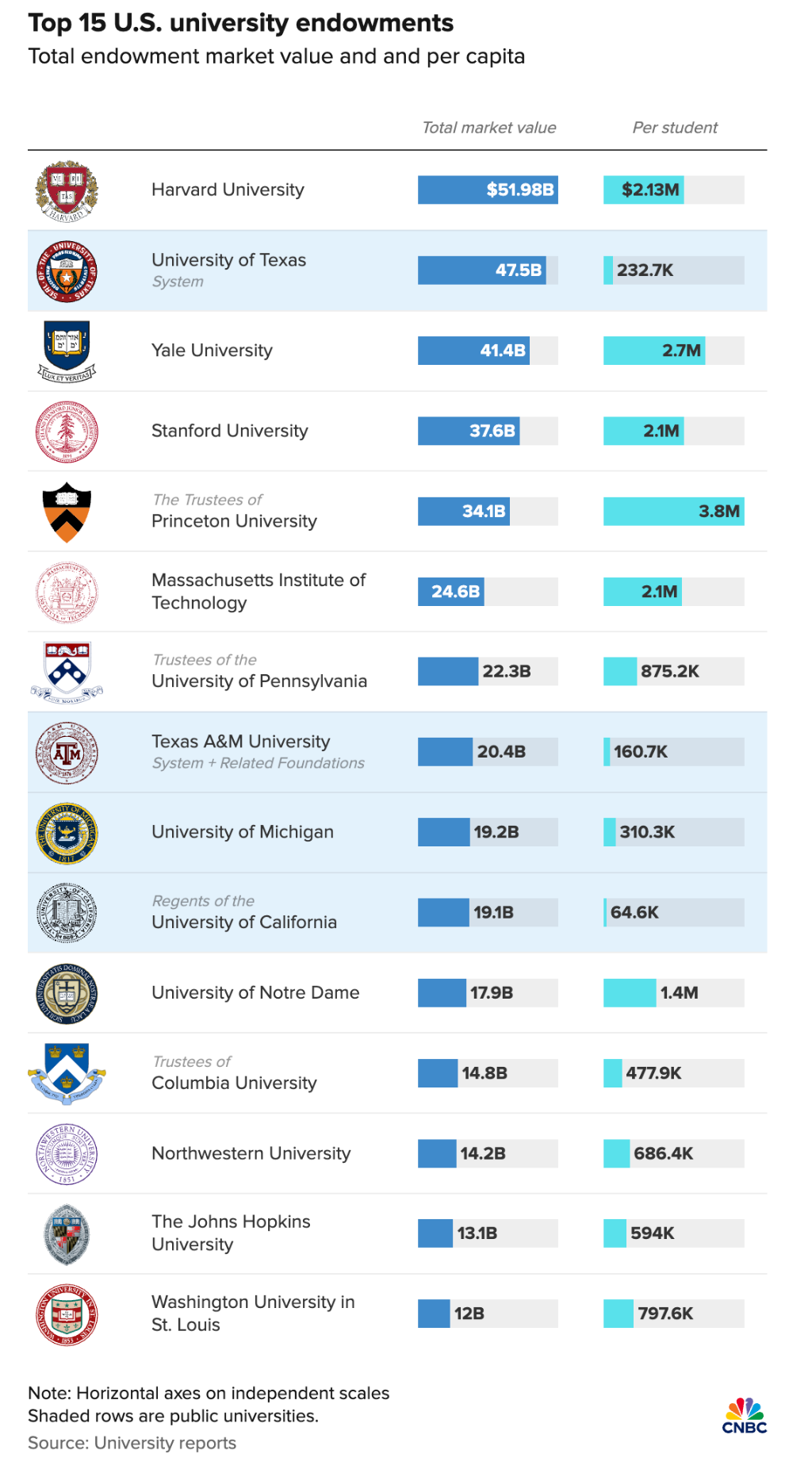
Core Insights - Yale University and Harvard University are facing financial difficulties, leading to significant sell-offs of their private equity portfolios [2][4][6] - Yale plans to sell up to $6 billion of its private equity investments, which represents 15% of its endowment fund [2][4] - Harvard aims to sell approximately $1 billion in private equity assets and issue $750 million in taxable bonds to alleviate financial pressure [5][7] Group 1: Yale University - Yale's endowment fund totals $41.4 billion, but its return rate has declined to 5.7% for the fiscal year 2024, below the 10-year average of 9.5% [4] - Approximately one-third of Yale's endowment is allocated to private equity, which has become a burden due to low liquidity in the current market [4][9] - The decision to sell private equity holdings is aimed at increasing liquidity and providing room for future portfolio adjustments [4][9] Group 2: Harvard University - Harvard's endowment fund stands at $53.2 billion, with a return rate of 6.3% for the fiscal year 2024, also below its long-term target [6][7] - Harvard's financial situation is exacerbated by the freezing of $2.2 billion in federal funding and threats to its tax-exempt status [6][7] - The university's strategy includes selling private equity assets and issuing bonds to enhance liquidity and optimize its investment portfolio [7][9] Group 3: Broader Industry Context - U.S. university endowments are generally facing challenges such as declining investment returns, liquidity issues, and market volatility [9][10] - The overall investment environment for endowments has become more complex due to global economic uncertainties and geopolitical tensions [10] - Despite these challenges, there are opportunities for endowments to adjust their investment strategies and improve risk management [10]
关税冲击之下,私募股权走向何方?|投中嘉川
投中网· 2025-04-29 06:21
将投中网设为"星标⭐",第一时间收获最新推送 关税对中国私募股权投资行业短时间内不会产生重大直接冲击。 作者丨 投中嘉川 来源丨 投中网 知名资管机构 Neuberger Berman 于 2025 年 4 月发布报告《 Potential Impact of U.S. Tariffs: Private Equity Manager Perspectives 》,通过深度调研全球逾百家私募股权基金管理 人,解析美国关税政策对私募股权行业的潜在影响。本次调研的时间窗口为特朗普政府公布加征关税 方案之后、宣布暂停部分国家互惠关税 90 天之前。调研对象涵盖并购、私募股权与风险投资策略的 管理人,涉及关税对其被投企业的关键经营指标、估值等方面的影响。调研发现, 管理人预期私募 股权资产在关税冲击之下仍具有强劲韧性,盖因资产组合并未聚焦于消费品、运输等关税敏感行业, 受到关税的直接冲击较小。 基于此,投中嘉川分析认为,中国虽与美国在关税问题上存在摩擦,但据海关总署数据显示,中国对 美出口的主要产品集中在机械器具及电气设备、塑料制品、纺织品、家具玩具、贱金属及其制品等领 域, 2024 年出口金额合计占比 74.1% ...
解读金融新规!看银行如何"变身"科技企业成长好伙伴→
Jin Rong Shi Bao· 2025-04-29 03:36
李佩珈提出,应更加重视发挥资本市场作用,助力长期资本和耐心资本的培育。国际经验表明,资本市 场是支持科技企业最有效的融资方式,美国是重视发展资本市场的典型代表,德国和日本重视通过"全 能银行"和"主办银行"等方式为企业提供股权性资本,未来我国也应更加重视发挥股权融资在优化科技 金融供给中的枢纽作用。从投融资两端促进资本市场高质量发展。围绕增加优质资产供给、提高上市公 司质量、完善多元化退市通道、净化投资环境、严惩财务造假等行为、提升股民投资获得感等多个维度 进行系统改革,切实打造一个有活力、有韧性、投融资两端互促平衡的资本市场。围绕私募股权"募、 投、管、退"各环节,形成更加高效规范的运作模式。私募股权是资本市场高质量发展的底层塔基,是 股权投资重要资金来源。当前,我国私募股权进入调整过渡期,在募投管退等环节都面临诸多新挑战。 未来,要围绕上述问题,拓宽资金来源、丰富投资主体、创新退出方式推动私募股权高质量发展。 3月5日,金融监管总局发布《关于进一步扩大金融资产投资公司股权投资试点的通知》,为银行业参与 股权投资带来新机遇,标志着银行股权投资业务由过去的间接参与转向直接参与,这是一个非常重大的 转变。股权投 ...
投资另类资产和私募股权有哪些风险?
伍治坚证据主义· 2025-04-25 02:26
Core Viewpoint - The article discusses the increasing interest of financial institutions in promoting alternative assets to individual investors, highlighting the potential for significant asset growth and management fee income if they can expand beyond institutional investors [1][2]. Group 1: Characteristics of Alternative Assets - Alternative assets, including hedge funds, venture capital, private equity, non-traded real estate, private credit, and infrastructure, are generally considered high-risk and misleading, with high fees, lack of transparency, and low liquidity, making them unsuitable for average investors [2][3]. - Private equity, as an example of alternative investment, is often perceived as lower risk due to infrequent price updates, leading to a false sense of security among investors [3][4]. Group 2: Fees and Transparency - The management fees for alternative assets can be exorbitantly high, often exceeding 7%, compared to as low as 0.04% for ETFs, which can significantly erode net returns for investors [5][6]. - The complexity of calculating returns and fees in private equity can make it challenging for even professional investors to fully understand, let alone individual investors [6]. Group 3: Liquidity Issues - Unlike publicly traded ETFs, private equity and most alternative assets typically have long redemption lock-up periods, which can lead to liquidity challenges for individual investors [7]. - Many private equity funds allow monthly subscriptions but restrict redemptions, which can create "redemption congestion" during high demand periods, making these assets more suitable for institutional investors with stable cash flows [7][8]. Group 4: Performance Comparison - Even top-performing university endowment funds, which have access to elite alternative asset managers, have reported lower annualized median returns compared to simple, low-cost index ETFs, with a median return of 6.7% over the past decade compared to 12.8% for the S&P 500 [8]. - The current landscape shows that many institutional investors are facing redemption challenges with private equity holdings, indicating that individual investors may inadvertently take on illiquid assets that institutions are struggling to exit [8].


投资另类资产和私募股权有哪些风险?
伍治坚证据主义· 2025-04-25 02:26
| 11 2017 11:55 PM 11 | 24 | CT OU 70 23 4470 | 48.51 | alled the said to the comments of the comments of the comments of the within the within with the with the with the with the with the with the with the with the with the ware | 2 ind 1 1 1 1 1 11 - | 603 | 231 | 660 | 174 | | | | | | | | | | | | | | | | --- | --- | --- | --- | --- | --- | --- | --- | --- | --- | --- | --- | --- | --- | --- | --- | --- | --- | --- | --- | --- | --- | --- | --- | | 67.59 | 23 = 11 30 | 224 | 4.93 | o ose the 1 Plus 1 The ...


面对特朗普威胁,哈佛、普林斯顿等开始“搞钱”
Hua Er Jie Jian Wen· 2025-04-23 13:40
Core Insights - Elite universities in the U.S. are urgently raising cash in response to unprecedented pressure from the Trump administration, with Princeton issuing $320 million in bonds, Northwestern securing $500 million, and Harvard raising $750 million [1][3] - The Trump administration has threatened over $10 billion in funding for higher education institutions, claiming these actions are aimed at protecting Jewish students and targeting diversity, equity, and inclusion (DEI) programs [2] - The current turmoil in the private equity market, combined with the financial pressures on universities, raises concerns about a potential new "subprime crisis" that could have widespread implications [7][8] Funding and Financial Strategies - Universities are issuing taxable bonds despite higher interest rates, as they face a challenging market environment [3][6] - Harvard's endowment, exceeding $50 billion, is largely locked in long-term investments, limiting liquidity and forcing universities to seek external financing [6] - Some universities are exploring the sale of private equity assets in the secondary market to alleviate financial pressures, a move that is rare in the history of educational endowments [8] Market Conditions and Risks - The private equity sector is experiencing a perfect storm of asset lock-up, trading stagnation, and liquidity crises, leading to concerns about the undervaluation of risks [7] - Analysts warn that the potential volatility of private equity assets has been masked for years, and without central bank support, the situation could worsen [7] - The financial strain on elite universities is unprecedented, as they navigate a landscape of reduced federal support and increased operational uncertainty [2][8]
另类投资简报 | 7-11母企私有化缺金难牵手;Golden Goose“浅栖”马云蔡崇信的蓝池
彭博Bloomberg· 2025-02-28 10:28
Core Insights - The private equity market is experiencing significant activity, with new fund launches and strategic acquisitions being highlighted [5]. Group 1: Private Equity Market Overview - The private equity market is seeing new fund launches and notable transactions, indicating a robust investment environment [5]. - The acquisition of the contact lens manufacturer, Kingko International, by Anhong Capital, backed by Yintuo Group, showcases strategic moves within the sector [5]. Group 2: Hedge Fund Market Review - Bloomberg's preliminary data indicates that hedge funds rose by 1.5% in January, with the Bloomberg Equity Hedge Fund Index leading the gains [4]. - The hedge fund market is actively recruiting talent to capitalize on the recovery of Japan's $7.1 trillion government bond market [5]. Group 3: Notable Transactions and Developments - A consortium's proposal to acquire Seven & i Holdings Co. faced financing challenges, highlighting the complexities in management buyouts [5]. - The luxury sneaker brand Golden Goose postponed its IPO, with Blue Pool Capital acquiring a minority stake, reflecting cautious market sentiment amid declining demand in China [5].