美元信用风险

Search documents
黄金早参|小非农数据疲软,降息预期回温,金价止跌回升
Mei Ri Jing Ji Xin Wen· 2025-11-19 02:47
Core Viewpoint - Gold prices experienced a slight decline but rebounded due to rising risk aversion and expectations of a Federal Reserve rate cut, closing at $4,067.40 per ounce on COMEX [1] Economic Data Summary - The ADP weekly employment report indicated an average weekly decrease of 2,500 jobs in the U.S. private sector for the four weeks ending November 1 [1] - The U.S. Department of Labor reported initial jobless claims at 232,000 for the week ending October 18, with continuing claims slightly rising to 1.957 million. The initial claims for the week ending September 20 were revised up from 218,000 to 219,000, and the four-week average was adjusted from 237,500 to 237,750, highlighting weak data that increased market expectations for a rate cut in December [1] Market Analysis - CITIC Futures noted that the high levels of initial and continuing jobless claims, coupled with the prolonged government shutdown, further elevate the risks in the labor market. U.S. stock markets continued to show weakness, while U.S. Treasury bonds slightly strengthened [1] - Attention is focused on the upcoming U.S. GDP and non-farm payroll data releases, with gold and silver expected to experience short-term fluctuations. However, the long-term bullish trend for precious metals remains intact [1] - The ongoing issues of excessive debt issuance and de-globalization are key drivers of the decline in U.S. dollar credibility, positioning gold as the preferred asset for hedging against dollar credit risk [1]
小非农数据疲软,降息预期回温,金价止跌回升
Mei Ri Jing Ji Xin Wen· 2025-11-19 01:41
Core Viewpoint - Gold prices experienced a slight decline but rebounded due to rising risk aversion and expectations of a Federal Reserve rate cut, closing at $4067.40 per ounce on COMEX [1] Economic Data Summary - The ADP weekly employment report indicated an average weekly decrease of 2,500 jobs in the U.S. private sector for the four weeks ending November 1 [1] - The U.S. Labor Department reported initial jobless claims at 232,000 for the week ending October 18, with continuing claims slightly rising to 1.957 million. Additionally, initial claims for the week ending September 20 were revised up from 218,000 to 219,000, with the four-week average adjusted from 237,500 to 237,750 [1] Market Analysis - Citic Futures noted that the high levels of weekly initial and continuing jobless claims, coupled with the prolonged government shutdown, have increased the downside risks in the labor market. This has contributed to a continued weakness in U.S. equities and a slight strengthening in U.S. Treasuries [1] - The market is closely watching upcoming U.S. GDP and non-farm payroll data releases, with expectations of short-term fluctuations in gold and silver prices. However, the long-term bullish trend for precious metals remains intact [1] Investment Perspective - The ongoing issues of excessive debt issuance and de-globalization are identified as core drivers of the decline in U.S. dollar credibility. Gold is viewed as the preferred asset for hedging against dollar credit risk, being a currency that transcends national boundaries [1]
黄金股逆市活跃 珠峰黄金涨超4% 紫金矿业涨超2%
Zhi Tong Cai Jing· 2025-11-07 13:41
Core Viewpoint - The gold stocks are actively rising in a bearish market, driven by expectations of interest rate cuts due to worsening employment conditions in the U.S. [1] Group 1: Gold Stocks Performance - Zhumeng Gold (01815) increased by 4.71%, closing at 2 HKD [1] - Zijin Mining (02899) rose by 2.37%, closing at 32.82 HKD [1] - China National Gold International (02099) gained 1.86%, closing at 131.1 HKD [1] - Shandong Gold (01787) went up by 1.61%, closing at 32.9 HKD [1] - Zhaojin Mining (01818) increased by 1.58%, closing at 29.56 HKD [1] Group 2: U.S. Employment Data - In October, the U.S. non-farm employment decreased by 9,100, compared to an increase of 33,000 in the previous month [1] - The number of layoffs reported by Challenger Companies in October reached 153,100, a year-on-year increase of 175.3%, marking the highest level for the same period since 2003 [1] Group 3: Interest Rate Expectations - The probability of the Federal Reserve cutting interest rates again in December exceeds 70%, according to the CME FedWatch Tool [1] - CITIC Futures emphasizes the importance of the trading window in December, suggesting potential discussions around next year's interest rate cuts [1] - The nomination of a new Federal Reserve chair is expected to be confirmed before Christmas, which may introduce risks related to independence and could act as a bullish driver [1] Group 4: Long-term Outlook for Gold - Long-term factors such as excessive debt and de-globalization are driving the decline of the dollar's credit [1] - Gold is viewed as a preferred asset to hedge against dollar credit risk, with a sustained trend of global central banks purchasing gold [1] - The long-term price center for gold is expected to maintain an upward trajectory [1]

港股异动 | 黄金股逆市活跃 珠峰黄金(01815)涨超4% 紫金矿业(02899)涨超2%
智通财经网· 2025-11-07 06:54
Core Viewpoint - Gold stocks are actively rising against the market backdrop, driven by expectations of interest rate cuts due to worsening employment conditions in the U.S. [1] Group 1: Gold Stock Performance - Zifeng Gold (01815) increased by 4.71%, closing at 2 HKD - Zijin Mining (02899) rose by 2.37%, closing at 32.82 HKD - China Gold International (02099) gained 1.86%, closing at 131.1 HKD - Shandong Gold (01787) went up by 1.61%, closing at 32.9 HKD - Zhaojin Mining (01818) increased by 1.58%, closing at 29.56 HKD [1] Group 2: U.S. Employment Data - In October, U.S. non-farm employment decreased by 9,100, compared to an increase of 33,000 in the previous month - The number of layoffs reported by Challenger Companies in October reached 153,100, a year-on-year surge of 175.3%, marking the highest level for the same period since 2003 [1] Group 3: Interest Rate Expectations - The probability of the Federal Reserve cutting rates again in December exceeds 70%, according to the CME FedWatch Tool - Focus is on the trading window period in December, with potential discussions on rate cuts for the following year [1] Group 4: Long-term Outlook for Gold - Long-term factors such as excessive debt issuance and de-globalization are driving down the credit of the U.S. dollar - Gold is viewed as a preferred asset to hedge against U.S. dollar credit risk, with a sustained trend of global central banks purchasing gold - The long-term price center for gold is expected to maintain an upward trajectory [1]
现货黄金突破4000美元,黄金ETF基金(159937)开盘上涨,昨日揽金近2亿元
Sou Hu Cai Jing· 2025-11-07 02:08
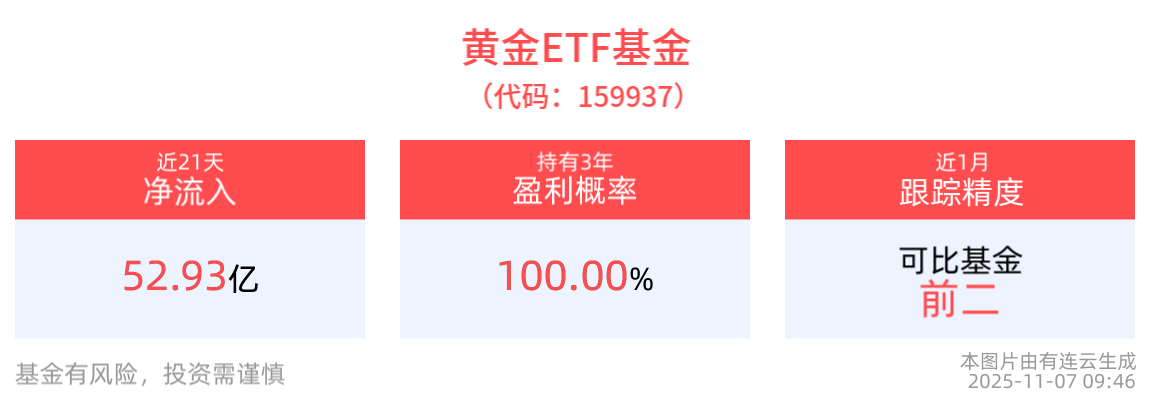
Core Insights - The gold ETF fund (159937) has seen a recent increase of 0.27%, with a latest price of 8.76 yuan, and a cumulative rise of 0.74% over the past week [2] - Spot gold prices have surpassed $4000 per ounce, reflecting a daily increase of 0.59% [2] - The U.S. job market is facing challenges, with a decrease of 9,100 non-farm jobs in October and a significant rise in layoffs, leading to increased expectations for interest rate cuts [2] Market Performance - The gold ETF fund has a turnover rate of 0.23% during the trading session, with a transaction volume of 86.62 million yuan [2] - The average daily transaction volume for the gold ETF fund over the past week is 1.309 billion yuan, ranking it among the top two comparable funds [2] Economic Indicators - The U.S. job market data shows a concerning trend, with the Challenger job cuts reaching 153,100 in October, a year-on-year increase of 175.3%, marking the highest level for the same period since 2003 [2] - The ongoing U.S. government shutdown has led to a suspension of official inflation data releases, raising concerns among Federal Reserve officials regarding future monetary policy [2] Investment Trends - According to CITIC Futures, there is currently a lack of significant drivers for precious metal prices, with expectations of a volatile market in the short term [3] - The gold ETF fund has seen a net inflow of 194 million yuan recently, with 12 out of the last 21 trading days showing net inflows totaling 5.293 billion yuan, averaging 252 million yuan per day [3]

黄金早参 | 裁员人数激增,美联储官员放鹰,金价冲高回落
Sou Hu Cai Jing· 2025-11-07 01:37
Group 1 - Gold prices experienced a temporary rise due to increased risk aversion but fell back as hawkish comments from Federal Reserve officials dampened rate cut expectations, closing at $3984.80 per ounce, a decrease of 0.20% [1] - In October, U.S. companies announced layoffs totaling 153074, a year-on-year increase of 175.3%, marking a seven-month high, with a month-on-month increase of 183% [1] Group 2 - Current precious metal prices lack significant drivers, with expectations of maintaining a volatile pattern in the short term, particularly around the December trading window and the Federal Reserve's meeting [2] - Long-term factors such as excessive debt and de-globalization are seen as core drivers of declining U.S. dollar credit, with gold being viewed as a preferred asset for hedging against dollar credit risk, supported by ongoing global central bank gold purchases [2]
美国挑战者裁员激增,贵?属震荡回暖
Zhong Xin Qi Huo· 2025-11-07 01:05
Report Summary 1. Report Industry Investment Rating No information about the report industry investment rating is provided in the given content. 2. Core Viewpoints of the Report - On Thursday, precious metal prices fluctuated and rebounded. The sharp increase in the number of laid - off employees by Challenger companies in the US, with the technology and warehousing and logistics industries being the most affected, led to the dollar index falling below 100 during the day, a slight decline in US stocks, and most metals oscillating upwards [1][3]. - Precious metal prices currently lack significant drivers and are expected to maintain a volatile pattern in the short term. Attention should be paid to the trading window in December. Before and after the December FOMC meeting, there may be a game about the rate - cut space for next year. In the long term, excessive debt issuance and de - globalization are the core factors driving the decline of the US dollar's credit. Gold is the preferred asset to hedge against the US dollar's credit risk, and the trend of central bank gold purchases globally continues, with the long - term price center of gold expected to rise. Silver's trend is consistent with that of gold, expected to adjust in tandem in the short term and its price center is expected to move up in the long term following gold [3]. - The weekly price range for London gold is expected to be between 3800 and 4200, and for London silver between 46 and 52 [3]. 3. Summary by Relevant Catalogs 3.1 Key Information - In October, the number of laid - off employees by Challenger companies in the US was 153,074, a year - on - year increase of 175.3% (the previous value was a decrease of 25.8%) and a month - on - month increase of 183% (the previous value was a decrease of 37.11%). The lay - offs were mainly concentrated in the technology and warehousing and logistics industries [2]. - The Bank of England kept the benchmark interest rate at 4.00%, in line with market expectations. It is predicted that the inflation rate will drop to 3.1% early next year and stabilize around the 2% target from the second quarter of 2027. The unemployment rate is expected to peak at 5.1% in the second quarter, higher than the 4.9% forecast in August. The Bank of England raised its economic growth forecast for this year from 1.25% to 1.5% and kept the forecasts for 2026 and 2027 unchanged [2]. - According to Revelio Labs data, the number of non - farm payrolls in the US decreased by 9,100 in October, compared with an increase of 33,000 in the previous month. The non - farm payroll report of the US Bureau of Labor Statistics (BLS) has been postponed due to the federal government shutdown [2]. 3.2 Price Logic - The short - term trend of precious metals is expected to be volatile, and attention should be paid to the trading window in December. Personnel changes in the Fed may become a positive driving factor. In the long term, gold is a preferred asset to hedge against the US dollar's credit risk, and the long - term price center of gold is expected to rise. Silver's trend is consistent with that of gold, and its price center is expected to move up in the long term [3]. 3.3 Price Outlook - The weekly price range for London gold is expected to be between 3800 and 4200, and for London silver between 46 and 52 [3]. 3.4 Index Information - The comprehensive index of CITICS Futures commodities on November 6, 2025, includes the commodity index (2244.89, +0.50%), the commodity 20 index (2541.79, +0.61%), and the industrial products index (2223.51, +0.45%) [43]. - As of November 6, 2025, the precious metals index had a daily increase of 0.83%, a 5 - day decrease of 0.35%, a 1 - month increase of 0.99%, and a year - to - date increase of 46.42% [45].
黄金股集体走高 现货黄金逼近4000美元大关 机构看好黄金长期价格中枢向上
Zhi Tong Cai Jing· 2025-11-06 12:05
Group 1 - The spot gold price continues to rise, approaching the $4000 per ounce mark, driven by concerns over the impact of the U.S. government shutdown on the economy [1] - The U.S. Congressional Budget Office indicated that if the shutdown lasts for six weeks, the economic loss could reach $11 billion [1] - Citic Futures suggests that long-term debt overexpansion and de-globalization are key factors driving the decline of the U.S. dollar's credit, making gold a preferred asset for hedging against dollar credit risk [1] Group 2 - Gold stocks collectively rose, with Zijin Gold International increasing by 8.35% to HKD 137.5, and Tongguan Gold rising by 7.14% to HKD 2.7 [2] - Lingbao Gold saw a 6.26% increase, reaching HKD 16.47, while Zijin Mining rose by 4.1% to HKD 32 [2] - Chifeng Jilong Gold increased by 2.5%, trading at HKD 28.66 [2]
港股异动 | 黄金股集体走高 现货黄金逼近4000美元大关 机构看好黄金长期价格中枢向上
智通财经网· 2025-11-06 07:15
Core Viewpoint - Gold stocks experienced a collective rise, driven by increasing gold prices and concerns over the U.S. economic outlook due to government shutdowns [1] Group 1: Gold Stock Performance - Zijin Mining International (02259) rose by 8.35%, closing at 137.5 HKD [1] - Tongguan Gold (00340) increased by 7.14%, closing at 2.7 HKD [1] - Lingbao Gold (03330) saw a rise of 6.26%, closing at 16.47 HKD [1] - Zijin Mining (02899) gained 4.1%, closing at 32 HKD [1] - Chifeng Jilong Gold (06693) increased by 2.5%, closing at 28.66 HKD [1] Group 2: Market Influences - On November 6, spot gold prices continued to rise, approaching the 4000 USD/ounce mark [1] - The U.S. government shutdown has reached a record number of days, raising concerns about the negative impact on the U.S. economy [1] - The Congressional Budget Office indicated that if the shutdown lasts for six weeks, economic losses could reach 11 billion USD [1] Group 3: Long-term Outlook for Gold - CITIC Futures noted that long-term debt overexpansion and de-globalization are key factors driving down the credit of the U.S. dollar [1] - Gold is viewed as a preferred asset for hedging against U.S. dollar credit risk, maintaining a long-term upward price expectation [1] - The trend of global central banks purchasing gold is expected to continue [1]

金价高企影响追踪:产业链苦乐不均,下游从业者称加班变少了
Zheng Quan Shi Bao Wang· 2025-11-05 12:46
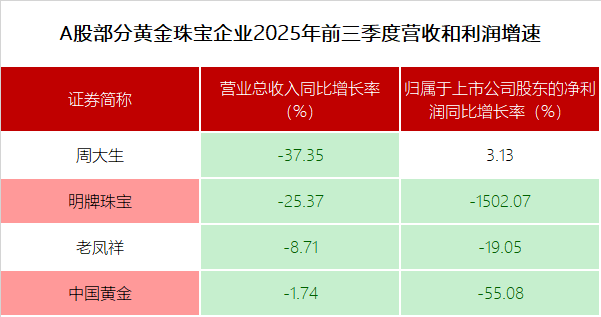
Core Insights - The recent surge and volatility in gold prices have sparked a new wave of investment in gold, significantly impacting companies within the gold industry chain [1] Group 1: Impact on Gold Mining Companies - The rise in gold prices has positively affected upstream gold mining companies, leading to increased performance as evidenced by the third-quarter reports of listed gold mining companies [2] - According to Wind data, gold industry listed companies reported growth in both revenue and net profit attributable to shareholders for the first three quarters of 2025, with companies like Zhaojin Mining and Western Gold seeing revenue and net profit growth rates exceeding 100% [2] Group 2: Impact on Gold Jewelry Companies - Conversely, the significant increase in gold prices has negatively impacted downstream gold jewelry companies, with many reporting declines in performance for the first three quarters of 2025 [2] - Companies such as Zhou Dashing, Mingpai Jewelry, Laofengxiang, and China Gold experienced varying degrees of revenue decline, with Mingpai Jewelry and Laofengxiang also reporting substantial drops in net profit [3] Group 3: Market Demand and Consumer Behavior - The overall demand for gold jewelry in China has seen a decline, with a reported 25% drop in total gold jewelry consumption for the first three quarters of 2025, despite a 21% quarter-on-quarter increase in the third quarter [5] - Zhou Dafu Jewelry Group indicated a potential turning point in business performance, with same-store sales growth in mainland China and Hong Kong/Macau showing positive trends [6][7] Group 4: Corporate Strategies and Innovations - Companies are actively seeking strategies to mitigate the impact of high gold prices, focusing on inventory management, product innovation, and marketing [8] - Zhou Dafu Jewelry Group has implemented mechanisms to monitor gold price fluctuations and adjust pricing accordingly, while also innovating product designs to cater to changing consumer preferences [9]