闭源模型

Search documents
中国“霸榜”全球开源大模型:光环下的隐忧与挑战丨人工智能AI瞭望台
Zheng Quan Shi Bao· 2025-08-07 00:32
Core Insights - China's open-source large models are reshaping the global AI landscape with a "cluster-style" rise, as evidenced by the dominance of Chinese models in recent rankings [1][2][3] - The rapid iteration of open-source models has led to challenges such as high compatibility costs and a tendency towards homogenization, raising concerns about the sustainability of innovation [2][11] Group 1: Open-Source Model Landscape - In recent weeks, major Chinese companies like Alibaba and Tencent have released multiple open-source models, contributing to a competitive environment reminiscent of the "hundred model battle" of 2023 [1][4] - As of July 31, 2023, nine out of the top ten open-source models listed by Hugging Face are from China, with notable entries including Zhiyuan's GLM-4.5 and Alibaba's Tongyi Qianwen series [4][5] Group 2: Advantages and Challenges of Open-Source - The rise of open-source models in China is attributed to the availability of vast amounts of quality Chinese language data and the maturation of domestic computing power, which supports large-scale distributed training [5][8] - Despite the advantages, developers face challenges such as frequent model updates and the need for constant debugging, which can lead to increased integration costs and compatibility issues [11][12] Group 3: Diverging Paths in AI Development - There is a clear divergence in the development paths of AI models, with Chinese companies favoring open-source approaches while U.S. firms tend to lean towards closed-source models to maintain competitive advantages [7][8] - The open-source model is seen as a way for Chinese firms to build trust and establish a developer ecosystem, contrasting with the capital-driven, profit-focused approach of U.S. AI companies [9][10] Group 4: Future Directions and Innovations - Experts suggest that the current trend of "fine-tuning" among models may lead to a lack of groundbreaking innovations, emphasizing the need for foundational algorithm breakthroughs and unified API standards [11][12] - The establishment of a knowledge-sharing community for AI algorithms in China is proposed as a means to foster innovation and overcome existing barriers in AI development [12]


中国“霸榜”全球开源大模型:光环下的隐忧与挑战丨人工智能AI瞭望台
证券时报· 2025-08-07 00:12
Core Viewpoint - China's open-source large models are rising in a "cluster-style" manner, reshaping the global AI landscape, while also presenting challenges such as frequent iterations leading to compatibility issues and a tendency towards homogenization [2][5][10]. Group 1: Open-source Model Surge - In recent weeks, major Chinese companies have released multiple open-source models, marking a resurgence in the domestic large model scene, reminiscent of the "hundred model battle" of 2023 [2][4]. - As of July 31, 2023, nine out of the top ten open-source large models listed by Hugging Face are from China, with notable models like Zhipu's GLM-4.5 and Alibaba's Tongyi Qianwen series dominating the rankings [4][5]. Group 2: Shift from Closed to Open-source - The success of DeepSeek has been pivotal in shifting the industry towards open-source models, prompting more companies to follow suit and focus on model optimization and iteration [4][5]. - The open-source approach is seen as a way for latecomers in the AI field, particularly in China, to break the dominance of established closed-source models [7][8]. Group 3: Economic and Technical Implications - The rise of open-source models in China is driven by the availability of vast amounts of quality Chinese language data and the maturation of domestic computing power, creating a strong feedback loop [5][8]. - Open-source models lower the barriers to entry for smaller companies, enabling them to leverage advanced models at reduced costs, thus accelerating AI integration into various sectors [8][10]. Group 4: Challenges and Concerns - The rapid iteration of open-source models has led to a phenomenon described as "tuning internal competition," where the lack of disruptive innovation results in similar capabilities across models [10][11]. - Developers face challenges such as high compatibility costs and frequent changes in model interfaces, which complicate integration efforts [10][11]. - Experts suggest that to avoid stagnation, there is a need for unified API standards and a focus on foundational algorithm innovation [11].


谁在拆 OpenAI 的围墙?
3 6 Ke· 2025-08-06 01:41
Core Insights - OpenAI's recent decision to open-source two new models, gpt-oss-120b and gpt-oss-20b, marks a strategic shift from its previous closed-source approach, which had established a dominant position in the large model market [1][2][3] - The move is seen as a response to the rising competition from open-source models that offer similar performance at significantly lower costs, prompting OpenAI to reconsider its strategy [2][4] Group 1: Strategic Implications - OpenAI's choice to use the Apache 2.0 license for its open-source models allows for commercial use and modifications, directly competing with Meta's Llama [3] - The models released are of medium scale, ensuring they do not threaten OpenAI's high-end closed-source products while still attracting developers [3][4] - OpenAI aims to maintain control over its core technology by keeping critical components, such as training data and optimization strategies, proprietary [4][8] Group 2: Market Dynamics - The AI industry is entering a phase of "layered competition," with OpenAI pursuing a dual strategy of open-source models to attract developers while retaining high-profit closed-source products for enterprise clients [5][7] - In contrast, Anthropic has chosen to focus on closed-source models targeting high-paying clients in sectors that prioritize safety and reliability, indicating a market segmentation based on user needs [6][7] Group 3: Regulatory Considerations - OpenAI's introduction of open-source models may serve as a proactive measure against increasing regulatory scrutiny on closed-source models, as open-source solutions are generally more transparent and easier to audit [8] - This strategic positioning could provide OpenAI with a competitive advantage as regulatory frameworks evolve, allowing it to maintain relevance in a changing landscape [8][10] Group 4: Developer Opportunities - The open-source models support local deployment and integration with popular frameworks, significantly lowering the barrier for independent developers to create advanced AI applications [8][10] - This shift could lead to a new wave of innovation, with the potential for groundbreaking AI applications emerging from smaller, independent developers [8][10]
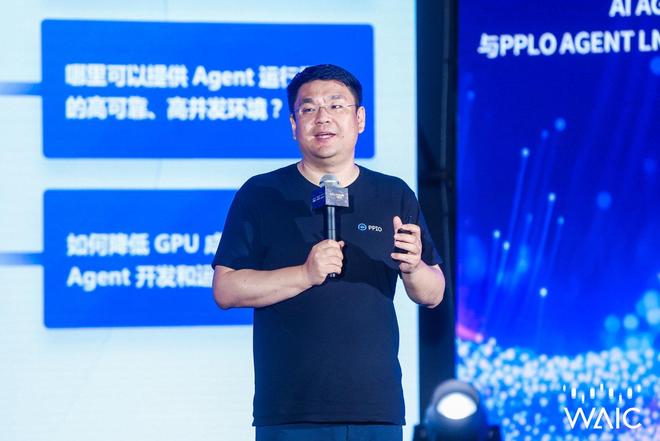
对话PPIO姚欣:AI大模型赛道加速内卷,但合理盈利路径仍需探索
Tai Mei Ti A P P· 2025-08-05 02:23
Core Insights - PPIO, co-founded by CEO Yao Xin, is focusing on AI cloud computing services, particularly in the context of the growing demand for GPU computing power and AI inference driven by technologies like ChatGPT and DeepSeek [3][4] - The company has optimized the DeepSeek-R1 model, achieving over 10 times throughput improvement and reducing operational costs by up to 90% [4] - PPIO is recognized as the largest independent edge cloud service provider in China, holding a market share of 4.1% and operating the largest computing network in the country [4][5] Company Developments - PPIO has submitted its IPO application to the Hong Kong Stock Exchange, indicating increased interest from investors following the submission [5] - The company launched China's first Agentic AI infrastructure service platform, which includes a sandbox for agents and supports rapid integration of various AI models [5][6] - PPIO aims to build a comprehensive infrastructure service for developers and enterprises, focusing on agent-based applications [5][6] Market Position and Strategy - PPIO is one of the earliest participants in the distributed cloud computing market to offer AI cloud services, with a significant increase in daily token consumption from 27.1 billion in December 2024 to 200 billion by June 2025 [5] - The company emphasizes the importance of open-source models for the development of the AI industry, contrasting with the trend of U.S. companies moving towards closed-source models [6][10] - Yao Xin believes that the future of AI will require a shift towards distributed computing, particularly in edge and side computing, as the industry moves away from centralized models [7][28] Industry Insights - The AI infrastructure market is characterized by low margins and large scale, with PPIO positioning itself to capitalize on the growing demand for distributed computing solutions [6][18] - The company sees significant opportunities in the domestic GPU market, particularly as the demand for inference capabilities increases [20] - Yao Xin highlights the need for a strong integration of hardware and software to drive advancements in AI technology, emphasizing the importance of end-to-end capabilities [20][22]
大模型年中报告:Anthropic 市场份额超 OpenAI,开源模型企业采用率下降
Founder Park· 2025-08-04 13:38
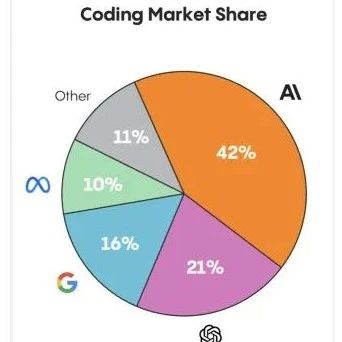
Core Insights - The foundational large models are not only the core engine of generative AI but are also shaping the future of computing [2] - There has been a significant increase in model API spending, which rose from $3.5 billion to $8.4 billion, indicating a shift in focus from model training to model inference [2] - The emergence of "code generation" as the first large-scale application of AI marks a pivotal development in the industry [2] Group 1: Market Dynamics - Anthropic has surpassed OpenAI in enterprise usage, with a market share of 32% compared to OpenAI's 25%, which has halved from two years ago [9][12] - The release of Claude Sonnet 3.5 in June 2024 initiated Anthropic's rise, further accelerated by subsequent releases [12] - The code generation application has become a killer app for AI, with Claude capturing 42% of the market, significantly outperforming OpenAI's 21% [13] Group 2: Trends in Model Adoption - The adoption of open-source models in enterprises has slightly declined from 19% to 13%, with Meta's Llama series still leading [17] - Despite the continuous progress in open-source models, they lag behind closed-source models by 9 to 12 months in performance [17][20] - Developers prioritize performance over cost when selecting models, with 66% opting to upgrade within their existing supplier ecosystem [24][27] Group 3: Shift in AI Spending - AI spending is transitioning from model training to inference, with 74% of model developers indicating that most of their tasks are now driven by inference, up from 48% a year ago [31]
刚刚,扎克伯克发文正式告别“默认开源”!网友:只剩中国 DeepSeek、通义和 Mistral 还在撑场面
猿大侠· 2025-07-31 04:09
Core Viewpoint - Meta CEO Mark Zuckerberg envisions "personal superintelligence," where individuals can leverage AI to achieve personal goals, while also indicating a shift in the company's AI model release strategy to better manage associated risks [1][12]. Group 1: Shift in Open Source Strategy - Zuckerberg's recent statements reflect a significant change in Meta's approach to open source AI, moving from a strong commitment to open sourcing models to a more cautious stance on what should be open sourced [2][6]. - In 2024, Zuckerberg expressed a commitment to open source AI, stating that Meta would create a long-term sustainable platform, but by 2025, he emphasized the need for careful management of risks associated with open sourcing [2][11]. - The shift from being a "radical open source advocate" to a "cautious selective open source" approach introduces uncertainty for the future of AI open sourcing, particularly benefiting companies that remain in the open source camp, especially in China [6][9]. Group 2: Financial and Strategic Investments - Meta has invested $14.3 billion in AI, marking a departure from the default open source model, as the company focuses on developing closed-source models to enhance commercial control [11][12]. - The company is restructuring its AI division into "Meta Superintelligence Labs" and has recruited top talent from leading AI firms, indicating a strategic pivot towards closed-source development [12][14]. - Reports suggest that Meta has paused testing of its latest open source model "Behemoth" to concentrate on developing a new closed-source model, reflecting a significant strategic shift [12][13]. Group 3: Future Directions and Product Integration - Zuckerberg's vision includes integrating "personal superintelligence" into consumer products like augmented reality glasses and virtual reality headsets, positioning these devices as primary computing tools for users [14]. - A company spokesperson reiterated that while Meta remains committed to open source AI, it also plans to train closed-source models in parallel, indicating a dual approach to AI development [15].


开源Qwen一周连刷三冠,暴击闭源模型!基础模型推理编程均SOTA
量子位· 2025-07-26 05:06
Core Insights - The article highlights the rapid advancements in open-source AI models, particularly focusing on the Qwen3 series, which has achieved significant milestones in performance and capabilities [1][2][3]. Group 1: Model Performance - The newly released Qwen3-235B-A22B-Thinking-2507 model has been recognized as the "strongest open-source model globally," surpassing top closed-source models like Gemini-2.5 Pro and o4-mini [3][7]. - In the "final exam for humans," the latest model scored 18.2, an improvement from 11.8 in the previous version, outperforming competitors such as DeepSeek-R1-0528 and OpenAI o4-mini [13][14]. - The Qwen3 series has achieved state-of-the-art (SOTA) results in various benchmarks, including MMLU-Pro, GPQA, and LiveCodeBench, demonstrating superior performance in knowledge, reasoning, and programming tasks [11][16][32]. Group 2: Open-Source Impact - The rapid release of three models in a short period has positioned Qwen3 as a leader in the open-source AI landscape, with significant interest and usage reflected in API call volumes exceeding 100 billion tokens [6][31]. - The article emphasizes that the advancements in open-source AI, particularly from Chinese companies like Alibaba, are reshaping the global landscape, with Qwen models surpassing previous leaders like the Llama series [33][37]. - Alibaba plans to invest over 380 billion yuan in cloud and AI hardware infrastructure over the next three years, indicating a strong commitment to enhancing its AI capabilities [38]. Group 3: Industry Recognition - The achievements of the Qwen3 series have garnered attention from industry leaders, with discussions highlighting the success of open-source models and their potential to challenge established closed-source counterparts [29][36]. - The article notes that the speed of development in China's open-source AI sector is rapidly closing the gap with closed-source models, suggesting a shift in the competitive landscape [39][40].

DeepSeek终于丢了开源第一王座。。。
自动驾驶之心· 2025-07-19 10:19
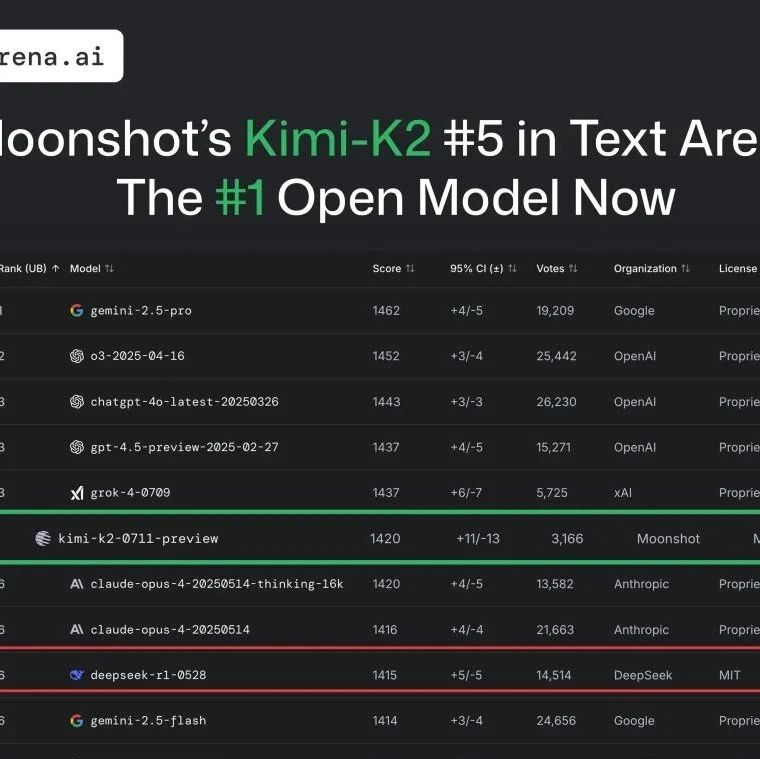
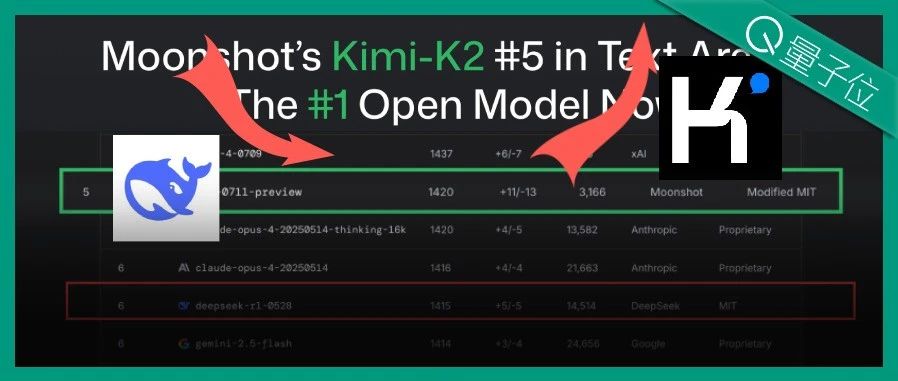
Core Viewpoint - Kimi K2 has surpassed DeepSeek to become the top open-source model globally, ranking fifth overall and closely following top proprietary models like Musk's Grok 4 [3][4]. Group 1: Ranking and Performance - Kimi K2 achieved a score of 1420, placing it fifth in the overall ranking, with a notable performance in various capabilities, including being tied for first in multi-turn dialogue and second in programming ability [4][7]. - The top ten models now all have scores above 1400, indicating that the performance gap between open-source and proprietary models is narrowing [22][24]. Group 2: Community Engagement and Adoption - Kimi K2 has gained significant attention in the open-source community, with 5.6K stars on GitHub and nearly 100,000 downloads on Hugging Face within a week of its release [6][5]. - The CEO of Perplexity has publicly endorsed Kimi K2, indicating plans to utilize the model for further training, showcasing its potential in practical applications [8]. Group 3: Architectural Decisions - Kimi K2 inherits the architecture of DeepSeek V3, with specific parameter adjustments made to optimize performance while managing costs effectively [10][14]. - The adjustments include increasing the number of experts while reducing the number of attention heads, which helps maintain efficiency without significantly impacting performance [15][18]. Group 4: Industry Trends - The perception that open-source models are inferior is being challenged, with industry experts predicting that open-source will increasingly rival proprietary models in performance [22][27]. - Tim Dettmers from the Allen Institute for AI suggests that open-source models defeating proprietary ones will become more common, highlighting a shift in the AI landscape [28].
DeepSeek终于丢了开源第一王座,但继任者依然来自中国
量子位· 2025-07-18 08:36
Core Viewpoint - Kimi K2 has surpassed DeepSeek to become the number one open-source model globally, ranking fifth overall, closely following top proprietary models like Musk's Grok 4 [1][19]. Group 1: Ranking and Performance - Kimi K2 achieved a score of 1420, placing it fifth in the overall ranking, with only a slight gap from leading proprietary models [2][22]. - The top ten models now all have scores above 1400, indicating that open-source models are increasingly competitive with proprietary ones [20][21]. Group 2: Community Engagement and Adoption - Kimi K2 has gained significant attention in the open-source community, with 5.6K stars on GitHub and nearly 100,000 downloads on Hugging Face [5][4]. - The CEO of AI search engine startup Perplexity has publicly endorsed Kimi K2, indicating its strong internal evaluation and future plans for further training based on this model [5][27]. Group 3: Model Architecture and Development - Kimi K2 inherits the DeepSeek V3 architecture but includes several parameter adjustments to optimize performance [9][12]. - Key modifications in Kimi K2's structure include increasing the number of experts, halving the number of attention heads, retaining only the first layer as dense, and implementing flexible expert routing [13][15]. Group 4: Industry Trends and Future Outlook - The stereotype that open-source models are inferior is being challenged, with industry experts predicting that open-source will increasingly outperform proprietary models [19][24]. - Tim Dettmers from the Allen Institute for AI suggests that open-source models defeating proprietary ones will become more common, highlighting their importance in localizing AI experiences [25][27].
互联网女王报告揭秘硅谷现状:AI指数级增长,中国厂商在开源竞争中领先 | 企服国际观察
Tai Mei Ti A P P· 2025-06-11 02:33
Core Insights - The report by Mary Meeker highlights the unprecedented speed and scale of AI adoption, indicating a transformative impact on technology history [3][6][22] - AI is experiencing exponential growth, with ChatGPT reaching 800 million users in just 17 months, surpassing any product from the internet era [3][8] - The report emphasizes a shift in AI development focus from academia to industry, driven by proprietary interests and competitive advantages [6][10] User Growth - ChatGPT achieved 800 million users within 17 months, with an annual recurring revenue growth rate that outpaces any product from the internet era [3][8] - The rapid user adoption of AI technologies is reshaping the landscape of digital interaction and functionality [8][18] Cost Dynamics - Training costs for AI models can reach up to $1 billion, but inference costs have decreased by 99% over two years [4][14] - The energy efficiency of GPUs has significantly improved, with NVIDIA's 2024 Blackwell GPU showing a 105,000-fold reduction in power consumption compared to the 2014 Kepler GPU [4][14] Competitive Landscape - The rise of Chinese firms in the AI space is notable, with open-source approaches enabling rapid advancements and global competition [4][10] - Closed-source models like OpenAI's GPT-4 and Anthropic's Claude dominate enterprise applications due to their superior performance, despite lacking transparency [6][10][13] Infrastructure and Investment - The demand for AI infrastructure is increasing, putting pressure on cloud providers and chip manufacturers [8][21] - Significant capital investment is required for AI development, with ongoing competition among companies for key technologies like chips and data centers [21][22] Job Market Impact - Since 2018, job vacancies related to AI have surged by 448%, indicating strong demand for talent in the AI sector [19][22] - AI is evolving roles in various professions, enhancing productivity rather than replacing jobs [18][22] Market Segmentation - The AI market is bifurcating into closed-source models, which are favored by enterprises, and open-source models, which are gaining traction among developers and startups [10][12][13] - Open-source models are becoming increasingly competitive, offering low-cost alternatives with robust capabilities [12][13] Strategic Implications - Companies are shifting from selling isolated software licenses to integrating AI functionalities across their technology stacks, focusing on delivering tangible outcomes [21][22] - The competition in AI is likened to a space race, highlighting the strategic importance of technological advancements in this field [21][22]