
Qwen3系列

Search documents
3B打32B?海外病毒式传播的小模型,竟然来自BOSS直聘
机器之心· 2026-03-09 03:58
Core Viewpoint - The competition among large model manufacturers resembles an arms race, with both open-source and closed-source camps striving to outdo each other in parameters and computational power, leading to models with unprecedented sizes [1][2][4] Model Size and Performance - The parameter size of models has significantly increased, with GPT-4 estimated to have around 10 times the parameters of GPT-3, reaching at least a trillion parameters, while open-source models are also expanding beyond 600 billion parameters [1][2] - However, larger models do not necessarily equate to better performance, as evidenced by the recent challenges faced by even the largest models in reasoning tasks [4][5] Emergence of Smaller Models - A 3 billion parameter model, Nanbeige4.1-3B, has demonstrated superior reasoning capabilities compared to larger models, successfully addressing complex tasks that larger models struggled with [7][10] - The efficiency and cost advantages of smaller models are becoming increasingly apparent, suggesting that they can perform tasks traditionally reserved for larger models [9][16] Technical Innovations in Smaller Models - Nanbeige4.1-3B integrates various capabilities such as general Q&A, complex reasoning, coding, and deep search within a compact model size, showcasing a significant breakthrough in model unification [21] - The model employs a phased optimization strategy to balance expertise across different domains while maintaining overall capability [22] Training Methodology - The training process for Nanbeige4.1-3B includes a structured approach that emphasizes the importance of data distribution and context length, allowing the model to learn complex relationships effectively [23][24] - Innovations in reinforcement learning (RL) have been implemented, including point-wise and pair-wise RL strategies, to enhance the model's performance and adaptability [33][35] Benchmark Performance - Nanbeige4.1-3B has outperformed similarly sized models and even those with ten times the parameters in various benchmarks, demonstrating its competitive edge [50][51] - In real-world task competitions, Nanbeige4.1-3B has shown exceptional generalization capabilities, surpassing larger models in coding and mathematical challenges [58] Future Implications - The advancements in smaller models like Nanbeige4.1-3B indicate a shift in the AI landscape, where smaller models are not merely lightweight alternatives but can achieve independent, generalized capabilities [60][61] - The potential for deploying smaller models in mobile, localized, and private environments opens new avenues for AI applications, suggesting a redefinition of deployment paradigms in the industry [62][63]

兴业证券:2026年值得关注的十大产业趋势
智通财经网· 2026-02-18 03:45
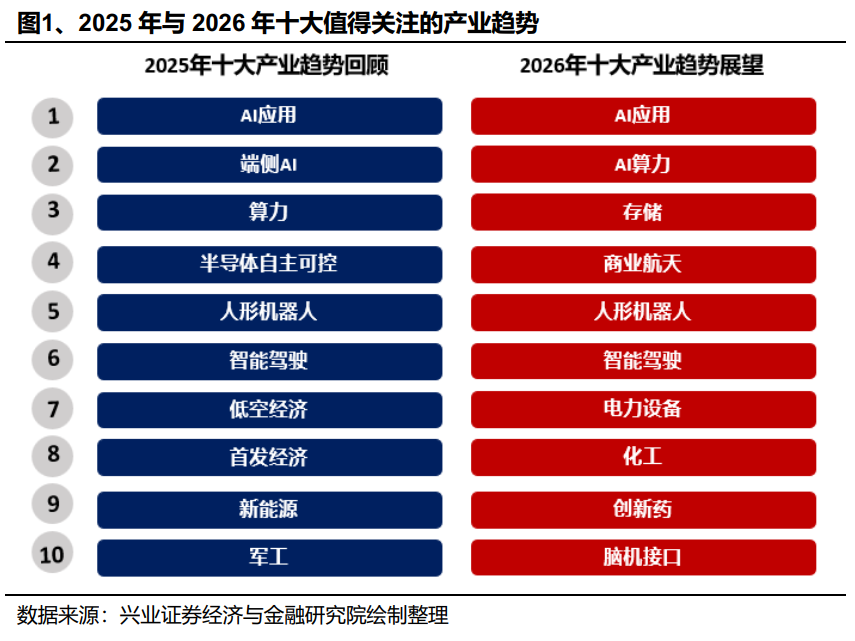
Group 1: AI Applications - The global AI competition is intensifying, with model iterations driving deeper application scenarios, and the focus is on whether significant capital expenditures by tech giants can lead to commercial applications [2][3] - The competitive landscape for AI applications is shifting from dominance by OpenAI to a more multipolar environment, with major players like Google and Meta integrating AI into their ecosystems [3] - In China, AI applications are experiencing a breakthrough, with major tech companies accelerating model iterations and application deployments, leading to a transformation from model landing to scenario monetization [5] Group 2: AI Computing Power - Overseas, major cloud service providers are maintaining high capital expenditures, with a projected increase of 67% in 2026, reflecting a strong demand for AI computing power [7][8] - In China, leading tech companies are increasing capital expenditures and accelerating the iteration of domestic large models, promoting the performance of domestic chips amid tightening supply from foreign sources [9] Group 3: Storage - The demand for storage is entering a new super cycle driven by AI training and inference needs, with AI servers consuming significantly more memory than traditional servers [11][16] - Supply constraints are expected to persist, leading to continued high prices for storage components, as major manufacturers shift production focus to advanced memory types [16] Group 4: Commercial Aerospace - Commercial aerospace is becoming a key battleground in US-China competition, with significant policy support and funding initiatives in both countries to accelerate industry development [19][21] - Domestic companies are achieving breakthroughs in satellite mass production and reusable rocket technologies, transitioning from technical validation to commercialization [22] Group 5: Humanoid Robots - Major overseas companies are ramping up production plans for humanoid robots, benefiting domestic component suppliers, with Tesla aiming for a production capacity of 500,000 units by 2026 [27][30] - Chinese manufacturers are leading in humanoid robot shipments, with significant contracts and production milestones achieved in 2025 [30] Group 6: Intelligent Driving - Domestic policies are expected to facilitate the commercialization of L3 autonomous driving in 2026, with several manufacturers preparing to launch L3 models [32][33] - Tesla's Full Self-Driving (FSD) technology is setting the direction for autonomous driving, with significant advancements in AI capabilities [35] Group 7: Energy Storage - The expansion of AI computing power in North America is driving electricity demand, with domestic power equipment expected to accelerate exports [37][40] - China's "14th Five-Year Plan" includes significant investments in the power grid and energy storage, creating a favorable environment for industry growth [40][43] Group 8: Chemicals - The chemical industry is undergoing a transformation driven by policies aimed at supply-side reform, with a focus on optimizing supply structures and reducing excess capacity [44][47] - New economic sectors are boosting demand for chemical materials, particularly in AI, renewable energy, and robotics, leading to a favorable outlook for new materials [47][48]


Token售卖已无溢价、大模型公司转型“系统商”?记忆张量 CTO 李志宇:智能体能力会拉开差距,长期记忆与状态管理成竞争核心
AI前线· 2026-01-12 11:04
Core Insights - The article discusses the evolution of AI companies and technologies, emphasizing the shift from merely scaling models to developing sustainable systems that incorporate memory and state management capabilities [2][4][17]. Group 1: Industry Trends - In 2025, notable companies like MiniMax and Zhipu have emerged, aiming for IPOs, but face challenges such as severe losses and production ratios [4]. - The pressure on tech companies has intensified, with a focus on system efficiency and sustainable technology accumulation rather than just chasing model parameters [5]. - The competition landscape is shifting from a focus on individual model capabilities to a broader emphasis on system-level capabilities, including memory management and reasoning [17]. Group 2: Technological Developments - The trend of using large-scale synthetic data is growing, but it is not expected to completely replace human-annotated data; high-quality synthetic data must be carefully constructed [9]. - Significant advancements in model capabilities have been observed, particularly in complex instruction understanding and multi-step reasoning stability [10]. - The introduction of Mixture of Experts (MoE) architecture has become mainstream due to its cost-effectiveness, balancing parameter efficiency and inference costs [12]. Group 3: Future Directions - The next major leap in AI models is anticipated to come from advancements in memory management, transitioning from static parameter storage to dynamic memory systems that support long-term tasks [18]. - The competition in AI is expected to focus on the development of intelligent agents, with a need for models to enhance reasoning, state understanding, and collaboration with tools [15]. - Companies are likely to explore value-added services beyond just selling model tokens to maintain profitability amid increasing price competition [16].

2025年AI的温柔转身:从颠覆行业到生活“缝补匠”
3 6 Ke· 2025-12-26 10:06
Group 1: AI Industry Developments - In 2025, the AI industry experienced significant advancements, transitioning from isolated technological breakthroughs to a comprehensive ecosystem development [1] - Major players like DeepSeek and Meta made notable contributions, with DeepSeek gaining attention for its efficient reasoning capabilities and Meta focusing on open-source ecosystems [1] - Alibaba Cloud launched the Qwen3 series, positioning Qwen3 Max as the "Android of the AI era," marking the beginning of intense competition in the AI ecosystem [1] Group 2: AI Applications for Accessibility - The AI application "Lingguang" helped bridge communication gaps for individuals with disabilities, allowing users to create simple applications for daily needs [2] - "Be My Eyes," an app connecting visually impaired users with sighted volunteers, integrated GPT-4o, enhancing decision-making efficiency for users [3] - The introduction of AI-powered guide dogs in Shenzhen improved navigation for visually impaired individuals in public transport, providing real-time assistance [4] Group 3: AI in Education and Healthcare - The AI English tutor "Owen" has supported over 7 million online speaking practice sessions, providing accessible education to children in remote areas [5] - AI technology in classrooms, such as the Seewo AI box, automates data entry and generates feedback reports, helping teachers optimize their strategies [5] - AI medical applications, like the remote diagnosis platform in Guigang, have improved healthcare access for patients in rural areas, facilitating timely medical consultations [6]
大厂 AI 各走“开源”路
3 6 Ke· 2025-10-16 11:53
Core Insights - Major Chinese tech companies like Alibaba, Tencent, and Baidu have simultaneously open-sourced their core AI models, creating significant ripples across the AI industry and its ecosystem [1] - Open-source models are seen as a strategic shift from merely following technology trends to establishing rules and standards in AI development [4][10] Group 1: Complexity Trap in AI Development - The complexity of modern AI systems has surpassed the control limits of any single organization, leading to a "complexity trap" that hinders development [5][7] - The demand for multi-modal interactions, 3D modeling, and code generation is growing exponentially, making centralized R&D models increasingly ineffective [5] - Open-source innovation allows for distributed development, filling technological gaps and accelerating model iteration through real-world feedback [4] Group 2: Advantages of Open-Source Models - Open-source models enhance R&D efficiency and innovation capabilities, with energy consumption for AI models potentially reduced by 42% using dynamic routing architectures [8] - China ranks second globally in the number of open-source participants, with over 9.4 million software developers, creating a distributed R&D network [8] - Alibaba Cloud's model matrix has over 300 open-source models, achieving over 600 million downloads, effectively providing tailored solutions for various industries [8] Group 3: Business Model Transformation - Traditional AI business models based on linear growth through technology licensing face challenges such as low customer stickiness and compressed profit margins [10] - The open-source model combines free core offerings with value-added services, significantly increasing the willingness of enterprise users to pay for comprehensive solutions [10] - API call revenue is projected to grow significantly, with estimates suggesting it could reach between 4 billion to 7 billion yuan in the coming years [11] Group 4: Impact on SMEs - Open-source AI models lower the entry barriers for small and medium-sized enterprises (SMEs), allowing them to access advanced AI capabilities at reduced costs [14][17] - A significant percentage of global enterprises, particularly SMEs, are utilizing open-source software, which can save them up to 90% in software procurement costs compared to commercial software [14] - Successful case studies illustrate how SMEs can leverage open-source models to enhance operational efficiency and product quality [14][17] Group 5: Future of AI Ecosystem - The shift towards open-source models is reshaping the competitive landscape, emphasizing ecosystem development over individual technological prowess [19] - Companies that can build comprehensive, deployable model systems will gain significant bargaining power in the market [19] - The future of AI will favor those who excel in nurturing ecosystems, as predicted by Kevin Kelly [19]



中国在AI领域超越美国已是板上钉钉?吴恩达:美国无法保持领先
机器之心· 2025-08-01 04:23
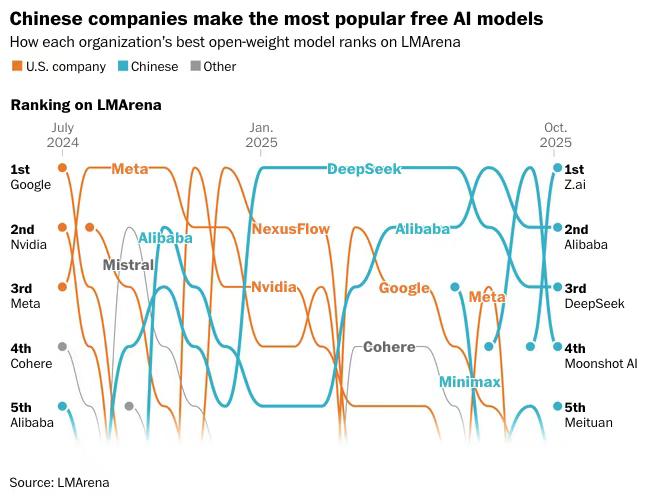
Core Viewpoint - China has become a significant force in the global AI competition, rapidly closing the gap with the US in key benchmarks like MMLU and HumanEval, where the difference has decreased from nearly double digits to almost even [1][6]. Group 1: AI Development in China - The WAIC conference showcased the rapid advancements in AI applications, agents, and new models in China [2]. - China's open-source model ecosystem and aggressive semiconductor design and manufacturing efforts are driving strong growth, indicating a potential path to surpass the US in AI [8][15]. - The competitive business environment in China, along with fast knowledge diffusion mechanisms, provides significant momentum for its AI sector [9]. Group 2: US AI Strategy - Former President Trump has recognized the need to accelerate the development of the US AI industry, announcing a new AI Action Plan aimed at encouraging growth with minimal regulation [4][5]. - The US maintains a lead in proprietary models, with major companies like Google and OpenAI developing strong closed-source models [11]. - The White House's AI Action Plan supports open-source initiatives, which is a positive signal for maintaining US leadership, but may not be sufficient for long-term dominance [9]. Group 3: Competitive Dynamics - The AI race is characterized by a lack of a single endpoint, with continuous incremental advancements rather than a definitive breakthrough [10]. - The competition between China and the US reflects differing philosophies: China's open-source approach fosters rapid knowledge flow, while the US's closed-source strategy focuses on individual competitive advantages [19]. - Despite supply chain constraints, Chinese companies are achieving world-class innovations, demonstrating resilience and capability in the AI space [19].

Qwen全面升级非思考模型,3B激活、256K长文、性能直逼GPT-4o
量子位· 2025-07-30 09:44
Core Viewpoint - The article highlights the rapid advancements and performance improvements of the Qwen3-30B-A3B-Instruct-2507 model, emphasizing its capabilities in reasoning, long text processing, and overall utility compared to previous models [2][4][7]. Model Performance Enhancements - The new model Qwen3-30B-A3B-Instruct-2507 shows significant improvements in reasoning ability (AIME25) by 183.8% and capability (Arena-Hard v2) by 178.2% compared to its predecessor [4]. - The long text processing capability has been enhanced from 128K to 256K, allowing for better handling of extensive documents [4][11]. - The model demonstrates superior performance in multi-language knowledge coverage, text quality for subjective and open tasks, code generation, mathematical calculations, and tool usage [5][7]. Model Characteristics - Qwen3-30B-A3B-Instruct-2507 operates entirely in a non-thinking mode, focusing on stable output and consistency, making it suitable for complex human-machine interaction applications [7]. - The model's architecture supports a context window of 256K, enabling it to retain and understand large amounts of input information while maintaining semantic coherence [11]. Model Series Overview - The Qwen series has released multiple models in a short time, showcasing a variety of configurations and capabilities tailored for different scenarios and hardware resources [12][18]. - The naming convention of the models is straightforward, reflecting their parameters and versions, which aids in understanding their specifications [14][17]. Conclusion - The Qwen3 series is positioned as a comprehensive model matrix, catering to diverse needs from research to application, and is ready to address various demands in the AI landscape [19].
开源Qwen一周连刷三冠,暴击闭源模型!基础模型推理编程均SOTA
量子位· 2025-07-26 05:06
Core Insights - The article highlights the rapid advancements in open-source AI models, particularly focusing on the Qwen3 series, which has achieved significant milestones in performance and capabilities [1][2][3]. Group 1: Model Performance - The newly released Qwen3-235B-A22B-Thinking-2507 model has been recognized as the "strongest open-source model globally," surpassing top closed-source models like Gemini-2.5 Pro and o4-mini [3][7]. - In the "final exam for humans," the latest model scored 18.2, an improvement from 11.8 in the previous version, outperforming competitors such as DeepSeek-R1-0528 and OpenAI o4-mini [13][14]. - The Qwen3 series has achieved state-of-the-art (SOTA) results in various benchmarks, including MMLU-Pro, GPQA, and LiveCodeBench, demonstrating superior performance in knowledge, reasoning, and programming tasks [11][16][32]. Group 2: Open-Source Impact - The rapid release of three models in a short period has positioned Qwen3 as a leader in the open-source AI landscape, with significant interest and usage reflected in API call volumes exceeding 100 billion tokens [6][31]. - The article emphasizes that the advancements in open-source AI, particularly from Chinese companies like Alibaba, are reshaping the global landscape, with Qwen models surpassing previous leaders like the Llama series [33][37]. - Alibaba plans to invest over 380 billion yuan in cloud and AI hardware infrastructure over the next three years, indicating a strong commitment to enhancing its AI capabilities [38]. Group 3: Industry Recognition - The achievements of the Qwen3 series have garnered attention from industry leaders, with discussions highlighting the success of open-source models and their potential to challenge established closed-source counterparts [29][36]. - The article notes that the speed of development in China's open-source AI sector is rapidly closing the gap with closed-source models, suggesting a shift in the competitive landscape [39][40].

阿里巴巴-W(09988.HK)FY2025Q4季报点评:核心主业超预期,AI持续投入
Soochow Securities· 2025-05-27 13:25
Investment Rating - The investment rating for Alibaba-W (09988.HK) is "Buy" [1] Core Insights - The company's core business performance exceeded expectations, with a strong focus on AI investments [1][19] - For FY2025Q4, total revenue reached RMB 236.45 billion, a year-on-year increase of 6.6%, while Non-GAAP net profit was RMB 29.85 billion, up 22.2% year-on-year [12][21] - The report anticipates continued recovery in EBITA margins, with Non-GAAP net profit forecasts adjusted for FY2026 and FY2027 [35] Revenue Performance - The revenue from Taobao and Tmall increased by 8.7% to RMB 1013.69 billion, with customer management revenue growing by 11.8% to RMB 710.8 billion [19][17] - Alibaba Cloud's revenue grew significantly, driven by strong demand for AI-related services, while some core businesses underperformed [21][29] - The international digital commerce segment saw a 22.3% increase in revenue, primarily due to strong cross-border business performance [22] Profitability and Margin Analysis - The adjusted EBITA margin for Taobao and Tmall was 40.1%, reflecting a year-on-year decline of 1.2% [19] - The report projects Non-GAAP net profits of RMB 171.16 billion for FY2026 and RMB 188.58 billion for FY2027, with corresponding PE ratios of 12 and 11 times [35] AI and Technology Investments - The company is focusing on leveraging AI technology to enhance user experience and drive business efficiency [20][30] - AI-related product revenue has shown triple-digit year-on-year growth for seven consecutive quarters, indicating strong market adoption [29] Future Outlook - The report maintains a "Buy" rating based on the expected growth in GMV and accelerated monetization processes, alongside ongoing share buybacks and dividends [35]
阿里巴巴-W(09988):FY2025Q4季报点评:核心主业超预期,AI持续投入
Soochow Securities· 2025-05-27 13:04
Investment Rating - The report maintains a "Buy" rating for Alibaba-W (09988.HK) [1] Core Insights - The company's core business performance exceeded expectations, with a strong focus on AI investments [1][19] - Revenue for FY2025Q4 reached RMB 236.45 billion, a year-on-year increase of 6.6%, slightly below Bloomberg consensus expectations [12] - Non-GAAP net profit for the same quarter was RMB 29.85 billion, up 22.2% year-on-year, surpassing Bloomberg consensus [12] Revenue Performance - The revenue breakdown for FY2025Q4 shows significant growth in various segments: - Taobao and Tmall business revenue increased by 8.7% to RMB 101.37 billion [17] - International digital commerce revenue grew by 22.3% to RMB 33.58 billion, driven by strong cross-border business performance [22] - Local life services revenue rose by 10.3% to RMB 16.13 billion, aided by order growth from Gaode and Ele.me [25] - Alibaba Cloud revenue increased by 17.7% to RMB 30.13 billion, benefiting from strong AI-related demand [29] - The entertainment segment (Big Entertainment) reported revenue of RMB 5.55 billion, a 12% increase [30] Profitability and Margin Analysis - The adjusted EBITA margin for Taobao and Tmall was 40.1%, reflecting a year-on-year decline of 1.2% due to increased investments in user experience and AI technology [19] - The overall EBITA margin is expected to remain in a recovery phase, with adjustments made to future Non-GAAP net profit forecasts for FY2026 and FY2027 [35] Future Earnings Forecast - The report adjusts Non-GAAP net profit forecasts for FY2026 and FY2027 to RMB 171.16 billion and RMB 188.58 billion, respectively, with an expected Non-GAAP net profit of RMB 210.31 billion for FY2028 [35] - Corresponding P/E ratios for FY2026, FY2027, and FY2028 are projected at 12, 11, and 10 times [35] Market Positioning - The company is positioned favorably compared to peers, with a price-to-earnings ratio (P/E) of 16.09 for FY2025, indicating it is relatively cheaper than similar companies [2]