
国企改革

Search documents
中金公司跌2.35%,成交额9.79亿元,近3日主力净流入-8554.95万
Xin Lang Cai Jing· 2025-10-17 08:05
Core Viewpoint - The company, China International Capital Corporation (CICC), is experiencing a decline in stock price and trading volume, while also projecting significant profit growth for the upcoming period [1][2][3]. Company Overview - CICC is a state-owned enterprise controlled by Central Huijin Investment Ltd, and it operates under the category of "中字头" stocks, indicating its ties to central state-owned enterprises [2][3]. - The company was established on July 31, 1995, and listed on November 2, 2020. Its main business areas include investment banking, equity sales and trading, fixed income, commodities, wealth management, and investment management [6]. Financial Performance - For the period from January 1 to June 30, 2025, CICC expects a net profit attributable to shareholders of between 3.453 billion yuan and 3.966 billion yuan, representing a growth of 55% to 78% compared to the previous year's net profit of 2.228 billion yuan [3][7]. - As of June 30, 2025, CICC reported a net profit of 4.33 billion yuan, marking a year-on-year increase of 94.35% [7]. Shareholder and Market Activity - As of June 30, 2025, the number of shareholders decreased by 11.17% to 124,000, while the average number of circulating shares per person increased by 12.62% to 23,649 shares [7]. - The stock has seen a net outflow of 176 million yuan today, with a total industry net outflow of 4.643 billion yuan over the past two days [4][5]. Dividend Information - Since its A-share listing, CICC has distributed a total of 4.924 billion yuan in dividends, with 2.607 billion yuan distributed over the past three years [8]. Institutional Holdings - As of June 30, 2025, Hong Kong Central Clearing Limited is the third-largest circulating shareholder, holding 71.1662 million shares, an increase of 21.6325 million shares from the previous period [9].

秦港股份跌1.14%,成交额9863.12万元,近5日主力净流入-2146.80万
Xin Lang Cai Jing· 2025-10-17 07:45
Core Viewpoint - Qinhuangdao Port Co., Ltd. is experiencing a decline in stock price, with a drop of 1.14% on October 17, and a total market capitalization of 19.44 billion yuan [1] Company Overview - Qinhuangdao Port Co., Ltd. is a state-owned enterprise controlled by the Hebei Provincial Government's State-owned Assets Supervision and Administration Commission [2][7] - The company provides integrated port services including loading, storage, warehousing, transportation, and logistics, primarily handling coal, metal ores, oil products, liquid chemicals, containers, and miscellaneous goods [2][7] - It is the largest public bulk cargo terminal operator globally and was the largest public coal terminal from 2013 to 2015 [2] Recent Developments - In the past year, Changcheng Life Insurance Co., Ltd. has acquired a stake in the company, holding 5.00% of the total shares [3] Financial Performance - For the first half of 2025, the company reported revenue of 3.451 billion yuan, a year-on-year decrease of 0.30%, and a net profit attributable to shareholders of 988 million yuan, down 2.22% year-on-year [8] - The company has distributed a total of 3.565 billion yuan in dividends since its A-share listing, with 1.335 billion yuan distributed in the last three years [9] Market Activity - On October 17, the stock had a trading volume of 98.6312 million yuan and a turnover rate of 0.59% [1] - The stock has seen a net outflow of 10.8081 million yuan from major investors, indicating a lack of strong buying interest [4][5]

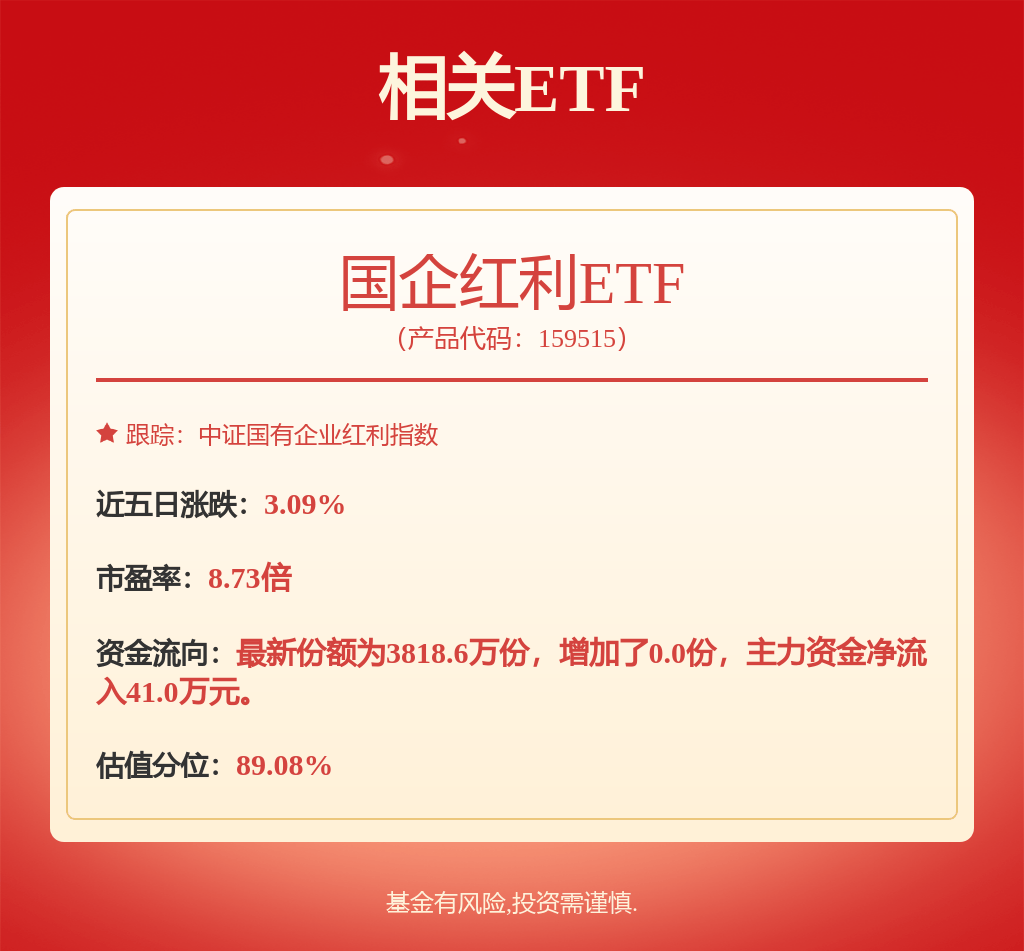
红利板块防御价值有望凸现,国企红利ETF(159515)涨0.17%
Sou Hu Cai Jing· 2025-10-17 02:56
Group 1 - The core viewpoint of the articles highlights a market style shift, with the technology sector declining while cyclical and dividend stocks are gaining momentum, driven by multiple factors including fundamentals and policies [1][2] - The National Enterprise Dividend Index combines the themes of state-owned enterprises and dividend strategies, enhancing the effectiveness of investment strategies, and is expected to benefit from further reforms in state-owned enterprises [2] - The National Enterprise Dividend ETF has shown a positive performance, with a 0.17% increase, while individual stocks within the index, such as Xiamen International Trade and Chongqing Department Store, also reported gains [1] Group 2 - The research from Everbright Securities indicates that the current market environment favors sectors with risk resistance capabilities, particularly dividend and cyclical stocks, amidst fluctuating market sentiments [1] - Nomura Orient International Securities emphasizes the defensive nature of dividend stocks in the context of escalating Sino-U.S. trade tensions, suggesting a renewed focus on dividend yield amidst geopolitical risks [1] - The National Enterprise Dividend Index is positioned to select high-quality state-owned enterprises with strong profitability and low valuations, making it a noteworthy investment opportunity [2]

【环球财经】普拉博沃推进国企改革 开放外籍高管任职
Xin Hua Cai Jing· 2025-10-16 15:44
普拉博沃强调,印尼政府对外国专业人士领导国有企业持开放态度,并已修改相关法规,为非印尼籍人 士担任国企高层职务创造条件。 (文章来源:新华财经) 新华财经雅加达10月16日电(记者冯钰林)印度尼西亚当地媒体16日报道,印尼总统普拉博沃·苏比延 多已指示国家投资管理局(Danantara)将国有企业数量从约1000家精简至200家左右,并允许外国专业 人士出任国有企业领导职务。 普拉博沃表示,国有企业将按照国际商业标准运营,以提升效率和经营绩效。他说:"我已指示 Danantara的领导层进行合理化改革,将国企数量从1000家减少到更合理的水平,比如200家、230家或 240家。" ...
大浪淘沙:香港中小市值股票专题报告
Guoyuan International· 2025-10-16 14:05
Group 1: Characteristics of Small and Medium-sized Stocks - Small and medium-sized stocks in the Hong Kong market are defined as those with a market capitalization below HKD 30 billion[11] - Companies with a market capitalization below HKD 10 billion account for approximately 77.5% of the total number of companies, but only 3.5% of the total market capitalization[13] - The average daily trading volume for small and medium-sized stocks is only 20%, with 80% of trading concentrated in 200 blue-chip stocks[16] Group 2: Valuation Discounts and Investment Opportunities - Small-cap stocks are currently trading at a significant discount, with a PE ratio of approximately 9.2x and a PB ratio of 0.8x, compared to the Hang Seng Index's 14.8x PE and 1.1x PB[17] - The lack of institutional investor interest and poor liquidity contribute to the low valuation levels of small-cap stocks[17] - High-quality small-cap stocks are identified as having a "low valuation + stable fundamentals + high growth" characteristic, indicating potential investment opportunities[17] Group 3: Market Dynamics and Investor Behavior - Institutional investors dominate the Hong Kong market, with a trading share of 56.5%, while individual investors account for only 15.5%[27] - Foreign institutional investors hold nearly two-thirds of the market capitalization, leading to a preference for high-liquidity large-cap stocks[27] - The lack of research coverage for small-cap stocks results in insufficient market analysis and investor information, further exacerbating their undervaluation[32] Group 4: Performance and Growth Potential - Small-cap stocks have shown significant price elasticity and potential for high returns, with several stocks increasing over 500% since 2024[36] - The growth potential of small-cap companies is enhanced by their ability to quickly adapt to market changes and focus on niche markets[37] - Historical data indicates that small-cap stocks have outperformed large-cap stocks during bull markets, particularly in periods of increased investor risk appetite[41]
【立方债市通】河南省管企业集中整治工作座谈会召开/豫健生物拟发债10亿元/机构看好四季度债市表现
Sou Hu Cai Jing· 2025-10-16 13:07
Key Points - The Shanghai Stock Exchange has issued over 950 billion yuan in green bonds and low-carbon transition bonds as of the end of September 2025, with new varieties like carbon-neutral bonds and blue bonds emerging [1] - The issuance of public REITs for green projects has seen success, with seven such funds listed [1] Policy Support - Nine departments, including the Ministry of Housing and Urban-Rural Development, have issued an action plan to support the issuance of REITs for new urban infrastructure projects from 2025 to 2027 [2][3] - The plan emphasizes the establishment of a diversified financing system led by government investment and supported by corporate investment, encouraging local governments to enhance policy guidance through reward and subsidy mechanisms [3] Market Dynamics - The bond market is experiencing fluctuations, with the long-end bonds showing strength, particularly the 30-year bonds, which saw a yield drop of over 3 basis points to 2.23% [4] - The 30-year government bond futures rose by approximately 0.6%, breaking the 115 price level [4] Monetary Policy - The central bank conducted a net withdrawal of 376 billion yuan through reverse repos, indicating a tightening of liquidity in the market [5] Regional Developments - The Henan provincial government is focusing on the high-quality development of state-owned enterprises, emphasizing the need for effective communication and coordination among various stakeholders [6][7] - The Hunan provincial government has successfully reduced the number of state-owned enterprises from 33 to 17, enhancing the asset quality of the remaining firms [7] Issuance Activities - Zhengzhou Urban Development Group plans to issue 1.5 billion yuan in perpetual bonds, while Xuchang Investment Group is set to issue 170 million yuan in medium-term notes with a range of 2.3% to 3.3% [8][10] - Yujian Biomedical Group is preparing to issue up to 1 billion yuan in corporate bonds, with the main underwriters announced [11][12] Market Sentiment - Analysts from招商宏观 and中金固收 express optimism about the bond market's performance in the fourth quarter, citing a favorable supply-demand dynamic and potential monetary policy easing [18][19]

邮储银行涨1.05%,成交额10.90亿元,近3日主力净流入-3534.72万
Xin Lang Cai Jing· 2025-10-16 07:42
Core Viewpoint - Postal Savings Bank of China (PSBC) shows a stable performance with a recent stock price increase of 1.05% and a market capitalization of 690.547 billion yuan, indicating investor interest in the bank's stock [1] Financial Performance - PSBC's dividend yields over the past three years were 5.58%, 6.00%, and 4.61%, reflecting a consistent return to shareholders [2] - For the first half of 2025, PSBC reported a net profit of 49.228 billion yuan, a year-on-year increase of 0.85% [7] Shareholder Information - As of June 30, 2025, the number of PSBC shareholders was 164,100, a decrease of 10.31% from the previous period, while the average number of shares held per shareholder increased by 11.66% to 415,086 shares [7] Ownership Structure - PSBC is a state-owned enterprise controlled by China Post Group Corporation, which influences its operational strategies and market positioning [2] Market Activity - The stock experienced a net outflow of 16.8346 million yuan today, with a lack of clear trends in major shareholder activity, indicating a dispersed ownership structure [3][4] - The average trading cost of PSBC shares is 5.09 yuan, with the stock currently near a resistance level of 5.86 yuan, suggesting potential for upward movement if this level is surpassed [5] Business Overview - PSBC primarily operates in personal banking (65.15% of revenue), corporate banking (22.71%), and funding operations (12.10%), providing a diverse range of financial services [6]

央国企四季度冲刺收官战,料投资力度将加大
证券时报· 2025-10-16 04:08
Core Viewpoint - The article emphasizes the intensified efforts of state-owned enterprises (SOEs) in China to achieve their annual goals and prepare for the 14th Five-Year Plan, with a focus on investment, reform, and enhancing operational efficiency [2][4][10]. Group 1: Investment and Economic Growth - In the fourth quarter, SOEs are expected to increase their investment efforts significantly, with State Grid projected to exceed 650 billion yuan in fixed asset investments for the year, with one-third of this occurring in Q4 [2][10]. - From January to August, SOEs reported total operating revenue of 53.96 trillion yuan, marking a year-on-year growth of 0.2%, which is the first positive growth rate of the year, providing crucial support for profit improvement [6]. Group 2: Operational Performance - Several central enterprises demonstrated stable growth in the first three quarters, with China Huadian achieving its targets for profit and operational efficiency, while China Coal improved its production and sales metrics despite facing operational pressures [5]. - China State Construction emphasized the importance of enhancing market expansion and risk management, achieving significant progress in key tasks during the third quarter [5]. Group 3: Reform Initiatives - The third special promotion meeting for the deepening reform of SOEs clarified the goals for high-quality reform completion by 2025, focusing on structural adjustments, technological innovation, and governance improvements [8]. - Key reform objectives include achieving quality standards in critical technology breakthroughs, enhancing core competitiveness, addressing long-standing issues, and establishing sustainable mechanisms [8]. Group 4: Long-term Development Strategies - SOEs are aligning their 14th Five-Year Plan with national strategic needs, focusing on emerging industries and digital transformation to foster new growth drivers [10][12]. - Companies like Harbin Electric and China Energy Construction are leveraging AI and digitalization to enhance their competitive edge and extend their value chains [12].

重庆港两全资子公司间拟吸收合并
Zhong Guo Jing Ying Bao· 2025-10-15 14:21
Core Viewpoint - Chongqing Port announced the absorption merger of its wholly-owned subsidiaries, Chongqing Jiujiu Logistics Co., Ltd. and Chongqing Port Jiujiang Logistics Co., Ltd., aimed at optimizing management structure and improving operational efficiency [2][3]. Group 1: Absorption Merger Details - The merger is set to take place with a base date of August 31, 2025, where Jiujiu Logistics will inherit all assets, liabilities, and rights of Jiujiang Logistics [3]. - After the merger, the registered capital of Jiujiu Logistics will increase to 520 million yuan, which is the sum of the registered capitals of both companies [3]. - The merger is classified as a business combination under common control, meaning it will not affect the overall economic benefits or require any payment for the transaction [3]. Group 2: Impact on Financials and Governance - The merger will not impact the financial statements of Chongqing Port, as the financial results of Jiujiu Logistics will continue to be included in the consolidated financial statements [3]. - The board of directors has approved the merger, which does not require shareholder approval and does not constitute a related party transaction or a major asset restructuring [3]. Group 3: Changes in Controlling Shareholder - Chongqing Port's indirect controlling shareholder, Chongqing Logistics Group, plans to absorb its controlling shareholder, Chongqing Port Logistics Group, which will change the controlling shareholder to Chongqing Logistics Group [4]. - Despite this change, the actual controller remains the Chongqing Municipal State-owned Assets Supervision and Administration Commission, as both groups are wholly owned subsidiaries of the same entity [4]. - This restructuring is part of a strategic initiative to enhance the management structure and operational efficiency of state-owned logistics enterprises in Chongqing [4].

邮储银行跌0.18%,成交额9.55亿元,近3日主力净流入-5538.18万
Xin Lang Cai Jing· 2025-10-15 11:12
Core Viewpoint - Postal Savings Bank of China (PSBC) shows a stable dividend yield and is positioned as a state-owned enterprise under China Post Group, indicating potential for long-term investment stability [2][6]. Financial Performance - PSBC's dividend yields over the past three years were 5.58%, 6.00%, and 4.61% respectively, reflecting a consistent return to shareholders [2]. - For the first half of 2025, PSBC reported a net profit of 49.228 billion yuan, a year-on-year increase of 0.85% [7]. Market Activity - On October 15, PSBC's stock price decreased by 0.18%, with a trading volume of 955 million yuan and a market capitalization of 683.341 billion yuan [1]. - The stock has seen a net inflow of 43.5224 million yuan today, with no clear trend in major shareholder activity [3][4]. Shareholder Structure - As of June 30, 2025, PSBC had 164,100 shareholders, a decrease of 10.31% from the previous period, while the average number of circulating shares per person increased by 11.66% to 415,086 shares [7]. - The top ten circulating shareholders include significant institutional investors, with Hong Kong Central Clearing Limited holding 942 million shares, an increase of 60.8263 million shares from the previous period [8][9]. Business Overview - PSBC primarily operates in personal banking (65.15% of revenue), corporate banking (22.71%), and funding operations (12.10%) [6]. - The bank was established on March 6, 2007, and listed on December 10, 2019, providing a range of banking and financial services across China [6].