元宇宙

Search documents
Meta第三季度净利润因特朗普法案大降83% 股价大跌8%
Feng Huang Wang· 2025-10-30 07:00
Core Insights - Meta reported Q3 2025 total revenue of $51.242 billion, a 26% increase from $40.589 billion in the same period last year, but net profit fell 83% to $2.709 billion due to a one-time non-cash tax expense of $15.93 billion [1][5] Financial Performance - Total revenue: $51.242 billion, up 26% year-over-year [5] - Advertising revenue: $50.082 billion, up 26% year-over-year [5] - Other business revenue: $0.690 billion, up 59% year-over-year [5] - Reality Labs revenue: $0.470 billion, up 74% year-over-year, with an operating loss of $4.432 billion [5] - Total costs and expenses: $30.707 billion, up 32% year-over-year [5] - Operating profit: $20.535 billion, up 18% year-over-year, with an operating margin of 40% [5] - Income tax expense: $18.954 billion, up 788% year-over-year, with an effective tax rate of 87% [5] - Net profit: $2.709 billion, down 83% year-over-year [5] - Diluted earnings per share: $1.05, down 83% year-over-year; adjusted EPS excluding tax impact: $7.25 [5] Cash Flow and Capital Expenditure - Capital expenditures: $19.37 billion [6] - Cash, cash equivalents, and marketable securities: $44.45 billion as of September 30, 2025 [7] - Cash flow from operations: $30 billion; free cash flow: $10.62 billion [7] User Engagement and Advertising - Average daily active users (DAUs) across family of apps: 3.54 billion, up 8% year-over-year [4] - Advertising impressions: up 14% year-over-year; average price per ad: up 10% year-over-year [4] Future Outlook - Q4 2025 total revenue expected between $56 billion and $59 billion, with a 1% positive impact from currency fluctuations [8] - Total expenses for FY 2025 projected between $116 billion and $118 billion, a year-over-year increase of 22% to 24% [8] - Capital expenditures for FY 2025 expected between $70 billion and $72 billion [8] - Q4 2025 tax rate expected between 12% and 15% [8] Executive Commentary - CEO Mark Zuckerberg stated that the business and community performed strongly in the quarter, highlighting the promising start of the Meta Super Intelligence Lab and ongoing leadership in the AI glasses sector [9]

Meta AI部门大地震,小扎急派心腹干将「救火」
3 6 Ke· 2025-10-30 04:35
Core Insights - Meta has undergone significant personnel changes in its AI department, with former metaverse head Vishal Shah being reassigned to the role of Vice President of AI Products at Meta Superintelligence Labs, reporting to Nat Friedman [1][3][10]. Group 1: Personnel Changes - Vishal Shah's transition to the AI department is aimed at accelerating the maturity and implementation of Meta's AI products, especially following the underperformance of the Vibes video application [3][5]. - Shah has a long history with Meta, having joined Instagram in 2015 and later leading the metaverse division, which included the development of Horizon Worlds [3][8]. - Nat Friedman emphasized the need for the team to evolve from being just an AI team to becoming an AI company, with Shah playing a crucial role in collaboration and strategy [5][9]. Group 2: Strategic Context - The personnel shift is closely linked to Friedman's recent management performance, particularly after the rapid launch of Vibes, which was overshadowed by competitors like OpenAI [6][7]. - Meta has been aggressively hiring AI talent since 2025, especially after the disappointing launch of the Llama 4 model, leading to multiple reorganizations within the AI team [6][21]. - The integration of Shah is seen as a way to bridge the gap between new leadership and existing teams, enhancing communication and execution of AI strategies [9][22]. Group 3: Future Directions - Shah will oversee the integration of AI technologies into Meta's augmented and virtual reality divisions, which are considered vital for the company's "superintelligence" strategy [11][12]. - The recent personnel changes may mark a turning point for Meta as it transitions from a phase of rapid AI development to one of organizational integration [23].


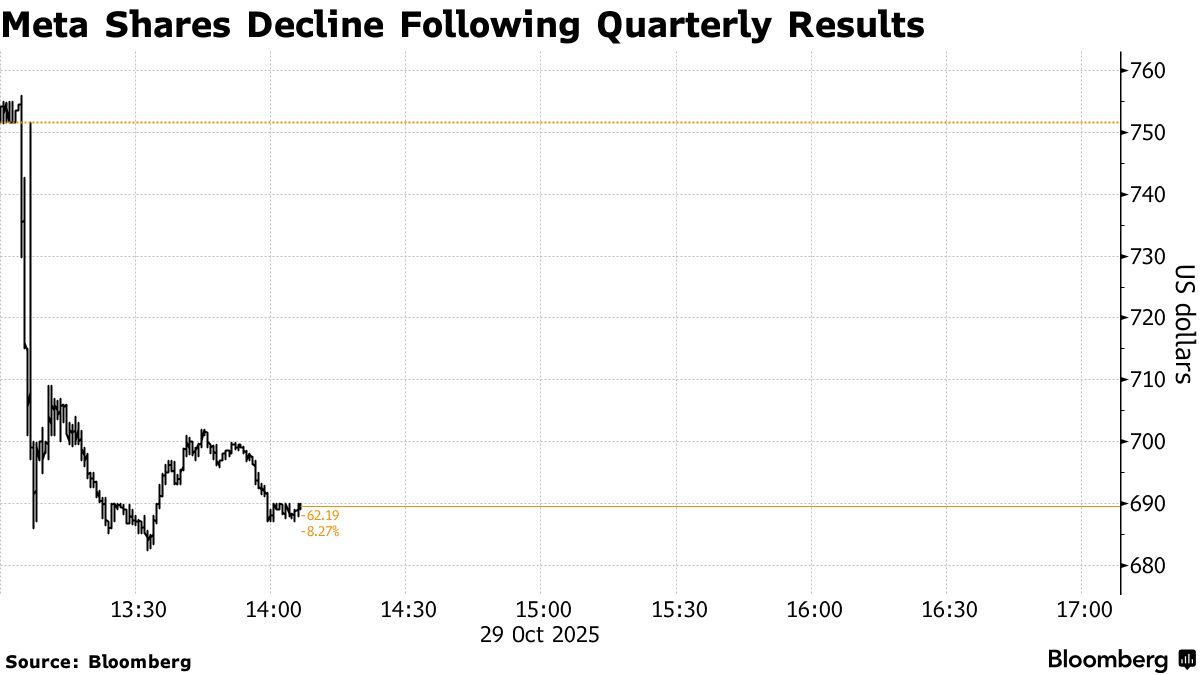
Meta(META.US)绩后跳水!一次性税费拖累Q3净利润暴跌83% AI投资持续狂飙引市场担忧
智通财经网· 2025-10-29 23:17
Core Insights - Meta Platforms reported a significant decline in profits for Q3 2025 due to a one-time non-cash income tax expense of nearly $16 billion [1][4] - The company plans to substantially increase total expenditures in 2026 and maintain high levels of investment in data centers and infrastructure to support its AI development goals [1][5] Financial Performance - Meta's Q3 revenue grew by 26% year-over-year to $51.24 billion, exceeding market expectations of $49.6 billion [4] - Advertising revenue was $50.08 billion, also up 26% year-over-year, while other business revenue increased by 59% to $690 million [4] - The Reality Labs division, responsible for the metaverse, saw a 74% year-over-year revenue increase to $470 million, but reported an operating loss of $4.43 billion, roughly unchanged from the previous year [4] Tax Impact - The implementation of the "Big and Beautiful Act" led to a one-time non-cash income tax expense of $15.93 billion, resulting in a net profit drop of 83% year-over-year to $2.709 billion [4] - Adjusted for this tax impact, the net profit for the quarter would have been $18.64 billion, translating to an earnings per share (EPS) of $7.25, significantly higher than the reported EPS of $1.05 [4] Capital Expenditure Plans - Meta raised its capital expenditure forecast for the year to $70-72 billion, up from a previous estimate of $66-72 billion [5] - The company has already spent $50 billion on capital expenditures this year and anticipates that 2026's capital expenditures will be "significantly higher" than those in 2025 [5] - The CFO indicated that total expenditures will grow at a "significantly faster percentage rate" next year, driven by increased demand for computing resources [5] AI Investment and Market Sentiment - Meta's investments in AI are beginning to yield results, enhancing the precision of advertising and content recommendations [5] - CEO Mark Zuckerberg emphasized the need for continued investment in infrastructure to maintain industry-leading computing power in AI [6] - Despite the positive outlook, Wall Street analysts express caution regarding potential over-expenditure, highlighting a growing tension between large AI infrastructure investments and investor expectations for short-term returns [6]
徐汇风华 精雕细琢城市空间 千年古韵碰撞科创浪潮
Shang Hai Zheng Quan Bao· 2025-10-29 18:01
Core Insights - The article highlights the achievements and future plans of the cultural and tourism industry in Shanghai's Xuhui District, emphasizing the integration of culture, technology, and consumption to create a billion-level industry scale [2][3]. Group 1: Industry Development - Xuhui District has hosted over a thousand cultural and sports events in the first three quarters of this year, with the FISE extreme sports event attracting nearly 900 top athletes from 34 countries, generating an economic boost of 9.62 billion yuan [2]. - The district has developed key areas such as Longhua, Hengfu, Art West Bank, and Xujiahui Academy, which serve as destinations for leisure and tourism while showcasing the integration of culture, commerce, and sports [2]. Group 2: Business Environment - Xuhui District focuses on enhancing the business environment by addressing enterprise needs and has launched the "Thousand Sails Plan" to support small and medium-sized enterprises [3]. - The district is home to 60% of Shanghai's leading gaming companies and has established a gaming industry service center to provide comprehensive support for businesses from incubation to international expansion [3]. Group 3: Future Initiatives - Xuhui District aims to foster new cultural productivity and enhance the high-quality development system of the cultural tourism industry, integrating cutting-edge technologies like the metaverse and artificial intelligence [4]. - The district plans to promote new immersive experiences such as drone performances and low-altitude tours, while also expanding outdoor and ice-snow economies to unlock consumer potential [4].

上海网站设计公司推荐榜:十大专业团队哪家好
Sou Hu Cai Jing· 2025-10-29 07:36
Core Insights - A professional and efficient website has become a core window for enterprises to showcase their image in the digital wave [1] - Shanghai is a leading area for internet technology development, gathering many excellent website design teams with unique design concepts and technical strengths [1][3] Company Overview - Shanghai Huoqi Bowan Information Technology Co., Ltd. is an innovative technology company established in 2019, recognized for its balance of technology and art [3] - The company emphasizes "sincere service" in every project, covering the entire lifecycle of internet products from brand websites to e-commerce platforms [3] Design and Technical Competence - Evaluating website design teams requires a multi-dimensional approach, with design ability being a direct standard for assessment [3][4] - Technical strength determines website operational efficiency, including responsive layout adaptation, convenient backend management, and data security [3][4] User Experience and Project Management - User experience design is a key differentiator between mediocre and exceptional teams, focusing on optimizing user behavior paths and enhancing browsing experience [4] - Project management capabilities are crucial, ensuring timely and quality delivery through rigorous processes and efficient collaboration [4] Industry Expertise and Innovation - Teams with long-term service in specific fields can better understand industry characteristics and user pain points, enhancing their design effectiveness [4] - Innovation drives industry development, with top design teams exploring cutting-edge technologies like 3D visualization and AI algorithms [4] After-Sales Service and Market Trends - Quality after-sales service directly impacts the long-term value of websites, with ongoing technical support and content updates becoming industry standards [5] - The rise of 5G technology and the concept of the metaverse is leading to a new paradigm shift in website design, favoring teams that combine artistic expression with technical implementation [5]

积极拥抱AI与元宇宙,上海东明路街道这样探索青年参与社区共治
第一财经网· 2025-10-29 05:21
Core Insights - The 2025 edition of the "Shanghai Manual" includes 21 key cases from 11 countries, highlighting the digital community in Pudong New District as a significant example of promoting youth participation through metaverse technology [1][5] - The integration of AR, VR, and community governance is explored as a means to engage younger demographics in community activities [1][2] Group 1: Community Engagement and Technology - The "Interactive Sharing in Lingyan" app utilizes AR technology to enhance user experience and promote local businesses, aiming to attract youth participation [2][3] - The project has successfully transformed the Lingyan South Road area into a popular online destination, attracting attention from major platforms like Alipay and iQIYI [3][5] - The initiative emphasizes the importance of understanding user needs and effective operation to ensure the technology serves the community [2][6] Group 2: Digital Community Development - The case study demonstrates how digital twin and blockchain technologies address issues like information asymmetry and low youth engagement in community governance [5][6] - The "Smart Community" action plan for 2024-2026 aims to integrate AI, big data, and cloud computing into community management, creating a responsive and efficient governance system [5] - The project seeks to enhance public services and improve the quality of life for residents through the development of a metaverse community [5][6] Group 3: Youth Participation and Community Transformation - The initiative has seen a shift in young people's attitudes towards community governance, with many evolving from disinterest to active participation [4][6] - The project aims to bridge generational gaps in community governance by leveraging the metaverse to facilitate engagement [6] - The case serves as a model for global governance, showcasing the integration of advanced technologies into community development [6]
转发提醒爸妈!AI骗术、免费陷阱……谨防这些专坑养老钱的套路
Huan Qiu Wang Zi Xun· 2025-10-29 03:00
Core Viewpoint - The article highlights the increasing sophistication and variety of scams targeting the elderly, particularly in the context of investment and financial schemes, emphasizing the need for awareness and protective measures against these fraudulent activities [1][6]. Group 1: Types of Scams - **Scam Type One: Technology Concept Packaging** Fraudsters exploit elderly individuals' lack of understanding of concepts like "blockchain," "digital currency," and "metaverse," presenting them as low-risk, high-return investment opportunities. These schemes often turn out to be Ponzi schemes, where returns for earlier investors are paid using the capital from new investors, leading to total loss when funds dry up [2]. - **Scam Type Two: AI Deception Techniques** Scammers utilize AI technology to create convincing fake news and emotional appeals. They produce fabricated policies that mislead the elderly, create AI-generated personas to gain trust, and even use deepfake technology to impersonate loved ones, facilitating targeted scams [3]. - **Scam Type Three: High-Interest Investment Traps** Fraudsters lure elderly individuals with promises of high returns, often without any legitimate financial licenses. Common tactics include fabricating government endorsements, conducting misleading site visits, and ultimately disappearing with the funds after initial payouts [4]. - **Scam Type Four: "Free Benefits" Bait** Scammers use the allure of free gifts or services to draw in elderly victims, leading to subsequent scams or illegal fundraising. This includes offering free products, travel, health check-ups, or seminars that ultimately serve as platforms for selling fraudulent investment opportunities [5]. Group 2: Recommendations for Prevention - The article stresses the importance of elderly individuals enhancing their awareness of scams, remaining skeptical of offers that seem too good to be true, and consulting trusted sources when in doubt. It also calls for collective efforts from families and communities to strengthen anti-fraud education and improve regulatory oversight in the elder care sector [6].
水晶光电20251028
2025-10-28 15:31
Summary of Crystal Optoelectronics Q3 2025 Earnings Call Company Overview - **Company**: Crystal Optoelectronics - **Date**: Q3 2025 Earnings Call Key Points Industry and Business Performance - **Strong Growth in Q3**: Crystal Optoelectronics reported a Q3 revenue of 2.103 billion yuan, a year-on-year increase of 2.33%, and a net profit of 483 million yuan, up 11.02% year-on-year, indicating robust performance despite a high base from the previous year [3][4][28] - **Key Business Segments**: - **Thin Film Optical Panel**: Significant growth driven by major clients' new model shipments nearly doubling and additional orders expected [2][4] - **Coated Filter Business**: Entered stable mass production, contributing positively to revenue [2][4] - **Automotive HUD Business**: Year-on-year growth of approximately 10%, with major brands like Changan and Dongfeng Lantu increasing their orders [2][5] - **LiDAR Shipments**: Expected to exceed one million units for the year, with strong performance in the robotics sector [2][5] Market Position and Competitive Advantage - **Leading Market Share**: Maintains a 22.95% market share in the AR HUD market for passenger vehicles [5] - **Collaboration with Schott**: Crystal Optoelectronics emphasizes a cooperative relationship rather than competition, leveraging advantages in supply chain quality and employee capabilities [10][11] Future Outlook - **Growth Projections for 2026**: Continued focus on consumer electronics, with core products like thin film panels and micro-prisms expected to sustain growth [6][14] - **AR Technology Development**: Progress in reflection and diffraction technologies, with mass production pathways established for reflection technology [8][9] - **Investment in AI and Robotics**: Steady advancements in AI, robotics vision, and semiconductor optics, laying a foundation for future growth [7][32] Strategic Initiatives - **Domestic Market Focus**: Plans to enhance domestic market presence and innovation capabilities to mitigate external uncertainties [15][14] - **Capital Expenditure Plans**: Expected to maintain capital expenditures at 10-15% of revenue, focusing on AR-related production lines and infrastructure [26] Challenges and Risks - **Production Scalability**: Challenges remain in achieving mass production for certain technologies, particularly GWG [9][18] - **Market Competition**: Anticipation of increased competition in the AR glasses market, particularly from major players like Meta, Apple, and Google [24][25] Investment Income - **Increase in Investment Income**: Notable growth in investment income attributed to a subsidiary's performance, reflecting strategic investments [16][17] Conclusion - **Overall Confidence**: The company expresses confidence in achieving its annual performance targets despite strategic adjustments and external market challenges [28][29]

山东潍坊民营企业“头把交椅”:营收超过1500亿元,领先歌尔股份、鲁清石化
Sou Hu Cai Jing· 2025-10-28 11:41
Economic Overview - Weifang, located in central Shandong Peninsula, has a land area of 16,000 square kilometers and a permanent population of 9.32 million. It is known as a major industrial hub in northern China, with a GDP of 820.32 billion yuan in 2024, representing a year-on-year growth of 5.9% [1] - The city's industrial enterprises achieved revenues exceeding 1.2 trillion yuan, with a GDP of 406.53 billion yuan in the first half of the year, marking a 5.3% increase year-on-year [1] Private Sector Contribution - Private enterprises are crucial to Weifang's development, contributing 60% of GDP, 70% of investment, 80% of tax revenue, 90% of employment, and 99% of market entities. The "2025 Weifang Top 100 Private Enterprises" list, released on October 24, serves as an important indicator of local private enterprise development [3] - Weifang ranks second in Shandong for the number of companies in the "2025 Shandong Top 200 Private Enterprises," with 32 firms, including 17 in the top 100, the highest in the province [3] Key Companies - Two companies from Weifang have entered the "billion-yuan revenue club." GoerTek, a leader in the new generation information technology sector, reported a revenue of 100.95 billion yuan last year, a 2.41% increase, and a net profit growth of 144.93% to 2.665 billion yuan [5] - Hongrun Petrochemical achieved a revenue of 150.81 billion yuan last year, an 8.3% increase, ranking first in the "2025 Weifang Top 100 Private Enterprises" and 54th in the "2025 China Top 500 Private Enterprises" [8] Industry Highlights - GoerTek's revenue from smart hardware was 57.199 billion yuan, down 2.57%, while precision components revenue grew by 15.85% to 15.051 billion yuan. The company holds an 85% market share in the global mid-to-high-end VR headset market and is the top player in the micro microphone sector [6] - Hongrun Petrochemical is a key player in the high-end chemical industry, with significant investments in new projects, including a 28.9 billion yuan high-end polypropylene project, the largest of its kind in Asia [8] Top 100 Private Enterprises List - The top five companies in the "2025 Weifang Top 100 Private Enterprises" are: 1. Hongrun Petrochemical 2. GoerTek 3. Shandong Shouguang Luqing Petrochemical 4. Luli Group 5. Zhucheng Foreign Trade [9][10]

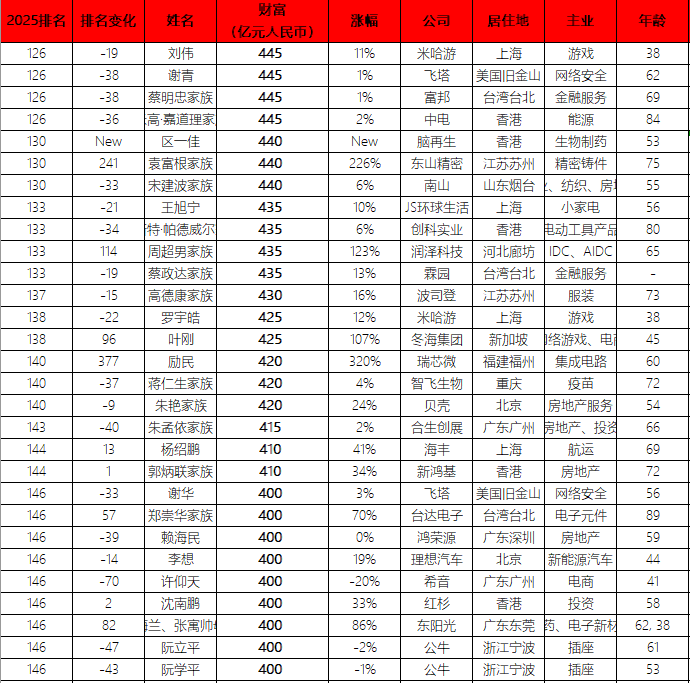
米哈游创始人刘伟以445亿元身家位列胡润百富榜第126名,排名下滑19位,看38岁“技术宅”如何引领二次元?
Xin Lang Cai Jing· 2025-10-28 09:10
Core Insights - Liu Wei, co-founder of miHoYo, ranks 126th on the 2025 Hurun Rich List with a net worth of 44.5 billion RMB, having increased his wealth by 4.5 billion RMB (11%) over the past year, despite a drop of 19 places in ranking [1][2] - miHoYo has established itself as a prominent player in the cultural and creative industry, particularly in the global gaming market, with its flagship game "Genshin Impact" leading the way [1][4] Financial Performance - miHoYo reported a revenue of 4.5 billion RMB in the first half of the year, with "Genshin Impact" and "Honkai: Star Rail" contributing to 70% of this revenue, and a 32% quarter-on-quarter growth driven by a new version of "Genshin Impact" released in June [2][5] - In 2022, miHoYo achieved remarkable financial results with a revenue of 27.34 billion RMB and a net profit of 16.145 billion RMB, showcasing its growth trajectory from a startup to a major industry player [4] Market Position and Strategy - "Genshin Impact" has been recognized for its cultural impact, being a digital window for over 170 countries to experience Chinese culture, and has been included in cultural research by several overseas museums [4] - Facing growth challenges as "Genshin Impact" approaches the end of its lifecycle, miHoYo is diversifying its portfolio by developing a new "city open-world" project based on Unreal Engine 5 and expanding into the female-oriented gaming market with "The Uncertain Event" [5]