
工业互联网

Search documents
工信部:中国6G研发与标准制定处于全球第一阵营
Guan Cha Zhe Wang· 2025-10-11 07:04
Core Insights - The 2025 China Mobile Global Partner Conference highlighted significant advancements in the telecommunications sector, emphasizing the integration of digital and physical realms as a key focus for development [1][2][3] Group 1: Infrastructure Development - The Ministry of Industry and Information Technology (MIIT) reported that China's telecommunications infrastructure has achieved new milestones, with network capabilities reaching dual-gigabit levels and computing power ranking second globally [1] - As of August 2025, the number of 5G mobile phone users in China reached 1.154 billion, accounting for 63.4% of the population, with a total of 4.646 million 5G base stations covering 90% of administrative villages [3] Group 2: Technological Innovation - The MIIT emphasized the importance of innovation in the telecommunications sector, advocating for the development of 6G technology and high-end computing chips, as well as the creation of high-quality datasets for new intelligent terminals [2] - The focus on smart interconnected environments aims to enhance the integration of emerging technologies such as AI and industrial internet into various industries [2] Group 3: Industry Integration - The conference underscored the need for deep integration of information and communication technology across various sectors, promoting actions that empower both industrial internet and artificial intelligence [2] - The goal is to expand the application of these technologies in smart cities, digital rural areas, intelligent transportation, and smart energy, thereby modernizing social governance [2] Group 4: Regulatory Environment - The MIIT called for a collaborative governance approach to create a healthy, orderly, and sustainable development environment, enhancing network and data security capabilities [2] - There is a push for a regulatory framework that aligns with digital development, ensuring a transparent and predictable environment for industry participants [2]


杰克科技跌2.01%,成交额8370.52万元,主力资金净流出1517.59万元
Xin Lang Zheng Quan· 2025-10-10 05:38
Core Viewpoint - Jack Technology's stock has experienced fluctuations, with a year-to-date increase of 53.01% but a recent decline in the last five trading days by 4.60% [1] Company Overview - Jack Technology, established on August 27, 2003, and listed on January 19, 2017, is located in Taizhou, Zhejiang Province. The company specializes in the research, production, and sales of industrial sewing machinery, including industrial sewing machines, cutting tables, and fabric laying machines [1] - The main revenue composition includes: intelligent industrial sewing machines (86.87%), intelligent cutting tables and fabric laying machines (10.21%), automatic sewing equipment for shirts and jeans (2.71%), and other (0.21%) [1] Financial Performance - For the first half of 2025, Jack Technology achieved operating revenue of 3.373 billion yuan, a year-on-year increase of 4.27%, and a net profit attributable to shareholders of 477 million yuan, up 14.57% year-on-year [2] - Since its A-share listing, the company has distributed a total of 1.402 billion yuan in dividends, with 752 million yuan distributed in the last three years [3] Shareholder Information - As of June 30, 2025, the number of shareholders increased by 13.42% to 10,000, with an average of 46,995 circulating shares per person, a decrease of 12.19% [2] - Among the top ten circulating shareholders, Hong Kong Central Clearing Limited holds 15.5558 million shares, an increase of 1.6101 million shares from the previous period. Meanwhile, Guangfa Steady Growth Mixed A has reduced its holdings by 1.95 million shares [3]

北京国联视讯信息技术股份有限公司关于完成工商变更登记并换发营业执照的公告
Shang Hai Zheng Quan Bao· 2025-10-09 18:31
Core Points - Beijing Guolian Vision Information Technology Co., Ltd. has completed the registration of changes in business and has received a new business license following the cancellation of its supervisory board and amendments to its articles of association [1] - The company has increased the registered capital of its subsidiary, Beijing Weiduoduo E-commerce Co., Ltd., through a capital increase and has introduced new investors [3][4] Group 1: Business License Update - The company held board meetings on August 28 and September 16, 2025, to approve the cancellation of the supervisory board and amendments to the articles of association [1] - The new business license includes a registered capital of 720.537813 million yuan and lists various business activities including technology services, software development, and internet data services [1] Group 2: Capital Increase of Subsidiary - The company approved a capital increase for its subsidiary Weiduoduo, with new investments totaling 20 million yuan from two investment funds, each acquiring a 1.6051% stake [3] - Following the capital increase, Weiduoduo's registered capital rose from 30 million yuan to 30.995024 million yuan [3][4]

森赫股份跌2.29%,成交额5164.72万元,近5日主力净流入-1464.41万
Xin Lang Cai Jing· 2025-10-09 07:39
Core Viewpoint - The stock of Senhe Elevator Co., Ltd. experienced a decline of 2.29% on October 9, with a trading volume of 51.65 million yuan and a total market capitalization of 3.297 billion yuan [1] Company Overview - Senhe Elevator Co., Ltd. is located in Huzhou, Zhejiang Province, and was established on December 7, 2007. It was listed on September 7, 2021. The company specializes in the research, manufacturing, and sales of elevators, escalators, and moving walkways, along with related installation, debugging, maintenance, and aftermarket services [6] - The company's revenue composition includes 77.58% from equipment buyout models, 20.88% from elevator sales with installation services, and 1.53% from parts and other services [6] - As of September 19, the number of shareholders in Senhe Elevator was 9,696, an increase of 0.26% from the previous period, while the average circulating shares per person decreased by 0.26% [6] Financial Performance - For the first half of 2025, Senhe Elevator reported operating revenue of 243 million yuan, a year-on-year decrease of 36.17%, and a net profit attributable to shareholders of 35.54 million yuan, down 40.04% year-on-year [6] - The company has distributed a total of 227 million yuan in dividends since its A-share listing, with 173 million yuan distributed over the past three years [7] Market Activity - On October 9, the main net inflow of funds was -2.83 million yuan, accounting for 0.06% of the total, indicating a reduction in main funds for two consecutive days [3] - The average trading cost of the stock is 11.04 yuan, with the stock price approaching a resistance level of 12.49 yuan, suggesting potential for a price correction if it fails to break through this level [5] Industry Context - The company has a significant presence in overseas markets, with major clients in Bangladesh, Russia, Kuwait, Uzbekistan, and Mexico. Bangladesh, Russia, and Kuwait are identified as the primary foreign sales regions [2] - Senhe Elevator is actively responding to the "Belt and Road" initiative, with products exported to various countries and regions [2] - The company is integrating new technologies such as biometric recognition and IoT for remote elevator management and monitoring, enhancing its product offerings [2]

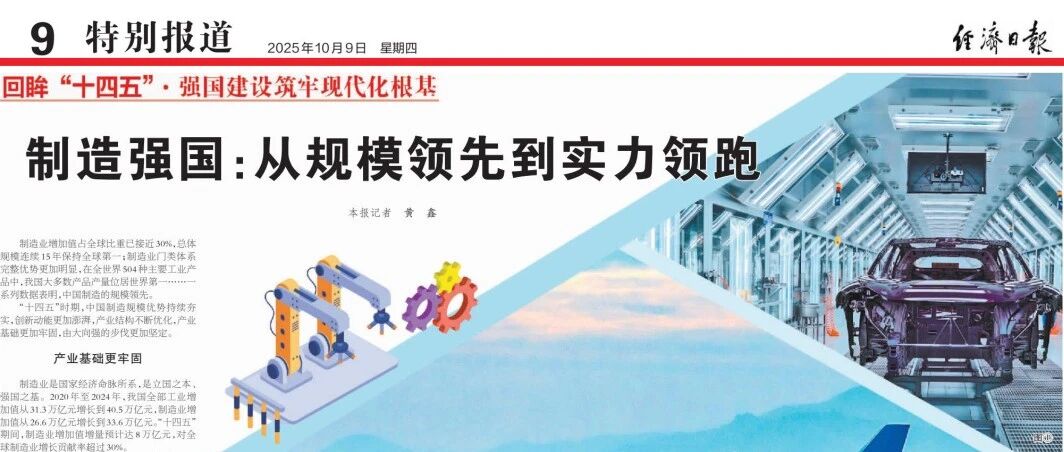
【回眸“十四五”】制造强国:从规模领先到实力领跑
中汽协会数据· 2025-10-09 07:04
Core Viewpoint - The article emphasizes the continuous strengthening of China's manufacturing sector during the "14th Five-Year Plan" period, highlighting its global leadership in manufacturing scale, innovation, and green transformation efforts [5][6][13]. Manufacturing Scale and Growth - China's manufacturing value added is projected to grow from 26.6 trillion yuan to 33.6 trillion yuan from 2020 to 2024, contributing over 30% to global manufacturing growth [6][5]. - The manufacturing sector's global share is nearing 30%, maintaining the world's largest scale for 15 consecutive years [3][5]. Innovation and Technological Advancement - R&D expenditure for large-scale manufacturing enterprises exceeds 1.6% of their revenue, with over 570 companies listed among the global top 2500 in R&D investment [6]. - Key technological advancements have been made in areas such as artificial intelligence and quantum communication, with notable achievements in space exploration and satellite navigation [6]. Industrial Upgrading and Digital Transformation - The average annual growth rates for equipment manufacturing and high-tech manufacturing value added are 7.9% and 8.7%, respectively, with their shares in the industrial sector rising to 34.6% and 16.3% [6]. - The digital transformation of manufacturing is being accelerated, with over 3.5 million enterprises benefiting from industrial internet platforms that connect more than 1 billion devices [11][12]. Green Transformation and Sustainability - The share of renewable energy in total power generation has increased by 20 percentage points, and energy consumption per unit of industrial value added is continuously decreasing [13][14]. - The number of national green factories has reached 6,430, and the green manufacturing system is being enhanced to support low-carbon industrial processes [14][15]. Resilience of Supply Chains - The resilience of industrial supply chains is being strengthened through the implementation of high-quality development actions and the engineering of key technologies [7][8]. - The quality compliance rate of manufacturing products is expected to reach 93.93% in 2024, reflecting improvements in product reliability and longevity [7].
博实股份涨2.01%,成交额2.18亿元,主力资金净流入215.47万元
Xin Lang Cai Jing· 2025-10-09 05:45
Core Insights - The stock price of Boshi Co., Ltd. increased by 2.01% on October 9, reaching 17.80 CNY per share, with a trading volume of 218 million CNY and a market capitalization of 18.202 billion CNY [1] - The company has seen a year-to-date stock price increase of 6.27%, with a recent decline of 2.09% over the last five trading days, but a rise of 11.04% over the last 20 days and 14.18% over the last 60 days [1] - Boshi Co., Ltd. has a diverse revenue structure, with solid material post-processing intelligent manufacturing equipment accounting for 57.65% of total revenue [2] Financial Performance - For the first half of 2025, Boshi Co., Ltd. reported a revenue of 1.362 billion CNY, a year-on-year decrease of 6.20%, while the net profit attributable to shareholders increased by 1.71% to 277 million CNY [2] - The company has distributed a total of 1.791 billion CNY in dividends since its A-share listing, with 765 million CNY distributed over the past three years [3] Shareholder Information - As of September 19, the number of shareholders for Boshi Co., Ltd. was 48,600, an increase of 3.13% from the previous period, with an average of 17,318 circulating shares per shareholder, a decrease of 3.04% [2]

风华高科涨2.04%,成交额2.14亿元,主力资金净流出1807.39万元
Xin Lang Cai Jing· 2025-10-09 03:03
Core Viewpoint - Fenghua High-Tech's stock price has shown a positive trend with a year-to-date increase of 12.46%, indicating strong market performance despite some fluctuations in net profit [1][2]. Group 1: Stock Performance - As of October 9, Fenghua High-Tech's stock price reached 15.97 yuan per share, with a market capitalization of 18.478 billion yuan [1]. - The stock has experienced a 1.20% increase over the last five trading days, a 10.98% increase over the last 20 days, and a 16.48% increase over the last 60 days [1]. - The company has seen a net outflow of 18.0739 million yuan in principal funds, with significant buying and selling activity from large orders [1]. Group 2: Financial Performance - For the first half of 2025, Fenghua High-Tech reported a revenue of 2.772 billion yuan, representing a year-on-year growth of 15.92%, while the net profit attributable to shareholders decreased by 19.50% to 167 million yuan [2]. - The company has distributed a total of 1.576 billion yuan in dividends since its A-share listing, with 476 million yuan distributed over the past three years [3]. Group 3: Shareholder Information - As of August 31, the number of shareholders for Fenghua High-Tech stood at 90,400, with an average of 12,797 circulating shares per person [2]. - Notable institutional holdings include the Southern CSI 500 ETF, which ranks as the seventh largest circulating shareholder with 11.9819 million shares, and Hong Kong Central Clearing Limited, which is a new ninth largest shareholder with 9.7988 million shares [3].

东方电子涨2.08%,成交额1.03亿元,主力资金净流入633.50万元
Xin Lang Cai Jing· 2025-10-09 02:32
Core Viewpoint - Oriental Electronics has shown a positive stock performance with a year-to-date increase of 15.54% and a market capitalization of 16.464 billion yuan as of October 9 [1][2]. Financial Performance - For the first half of 2025, Oriental Electronics achieved a revenue of 3.162 billion yuan, representing a year-on-year growth of 12.18%, and a net profit attributable to shareholders of 302 million yuan, up 19.65% year-on-year [2]. - The company has distributed a total of 702 million yuan in dividends since its A-share listing, with 367 million yuan distributed over the past three years [3]. Stock Market Activity - As of October 9, the stock price increased by 2.08% to 12.28 yuan per share, with a trading volume of 1.03 billion yuan and a turnover rate of 0.63% [1]. - The net inflow of main funds was 6.335 million yuan, with large orders accounting for 28.67% of purchases and 19.96% of sales [1]. Shareholder Structure - As of June 30, 2025, the number of shareholders decreased by 11.27% to 74,300, while the average circulating shares per person increased by 12.70% to 18,039 shares [2]. - The top ten circulating shareholders include Hong Kong Central Clearing Limited and Penghua New Energy Mixed Fund, with notable changes in their holdings [3].

东方国信9月30日获融资买入3374.03万元,融资余额9.07亿元
Xin Lang Cai Jing· 2025-10-09 01:29
Core Insights - On September 30, Dongfang Guoxin's stock increased by 0.65% with a trading volume of 286 million yuan [1] - The company reported a net financing outflow of 17.55 million yuan on the same day, with a total financing balance of 909 million yuan [1][2] - As of June 30, the company experienced a year-on-year revenue decline of 8.37%, totaling 941 million yuan, and a net loss of 79.17 million yuan [2] Financing and Margin Trading - On September 30, Dongfang Guoxin had a financing buy amount of 33.74 million yuan and a financing repayment of 51.29 million yuan, resulting in a net financing buy of -17.55 million yuan [1] - The current financing balance of 907 million yuan accounts for 7.32% of the company's market capitalization, indicating a high level compared to the past year [1] - The margin trading data shows a low short selling balance of 1.6962 million yuan, below the 20th percentile of the past year [1] Shareholder and Dividend Information - As of June 30, the number of shareholders decreased by 4.37% to 85,700, while the average circulating shares per person increased by 4.57% to 10,573 shares [2] - Since its A-share listing, Dongfang Guoxin has distributed a total of 156 million yuan in dividends, with no dividends paid in the last three years [3] - The top ten circulating shareholders include Hong Kong Central Clearing Limited and various ETFs, with notable increases in holdings [3]

“十四五”期间我国轻工业经济总量持续增长
Xin Hua Wang· 2025-10-05 06:35
Core Insights - The light industry in China has shown significant development during the 14th Five-Year Plan period, with continuous growth in economic scale and structural optimization [1] Summary by Categories Economic Performance - In 2024, there are expected to be 140,000 large-scale enterprises in the light industry, creating employment for 17.92 million people [1] - The total export value of the industry is projected to reach $925.4 billion, accounting for 25.9% of the national export total, maintaining the top position for five consecutive years [1] Industry Development - The light industry is experiencing accelerated growth in sectors such as smart home appliances, new energy batteries, and electric bicycles [1] - The coverage rate of industrial internet platforms has exceeded 60%, with 1,321 national-level green factories established [1] Innovation and Research - Since the beginning of the 14th Five-Year Plan, the light industry has established 25 national key laboratories, 44 national engineering research centers, 2 national manufacturing innovation centers, and 214 national enterprise technology centers, forming a multi-level innovation platform system [1] Future Goals - The light industry aims to achieve a revenue of over 30 trillion yuan by 2030, with an average annual growth rate of over 5% [1] - The total number of key laboratories and engineering research centers is expected to exceed 300, with an annual growth of effective invention patents at 15% [1] - The industry plans to cultivate over 10 globally recognized brands and more than 50 regional characteristic brands, maintaining the highest global market share for light industry products [1] - The coverage rate of green factories is targeted to reach 40%, with green products accounting for 35% of the total, aiming to establish a green and low-carbon industrial system [1]