全固态电池技术

Search documents
孚能科技:公司全固态电池配套车型续航里程可达1000~1500km
Mei Ri Jing Ji Xin Wen· 2025-10-31 10:57
Core Viewpoint - The company, Funeng Technology, is set to launch its first generation of all-solid-state batteries in 2025, with significant advancements in energy density and range for electric vehicles [1] Group 1: Battery Specifications - The all-solid-state battery models will have a range of 1000 to 1500 km, depending on customer needs, application scenarios, and environmental conditions [1] - The first generation of solid-state batteries will feature a high nickel ternary cathode and high silicon anode, achieving an energy density of 400 Wh/kg [1] - The second generation, expected in 2026, will upgrade the cathode material to lithium-rich manganese-based/high nickel and use a lithium metal anode, increasing energy density to 500 Wh/kg [1] - The third generation, anticipated in 2027, aims to exceed an energy density of 500 Wh/kg [1]

Solid Power(SLDP.US)盘后大涨!与三星、宝马达成战略合作 推进全固态电池技术
Zhi Tong Cai Jing· 2025-10-31 03:38
Core Insights - Solid Power announced a strategic partnership with Samsung and BMW to develop and validate a demonstration vehicle using all-solid-state battery technology [1] - Following the announcement, Solid Power's stock surged over 20% in after-hours trading [1] Group 1: Partnership Details - Solid Power will provide Samsung SDI with sulfide-based solid electrolytes, which will be integrated into the separator and/or cathode electrolyte systems for battery cell manufacturing [1] - The battery cells will be evaluated based on performance parameters and requirements agreed upon by Samsung SDI and BMW [1] - The ultimate goal of the collaboration is to develop and supply all-solid-state battery cells for demonstration vehicles [1] Group 2: Technology Benefits - The all-solid-state battery cells have the potential to enhance energy density, battery lifespan, and safety by replacing liquid electrolytes with solid materials [1] - This partnership aligns with Solid Power's strategic objective to produce and sell electrolytes to tier-one battery manufacturers and automotive original equipment manufacturers (OEMs) [1]

世界动力电池大会将连续四年在宜宾举办 从动力电池到低空航空器 这场大会带来哪些新看点
Si Chuan Ri Bao· 2025-10-30 07:17
Core Insights - The 2025 World Power Battery Conference will be held in Yibin on November 12, focusing on new opportunities and collaborations within the battery industry [3] - Yibin's power battery industry has shown significant growth, with a 25.1% increase in added value year-on-year in the first three quarters [3][8] - The conference will emphasize the importance of battery recycling and low-altitude economy, aiming to create new growth points in the industry [5][6] Industry Growth and Developments - Yibin produces 1 out of every 10 power batteries globally, highlighting its significant role in the industry [3] - The Sichuan Times, a subsidiary of CATL, is expected to increase its production capacity by 30 GWh by the end of the year [3] - The province of Sichuan has seen a 49.2% year-on-year increase in power battery production, with an expected annual output surpassing 200 GWh [8] Technological Innovations - The conference will spotlight next-generation battery technologies, particularly all-solid-state batteries, with a new production line set to launch in Yibin [6][7] - Collaboration with international organizations and experts will be a key focus, aiming to address challenges in all-solid-state battery development [7] Strategic Collaborations - The conference aims to enhance strategic cooperation among various regions in Sichuan, promoting local supply chain integration [8] - The emphasis on policy collaboration and standardization across the industry is expected to strengthen the overall ecosystem [7][8]



新能源板块全线暴涨!新能源ETF(516160)大涨超6%,隆基绿能等多股涨停,阳光电源涨近17%
Xin Lang Cai Jing· 2025-10-29 06:33
Group 1 - The core viewpoint of the articles emphasizes the strong performance of the New Energy ETF (516160) and the underlying index, driven by government initiatives to accelerate the development of a new energy system and strategic emerging industries [1][2] - The New Energy ETF has risen by 6.07%, with a trading volume of 361 million yuan, reflecting a robust market interest in renewable energy stocks [1] - Key stocks within the index, such as Aters, Sungrow Power, and LONGi Green Energy, have shown significant gains, with Aters up by 19.97% and Sungrow Power up by 16.55% [1] Group 2 - The "14th Five-Year Plan" suggests the establishment of emerging pillar industries, focusing on the accelerated development of new energy and new materials, particularly in solid-state battery technology [2] - Solid-state batteries are identified as a next-generation lithium battery technology with potential for large-scale application in the electric vehicle sector, marking a significant opportunity for industry upgrades [2] - Major companies like CATL and EVE Energy are targeting 2027 for small-scale production of solid-state batteries, indicating a clear path towards industrialization and investment opportunities in the equipment sector [2]

议程官宣丨2025固态电池行业年会暨固态电池金鼎奖颁奖典礼11月8日广州举办!
起点锂电· 2025-10-23 10:20
Core Viewpoint - The 2025 Solid-State Battery Industry Annual Conference and the Golden Ding Award Ceremony will focus on new technologies and building a new ecosystem in the solid-state battery sector, highlighting advancements and innovations in the industry [4][6]. Event Overview - The event will take place on November 8, 2025, at the Guangzhou Nansha International Convention and Exhibition Center, featuring a main forum and various specialized sessions [4][5]. - The forum is organized by Qidian Solid-State Battery, Qidian Lithium Battery, and the SSBA All-Solid-State Battery Alliance, with over 1000 participants expected [2][4]. Forum Agenda - The agenda includes a series of presentations and discussions on solid-state battery technologies, materials, and manufacturing processes, featuring industry leaders and experts [6][7]. - Key topics will cover advancements in solid-state battery technology, challenges in manufacturing, and innovations in materials such as sulfide and halide solid electrolytes [6][7]. Awards and Recognition - The event will also host the 2025 Golden Ding Award Ceremony, recognizing outstanding contributions in various categories related to solid-state batteries, including technology innovation and investment value [7][8]. - Specific awards include the 2025 China All-Solid-State Battery Industrial Pioneer Award and the 2025 China Solid-State Battery Most Investable Award [7]. Participation and Sponsorship - Registration fees for attendees are set at 1688 RMB per person, which includes access to the conference, lunch, and the award ceremony [10]. - Various sponsorship and exhibition options are available, with prices ranging from 15,000 RMB for a standard booth to 48,000 RMB for a custom-designed space [10].

新能源车续航里程有望翻倍
Huan Qiu Shi Bao· 2025-10-16 07:41
Core Insights - A research team led by Huang Xuejie from the Chinese Academy of Sciences has successfully addressed the challenge of achieving tight contact between solid electrolytes and lithium electrodes in all-solid-state lithium batteries, marking a significant advancement in next-generation battery technology [1][3][6] Group 1: Breakthrough Technology - The new technology allows all-solid-state lithium batteries to operate effectively under low or no external pressure, overcoming the traditional reliance on heavy mechanical systems that apply over 5 MPa of pressure [2][3] - By introducing iodine ions into the sulfide electrolyte, the team created an iodine-rich interface that attracts lithium ions, ensuring a stable and tight contact between the electrode and electrolyte without external pressure [3][4] Group 2: Performance and Applications - The energy density of the new battery design can exceed 500 Wh/kg, significantly higher than current lithium iron phosphate batteries (approximately 200 Wh/kg) and ternary lithium batteries (up to 300 Wh/kg), potentially doubling the range of electric vehicles [4][5] - The removal of the external pressure system increases the volume of active materials within the battery pack, enhancing overall performance and safety [4][5] Group 3: Resource Efficiency and Sustainability - The new technology reduces reliance on scarce metals like cobalt and nickel by enabling the use of more abundant and cost-effective materials such as sulfur and sulfides for the positive electrode [5] - This shift aligns with sustainable development strategies in battery materials, addressing concerns over resource scarcity and price volatility [5] Group 4: Global Positioning - The breakthrough positions China as a partial leader in the global race for all-solid-state battery technology, moving from a significant "follower" to a key "leader" in the field [6] - The research has garnered international attention and praise, with experts acknowledging its potential to overcome critical bottlenecks in the commercialization of solid-state batteries [5][6]
美股异动|丰田盘前涨超2% 加速全固态电池量产 目标两年后推出首款车型
Ge Long Hui· 2025-10-13 09:07
Core Viewpoint - Toyota plans to launch its first mass-produced vehicle equipped with solid-state battery technology as early as 2027, aiming to lead in range, charging speed, and performance [1] Group 1: Company Developments - The solid-state battery technology utilizes a more stable solid electrolyte, offering advantages such as higher energy density, smaller size, high-temperature resistance, and reduced fire risk [1] Group 2: Stock Performance - Toyota's stock rose over 2% in pre-market trading, with a pre-market price of $189.230, reflecting a 2.16% increase from the previous close [1] - The closing price on October 10 was $185.220, down 3.70% from the previous trading session [1] - The stock has a market capitalization of approximately $241.415 billion and a price-to-earnings ratio of 7.79 [1]

国轩高科:公司在全固态电池技术领域实现关键突破 全固态金石电池目前处于中试量产阶段
Zheng Quan Shi Bao Wang· 2025-10-13 07:29
Core Viewpoint - Guoxuan High-Tech (002074) has achieved a significant breakthrough in all-solid-state battery technology, currently in the pilot production stage, with plans for a 2GWh production line design underway [1] Group 1 - The company emphasizes technological innovation as a driving force for its advancements [1] - The all-solid-state battery, referred to as "Jinshi Battery," is in the pilot production phase [1] - The design work for a 2GWh production line has been initiated [1]

国轩高科:在全固态电池技术领域实现关键突破,全固态金石电池目前处于中试量产阶段
Di Yi Cai Jing· 2025-10-13 07:10
Core Viewpoint - The company has achieved significant breakthroughs in all-solid-state battery technology, leveraging years of technological accumulation and innovation as its driving force [1] Group 1 - The all-solid-state battery, known as the "Jinshi" battery, is currently in the pilot production stage [1] - The company has initiated the design work for a 2GWh production line [1] - Further progress can be referenced through related public information [1]
全固态电池实现超低温稳定运行
中国能源报· 2025-10-11 01:51
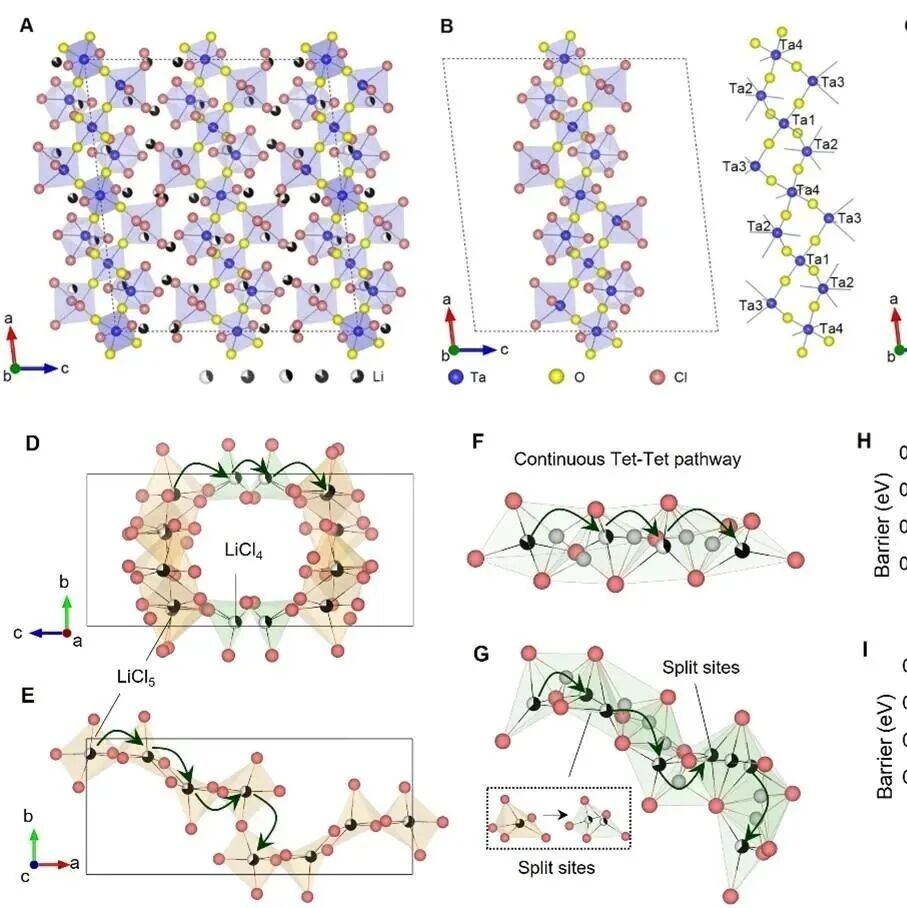
Core Insights - A new type of halide electrolyte with ultra-high ionic conductivity has been developed, enabling stable operation of all-solid-state batteries in ultra-low temperature environments [1][4] - The research team has successfully created a mixed anion structural design strategy, resulting in a highly crystalline oxygen-containing halide Li3Ta3O4Cl10, which allows for three-dimensional continuous lithium ion transport [2][4] - The all-solid-state battery based on this new electrolyte has demonstrated over 4000 cycles of stable operation at room temperature and over 2000 cycles at -50 degrees Celsius, showcasing excellent low-temperature cycling stability [4] Group 1 - The core material of all-solid-state batteries, solid electrolyte materials, is a major research focus, with halides emerging as a new direction due to issues with sulfides [1][2] - The breakthrough in understanding lithium ion conduction mechanisms in amorphous oxygen-containing halides has been a key challenge in developing high ionic conductivity halide electrolytes [1][2] Group 2 - The new halide-based solid electrolyte has set a record for room temperature ionic conductivity at 13.7 mS/cm, surpassing previous benchmarks [2] - The research provides a new technical pathway for the preparation of ultra-stable all-solid-state batteries, potentially accelerating their transition from laboratory to practical applications [4]