净息差收窄

Search documents
需重视银行净息差收窄的挑战
2 1 Shi Ji Jing Ji Bao Dao· 2025-08-11 23:14
Core Viewpoint - The narrowing of net interest margin (NIM) poses significant challenges to the sustainable development of the banking industry, reflecting a downward trend that has persisted for five consecutive years, with the average NIM of 58 listed banks dropping to 1.52% in 2024 and further declining to 1.43% in the first quarter of this year [1][2]. Factors Influencing NIM - Multiple factors contribute to the decline in NIM, including global economic growth challenges, asymmetric interest rate policies during active monetary policy implementation, intensified competition among banks leading to "price wars," and the differentiated impacts of banks' business structures and strategies [2][3]. Implications of NIM Decline - The decline in NIM affects not only the banking sector but also the overall stability of the financial industry. It necessitates banks to enhance asset-liability management strategies focused on NIM and capital returns, while also increasing pressure on capital replenishment for smaller banks [3][4]. Recommendations for Banks - Banks should improve asset-liability and cost-revenue management capabilities by optimizing their asset-liability structure and enhancing non-interest income through wealth management and other light-capital businesses. They should also focus on risk management capabilities to better handle macroeconomic fluctuations and reduce exposure to high-risk areas [4][5]. International Experience and Strategies - Internationally, banks facing NIM challenges have adopted common strategies, such as expanding into international markets to gain competitive advantages and optimizing regulatory policies to provide banks with the necessary space for transformation and adjustment [5][6].
需重视银行净息差收窄的挑战丨杨涛专栏
2 1 Shi Ji Jing Ji Bao Dao· 2025-08-11 22:24
Core Viewpoint - The narrowing of net interest margin (NIM) poses significant challenges to the sustainable development of the banking industry, reflecting a downward trend that has persisted for five consecutive years, with the average NIM of 58 listed banks dropping to 1.52% in 2024 and further declining to 1.43% in the first quarter of this year [1][2]. Factors Influencing NIM - Multiple factors contribute to the decline in NIM, including global economic growth challenges, asymmetric interest rate policies during active monetary policy implementation, intensified competition among banks leading to "price wars," and the differentiated impacts of banks' business structures and strategies [2][3]. Implications for the Banking Sector - The decline in NIM affects not only the banking sector but also the overall stability of the financial industry. It necessitates banks to enhance asset-liability management strategies focused on NIM and capital returns, while also addressing the capital replenishment pressures faced by smaller banks [3][4]. Strategic Responses - Banks are encouraged to improve asset-liability and cost-revenue management capabilities by optimizing their asset-liability structures and enhancing non-interest income through the development of wealth management and investment banking services [4][5]. - Strengthening risk management capabilities is essential for banks to navigate macroeconomic fluctuations and reduce exposure to high-risk areas [4][5]. International Experience and Recommendations - Internationally, banks facing NIM challenges have adopted common strategies, such as enhancing asset-liability management, increasing non-interest income, and improving risk management capabilities [4][5]. - Banks should also consider international expansion to tap into high-yield credit markets and support enterprises going abroad, while regulatory adjustments may be necessary to provide banks with the flexibility needed for transformation [5].
扬子银行上市辅导更新:第一大股东持股比例仍“超限”
Xi Niu Cai Jing· 2025-08-11 12:36
来源:公告 近日,证监会官网发布《关于芜湖扬子农村商业银行股份有限公司(以下简称"扬子银行")首次公开发行股票并上市辅导工作进展报告(第三十期)》,辅 导期间为2025年4月至2025年6月。自2015年12月启动上市辅导开始,扬子银行的IPO长跑之路已持续10年有余。 扬子银行成立于2006年12月29日,是安徽省首家农村商业银行。截至2024年末,该行下辖营业网点43个,并在广德市、石台县、东至县、天津市、巢湖市、 武汉市以及上海市发起设立7家村镇银行。 财报显示,截至2024年末,扬子银行资产总额为627.18亿元,同比增长7.77%;资本充足率为13.58%,核心一级资本充足率为11.51%,拨备覆盖率为 266.53%,均符合监管要求。 业绩方面,2024年,扬子银行实现营收10.23亿元,同比增长30.32%;实现净利润2.67亿元,同比下滑6.97%。 本期辅导期间,扬子银行针对具体监管意见研究制定了整改措施,并进一步规范了贷款三查、征信管理、股东及股权管理、公司治理等方面的内控措施。 然而,扬子银行第一大股东淮南矿业股权问题至今仍未解决。 报告显示,截至2025年6月30日,淮南矿业持有扬子银 ...


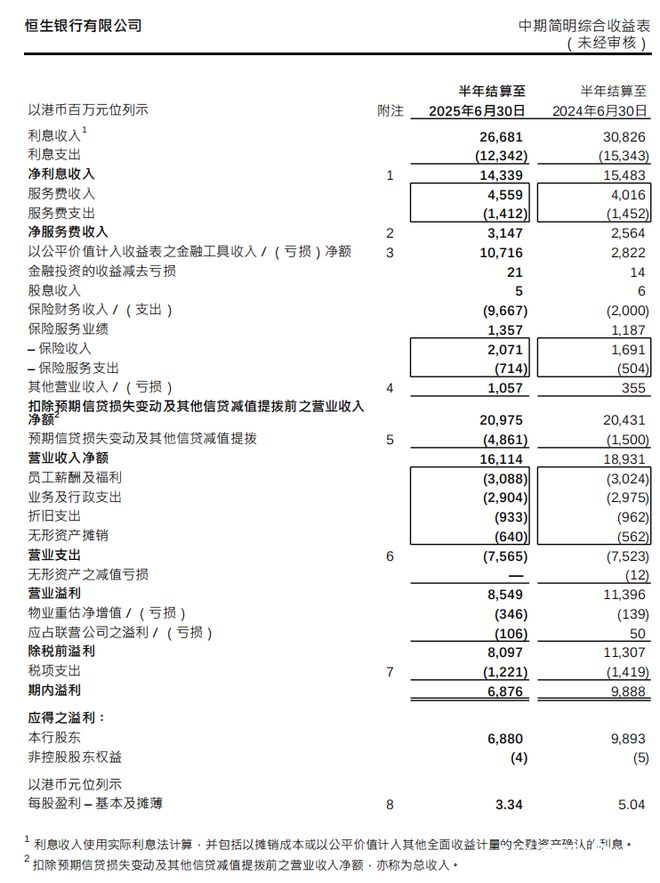
恒生银行上半年净利缩水三成,新董事长首份“成绩单”遇考验
Nan Fang Du Shi Bao· 2025-08-08 03:19
Core Viewpoint - Hang Seng Bank's interim results for the first half of 2025 show a significant decline in net profit and net interest income, reflecting challenges in the current economic environment and the bank's strategic focus on diversifying income sources to drive future growth [1][9]. Financial Performance - The bank reported a net profit attributable to shareholders of HKD 6.88 billion, a decrease of 30.46% year-on-year [1]. - Net interest income fell by 7.39% to HKD 14.339 billion, primarily due to a 3% reduction in average total customer loans and a decline in market interest rates [2][3]. - Total operating income increased by 3% to HKD 20.975 billion, but pre-tax profit dropped by 28.39% to HKD 8.097 billion [2][4]. Income Diversification - Non-interest income grew significantly, with service fees and other income rising by 34% to HKD 6.636 billion, now accounting for 31.6% of total income [4][5]. - Wealth management and investment services saw a remarkable increase of 43% in revenue, while securities brokerage income surged by 60% [5]. Strategic Initiatives - The bank is focusing on expanding its wealth management services and enhancing cross-border financial capabilities, with a 75% increase in new affluent clients and an 81% rise in new retail clients from mainland China [7][9]. - A sustainable development financing fund of HKD 80 billion has been launched, with over two-thirds already disbursed, indicating a commitment to green finance [6]. Shareholder Returns - Despite the decline in net profit, the bank announced an 8% increase in interim dividends, totaling HKD 2.60 per share, and initiated a HKD 3 billion share buyback program [7][8]. - The bank's capital adequacy ratios improved, with a common equity tier 1 capital ratio of 21.3%, reflecting its ability to manage future risks [8]. Leadership Transition - The recent appointment of new Chairman Zheng Weixin marks a strategic shift for the bank, emphasizing a focus on core strategies and the importance of adapting to the evolving economic landscape [1][9].

王小龙:净息差收窄的原因分析与中小银行应对思考
Xin Lang Cai Jing· 2025-08-04 02:52
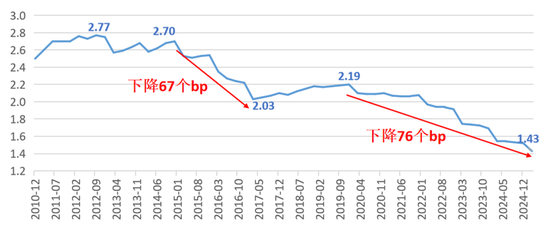
意见领袖 |王小龙 从长周期看,我国银行业净息差经历了两轮下降,分别是2015-2017年一季度和2019年至今,这两个时 间节点值得深入研究。 信贷需求减弱有深层次背景,包括人口红利和人口总数见顶等因素,需求减弱呈现从个人贷款到小企业 再到大企业的传导路径。 当前中小银行面临的压力相对更大,农商行净息差下降最为显著。银行业增量客户增长见顶背景下,大 行下沉对中小银行冲击明显,低利率环境下内卷式竞争加剧。 应对的核心在于战略定力,需要在规模、质量、效益之间做出合理选择,中小银行应立足差异化发展, 通过联合体方式克服规模和范围不经济难题。 ——王小龙 浙江省政协经济委员会副主任、浙江农村商业联合银行原董事长 * 本文为作者在2025年7月6日的CF40双周内部研讨会第458期"低利率、信贷需求与银行业挑战"上所做 的主题演讲,经作者审核。 中国银行业进入低息差低利率时代 净息差是规模、质量、效益不可能三角的核心问题,是当前银行业面临信贷需求不足和低利率环境背景 下生存发展的焦点所在。 从长周期视角观察,近15年来,我国银行业净息差经历了两轮明显的下行周期。第一轮是2015年至2017 年一季度,第二轮是2019 ...
存款利率再降!3个月期击穿1%
21世纪经济报道· 2025-07-23 15:23
Core Viewpoint - The article highlights the continuous decline in bank deposit rates, with many banks entering the "1 era" for medium to long-term rates, indicating a broader trend of decreasing interest rates in the banking sector [1][2][4]. Summary by Sections Bank Deposit Rates - As of June 2025, the average interest rates for various term deposits are as follows: 3-month at 0.949%, 6-month at 1.156%, 1-year at 1.287%, 2-year at 1.372%, 3-year at 1.695%, and 5-year at 1.538% [3]. - Compared to May, the rates have decreased: 3-month by 5.5 basis points (BP), 6-month by 5.6 BP, 1-year by 5.2 BP, 2-year by 5.6 BP, 3-year by 1.6 BP, and 5-year by 3.5 BP [3]. Factors Influencing Rate Changes - The decline in deposit rates was anticipated following the People's Bank of China's (PBOC) reduction of the Loan Prime Rate (LPR) on May 20, which led major banks to lower their deposit rates by up to 25 BP [3][4]. - The ongoing marketization of interest rates and the pressure on banks' net interest margins are contributing to the trend of decreasing deposit rates [4][5]. Large Certificates of Deposit (CDs) - The average interest rates for large CDs have also decreased, with 3-month at 1.179%, 6-month at 1.391%, 1-year at 1.477%, 2-year at 1.462%, 3-year at 1.768%, and 5-year at 1.700% [7]. - The decline in rates is more pronounced for longer-term CDs, with significant reductions observed across all terms compared to May [7]. Structural Deposits - The average term for structured deposits has increased to 103 days, with an average expected middle yield of 1.78% and an average expected maximum yield of 2.14% [11]. - The yields for structured deposits linked to various assets have shown mixed trends, with some categories experiencing declines while others, like those linked to indices, have seen slight increases [12]. Future Outlook - Analysts predict that the downward trend in deposit rates will continue due to multiple factors, including the need for banks to manage their funding costs and the overall low-interest-rate environment [13]. - The expectation is that banks will further adjust their deposit rates to mitigate risks associated with high-interest liabilities in a declining rate environment [9][13].

整体跌至“1字头”,大额存单“失宠了”
21世纪经济报道· 2025-07-08 15:39
Core Viewpoint - The article discusses the decline in the attractiveness of large-denomination time deposits in the context of falling interest rates, leading to a shift in consumer investment behavior towards more appealing financial products like wealth management and insurance [1][2][4]. Summary by Sections Interest Rate Changes - Major banks have reduced interest rates on large-denomination time deposits, with rates now entering the "1" era, marking the first large-scale adjustment since 2025 [4]. - As of July 8, 2025, the interest rates for large-denomination time deposits at major banks are generally below 2%, with some rates even matching or falling below those of regular savings products [5][7]. Market Response - The decline in interest rates has led to a noticeable trend of "deposit migration," where funds are moving from traditional deposits to more attractive investment options such as wealth management and insurance products [2][10]. - The demand for large-denomination time deposits has decreased significantly, with fewer customers inquiring about these products [4][10]. Product Availability - Many banks have removed long-term large-denomination time deposits from their offerings, focusing instead on shorter-term products ranging from 1 month to 2 years [1][5]. - The availability of 5-year large-denomination time deposits has virtually disappeared, and even 3-year products are limited in supply [5][6]. Investment Trends - The shift in consumer behavior is reflected in the increasing popularity of wealth management products, with the market size surpassing 31.3 trillion yuan in the first half of 2025 [10]. - Financial advisors are now recommending products based on clients' liquidity preferences, with a focus on short-term fixed-income investments for those requiring higher liquidity [11][12].




银行调高服务收费应做好五个平衡
Guo Ji Jin Rong Bao· 2025-07-02 06:51
Core Viewpoint - The recent increase in service fees by over 10 banks in the first half of 2025 is a response to the narrowing net interest margin and aims to enhance revenue sources and profitability [1][2] Group 1: Reasons for Fee Increases - The continuous narrowing of net interest margins has compelled banks to seek new revenue sources to improve profitability and risk resilience, with the net interest margin reported at 1.43% at the end of Q1, down 11 basis points year-on-year [1] - Banks are adjusting service fees to improve cost coverage and enhance equipment utilization efficiency [1] - The expansion of free services during the COVID-19 pandemic has increased pressure on net interest margins, prompting banks to optimize their service fee structures to ensure sustainable development [1] Group 2: Regulatory and Consumer Considerations - The adjustments in service fees align with the 2014 regulations allowing banks to set market-adjusted prices autonomously, while also respecting consumers' rights to information and choice [2] - Banks must communicate effectively with customers regarding the basis for fees and the value of services to avoid customer dissatisfaction and potential loss [2] - A careful balance must be struck between profit growth and customer satisfaction to mitigate negative social impacts from fee adjustments [2] Group 3: Long-term Strategies for Sustainability - Relying solely on new fees for income is not a sustainable long-term strategy; banks must focus on economic transformation and enhancing core competitiveness [3] - Smaller banks should leverage their unique characteristics and market positioning to offer customized financial products and services, creating competitive advantages [3] - There is a need for banks to accelerate digital transformation and improve operational efficiency to reduce costs and enhance customer experience [3]
中长期大额存单货架越来越空:低利率重塑银行负债端业态
Zhong Guo Zheng Quan Bao· 2025-06-23 21:10
Core Viewpoint - The decline in the issuance of medium- and long-term large-denomination certificates of deposit (CDs) reflects banks' proactive adjustments in their liability management strategies amid pressure on net interest margins [1][3][5]. Summary by Sections Changes in Large-Denomination CDs - Many national banks have stopped issuing medium- and long-term large-denomination CDs, with the longest available term now being two years, and the interest rates for two-year CDs being the same as for one-year CDs at 1.4% [1][2]. - The interest rates for large-denomination CDs have become comparable to those of regular fixed-term deposits, diminishing their appeal [2][3]. Impact of Low-Interest Rates - The low-interest environment is forcing banks to reshape their deposit strategies and liability structures, shifting focus from scale to quality and efficiency [4][5]. - Banks are increasingly converting medium- and long-term deposits into short-term deposits to manage costs effectively [3][4]. Net Interest Margin Pressure - The net interest margin for commercial banks in China was reported at 1.43% in Q1 2025, a decrease of 9 basis points from Q4 2024, indicating ongoing pressure on profitability [3][4]. - Different types of banks, including state-owned and joint-stock banks, have experienced varying degrees of decline in net interest margins, with some facing significant challenges in maintaining profitability [3][4]. Shift in Deposit Strategies - Regional small and medium-sized banks are rapidly adjusting their deposit rates, sometimes lowering them below those of larger banks, indicating a shift in competitive dynamics [4][5]. - Banks are focusing on optimizing their deposit structures by increasing short-term deposits and reducing reliance on high-cost liabilities [5][6]. Future Trends in Deposits - There is an expectation that funds will flow towards non-bank financial products, the real economy, and potentially back to smaller banks due to their delayed rate adjustments [6][7]. - Investors are encouraged to reconsider traditional reliance on deposits and explore diversified investment strategies to enhance long-term returns [7].
多家银行下架3年期大额存单
21世纪经济报道· 2025-06-11 03:43
Core Viewpoint - The article discusses the declining availability and interest rates of large-denomination time deposits in China, highlighting a shift in the banking sector's focus towards high-net-worth clients and the impact of market interest rate changes on deposit products [2][4][16]. Summary by Sections Availability of Large-Denomination Time Deposits - Many banks, including major state-owned and joint-stock banks, have removed five-year and some three-year large-denomination time deposit products from their offerings, now primarily providing two-year options [2][7]. - For example, Industrial and Commercial Bank of China has no five-year large-denomination time deposits available, with one-year and two-year rates at 1.2% and three-year rates at 1.55% respectively [3][10]. Interest Rate Trends - The majority of banks have seen their maximum annualized interest rates for large-denomination time deposits drop to the 1% range, with some banks offering rates as low as 0.9% for one-month deposits, which are now lower than many money market funds [4][6][11]. - The three-year large-denomination time deposit rates have decreased by approximately 80 basis points compared to the previous year, reflecting a broader trend of declining deposit rates in response to market conditions [15][16]. Market Dynamics and Client Focus - In the current environment, banks are focusing on managing their liability costs and optimizing client structures, with a notable shift towards serving high-net-worth clients [5][17]. - The article notes that some banks are promoting the transfer of existing high-rate large-denomination time deposits as a strategy to attract clients seeking better returns [13]. Regional Variations in Rates - There are discrepancies in interest rates for the same large-denomination time deposit products across different regions, indicating a localized approach to deposit pricing [14][19]. Competitive Landscape - The competition among banks has intensified, leading to a reduction in deposit interest rates as banks seek to lower their funding costs while still growing their deposit bases [18][19].