
新会计准则

Search documents
利率专题:险资配债的逻辑与新趋势
Tianfeng Securities· 2025-08-24 04:42
Group 1: Report Information - Report Title: "Analysis of Insurance Funds' Bond Allocation Logic and New Trends" [1] - Report Date: August 24, 2025 [1] Group 2: Industry Investment Rating - No industry investment rating is provided in the report. Group 3: Core Views - The growth rate of insurance premium income has weakened, while the investment in stocks and bonds has strengthened. Insurance funds' overall investment intensity has increased significantly against the trend of premium income [2][17]. - When allocating bonds, insurance funds need to consider both increasing returns and smoothing fluctuations. They should choose the optimal solution by comprehensively considering tax costs, capital occupation costs, and adapting to new accounting standards [4][5]. - The reduction of the预定利率 of insurance products is expected to have limited impact on boosting the bond market allocation power. The trading attribute of insurance bond allocation has shown certain trends in a low - interest - rate environment [7][8]. Group 4: Insurance Funds' Investment Overview Overall Investment Intensity - Premium income is the cornerstone of the liability side for insurance funds' asset investment. Life insurance products account for about 60% of premium income, and their scale changes directly affect the overall premium income trend of the industry. After the "panic - buying before product discontinuation" craze subsided in the second half of last year, the growth rate of life insurance premium income weakened significantly, dragging down the overall performance of the industry [13][14]. - In contrast, the overall investment intensity of insurance funds has increased significantly against the trend. Since the second half of 2024, the year - on - year growth rate of the balance of insurance funds used by life insurance companies has increased from 15% in Q2 2024 to 18% in Q2 2025, and that of property insurance companies has increased from 5% to 11%. The ratio of "accumulated new insurance funds used after deducting investment income in the current year/accumulated new premium income" also shows that the subjective investment willingness of insurance funds is relatively strong [17]. Investment Allocation - From the perspective of asset allocation, bonds and stocks are the main areas of investment. The bond investment proportion of life insurance companies has been steadily increasing, with a quarterly increase of about 1 pct since the second half of 2024. The bond investment proportion of property insurance companies has increased by 3 pcts in three quarters since Q4 2024 [26][30]. - The stock investment proportion of both life and property insurance companies has increased by 1.8 pcts since Q2 2024. The reasons include the good performance of equity assets and the policy - driven increase in risk appetite. The Hong Kong stock market's high - dividend assets have shown strong performance, and about 63% of surveyed institutions plan to increase their investment in Hong Kong stocks in 2025 [31]. Group 5: Considerations for Insurance Funds' Bond Allocation Bond Allocation Structure Overview - Insurance funds account for about 9.32% of the Chinese bond market. As of June 2025, local government bonds accounted for 47% of the insurance bond portfolio. In the secondary cash - bond market, ultra - long - term local government bonds have accounted for more than 50% of the net purchase scale of insurance since November 2024 [3][41][46]. Increasing Returns: Tax and Capital Occupation Costs - Tax Costs: Before August 8, 2025, insurance self - operated funds' bond investment income was subject to value - added tax, value - added tax surcharge, and income tax. After August 8, the interest income of newly issued government bonds and financial bonds resumed VAT collection, but government bonds still have significant tax advantages [52]. - Capital Occupation Costs: The "C - RISK II" Phase II regulatory system will be fully implemented in 2026. Insurance companies, especially small and medium - sized ones, are under pressure to meet solvency requirements. Life insurance companies can improve solvency by extending bond investment duration, while property insurance companies should choose bonds with shorter duration and higher credit ratings to reduce capital occupation costs [54][63]. Reducing Fluctuations: Adapting to New Accounting Standards - Under the new IFRS9 and IFRS17 accounting standards, insurance companies need to shorten the duration gap to reduce net asset fluctuations, so they have a more rigid demand for long - term bonds. They are also expected to be more cautious in allocating bank secondary capital bonds and credit bond sinking [73][74]. Group 6: Adjustment of Bond Allocation Structure Local Government Bonds - Insurance has an absolute preference for 20Y and 30Y local government bonds, and the secondary - market purchase scale mainly depends on supply. However, its influence on pricing power is not absolute [77][80]. Treasury Bonds - The purchase of new treasury bonds has weakened, and insurance needs to free up positions first. Old treasury bonds with maturities of less than 7Y and between 20 - 30Y are mainly sold [89]. Policy Financial Bonds - Insurance rarely participates in policy financial bonds in both primary and secondary markets, and the existing positions remain stable [6]. Credit Bonds and Perpetual Bonds - The net purchase scale of credit bonds depends on the overall bond - allocation strength of insurance funds, and the allocation of perpetual bonds has changed from purchase to continuous reduction [6]. Group 7: New Trends and Issues in Insurance Bond Allocation Impact of Insurance Product Predetermined Interest Rate Reduction - The reduction of the predetermined interest rate of insurance products is expected to have limited impact on boosting the bond market allocation power. The expansion speed of the insurance liability side may slow down in the long term, and the relative attractiveness of the equity market is more prominent [7]. Trading Attribute of Insurance Bond Allocation in a Low - Interest - Rate Environment - Since 2023, insurance has rarely significantly reduced bond allocations, and the probability of significant increases has increased year by year. In 2025, the willingness to increase the allocation of bonds with maturities over 10Y has further strengthened, and the probability of selling such bonds to realize floating profits when interest rates decline significantly has also increased [8].
九盈一亏!银行系险企“中考”揭榜
Guo Ji Jin Rong Bao· 2025-08-21 15:09
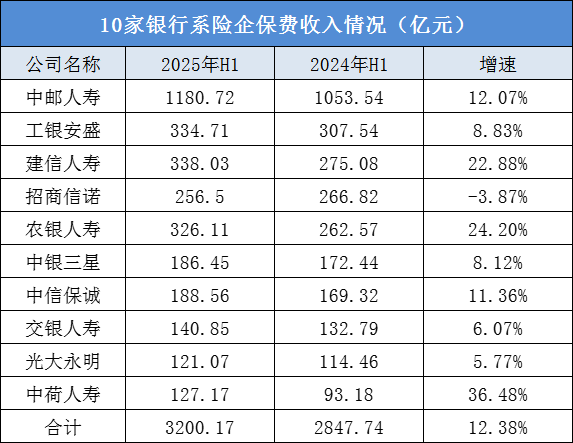
Core Insights - The performance of ten bank-affiliated insurance companies in the first half of 2025 shows a significant increase in premium income and net profit, indicating a strong growth trend in the sector [1][3]. Premium Income - The ten bank-affiliated insurance companies collectively achieved premium income of 3200.17 billion yuan, representing a year-on-year growth of 12.38%, outperforming the overall life insurance industry's growth rate of 6.6% [1][3]. - Among these companies, China Post Life Insurance led with premium income of 1180.72 billion yuan, a growth of 12.07% year-on-year [5]. - Other notable performers include: - CCB Life Insurance with 338.03 billion yuan, a growth of 22.88% - Agricultural Bank Life Insurance with 326.11 billion yuan, a growth of 24.20% - China Netherlands Life Insurance with 127.17 billion yuan, a growth of 36.48%, the highest among the group [4][5]. Net Profit - The total net profit for the ten companies reached 96.21 billion yuan, nearly doubling from 50.5 billion yuan in the same period last year, reflecting a growth of 90.51% [8]. - However, seven of the ten companies reported a decline in net profit compared to the previous year [8][11]. - Key net profit figures include: - China Post Life Insurance: 51.77 billion yuan, down 9.02% - Agricultural Bank Life Insurance: 7.43 billion yuan, down 33.72% - CCB Life Insurance: 5.65 billion yuan, down 5.68% - China Netherlands Life Insurance: 2.77 billion yuan, up 1631.25% [9][11]. Market Dynamics - The "bank-insurance integration" policy is expected to enhance the competitive advantage of bank-affiliated insurance companies by optimizing costs and focusing on product innovation and service upgrades [1][5]. - The average commission in the industry is projected to decrease by 30%, further influencing the market dynamics [5][6]. - The shift to new accounting standards has led to a divergence between profit growth and net asset reduction, with companies like China Netherlands Life Insurance and China CITIC Life Insurance experiencing significant net asset declines despite profit increases [12][13].

民生人寿出手举牌、4家险企争相竞逐浙商银行 年内险资26次举牌11次涉及银行股
Zhong Guo Jing Ji Wang· 2025-08-20 02:14
Core Viewpoint - Minsheng Life Insurance increased its stake in Zheshang Bank, reaching 5% of the bank's H-share capital, triggering a mandatory disclosure under Hong Kong stock market rules. This move is aimed at achieving long-term investment returns while managing current profit volatility [1][2]. Group 1: Investment Activity - On August 11, Minsheng Life purchased 1 million shares of Zheshang Bank H-shares for HKD 2.7679 million, bringing its total holdings to 296 million shares [2]. - Other insurance companies, including Ping An Life, Xinhua Insurance, and Ruizhong Life, have also been actively increasing their stakes in bank stocks, with over 100 instances of share purchases this year, leading to multiple mandatory disclosures [1][9]. Group 2: Strategic Rationale - The low interest rate environment and changes in liability structures are driving insurance companies to seek better asset-liability matching, pushing them towards equity markets, particularly in stable banks with strong dividend returns [2][9]. - The strategic focus on bank stocks is also linked to the growing importance of bancassurance channels for insurance companies, aiming to enhance their business models through significant equity investments in banks [2][12]. Group 3: Historical Context - Minsheng Life has a history of involvement with Zheshang Bank, having acquired shares from the major shareholder, Wanxiang Holdings, in 2012 and participated in capital increases in 2015 [3]. - Zheshang Bank has consistently provided substantial cash dividends, totaling CNY 13.254 billion over the last three fiscal years, with annual cash dividend ratios exceeding 30% [3]. Group 4: Competitive Landscape - Other insurance companies, such as Taiping Life, Xintai Life, and Baidian Life, are also competing for stakes in Zheshang Bank, indicating a broader trend of insurance capital flowing into the banking sector [4][6]. - As of the end of 2024, Xintai Life and Taiping Life hold 1.37 billion shares and 922 million shares of Zheshang Bank, respectively, further illustrating the competitive interest in the bank [7]. Group 5: Future Outlook - Industry experts anticipate that insurance capital will continue to increase its allocation to bank stocks, driven by the need for stable, low-volatility assets in the current economic climate [12]. - The implementation of new accounting standards is expected to further encourage insurance companies to invest in high-dividend assets and long-term equity investments to stabilize profit fluctuations [12].
上市险企缘何不再披露月度保费?
Jin Rong Shi Bao· 2025-08-20 01:59
Core Viewpoint - The practice of monthly premium disclosure by listed insurance companies in China has been broken, with major companies like China Life, China Ping An, and China Pacific Insurance no longer releasing this data [1][2]. Group 1: Reasons for Stopping Monthly Premium Disclosure - Regulatory bodies do not mandate insurance companies to disclose monthly premium income, allowing companies to have discretion over such disclosures [1][2]. - The implementation of new accounting standards (IFRS 17) has changed the way premium income is recognized, making previous data incomparable [1][2]. - Monthly premium income can fluctuate significantly due to various factors such as seasonality, marketing activities, and new product launches, which may not accurately reflect the long-term operational performance of insurance companies [2][3]. Group 2: Alternative Metrics for Evaluating Insurance Companies - Consumers should focus on the solvency adequacy of insurance companies, which indicates their ability to meet payout obligations under extreme risk scenarios [3][4]. - Investors should pay attention to indicators such as new business value, channel efficiency, comprehensive cost ratio, and investment return rate, which can be found in annual and semi-annual reports [3][4]. - Monitoring regulatory penalties against insurance companies can provide insights into their business quality and compliance levels [3][4].



上市险企缘何不再披露月度保费?
Jin Rong Shi Bao· 2025-08-19 01:03
Core Viewpoint - The practice of monthly premium disclosure by listed insurance companies in China has been broken, with major companies like China Life, China Ping An, and China Pacific Insurance no longer publishing this data [1][2]. Group 1: Reasons for Stopping Monthly Premium Disclosure - Regulatory bodies do not mandate insurance companies to disclose monthly premium income, allowing companies to have discretion over such disclosures [1][2]. - The implementation of new accounting standards (IFRS 17) has changed the way premium income is recognized, making previous data incomparable [1][2]. - Monthly premium income can fluctuate significantly due to various factors, such as seasonal trends and marketing activities, which may not accurately reflect the long-term operational stability of insurance companies [2][3]. Group 2: Alternative Metrics for Evaluating Insurance Companies - Consumers should focus on the solvency adequacy of insurance companies, which indicates their ability to meet obligations under extreme risk scenarios [3][4]. - Investors should pay attention to indicators such as new business value, channel efficiency, comprehensive cost ratio, and investment return rate, which are available in annual and semi-annual reports [3][4]. - Monitoring regulatory penalties against insurance companies can provide insights into their business quality and compliance levels [3][4].
三险企停更 新华保险2年前换帅保费增速垫底后两跃进
Zhong Guo Jing Ji Wang· 2025-08-18 23:16
Core Viewpoint - The recent decision by China Ping An to stop disclosing monthly premium income has raised concerns about the transparency of A-share listed insurance companies, particularly regarding their insurance service income and the impact of new accounting standards on reported figures [1][4]. Group 1: Premium Income Trends - As of July 31, 2025, New China Life reported a cumulative original insurance premium income of RMB 13,780.63 million, reflecting a year-on-year growth of 23% [1]. - New China Life's premium income has shown significant growth since 2025, with monthly figures reaching RMB 121.26 billion in June 2025, marking a year-on-year growth rate of 23% [2]. - In contrast, New China Life experienced a negative growth trend in 2024, with a total premium income of RMB 130.28 billion, only growing by 1.9% year-on-year after seven months of decline [2]. Group 2: Competitive Positioning - In the first half of 2024, New China Life's premium growth lagged behind its peers, with the company consistently ranking last among five listed insurance companies in terms of premium growth rates [3]. - The premium income growth rates for competitors such as China Life and Ping An were significantly higher during the same period, indicating a competitive disadvantage for New China Life [3]. Group 3: Regulatory Changes and Accounting Standards - The implementation of the new insurance contract accounting standards (IFRS 17) starting January 1, 2023, has prompted changes in how insurance companies report their financials, affecting the transparency of premium income disclosures [4]. - New China Life clarified that the decline in monthly premium income from January to July 2024 was not related to the switch to the new accounting standards [4].

民生人寿出手举牌,4家险企争相竞逐浙商银行,年内险资26次举牌11次涉及银行股
Xin Lang Cai Jing· 2025-08-14 05:17
Core Viewpoint - Minsheng Life Insurance increased its stake in Zheshang Bank, reaching 5% of the bank's H-share capital, triggering a mandatory disclosure under Hong Kong stock market rules [1][2]. Group 1: Investment Activity - On August 11, Minsheng Life purchased 1 million shares of Zheshang Bank H-shares for HKD 2.7679 per share, totaling HKD 276.79 million [2][3]. - Following this transaction, Minsheng Life holds 296,023,000 shares of Zheshang Bank H-shares, representing 5% of the bank's total H-share capital [2][3]. - Other insurance companies, including Ping An Life and Xinhua Insurance, have also been actively increasing their holdings in bank stocks, with over 100 instances of share purchases this year [1][10]. Group 2: Strategic Rationale - The shift in accounting standards and the low-interest-rate environment are driving insurance companies to seek stable returns in equity markets, with listed banks being a preferred investment due to their solid operational performance and attractive dividend yields [2][10]. - Minsheng Life's investment strategy aims to balance long-term investment returns with current profit volatility, leveraging the support from its major shareholder, Wanxiang Holdings, which is also a founding shareholder of Zheshang Bank [1][2][4]. Group 3: Market Context - The insurance sector is increasingly focusing on high-dividend assets to stabilize cash flow and mitigate profit fluctuations caused by equity price volatility [10][12]. - In 2023, insurance companies have made 26 instances of share purchases, with 11 involving bank stocks, indicating a strong preference for this sector [10][12].

中国银河证券:银行基本面积极因素持续积累,业绩拐点可期
Mei Ri Jing Ji Xin Wen· 2025-08-12 00:56
(文章来源:每日经济新闻) 每经AI快讯,中国银河证券表示,近期险资再现频繁举牌,中小险企也逐步加大股权投资力度,银行 板块依然受到青睐。预计低利率环境下,险企对稳健高收益资产具有长期配置需求。当前银行板块股息 率约4%,仍处于行业前列,H股股息率优势更加显著,且银行分红稳定、估值较低、业绩波动较小, 有望持续吸引险资流入。此外,考虑到中小险企将自2026年1月起实施新会计准则,银行板块增量资金 有望进一步扩容。当前险资对银行股投资主要集中于国有大行和股份行H股,股息率为主要考虑因素。 而弘康人寿投资郑州银行H股显示险资对区域行布局扩大。未来不排除保险公司加大对估值低、业绩修 复和成长潜力较好的区域行股权投资力度,通过并表和银保业务渠道协同进一步改善投资回报。银行基 本面积极因素持续积累,业绩拐点可期。 ...

35万亿险资重构底仓资产 权益配置盘浇灌“时间的玫瑰”
Zhong Guo Zheng Quan Bao· 2025-08-11 21:14
Core Insights - The insurance industry is experiencing a significant shift towards long-term equity investments, driven by low interest rates and the need for better asset-liability matching [1][5][6] - Insurance companies are increasingly focusing on high-dividend assets as a stable source of cash flow, with a notable rise in the number of equity investments and strategic shareholdings [2][3][5] - Regulatory reforms are facilitating the establishment of private equity funds by insurance firms, allowing them to invest more heavily in the stock market [2][8] Group 1: Investment Strategies - Insurance companies are restructuring their asset allocations to prioritize long-term equity investments, moving from trading-oriented assets to those that generate stable cash flows [1][3] - The trend of increasing shareholdings in listed companies is evident, with insurance firms triggering shareholding notifications through significant stock purchases [2][3] - High-dividend sectors such as banking, utilities, energy, and technology are particularly favored by insurance investors, reflecting a strategic shift towards stable income generation [2][5] Group 2: Regulatory Environment - The establishment of private equity funds is part of a broader regulatory initiative to encourage long-term investments by insurance companies, with over 220 billion yuan approved for various pilot projects [2][8] - New accounting standards are reshaping investment strategies, emphasizing the importance of stable dividend income and reducing reliance on capital gains [6][7] - There are ongoing challenges related to regulatory constraints, including solvency requirements and accounting measurement methods, which may hinder the full potential of insurance capital in equity markets [8][9][10] Group 3: Market Dynamics - The insurance sector is facing pressure from high liability costs and low bond yields, prompting a shift towards equities to enhance returns [5][6] - The demand for high-quality, stable cash flow assets is increasing, with insurance firms actively seeking opportunities in REITs and other equity instruments [3][6] - The industry's asset duration is currently shorter than its liability duration, necessitating a strategic focus on extending asset duration to mitigate risks associated with interest rate fluctuations [5][9]
35万亿险资重构底仓资产权益配置盘浇灌“时间的玫瑰”
Zhong Guo Zheng Quan Bao· 2025-08-11 21:05
Core Insights - The insurance industry is experiencing a significant shift towards long-term equity investments, driven by low interest rates and changes in liability structures, with total insurance assets reaching 35 trillion yuan [1] - Insurers are increasingly focusing on high-dividend assets and long-term equity investments to enhance cash flow and reduce reliance on trading profits [2][3] - Regulatory approvals for pilot projects have led to over 220 billion yuan being allocated to equity investments, with a notable increase in shareholding stakes and strategic investments in high-dividend sectors [2][4] Group 1: Investment Strategies - Insurers are transitioning from trading assets to long-term equity investments, emphasizing stable cash flow and high dividend yields [1][2] - The trend of increasing shareholding stakes, with 22 instances of shareholding increases this year alone, highlights a growing preference for high-dividend sectors such as banking, utilities, and technology [2][3] - The focus on high-dividend assets is a response to the challenges posed by low interest rates and the need for stable returns [4][5] Group 2: Regulatory Environment - The approval of multiple pilot projects by regulatory authorities has facilitated the establishment of private equity funds aimed at long-term stock market investments [2][3] - Despite progress, there are still regulatory hurdles that need to be addressed, including accounting measurement methods and solvency regulations that impact insurers' investment strategies [6][7] - The industry is advocating for a long-term assessment mechanism to better align investment strategies with the inherent long-term nature of insurance operations [7][8] Group 3: Market Dynamics - The current low interest rate environment has led to a shrinking supply of high-yield assets, prompting insurers to seek alternative investment opportunities [5][6] - The shift towards stable dividend-paying assets is seen as a way to mitigate the pressures of high liability costs and interest rate fluctuations [4][5] - Insurers are increasingly utilizing various investment vehicles, including REITs and private equity funds, to diversify their portfolios and enhance returns [3][4]