
汽车金融

Search documents
出海提速,金融滞后:中国汽车全球化的隐形痛点
Tai Mei Ti A P P· 2025-07-01 01:03
Core Viewpoint - The underlying logic of globalization is being restructured, highlighting the need for a robust financial support system to accompany the rapid growth of China's automotive exports, which reached 6.4 million units in 2024 and is expected to hit 10 million by 2030 [2][3]. Financial Support Challenges - China's automotive industry faces significant financial shortcomings, with the central bank maintaining a conservative stance on overseas automotive financing, which is deemed unsuitable for the industry's development [2][3]. - High overseas financing costs and an underdeveloped network of Chinese banks abroad hinder companies' ability to expand internationally, impacting profit margins and competitiveness [3]. New Energy Vehicle Financing Issues - The rapid evolution of new energy vehicles creates fundamental conflicts with traditional financial product designs, leading to a lack of mature financial solutions for emerging needs such as battery technology and charging infrastructure [4]. - Cross-border capital flow poses additional risks, with companies facing challenges in fund transfers due to sanctions and payment chain vulnerabilities [4]. Policy and Institutional Support - The Chinese government is stepping in to fill the financial gap, with China Export & Credit Insurance Corporation providing $2.2 billion in coverage for 118 new energy vehicle companies in 2024, a 45% increase year-on-year [5]. - Innovative financial products, such as cross-border supply chain financing accounts, are being developed to facilitate capital flow for overseas subsidiaries [5]. Strategic Recommendations - Establishing dedicated automotive finance companies in key overseas markets is recommended to enhance financial support for capable Chinese automakers [6]. - The creation of specialized export support funds or overseas industry development funds is suggested to focus on greenfield investments, mergers and acquisitions, and local operations [6]. Collaborative Approaches - The automotive industry needs to move from isolated efforts to collaborative strategies, similar to the integrated approach of Japanese trading companies, which provide funding and infrastructure support for automotive manufacturers [7][8]. - A comprehensive ecosystem involving manufacturing, finance, after-sales service, and resource recovery is essential for Chinese automotive companies to succeed in international markets [8].


“高息高返”退场倒计时,有购车者接到通知“11点后优惠失效”
Di Yi Cai Jing· 2025-06-23 15:30
Core Insights - The "high interest, high rebate" automotive financing policy is being abruptly terminated, affecting consumers' ability to benefit from financial incentives for purchasing vehicles [1][2] - Many consumers are rushing to finalize their purchases before the deadline, as dealerships notify them of the imminent end of these financial offers [1][2] - The cancellation of this policy is part of a broader regulatory crackdown on automotive financing practices, which is expected to lead to an increase in vehicle prices at the retail level [3] Summary by Sections Financial Policy Changes - The "high interest, high rebate" financing scheme allows consumers to save approximately 7,000 yuan on a 500,000 yuan vehicle by opting for a bank loan instead of the manufacturer's financing [2] - Consumers who do not repay their loans within two years will face increased interest costs, highlighting the risks associated with this financing option [2] Consumer Behavior - Consumers are being urged to complete their purchases quickly due to the sudden notification of policy changes, with some able to finalize their loans on the last day [1][2] - The urgency is reflected in the actions of consumers who had already planned to purchase vehicles but are now racing against the clock to secure the financial benefits [1] Industry Impact - Multiple dealerships across various cities are reporting the cessation of the "high interest, high rebate" financing options, indicating a widespread industry shift [3] - The termination of these financing incentives is expected to lead to higher vehicle prices, as the previous subsidies provided by banks to manufacturers are no longer sustainable [3] - Regulatory bodies are intensifying their oversight of automotive financing to mitigate financial risks, contributing to the policy's discontinuation [3]
“7月前不办,以后没机会了”!有大行已全部停办,买车分期“高息高返”加速退场
21世纪经济报道· 2025-06-17 09:53
Core Viewpoint - The "high interest high rebate" auto financing model is being phased out due to regulatory pressures and banks' profitability challenges, leading to a transformation in the auto finance industry [1][4][16]. Group 1: Industry Changes - Major banks have begun to halt the "high interest high rebate" auto financing model, with a significant bank announcing the cessation of this model effective June 1 [4][16]. - As of July 1, multiple banks will stop offering high-interest auto loans with rebates, indicating a shift in the market dynamics [1][4]. - Regulatory bodies have been actively promoting the standardization of auto finance practices, with various regions implementing self-regulatory agreements to curb excessive commission practices [17]. Group 2: Consumer Impact - Consumers are being advised to take advantage of existing auto financing options before the cessation of high-rebate loans, as these opportunities may not be available in the future [1][4]. - New financing options are emerging, such as zero-interest loans for two years, which are being promoted as more consumer-friendly alternatives [6][9]. - The shift away from high-rebate loans may lead consumers to reassess their financing choices, focusing on lower interest rates and more transparent terms [1][4][17]. Group 3: Bank Strategies - Banks are facing challenges with the high rate of early loan repayments, which undermines their profitability in the "high interest high rebate" model [15][16]. - Financial institutions are expected to unify their auto financing strategies, moving towards more sustainable and profitable models [15][16]. - The competition among banks for auto loans is intensifying, with banks increasing their focus on this segment as traditional mortgage lending slows down [14][15].
“园区+科技”深度融合,兴业银行南宁分行赋能新能源车企智造升级
Zhong Guo Jin Rong Xin Xi Wang· 2025-06-16 12:53
Core Viewpoint - Recently, Industrial Bank's Nanning Branch provided a loan of 86.8 million yuan to a listed new energy vehicle company for the construction of an intelligent manufacturing project for hybrid crankshafts, supporting the company's smart manufacturing upgrade [1][2]. Group 1: Financial Support and Strategy - The loan is part of a broader strategy by Industrial Bank to accelerate the layout of five new financial sectors: science and technology finance, inclusive finance, energy finance, automotive finance, and park finance [1]. - The Nanning Branch has tailored financing solutions for the new energy vehicle company by optimizing approval processes, matching special quotas, and offering preferential interest rates to ensure funds reach the company's R&D and production frontline [2]. - As of now, the Nanning Branch has cumulatively provided 276.93 million yuan in loan support for the project, assisting the company in optimizing financial management and reducing financing costs [2]. Group 2: Technological and Economic Integration - The Nanning Branch employs a "technology flow" credit evaluation system, converting the company's patent technology, R&D investment, and market prospects into financing "hard currency," providing long-term stable credit support [2]. - The bank continues to optimize its "commercial bank + investment bank" service model to offer a comprehensive suite of financial services, including investment-loan linkage, supply chain finance, and cross-border settlement, aiding the company in achieving sustainable development [2]. - The Nanning Branch aims to integrate "park finance + technology finance" to construct a comprehensive financial ecosystem that provides timely financial assistance to high-tech industrial clusters [3].

车贷高息高返遇“紧箍咒” 大行率先转向服务战
Zhong Guo Zheng Quan Bao· 2025-06-03 20:43
Core Viewpoint - The banking sector is moving to regulate high-interest, high-rebate auto loan practices, reducing commission rates significantly to promote sustainable growth in the automotive finance market [1][4][6]. Group 1: Changes in Auto Loan Practices - Agricultural Bank of China has halted high-interest, high-rebate practices, reducing car loan commission from 15% to 5%, leading to decreased subsidies for car prices [1]. - Multiple banks across regions like Beijing, Sichuan, and Henan are adjusting their auto loan commission structures under regulatory guidance, aiming to lower actual loan interest rates and enhance service quality [1][2]. - The shift from "loan 5, full 1" to "loan 5, full 2" or even "loan 5, full 3" indicates a tightening of loan terms, reflecting banks' inability to sustain previous subsidy levels [2][5]. Group 2: Market Dynamics and Competition - Auto dealers are incentivized to promote loans due to bank commissions, allowing them to offer lower prices and interest rates to customers [2][3]. - The competitive landscape is characterized by banks attempting to rapidly grow personal loan volumes through high commissions, which is not a sustainable strategy [3][4]. - The prevalence of similar financial products among banks has led to intensified competition, with many banks adopting high-rebate strategies to capture market share [4][6]. Group 3: Regulatory and Self-Regulatory Measures - The Sichuan Banking Association has initiated a self-regulatory agreement to optimize cooperation with auto dealers, aiming to lower actual interest rates and establish reasonable commission rates [6][7]. - Other regional banking associations are also promoting self-regulatory agreements to protect consumer rights and ensure high-quality development in the automotive finance sector [7]. - Regulatory bodies have mandated financial institutions to rectify high-interest, high-rebate practices and adhere to self-regulatory standards to maintain market order [7].


协会资讯|2025汽车金融趋势发展论坛成功举办
Sou Hu Cai Jing· 2025-05-25 04:41
Core Insights - The automotive finance market in China is experiencing intensified competition due to new regulatory requirements and market developments, with significant growth potential in areas like new energy finance and used car finance [3][5] - The industry is urged to innovate and address issues such as the homogeneity and singularity of financial products to better meet market consumption demands [3] - Financial institutions are increasingly focusing on automotive consumer finance, with cost and scale of funds becoming core competitive advantages [5] Group 1: Industry Trends - The automotive market is undergoing structural adjustments, leading to rapid growth in demand for used car finance and export finance [3] - Financial institutions are prioritizing automotive finance, particularly in consumer finance, which is becoming highly competitive [5] - The need for improved risk control and asset management capabilities is essential for the healthy development of automotive finance [5] Group 2: Company Initiatives - Shanghai Pudong Development Bank has developed a comprehensive auto installment service since 2015, collaborating with over 20 automotive manufacturers and 7,234 nationwide merchants [7] - Kuaiqian Payment provides integrated solutions for automotive finance, enhancing efficiency and innovation in business models through digital payment capabilities [9] - Ping An Leasing has been active in the automotive circulation industry for ten years, offering financing leasing services to automotive dealers and rental companies [11] Group 3: Technological Solutions - Shenzhen Juyun Control focuses on risk management solutions in automotive finance, utilizing Beidou technology to enhance vehicle tracking and operational solutions for financial institutions [13]
都市车界|央行降准助力汽车金融发展:“五年免息”或成竞争新常态
Qi Lu Wan Bao· 2025-05-16 02:59
Core Viewpoint - The People's Bank of China has implemented a targeted reserve requirement ratio cut for auto finance and leasing companies, releasing approximately 1.2 trillion yuan in long-term funds, which is expected to reshape the automotive consumption market and industry dynamics [1][2]. Group 1: Impact on Auto Finance Industry - The reserve requirement ratio for auto finance institutions has been reduced from 10% to 5%, leading to an estimated release of over 200 billion yuan in usable funds for the auto finance sector [2]. - The reduction in funding costs is projected to lower interest rates by approximately 1.2 percentage points, providing a significant financial boost to auto finance and leasing companies [2]. - Major auto finance companies have already begun to lower their loan rates, with Great Wall Motors announcing a reduction to 3.88% for installment loans on mainstream models, making car ownership more affordable for consumers [2]. Group 2: Consumer Benefits - Consumers can expect to save around 15,000 yuan in interest payments when purchasing a 300,000 yuan vehicle due to the lowered loan costs resulting from the reserve requirement cut [3]. - The approval rate for loans is expected to increase by 20% for consumers with minor credit issues, as auto finance companies relax lending criteria to expand their customer base [3]. - There has been a noticeable increase in customer traffic at dealerships, indicating strong consumer interest in financing options following the policy changes [3]. Group 3: Market Dynamics and Competition - The automotive market is witnessing a shift from price competition to financial service competition, with companies like Tesla offering attractive financing packages such as five-year interest-free loans [4]. - Traditional automakers are responding by extending warranty periods to enhance consumer confidence and reduce post-purchase concerns [4]. - New energy vehicle brands are benefiting from higher subsidy levels compared to traditional fuel vehicles, with some brands offering financial subsidies that can reach up to 8% of the vehicle price, enhancing their competitive edge [4]. Group 4: Future Trends - The automotive finance penetration rate is expected to exceed 75% by 2025, with a shift from simple credit support to comprehensive lifecycle services [6]. - The ongoing effects of the policy changes are anticipated to redefine consumer purchasing experiences, allowing for more affordable and convenient vehicle ownership options [6].
易鑫集团(02858.HK)1Q25运营资料点评:二手车销量承压拖累融资额表现 金科业务快速增长
Ge Long Hui· 2025-05-15 10:08
Core Insights - Yixin Group reported a slight decline in total financing in Q1 2025, primarily due to a slowdown in used car sales growth and a decrease in average financing amounts [1][2] Summary by Category Overall Performance - In Q1 2025, Yixin Group achieved a total of 172,000 auto financing transactions, reflecting a year-on-year increase of 0.5% [1] - The total financing amount reached 15.3 billion yuan, showing a year-on-year decrease of 5.0% [1] - The decline in total financing is attributed to a slowdown in used car sales growth, with a total of 4.607 million used cars sold nationwide in Q1 2025, marking a year-on-year increase of 0.15% [1] Structural Changes - The proportion of used car financing has increased, with Q1 2025 used car financing transactions reaching 104,000, a year-on-year increase of 31.9%, accounting for 60.5% of total transactions, up 14.3 percentage points year-on-year [2] - The financing transactions for used electric vehicles reached 9,000, representing 23.2% of the company's new energy vehicle financing transactions, with a year-on-year increase of 10.7 percentage points [2] - The company's fintech business saw significant growth, facilitating a total financing amount of 6.1 billion yuan in Q1 2025, a year-on-year increase of 56.5%, accounting for 39.9% of total financing, up 15.6 percentage points year-on-year [2] Investment Analysis - Yixin Group is recognized as a leading third-party auto finance provider, characterized by high dividend yields, with a dividend of 0.13 HKD in 2024 and a payout ratio exceeding 100%, resulting in a dividend yield of 6% for 2025 [2] - The company expresses strong confidence in future growth, with projected net profits for 2025-2027 expected to be 1.09 billion, 1.30 billion, and 1.49 billion yuan, reflecting year-on-year growth rates of 34%, 20%, and 14% respectively [2] - The dynamic PE ratios for 2025-2027 are estimated to be 12.1x, 10.1x, and 8.8x [2]
2025年中国商用车融资租赁行业租赁模式、发展历程、产业链、市场规模及前景研判:商用车融资租赁发展前景广阔,行业朝多元化、定制化方向发展[图]
Chan Ye Xin Xi Wang· 2025-04-28 01:27
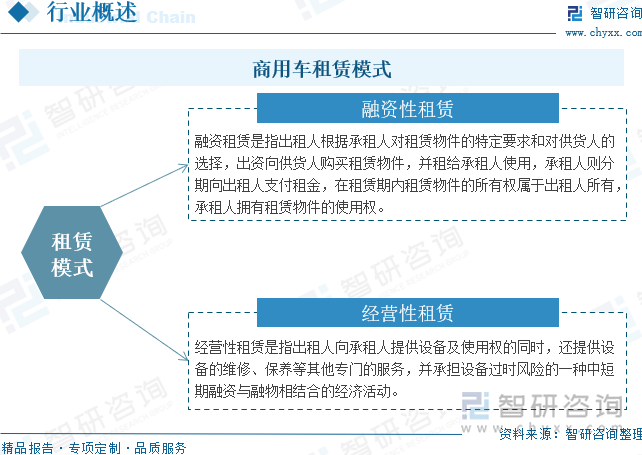
Core Insights - The commercial vehicle financing leasing industry in China has shown stable growth, with the market size projected to increase from 20.53 billion yuan in 2015 to 140.87 billion yuan in 2024, reflecting a compound annual growth rate (CAGR) of 23.86% [1][21] - The industry is expected to benefit from government policies and subsidies that support automation, intelligence, and energy-saving developments in commercial vehicles, leading to unprecedented growth opportunities [1][21] Industry Overview - Commercial vehicle leasing is primarily divided into financial leasing and operating leasing, with financial leasing being the dominant model in China [4] - The commercial vehicle financing leasing framework includes offline transactions, online transaction platforms, and online service platforms, facilitating a comprehensive service ecosystem [6][7] Industry Development History - The development of commercial vehicle financing leasing has been closely tied to the evolution of the commercial vehicle industry in China, with significant regulatory support emerging in the 21st century [10][11] - The introduction of the "Interim Measures for the Supervision and Administration of Financing Leasing Companies" in 2020 has imposed stricter requirements on the industry, promoting a healthier market environment [10][11] Industry Policies - Recent government policies have aimed to promote the standardization and market-oriented development of the commercial vehicle financing leasing sector, including initiatives for green financing and support for equipment updates [13][15] Industry Structure - The commercial vehicle financing leasing industry consists of upstream financial supply, commercial vehicle supply, and service institutions, with banks, insurance companies, and trusts playing crucial roles [16] - The downstream market primarily serves individual and enterprise consumers, with the second-hand vehicle market being less developed compared to international standards [16] Market Challenges - The commercial vehicle leasing sector faces challenges such as a fragmented customer base, high operational costs, and difficulties in asset disposal due to the chaotic second-hand market [29][30] Future Trends - The industry is expected to see diversification in leasing models, with innovations such as battery leasing for electric vehicles and integrated transport solutions gaining traction [31][32] - The integration of technology, including IoT and blockchain, is anticipated to enhance risk management and operational efficiency within the sector [32] - Customized services tailored to specific industry needs, such as cold chain logistics and hazardous materials transport, are likely to emerge, providing comprehensive solutions [33]
部分银行调整车贷提前还款规则
Jin Rong Shi Bao· 2025-04-22 11:48
Core Viewpoint - Recent adjustments in car loan early repayment rules by banks in Zhejiang, changing from "loan for 5 years, repay after 2 years" to "loan for 5 years, repay after 3 years" reflect a response to regulatory pressures and market changes [1][6]. Group 1: Changes in Loan Policies - The new rule requires customers to complete 3 years of the loan term before being eligible for early repayment without penalty, whereas previously it was 2 years [2]. - Under the new policy, penalties for early repayment are structured as follows: 8% within the first year, 5% between 1 to 2 years, and 3% between 2 to 3 years [2]. - Agricultural Bank also imposes a 5% penalty on the remaining principal for early repayments made before the 3-year mark [3]. Group 2: Industry Context and Implications - The shift in loan policies is part of a broader industry trend influenced by regulatory measures aimed at curbing improper competition linked to dealer commissions [6]. - The banking sector is facing pressure from narrowing net interest margins, prompting adjustments in car loan policies as a necessary response to profit pressures and market dynamics [6][7]. - The change in repayment rules may lead consumers to reconsider the cost of full car purchases, while also altering the profit models for car dealers [7]. Group 3: Market Competition and Future Outlook - The automotive finance market is becoming increasingly competitive, with various players including financial institutions, leasing companies, and online platforms entering the space [7]. - Experts suggest that banks must innovate product designs to meet the nuanced demands of consumers, as the industry transitions from scale expansion to quality enhancement [8]. - There is a possibility that more regions may adopt similar changes in loan policies, although the pace and extent of implementation may vary [8].