
海洋强国战略

Search documents
这些沿海大市,要开始“抱团”发展了?
Mei Ri Jing Ji Xin Wen· 2025-08-11 16:11
Core Insights - The total scale of China's marine economy is projected to reach 10.54 trillion yuan in 2024, with a marine GDP of 5.1 trillion yuan in the first half of the year, reflecting a year-on-year growth of 5.8%, surpassing the national GDP growth rate by 0.5 percentage points [1] - The Central Financial Committee emphasizes the need for high-quality development of the marine economy, advocating for enhanced top-level design and policy support [1] - The development of bay economies is being explored across various coastal provinces, with over 150 bays larger than 10 square kilometers along China's 32,000-kilometer coastline [1] Marine City Clusters - Marine city clusters are defined as urban agglomerations centered around port groups, with marine economies at their core, facilitating collaboration among multiple cities [2] - Approximately 60% of global economic output is concentrated in port bays and adjacent areas, with 75% of major cities and 70% of industrial capital located within 100 kilometers of coastal areas [2] Bay Area Development - The Greater Bay Area's marine city cluster aims to create a unique multi-center collaborative development model, leveraging the strengths of Hong Kong, Shenzhen, and Guangzhou [7] - The three cities form a "golden triangle," enhancing resource allocation efficiency and global competitiveness through improved connectivity and collaboration [7][19] Economic Goals - The Greater Bay Area aims for a container throughput of 100 million TEUs by 2030, surpassing the combined throughput of New York and Los Angeles ports [9] - Research and development investment is targeted to exceed 5% by 2025, outpacing Norway's 3.9% [9] - The goal for green shipping is to have 15% of ammonia-fueled vessels by 2035, exceeding the EU's target of 10% [9] Collaborative Development - The concept of "collaborative development" is not unique to the Greater Bay Area, with cities like Qingdao and Ningbo-Zhoushan also pursuing marine city cluster initiatives [11][10] - The integration of surrounding marine cities can enhance economic scale and create economies of scale and scope [11] Current Leaders in Marine Economy - Shanghai remains the leader in marine economy, with a marine GDP projected to reach 1.1387 trillion yuan in 2024, followed by Tianjin, Qingdao, and Shenzhen [15] - The collaborative model among Shenzhen, Hong Kong, and Guangzhou is seen as a necessity due to their individual limitations compared to cities like Shanghai and Singapore [15] Infrastructure and Innovation - The development of transportation infrastructure, such as the Shenzhen-Zhongshan Bridge, is crucial for enhancing connectivity and collaboration among cities [23] - The establishment of marine universities and research institutions is essential for fostering innovation in marine-related fields [23][24] Institutional Innovation - Shenzhen is encouraged to create legal frameworks related to marine development while deepening integration with Hong Kong [24] - The Greater Bay Area is positioned as a testing ground for innovative marine governance models under the "one country, two systems" framework [24]

数读3.2万亿北部海洋经济圈 蓝色引擎激活发展新动能
Zheng Quan Shi Bao· 2025-08-06 18:33
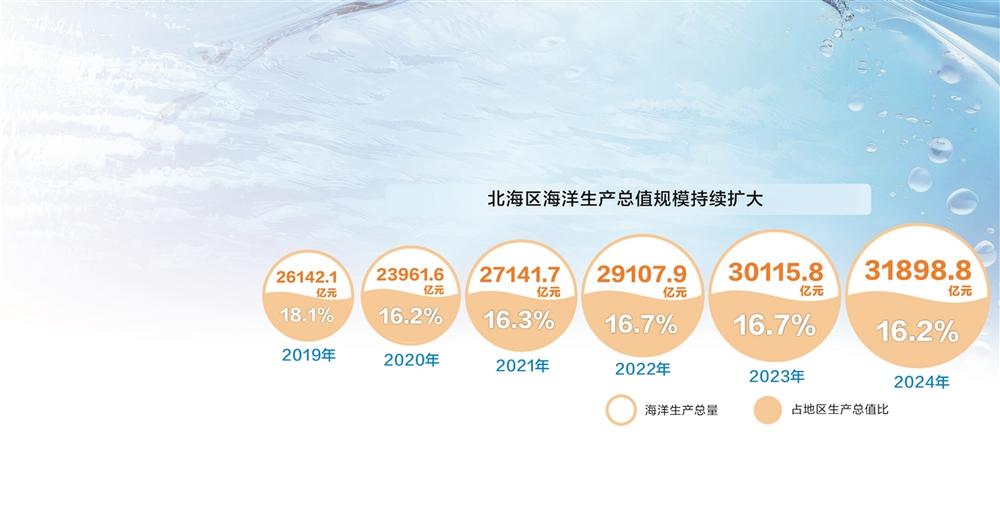
Core Insights - The northern marine economy is experiencing high-quality development, with significant contributions from the provinces of Shandong, Liaoning, Hebei, and the municipality of Tianjin [4][5]. Group 1: Marine Economic Performance - In 2024, the marine GDP of the northern marine economic zone reached 31,898.8 billion yuan, with a nominal growth rate of 5.9%, accounting for 16.2% of the regional GDP and 30.3% of the national marine GDP [5]. - Shandong Province's marine GDP surpassed 18,011.8 billion yuan, growing by 6.1% year-on-year, contributing 23.9% to the province's economic growth [6]. - Hebei Province's port cargo throughput exceeded 1.4 billion tons for the first time in 2024, with Tangshan Port handling 862 million tons, marking a 2.37% increase from the previous year [9]. Group 2: Sector Contributions - The marine tourism industry is the dominant sector in the northern marine economy, contributing 30.8% to the marine industry value added in the northern region [5]. - In Shandong, the marine fishery, marine product processing, marine mining, marine salt, and marine chemical industries all ranked first nationally in value added [6]. - In Tianjin, the marine oil and gas industry achieved a value added of 1,280.3 billion yuan, accounting for 41.7% of the city's marine industry value added [13]. Group 3: Growth Drivers and Innovations - The marine shipbuilding industry in the northern region saw the highest growth rate at 28.5% year-on-year [5]. - Shandong has developed a robust marine biopharmaceutical industry, holding over 50% of the national market share and ranking first in value added for three consecutive years [8]. - Liaoning Province is focusing on clean marine energy, with wind and solar power installations exceeding 50% of total energy capacity [11][12]. Group 4: Future Outlook - Hebei plans to accelerate port project construction with an investment of 8.5 billion yuan in 2025, aiming to enhance its port capacity significantly [10]. - Tianjin's cruise economy is rapidly growing, with a 67% increase in cruise ship entries and a 93% rise in passenger numbers from May 2024 to May 2025 [14].
学习笔记|向海图强 广东推动海洋经济高质量发展
2 1 Shi Ji Jing Ji Bao Dao· 2025-07-31 15:35
Core Viewpoint - The article emphasizes the importance of advancing the construction of a unified national market and high-quality development of the marine economy in Guangdong, which is crucial for building a new development pattern and promoting high-quality growth [1][4]. Group 1: Policy and Regulation - Guangdong has implemented the "Regulations on Promoting High-Quality Development of the Marine Economy," effective from July 1, which focuses on extending marine industries to non-coastal areas and enhancing cooperation in marine capacity [2][4]. - The regulations highlight the need for government planning and guidance to cluster marine enterprises in designated economic zones and explore the establishment of marine industrial parks [2][3]. Group 2: Industry Development - The regulations call for the enhancement of high-end marine engineering equipment manufacturing capabilities and support for breakthroughs in key technologies in deep-sea fishing, marine oil and gas exploration, and marine renewable energy equipment [2][3]. - There is a strong emphasis on the application of new technologies in the marine sector, including the integration of IoT, big data, and artificial intelligence [3]. Group 3: Infrastructure and Economic Growth - The regulations aim to promote the development of offshore wind power and optimize port resources to enhance regional port cluster development [3][4]. - Guangdong's financial commitment to marine economic development is significant, with nearly 2 billion yuan invested over the past seven years to support 315 marine projects [4].
数读东部海洋经济圈,4.6万亿蓝色成绩单拿下近半壁江山
Zheng Quan Shi Bao Wang· 2025-07-31 05:12
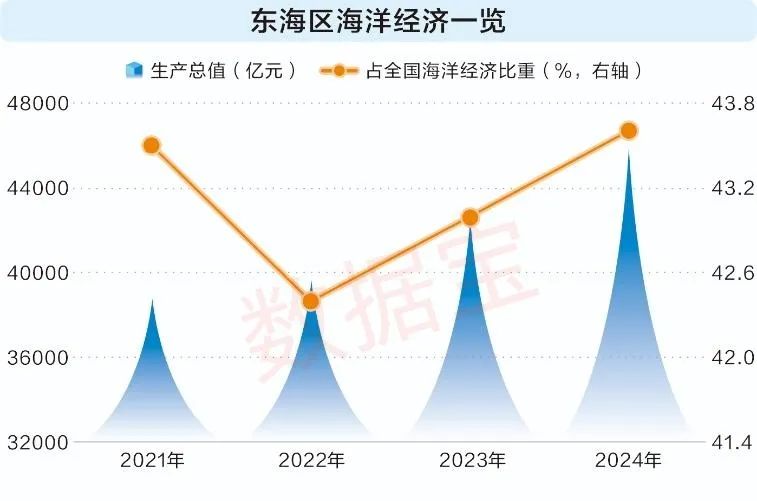
Core Viewpoint - The Eastern Marine Economic Zone, comprising Jiangsu, Shanghai, Zhejiang, and Fujian, is a vital and promising area for marine economic development in China, with significant growth in marine industries and a notable contribution to the national marine GDP [1][5]. Group 1: Marine Economic Growth - In 2024, the marine GDP of the Eastern Marine Economic Zone is projected to reach 45,992.9 billion yuan, representing a year-on-year growth of 7.1% and accounting for 43.6% of the national marine GDP [1]. - The marine industry structure in the Eastern Marine Economic Zone is continuously optimizing, with the primary, secondary, and tertiary industries contributing 4.0%, 36.3%, and 59.7% to the marine GDP, respectively [3][4]. - The total value added of 15 marine industries in the Eastern Marine Economic Zone is expected to grow by 8.5% in 2024, with traditional industries like marine oil and gas, shipbuilding, and marine tourism experiencing double-digit growth [4]. Group 2: Jiangsu Province - Jiangsu's marine economy is set to exceed 1 trillion yuan for the first time in 2024, growing from over 550 billion yuan in 2014 [6]. - The cumulative installed capacity of offshore wind power in Jiangsu reached 11.83 million kilowatts in 2024, with a total power generation of 32.8 billion kilowatt-hours, ranking among the top in the country [8]. - The number of specialized and innovative small and medium-sized enterprises in Jiangsu's marine sector increased by 58.8% year-on-year, reaching 786 by the end of 2024 [8]. Group 3: Zhejiang Province - Zhejiang has the longest coastline in China at 6,715 kilometers and has developed a comprehensive port system centered around Ningbo-Zhoushan Port, which is a global leader in cargo throughput [9][11]. - In 2024, Ningbo-Zhoushan Port achieved a cargo throughput of 1.377 billion tons, a 4% increase, and a container throughput of 39.3 million TEUs, marking an 11% growth [9]. - Zhejiang established a Marine Economy Development Bureau to enhance its marine economic capabilities and plans to invest over 60 billion yuan in 120 strong port projects by 2025 [11]. Group 4: Fujian Province - Fujian's marine GDP is expected to exceed 1.25 trillion yuan in 2024, with a year-on-year growth of 6.1%, maintaining its position as the third-largest marine economy in China [12]. - The total aquatic product output in Fujian reached 9.246 million tons in 2024, with a 3.9% increase, and the province continues to lead in aquatic product exports [12][14]. - Fujian is also focusing on marine biomedicine, with significant developments in marine high-tech industrial parks and a strong emphasis on marine pharmaceuticals [14]. Group 5: Shanghai - Shanghai's marine GDP is projected to reach 1,138.7 billion yuan in 2024, contributing 10.8% to the national marine GDP despite having only 0.35% of the national marine area [15]. - The marine advanced manufacturing sector in Shanghai is thriving, with the shipbuilding industry showing significant growth, including a 20% increase in industrial output value [15][17]. - The marine tourism sector in Shanghai is also expanding, with a nominal growth of 17.6% in value added, making it a new growth point for the industry [18].
构建人海和谐的生态环境——高质量发展海洋经济述评(下)
Jing Ji Ri Bao· 2025-07-17 00:00
Core Concept - The concept of "Human-Sea Harmony" is central to modern marine governance and development, emphasizing the importance of marine ecological environment protection and the implementation of comprehensive management of key sea areas [1] Group 1: Marine Ecological Environment Protection - Strengthening marine ecological environment protection is strategically significant and essential for achieving high-quality development in the marine sector [2] - The transition from a marine power to a marine strong nation requires a balance between marine industry development and environmental protection, promoting efficient use of marine resources and fostering a low-carbon, circular economy [2][4] - The construction of a marine strong nation relies on ecological foundations, with a focus on transforming ecological assets into economic value through technological innovation and institutional reform [2] Group 2: Achievements in Marine Environment - In the previous year, the proportion of good water quality in nearshore waters reached 83.7%, an increase of 6.3 percentage points from 2020 [3] - Continuous improvement in water quality has been observed, with key monitored marine ecosystems maintaining a healthy status for four consecutive years [3] - Significant progress has been made in restoring typical ecosystems such as coastal wetlands and mangroves, with stable populations of rare species like the Chinese white dolphin [4] Group 3: Comprehensive Management of Key Sea Areas - The Bohai Sea, Yangtze River Estuary-Hangzhou Bay, and Pearl River Estuary are critical areas for comprehensive management, with a projected water quality improvement to 66.8% by 2024, an increase of 8.1 percentage points from 2020 [5] - The Ministry of Ecology and Environment is set to continue implementing comprehensive management actions in these key sea areas, focusing on nitrogen control in rivers flowing into the sea [6] Group 4: Marine Carbon Sink Accounting - Significant breakthroughs have been made in marine carbon sink accounting, transitioning from local pilot projects to nationwide promotion [6] - Marine carbon sinks are expected to play a crucial role in integrating ecological civilization with the blue economy, although challenges remain in monitoring accuracy and asset transformation [6]
净利飙升达5.8亿-7亿元!松发股份半年度预告扭亏,船舶制造成新增长引擎
Zheng Quan Zhi Xing· 2025-07-14 02:45
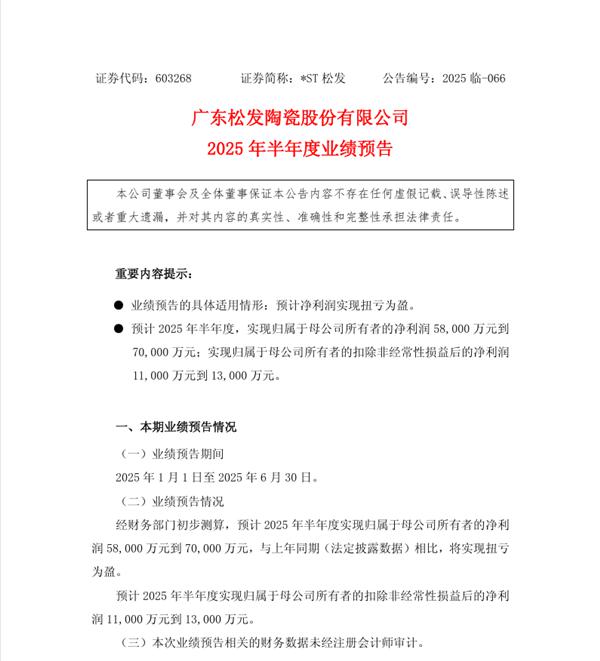
Group 1 - The core viewpoint of the news is that Songfa Co., Ltd. has successfully completed a strategic transformation and is expected to achieve profitability in the first half of 2025, with a projected net profit of 580 million to 700 million yuan, marking a significant milestone in its development [1] - The acquisition of 100% equity in Hengli Heavy Industry represents a landmark case in capital market mergers and acquisitions, enhancing Songfa's strategic upgrade towards high-end equipment manufacturing [2] - Hengli Heavy Industry has established a complete industrial chain from core components to ship manufacturing, with a production capacity of 180 marine engines annually, positioning itself advantageously in the green ship sector [2] Group 2 - Hengli Heavy Industry has a strong order reserve of 170 high-value orders scheduled for delivery by 2029, showcasing its transition from technology catch-up to innovation leadership [3] - The company has achieved a leading position in the global shipbuilding industry, ranking fifth in new orders globally and fourth in China in 2024, indicating robust growth prospects [3] - Songfa Co., Ltd. is financing Hengli Heavy Industry's strategic development, focusing on building a green high-end equipment manufacturing base and an international ship research and design center, which will enhance production efficiency and technological innovation [4]

深海科技:海洋强国战略的关键支柱
2025-07-09 02:40
Summary of Deep Sea Technology and Marine Economy Conference Call Industry Overview - The deep sea technology and marine economy are recognized as key pillars in the national strategy, with the national marine production value expected to exceed 10 trillion yuan in 2024, accounting for 7.8% of GDP and contributing 11.5% to GDP growth [1][3][4]. Core Insights and Arguments - The government has placed significant emphasis on deep sea technology, highlighting its importance alongside commercial aerospace and low-altitude economy in the work report, indicating a period of rapid development supported by policy [1][3][5]. - Deep sea technology encompasses three main areas: deep sea material research and development, deep sea equipment manufacturing, and deep sea tool application, with structural and buoyancy materials being critical [1][6]. - The marine equipment manufacturing sector is experiencing new opportunities, particularly in underwater detection technology, underwater construction technology, and oil and gas production equipment, with significant growth potential in underwater robots and related fields [1][7][8]. - The shipbuilding industry is at a peak due to the shipping cycle, with shipbuilding completion volume expected to grow by 13.8% year-on-year in 2024, and new orders increasing by 58.8% [6][8][10]. Investment Opportunities - Investment opportunities exist in deep sea technology, particularly in high-performance steel, alloy materials, and composite materials that are resistant to corrosion and high pressure [6]. - Companies such as Baotai Co., Baose Co., and Steel Research High-Tech are noted for their competitive edge in these segments [6]. - The marine equipment manufacturing industry is poised for growth, with a focus on underwater exploration and military equipment, supported by a favorable policy environment [9][10]. Additional Important Insights - The development of offshore wind power is currently concentrated in nearshore areas, but there is significant potential for growth in deep offshore wind power, which will increase demand for submarine cables and related infrastructure [11][12]. - The trend towards digitalization and intelligence in deep sea technology is accelerating, with the construction of underwater data centers addressing cooling and land cost issues while ensuring data security and compliance [2][13][14]. - Marine communication, particularly its integration with AI, is identified as a promising direction for future development in deep sea technology [15].
港股异动 | 中集集团(02039)涨超6% 深海科技再获关注 公司布局深海油气及新能源业务
智通财经网· 2025-07-02 01:53
Group 1 - Central Financial Committee meeting proposed promoting high-quality development of the marine economy, emphasizing the importance of marine technology development for resource exploitation [1] - Deep-sea technology has become a key pillar in the marine economy, covering three main areas: deep-sea material research and development, deep-sea equipment manufacturing, and deep-sea intelligent applications [1] - Domestic policies are expected to be introduced to promote deep-sea economic development, focusing on deep-sea mining, oil and gas development, and utilization of deep-sea biological resources [1] Group 2 - CIMC Group is involved in two main aspects of deep-sea technology exploration: deep-sea oil and gas extraction equipment manufacturing and services, and deep-sea renewable energy development [2] - The "Blue Whale 1" and "Blue Whale 2" semi-submersible drilling platforms are significant achievements in China's deep-sea engineering, capable of operating at a maximum water depth of 3,658 meters and drilling to a depth of 15,240 meters [2] - CIMC Group is advancing the development of marine renewable energy, including offshore wind power and the upcoming delivery of the world's first bamboo-based composite floating photovoltaic platform, "Jilin No. 1," in 2024 [2]

深海科技 “深海经济”将高速启航!
2025-07-02 01:24
Summary of Deep Sea Technology Conference Call Industry Overview - The deep sea economy has been elevated to a national strategic level, impacting economic development and national security, particularly concerning strategic resources like manganese, iron, cobalt, and rare earths, which are crucial for reducing China's import dependency [1][2][6] - The deep sea technology sector is projected to become a trillion-dollar industry, with significant investment opportunities in infrastructure, exploration, robotics, unmanned equipment, and information technology [1][9] Core Insights and Arguments - The government has recognized deep sea technology in its work report since March 25, 2025, highlighting its importance in resource acquisition, especially in extreme situations [2] - Compared to low-altitude economy, the deep sea economy has unique resource advantages, including oil, natural gas, and strategic metals, making it a vital component of national strategy [3] - Investment opportunities in 2025 are focused on dual-use technologies, policy support, social capital participation, and domestic innovation, particularly in underwater combat and related technologies [3][10] - The Ocean Power Strategy aims to reduce reliance on imported energy and minerals, enhancing national energy security and promoting regional coordinated development [6] Important Measures and Developments - China is implementing various measures to promote deep sea technology, including policy inclusion in government reports and showcasing new combat capabilities during military parades [5] - The establishment of a unified national market is expected to improve traditional industries by optimizing supply structures and enhancing overall efficiency [7][8] Investment Opportunities - Key investment areas for 2025 include: 1. **Dual-use Technologies**: Focus on underwater combat-related companies such as China Marine Defense, China Shipbuilding, and China Power [10] 2. **Policy Support and Social Capital**: Increased government backing and private sector involvement are anticipated [11] 3. **Domestic Innovation and Replacement**: Emphasis on enhancing domestic capabilities in sensors and underwater robotics [12] 4. **Mature and Emerging Industries**: Opportunities in offshore wind power, deep-sea fishing, marine biomedicine, and ecological protection [13] Recommended Companies and Sectors - **Deep Sea Equipment**: Recommended companies include China Shipbuilding, China Marine Defense, and Zhenhua Heavy Industries [16] - **Deep Sea Exploration**: Focus on companies like China Hai Fang and Micro Light [17] - **Deep Sea Information Technology**: Key players include Zhongtian Technology, Huatong Cable, and Dongfang Cable [18] Future Outlook - The deep sea technology sector is expected to experience significant growth, driven by national policies and the urgent need for technological advancements in resource exploration [20] - The industry is seen as a long-term investment opportunity, contributing to both civilian economic transformation and national defense [20]
深海科技“深海”借“科技”启航
2025-06-30 01:02
Summary of Deep Sea Technology Conference Call Industry Overview - Deep Sea Technology is a key component of China's marine power strategy, expected to receive continued high-level attention, potentially boosting sector prosperity [1][2] - The marine economy is projected to reach 11 trillion yuan by 2025, with deep sea technology accounting for approximately 25%, or about 2.75 trillion yuan [1][4] Core Insights and Arguments - The importance of deep sea resources for China's energy and non-ferrous metal security is emphasized, especially in the context of the US-China trade war, which has intensified the need for China to develop deep sea technology and establish a comprehensive marine observation network [1][5] - The Chinese government has included deep sea technology in its work report for the first time, indicating it will be a strategically supported emerging industry, likely leading to increased sector focus and investment [2][6] - Deep sea mining primarily involves polymetallic nodules, cobalt-rich ferromanganese nodules, and hydrothermal sulfides, which are crucial for ensuring resource security as China's dependence on foreign sources for key minerals exceeds 70% [3][9] Key Areas of Focus - The deep sea technology sector should concentrate on three main areas: equipment manufacturing, exploration technology, and information technology [3][13] - Notable companies in the sector include Yaxing Anchor Chain, China Shipbuilding Industry Corporation, China Power, Zhenhua Heavy Industries, and others, which are involved in unmanned equipment, sensors, and cables [3][8][13] Policy Impact - The Chinese government is expected to implement policies from the central to coastal provinces following the work report, which will drive infrastructure investments and support the industrial chain, leading to a win-win situation for capital, industry, and the nation [6][8] Challenges and Urgency - China is currently about five years behind the US in deep sea mineral resource development technology, with the US already in the early stages of commercial mining [7][11] - The urgency for China to accelerate its deep sea mining development is heightened by the US government's recent actions to authorize commercial licenses for deep sea mining beyond national jurisdiction [10][11] Importance of Marine Observation Network - The marine observation network is a comprehensive monitoring system deployed on the seabed, essential for real-time monitoring of marine environments, geological activities, and biological ecosystems [12] - Accelerating the construction of the marine observation network is critical for China to advance into deep sea exploration and achieve its marine power goals [12] Investment Recommendations - Investment focus should be on equipment manufacturing, exploration technology, and information technology, with specific recommendations for companies involved in these areas [8][13]