量子计算

Search documents
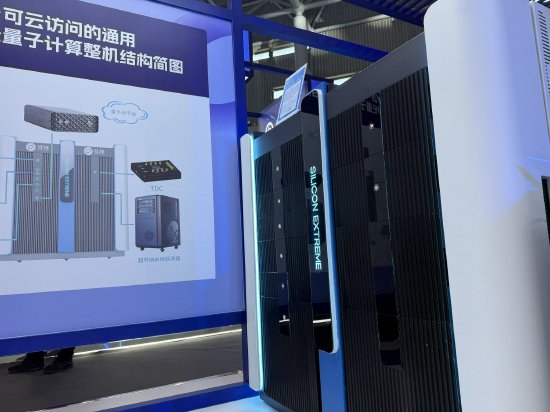
硅臻首发基于硅光集成芯片的通用可编程量子计算机
Xin Lang Cai Jing· 2025-11-20 05:04
Core Insights - Hefei Silizhen Chip Technology Co., Ltd. has launched a general-purpose programmable quantum computer based on silicon photonic integrated chips at the 2025 Quantum Technology and Industry Conference [1][3] - The quantum computer utilizes photons as qubit carriers and integrates photonic chips, significantly reducing system operation complexity and cost, facilitating the transition of quantum computing from laboratory to industrial applications [3] Technical Specifications - The device currently offers 4 qubits of physical resources for experimental validation in small to medium quantum computing scenarios [3] - The average fidelity for single and two-qubit states reaches 99.7% and 99.4%, respectively, providing a solid foundation for computational results [3] - It supports visual programming and cloud platform access, allowing users to customize algorithms and deploy services, making it accessible even to non-quantum professional teams [3] Future Applications - The quantum computer is expected to find widespread applications in strategy optimization, artificial intelligence, simulation analysis, and information security [3] Development Background - The quantum computing technology is derived from the team of Academician Guo Guangcan from the University of Science and Technology of China, with shareholders including Benyuan Quantum and Guoxin Technology [3] - In May of this year, Silizhen Chip completed a multi-million yuan financing from Xiangfeng Investment to accelerate the progress of photonic quantum computing [3]

超导量子计算机“天衍-287”建成
Ke Ji Ri Bao· 2025-11-20 01:21
Core Insights - China Telecom Quantum Research Institute announced the completion of the "Tianyan-287" superconducting quantum computer, which features 105 data qubits and 182 coupling qubits, developed in collaboration with Keda Guandun Quantum Technology Co., Ltd [1][2] - The quantum computing system demonstrates "quantum computing superiority," processing specific problems 450 million times faster than the fastest supercomputer currently available, and will be integrated into the "Tianyan" quantum computing cloud platform for global application services [1][2] Group 1 - The construction of "Tianyan-287" showcases breakthroughs in three areas: "national production," "AI empowerment," and "super fusion" technology [2] - The hardware and components used in "Tianyan-287" are entirely domestically produced, with key parts like large-capacity dilution refrigerators and low-temperature components developed by local manufacturers [2] - The team developed an AI-enabled automatic calibration system for superconducting chip parameters, achieving efficient and high-precision calibration and maintenance of the quantum computing system [2] Group 2 - The integration of the superconducting quantum computer with the "Tianyi Cloud" supercomputing platform allows for high-bandwidth super fusion, enabling low-latency interaction between quantum computing and supercomputing resources [2] - The "Tianyan" quantum computing cloud platform was officially launched in November 2023, merging Tianyi Cloud supercomputing capabilities with 176 qubit superconducting quantum computing capabilities [2] - The platform has seen over 37 million visits, serving users across more than 60 countries and regions, with over 2.7 million experimental tasks completed [2] Group 3 - The company aims to provide computational support for more industry users and research institutions, expanding the application boundaries of quantum computing and enhancing China's core competitiveness and influence in the field [3]


加快形成推动未来产业发展的社会合力
Zheng Quan Ri Bao· 2025-11-19 16:21
Core Viewpoint - Future industries are leading the technological revolution and represent a strategic high ground in global competition, encompassing areas such as artificial intelligence, quantum computing, biomanufacturing, and aerospace technology [1] Summary by Categories Technological Innovation - Technological innovation is the core engine driving the development of future industries, with breakthroughs in disruptive technologies being essential for progress. For instance, the "Nine Chapters No. 3" quantum computing prototype developed by the University of Science and Technology of China can solve Gaussian boson sampling problems one quintillion times faster than the fastest supercomputer globally, positioning China as a leader in the quantum computing sector [2] Policy Support - Policy support is crucial for the development of future industries, which are characterized by high investment, long cycles, and significant uncertainty. The Central Committee's recommendations for the 15th Five-Year Plan emphasize the need for forward-looking layouts in future industries and the promotion of sectors like quantum technology, biomanufacturing, hydrogen energy, and sixth-generation mobile communications as new economic growth points [2] Capital Empowerment - Sufficient and diverse capital supply is key to accelerating the transition of technologies from laboratories to markets, thereby forming future industries. China has established a multi-tiered capital market system, including the main board, Sci-Tech Innovation Board, Growth Enterprise Market, New Third Board, and regional equity markets, enhancing the capital market's ability to support technological innovation and high-level self-reliance [2] Talent Development - Talent cultivation is a lasting driving force for future industries, as competition fundamentally revolves around high-end talent. There is a growing need for interdisciplinary talent who understand both fundamental research and industrial applications. Cities like Shanghai and Guangzhou are implementing talent introduction policies to support core R&D personnel in future industries, with financial incentives of up to 500,000 yuan [3] Systematic Integration - The development of future industries is not merely a combination of the four core elements but requires a collaborative and integrated approach. For example, technological innovation provides value targets for capital empowerment, while policy support and talent development facilitate continuous breakthroughs in technological innovation [3]
张家栋:警惕科技新冷战,遏华注定徒劳
Xin Lang Cai Jing· 2025-11-19 02:14
Group 1 - The article argues that the narrative of a "new cold war" in technology competition between the US and China is misguided, as it overlooks the global logic of technological development and historical lessons that show that blockades do not lead to long-term technological leadership [1][3] - Historical examples illustrate that technology blockades, such as those imposed by Britain and the US during the industrial revolution and the Cold War, ultimately failed to achieve their intended goals and instead led to losses for the imposing countries [1][2] - The US's attempts to extend technology restrictions against China across the entire supply chain are deemed futile, as evidenced by a report acknowledging China's significant advancements in innovation and its solidified position as a global manufacturing power [2][3] Group 2 - The article highlights that the modern technological system cannot be divided by national borders, as it relies on four core elements: talent, institutional culture, resources, and application scenarios, which are deeply integrated globally [3][4] - It emphasizes that cooperation between the US and China in technology fields, such as AI ethics and climate change, could provide new solutions to common challenges, rather than falling into a zero-sum game [3][4] - The author advocates for abandoning hegemonic thinking and confrontation, promoting dialogue, sharing, and collaboration as the correct approach to face the technological revolution [4]

全球最大的硅光企业诞生
半导体行业观察· 2025-11-19 01:35
Core Insights - GlobalFoundries has acquired Singapore-based silicon photonics manufacturer AMF, becoming a leading player in the silicon photonics sector [2] - Silicon photonics technology uses light instead of electrical pulses for data transmission, which is crucial for communication within chips, between components, and across servers [2] - NVIDIA plans to implement silicon photonics technology in its next-generation AI servers to reduce power consumption while increasing data transfer speeds, which is essential for managing millions of GPUs in data centers [2][3] - AMD is also investing heavily in this technology, having established a dedicated R&D center in Taiwan with an investment of nearly $300 million and previously acquiring Enosemi to enhance its competitive edge against NVIDIA [2][3] Industry Trends - The demand for silicon photonics technology is driven by the rapid expansion of AI data centers, which are experiencing significant increases in power consumption and placing pressure on electrical grids [3] - Tim Breen, CEO of GlobalFoundries, emphasized the importance of high-speed, precise, and energy-efficient data transmission for AI data centers and advanced telecommunications networks [3] - Silicon photonics is also a key technology for quantum computing, allowing for systems that do not require low-temperature cooling, making quantum computers more practical and cost-effective [3] Competitive Landscape - Major companies like AMD, NVIDIA, and GlobalFoundries are investing in silicon photonics, but several startups such as Ayar Labs, Celestial AI, and Lightmatter are also developing their own photonic technologies, indicating a competitive landscape [3] - While consumer-grade CPUs, GPUs, and motherboards are not expected to adopt this technology in the short term, it is already being utilized in large servers capable of processing terabytes of data per second [4] - Continued investment in AI data centers is anticipated to drive further research and development in this promising technology [4]



做量子世界“探矿人” 促量子应用“多点开花”
Xin Hua Ri Bao· 2025-11-18 22:03
Core Insights - The article emphasizes the strategic importance of quantum technology as a key driver for future industrial growth and innovation in China, particularly highlighted in the "14th Five-Year Plan" [1] Group 1: Quantum Technology Developments - Southeast University has achieved significant breakthroughs in the research of "interleaved magnetic materials," a new type of quantum material, which can enhance data storage technology by potentially increasing processing speeds by several times or even hundreds of times [2] - Nanjing University of Posts and Telecommunications is leading a project on high-performance quantum secure communication systems, utilizing machine learning and AI for real-time monitoring and automatic calibration of quantum signals [3] - The collaboration between universities and enterprises is accelerating the practical application of quantum technology, moving from isolated developments to widespread implementations [3][4] Group 2: Industry Applications and Collaborations - Nanjing University of Posts and Telecommunications has partnered with Jiangsu Hengtong Optic-Electric Co., Ltd. to develop "quantum random number" technology and is involved in various encryption projects with local companies [3][4] - The development of a superconducting quantum computer by a team at Nanjing University of Posts and Telecommunications has made progress in electromagnetic interference testing, which is crucial for large-scale chip integration [4] - The launch of the "Dongnan. Cloud" software platform by Southeast University aims to facilitate the application of quantum computing across various fields, including AI and biomedicine [4] Group 3: Talent Development and Education - The demand for skilled professionals in quantum technology is increasing, prompting universities to enhance their educational programs in this field [6] - Nanjing University of Posts and Telecommunications is implementing a tiered training system to cultivate students' understanding and practical skills in quantum technology [7] - Collaborative training programs with leading enterprises are being planned to address real-world challenges in quantum technology [7]

中国电信实现百公里级量子-经典空芯共纤传输重大突破
Xin Hua She· 2025-11-18 10:33
Core Viewpoint - China Telecom has successfully completed a transmission experiment of over 100 kilometers using hollow-core optical fibers, setting a new record in the field [1] Group 1: Technological Breakthrough - The joint transmission of quantum and classical signals is a key bottleneck for the large-scale deployment of quantum communication [1] - The research team proposed an innovative spectrum collaborative allocation mechanism, achieving efficient and stable joint transmission of quantum and classical signals, addressing the interference issue in traditional solid-core fibers [1] Group 2: Industrial Implications - The industrialization prospects of this technological breakthrough are widely regarded as promising, injecting innovative momentum into multiple fields [1] - In network construction, this technology can significantly reduce the integration deployment costs of quantum communication with existing classical communication networks, accelerating the large-scale implementation of quantum communication and promoting the rapid development of related industries [1] Group 3: Recent Achievements - China Telecom has been continuously focusing on quantum-related innovative technologies, recently achieving new results in quantum computing [1] - The superconducting quantum computer "Tianyan-287," equipped with the same chip as "Zuchongzhi No. 3," has officially started operation, demonstrating "quantum superiority" by processing specific problems 450 million times faster than the fastest supercomputer currently available [1]
广州首个量子计算平台发布 首届量子计算+生物医药科技峰会举行
Ke Ji Ri Bao· 2025-11-18 03:24
Core Insights - The first Quantum Computing + Biomedicine Technology Summit was held in Guangzhou, marking a significant step in integrating quantum technology with the biomedicine sector [1] - The launch of the "Pude" dedicated quantum scientific computing platform aims to provide low-cost and efficient quantum computing services to enterprises and research institutions in Guangzhou [1] Group 1: Quantum Computing Developments - The "Pude" platform is designed to be a leading public service platform for quantum computing in China, facilitating the deep integration of quantum technology with the real economy [1] - The introduction of quantum Gibbs sampling mechanisms into classical deep generative models represents a breakthrough in quantum-classical collaborative computing architecture [2] - The self-developed coherent light quantum computer by Boson Quantum is specialized for solving the Ising model, featuring high parallel computing capabilities [3] Group 2: Collaborations and Applications - Boson Quantum collaborates with various institutions, including Sun Yat-sen University and Shanghai Jiao Tong University, to enhance quantum computing applications in biomedicine [3] - China Mobile is developing platforms that integrate quantum computing with classical computing to improve efficiency in drug simulation and biomolecular structure prediction [2] - Guangzhou's health commission is planning to implement 21 quantum medical application scenarios in collaboration with multiple organizations [1]
机构:量子计算正加速从实验验证走向商业化应用
Zheng Quan Shi Bao Wang· 2025-11-18 00:46
Core Insights - The 2025 Quantum Technology and Industry Conference will be held from November 20 to 22 in Hefei, highlighting the growing importance of quantum technology in various applications [1] - Quantum technology is recognized for its significant advantages over classical information tools, particularly in computing, communication, and measurement [1] - The global quantum computing market is projected to grow from $5 billion in 2024 to over $800 billion by 2035, indicating a substantial commercial opportunity [2] Group 1 - Quantum computing is at a critical turning point, transitioning from experimental validation to commercial application, with hardware expected to lead the way in industrial breakthroughs [2] - China is leading in quantum key distribution (QKD) technology, establishing a comprehensive quantum secure communication industry chain [3] - The quantum measurement industry is entering a diversified development phase, enhancing measurement precision across various physical quantities [3] Group 2 - Major global tech companies, including Google, IBM, and Microsoft, are making significant advancements in quantum bit scale and error correction, contributing to the acceleration of quantum technology commercialization [2] - The Chinese quantum technology initiative is prioritized in the "14th Five-Year Plan," emphasizing its importance for future industrial development [1] - The quantum computing market is expected to experience rapid growth between 2028 and 2030, suggesting a favorable investment landscape [1]
重大转变!“中国:0→47%,美国:88%→9%”
Guan Cha Zhe Wang· 2025-11-18 00:44
Core Insights - The article highlights a significant shift in the global remote sensing research landscape, with China increasing its share of published papers from nearly zero in the 1990s to 47% by 2023, while the U.S. share plummeted from 88% to 9% [1][2][5]. Group 1: Research Output - In 2023, China accounted for nearly half of the global remote sensing publications, while the U.S. share fell below 10% [2]. - The number of remote sensing papers published globally has grown exponentially, from just over ten per year in the 1960s to more than 13,000 annually by 2023 [9]. - A study analyzed over 126,000 scientific papers from 72 journals between 1961 and 2023, revealing China's rapid rise in research output [5]. Group 2: Funding and Institutional Support - Research funding levels are strongly correlated with publication output, with over 53% of China's remote sensing papers funded by the National Natural Science Foundation, compared to only 5% for U.S. institutions [6]. - The top six funding agencies for remote sensing research from 2011 to 2020 were all Chinese, while NASA and the National Science Foundation (NSF) ranked seventh and eighth, respectively [7][8]. Group 3: Technological Advancements - China has made significant breakthroughs in remote sensing technologies, including multi-spectral and hyperspectral imaging, synthetic aperture radar, and advancements in data transmission and processing [12]. - Recent innovations include a dual-station collaborative ranging technology achieving nanometer-level precision, which could support high-precision space research [12]. Group 4: Future Outlook - The article suggests that unless the U.S. government significantly adjusts its funding priorities, it is unlikely to regain its leadership in remote sensing innovation [13][14]. - The ongoing investment in artificial intelligence, machine learning, and quantum computing by China is expected to further enhance its capabilities in remote sensing [10].