AI技术

Search documents
量化、宏观、CTA,到底选谁?
雪球· 2026-01-15 08:06
Core Viewpoint - The article discusses the increasing trend of quantitative macro strategies in the investment landscape, emphasizing their growth and effectiveness in asset allocation and risk management [9][10]. Group 1: Growth of Quantitative Macro Strategies - Over the past seven years, the global management scale of quantitative macro strategies has experienced explosive growth, surpassing 60% of the global macro strategy proportion in 2023, with this percentage continuing to rise [9]. - Quantitative macro strategies shift investment decision-making from narrative-driven approaches to rule-based execution through quantitative models, integrating both quantitative trading and macroeconomic logic [10]. Group 2: Addressing Criticisms of Quantitative Macro Strategies - Criticism regarding the rationality of macro strategies is addressed, highlighting that while traditional macro strategies rely on low-frequency economic data, quantitative macro can utilize a broader range of high-frequency data through advancements in machine learning and AI [12][13]. - The article counters the skepticism about the performance of quantitative macro strategies, asserting that many strategies have demonstrated significant excess returns, particularly in volatile market conditions, where they can quickly respond to market signals [16][18]. Group 3: Strategy Implementation - An example of a quantitative macro strategy is provided, which divides its approach into Beta and Alpha components, with the Beta portion using a risk parity model to allocate equal volatility weights to equity indices, government bonds, and commodity futures [15]. - The Alpha component employs machine learning models to identify short-term signals for timing and trading, enhancing returns without increasing overall portfolio risk [15][18]. Group 4: Risk Management and Leverage - Quantitative macro strategies are noted for their cautious approach to leverage, utilizing a more diversified trading portfolio and a programmatic risk control mechanism to monitor leverage usage in real-time [20]. - The article emphasizes that the flexibility in using leverage is a significant advantage of macro strategies, particularly when employing CTA methods to amplify returns during certain market conditions [18][20].


2026年广告主怎么看?预计中国营销投资平均增长10%
Jing Ji Guan Cha Wang· 2026-01-15 05:43
Core Insights - The report indicates a recovery in investment confidence among advertisers in China's digital marketing market, with a projected growth rate of 10% for marketing expenses in 2026, an increase in the proportion of advertisers holding positive investment confidence to 30%, up 8 percentage points year-on-year [1][2] Group 1: Market Trends - The digital marketing industry in China is at a crossroads of technological revolution and value reconstruction, with AI technology evolving from a content tool to a fundamental infrastructure for businesses [1] - The report highlights a decline in the importance of traffic dividends, with advertisers increasingly recognizing that brand strength is the core driver of long-term growth, although they face business pressures [1][3] Group 2: Investment Confidence - 30% of advertisers believe that overall marketing investment in China will increase in 2026, up 8 percentage points year-on-year, while 47% expect a decrease, reflecting an improvement in market sentiment [2] - The healthcare and beauty sectors show the strongest confidence, while the automotive and food and beverage sectors exhibit relatively lower confidence [2] Group 3: Marketing Challenges - Key challenges for marketers in 2026 include difficulties in measuring effectiveness (52%), enhancing marketing ROI (48%), and media fragmentation (45%), with the challenge of applying AI rising significantly [3] - The proportion of advertisers choosing to optimize internal organization to reduce management costs has increased to 37%, up 5 percentage points from the previous year [3] Group 4: Growth Opportunities - Advertisers identify increasing brand building (48%), launching new products (47%), and targeting younger demographics (42%) as key growth opportunities for 2026 [4] - The importance of brand awareness and image remains stable, with 83% of advertisers focusing on brand goals, while the proportion of those prioritizing sales effectiveness has dropped to its lowest in six years at 74% [4] Group 5: Marketing Insights - 28% of advertisers believe that the importance of data insights in marketing has declined, while the challenge of understanding consumer changes has risen to 31% [5] - The highest increases in media investment are seen in mobile internet (62%), content marketing (44%), and outdoor advertising (29%) [5] Group 6: Content Marketing Trends - Among advertisers engaged in content marketing, 44% expect their investment to grow in 2026, with sports events and short dramas being the top content types for increased investment [6] - 85% of advertisers recognize the urgent need to apply AI tools in marketing, with the main barriers being a lack of successful case studies and concerns over AI output reliability [6]
百亿私募指增产品2025年业绩大爆发!蒙玺、顽岩、衍复、幻方分列超额10强榜首
私募排排网· 2026-01-15 03:33
Core Viewpoint - In 2025, index-enhanced products are expected to experience significant excess returns, driven by factors such as a daily trading volume of 1.7 trillion yuan in the Shanghai and Shenzhen markets, advancements in AI technology enhancing alpha extraction capabilities, and a favorable style for small and mid-cap indices [2] Summary by Category Performance of Index-Enhanced Products - A total of 471 index-enhanced products are projected for 2025, with an average return of 46.47% and an average excess return of 15.56% [2][4] - Among these, 177 products from private equity firms with over 10 billion yuan in assets have the highest average return of 49.05% and an average excess return of 17.45% [4] Performance by Strategy - The top-performing strategies in 2025 include: - Quantitative stock selection with an average excess return of 28.29% and an average return of 55.06% [6] - CSI 1000 index enhancement with an average excess return of 21.24% and an average return of 54.56% [5][6] - CSI 500 index enhancement with an average excess return of 15.80% and an average return of 50.99% [13][6] Top Products in Each Category - For the CSI 1000 index enhancement, the top products are managed by: - Mengxi Investment with an outstanding performance [8][12] - Mingyuan Investment and Square Investment also rank highly [8] - In the CSI 500 index enhancement category, the leading products are managed by: - Wanyan Asset and Mingyuan Fund [13][16] - Other index-enhanced products are led by: - Yanfu Investment with significant returns [19][20] Notable Managers and Firms - Mengxi Investment's Li Xiang emphasizes the transformative impact of AI on investment strategies, focusing on data processing and model optimization [12] - Mingyuan Investment, known for its application of AI in finance, maintains a strong position in the quantitative investment sector [12] - Wanyan Asset's Jin Teng has extensive experience in quantitative research and investment management [16][18] - Yanfu Investment's Gao Kang, a former researcher at Two Sigma, leads the top-performing small-cap index enhancement product [24] Market Trends and Insights - The small-cap stock style is expected to dominate in 2025, contributing to the strong performance of the CSI 1000 index enhancement products [5] - The overall market environment, characterized by high liquidity and technological advancements, is conducive to achieving high excess returns in index-enhanced products [2]

一代股神巴菲特警告AI技术存在失控风险:堪比“核武器”
Jin Rong Jie· 2026-01-15 01:21
Core Viewpoint - Warren Buffett, the former CEO of Berkshire Hathaway, equates the rapidly evolving risks of AI with one of the most profound global security issues of his career—nuclear weapons, highlighting the uncertainty surrounding the future of AI technology [1] Group 1: AI Industry Concerns - Buffett emphasizes that even the leading experts in the AI field lack a clear understanding of the technology's ultimate direction, which poses a potential threat [1] - He uses the analogy of Columbus to illustrate that while exploration of the unknown may allow for retreat, there is no option to "turn back" with AI [1] Group 2: Nuclear Weapons Comparison - Buffett draws a parallel between the progress made in nuclear weapons concerns and the current state of AI, noting that initial fears of a single nation possessing nuclear capabilities have evolved into multiple nations having access [1] - He expresses that while he does not believe the threat of nuclear weapons can be simply resolved with money, he is willing to invest significant resources to eliminate this threat, which is a core issue in his philanthropic considerations [1]
消费级3D打印行业专题解读-创意点亮生活-3D打印入万家
2026-01-15 01:06
Summary of the Consumer-Level 3D Printing Industry Conference Call Industry Overview - The global consumer-level 3D printing industry is experiencing rapid growth, with a compound annual growth rate (CAGR) of 28% from 2020 to 2024, expected to reach nearly 30 billion RMB by 2024. However, household penetration is only 1.8%, indicating significant growth potential. The industry is projected to maintain a CAGR of over 30% in the coming years [1][3]. Market Position of Chinese Companies - Chinese companies dominate the global consumer-level 3D printing market, accounting for 45% of global export value in 2024, with a CAGR of 51% over the past two years. Top companies include Tuozhu Technology with a 29% market share and Creality 3D with a 17% market share. The market concentration (CR5) among the top five companies is 80% [1][4][5]. Application Areas - Consumer-level 3D printers are primarily used in consumer goods (43%), education (34%), and trendy stationery (13%). The demand for personalized products and the push for 3D printing in education are key growth drivers [1][6]. Future Growth Drivers - Several factors will continue to drive the growth of the consumer-level 3D printing industry, including ongoing technological upgrades (e.g., AI integration), diverse material applications, and the leading position of top Chinese companies. The market is expected to exceed 60 billion RMB by 2029 [1][7]. Export Performance - China is a major exporter of consumer-level 3D printing equipment, with 45% of global export value in 2024 and a CAGR of 51% over the past two years. The U.S. and Europe are the primary import regions, each accounting for about 30% [1][8]. Revenue Contribution by Product Type - In the industry chain, approximately 50% of revenue comes from complete machine sales, while consumables and accessories contribute around 20%. The revenue growth rate for complete machines is 21%, while consumables and accessories see a higher growth rate of 40% due to increased ownership [1][9]. Investment Opportunities - Investors are advised to focus on Creality 3D, which is set to go public in Hong Kong, and Jia Lin Technology, a leader in modified plastics. Creality 3D has a strong technological edge, while Jia Lin Technology is experiencing profit recovery and growth from overseas base construction. Additionally, companies related to consumables are also worth considering due to the rapid growth in demand [2][10]. Financial Performance of Creality 3D - Creality 3D is projected to achieve revenue of 2.3 billion RMB in 2024, with a CAGR of 30% over the past three years. The revenue from 3D printers accounts for nearly 62%, while other products like 3D scanners and laser engravers contribute about 10%. The gross margin remains stable at around 30%, but net profit margin has decreased from 8% in 2022 to 4% in 2024 due to increased sales expenses [12]. Channel Development - Creality 3D's revenue sources are well-balanced, with China, North America, and Europe each contributing 20%-30% of revenue. The company has significantly increased its online channel presence, growing from 6 overseas stores in 2022 to 57 in 2024, with online revenue achieving a CAGR of 127% [13]. Technological Advantages of Tuozhu Technology - Tuozhu Technology has notable advantages in smart integration, leveraging technology from the drone industry to enhance user experience in 3D printing. The company has rapidly become the global leader in consumer-level 3D printers since its establishment in 2020 [14]. Recommendations for Consumables Companies - The consumables sector is expected to grow at a CAGR of 36% from 2024 to 2029, outpacing the overall industry growth. Key recommendations include Jia Lian Technology and Yinxi Technology, both of which are well-positioned to benefit from the increasing demand for consumables [15]. Overall Industry Outlook - The consumer-level 3D printing industry shows strong growth potential driven by both supply and demand factors. Key players like Creality 3D and fast-growing consumables companies such as Jia Lian Technology and Yinxi Technology are expected to benefit significantly from industry growth [16].
梁文锋旗下幻方量化,去年收益率56.6%,规模已超700亿元
Mei Ri Jing Ji Xin Wen· 2026-01-14 23:20
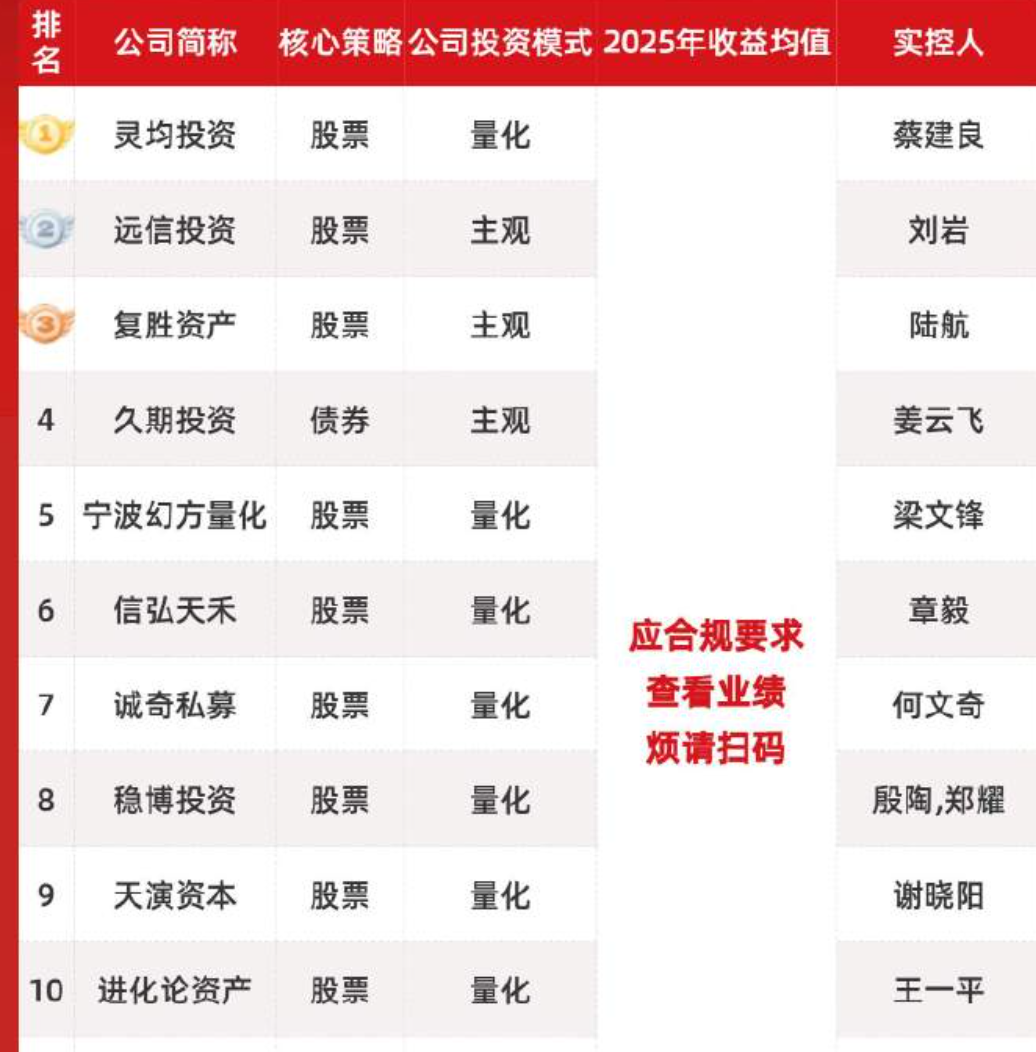
Core Insights - The A-share market in 2025 has shown significant performance, with the top three private equity firms achieving annual returns exceeding 70% [1][4][10] - Quantitative private equity firms have outperformed subjective strategies, with an average return of 37.61% compared to 25.80% for subjective firms [4][11] Performance Summary - The top three private equity firms in 2025 are Lingjun Investment with a return of 73.51%, Yuanshin Investment at 72.05%, and Fusheng Asset at 70.57% [1][4] - The average return for 75 private equity firms with reported performance was 32.77%, with 74 firms achieving positive returns, representing a positive return rate of 98.67% [4][10] - Among the 45 quantitative private equity firms, all achieved positive returns, while 22 out of 23 subjective firms also reported positive returns [4][11] Notable Firms - Huanfang Quantitative, led by Liang Wenfeng, achieved a return of 56.55%, ranking fifth among firms with over 100 billion in assets [1][5] - Huanfang Quantitative has shown strong long-term performance, with a three-year average return of 85.15% and a five-year average return of 114.35% [5][6] Market Dynamics - The bull market that began on September 24, 2024, has significantly enhanced the profitability of private equity firms, particularly in the context of a hot A-share market in 2025 [4][10] - The performance disparity among private equity firms is notable, with some firms like Lin Yuan Investment reporting a loss of 6.46%, making it the only firm with negative performance among the 75 firms [10][11] Strategy Analysis - Quantitative strategies have shown a clear advantage due to their adaptability to market conditions, leveraging AI technology for rapid trading and risk management [11] - Subjective strategies face challenges due to slower decision-making processes and limited coverage, which hinder their performance in fast-moving markets [11]
微创机器人重塑全球手术机器人市场格局 ——专访微创机器人创始人、首席执行官何超博士
Zheng Quan Shi Bao· 2026-01-14 18:15
Core Viewpoint - The company, MicroPort Robotics, has become the first and only enterprise globally to achieve commercialized listings of surgical robots across all categories, breaking a 20-year monopoly held by foreign products in the surgical robot market [1][2]. Group 1: Product Development and Market Position - MicroPort Robotics has received approval for seven surgical robot products, including the recently approved bronchoscopic surgical robot, establishing itself as a leader in the domestic surgical robot industry [2]. - The company’s first product, the TUMAI laparoscopic surgical robot, ended the long-standing monopoly of the Da Vinci system in the laparoscopic field, with over 160 global orders and more than 100 commercial installations [2]. - The orthopedic surgical robot, HONGHU, has also gained significant traction, with hospitals in Germany fully adopting it for joint replacement surgeries, marking a shift from traditional surgical methods [2]. Group 2: Financial Performance and Growth - In the first half of the previous year, the company reported a revenue of 176 million yuan, representing a 77% year-on-year increase, while significantly reducing losses by 59% [3]. - The company achieved overseas revenue of 103 million yuan, a 189% increase year-on-year, accounting for approximately 60% of total revenue [4]. Group 3: International Expansion and Strategy - MicroPort Robotics has successfully expanded into international markets, including Europe, Latin America, the Middle East, Southeast Asia, and Africa, with the TUMAI robot's overseas installations surpassing the total installations of all domestic brands in China [4]. - The company is focusing on innovation in overseas markets, particularly in vascular intervention robots, utilizing European research and clinical applications to leverage academic influence globally [4]. Group 4: Industry Insights and Future Directions - The company recognizes the need for collaborative efforts among policies and markets to promote healthy industry development, emphasizing the importance of innovation and unique value in technology [6]. - MicroPort Robotics has completed the world's first animal experiment of "large model autonomous surgery," exploring the integration of AI technology with surgical robots [6]. - There is a growing consensus within the industry regarding the need for improved policies and mechanisms to support original technology and facilitate clinical transformation [7].

梁文锋旗下幻方量化,去年收益率56.6%,规模已超700亿元!林园旗下产品业绩亏损,但斌收益跑输大盘
Mei Ri Jing Ji Xin Wen· 2026-01-14 15:01
Core Insights - The A-share market in 2025 has shown strong performance, with the top three private equity firms achieving annual returns exceeding 70% [1][3] - Quantitative private equity firms have significantly outperformed subjective strategies, with an average return of 37.61% compared to 25.80% for subjective firms [4][8] Group 1: Performance of Private Equity Firms - Lingjun Investment topped the list with a return of 73.51%, followed by Yuanshin Investment at 72.05% and Fusheng Asset at 70.57% [1][4] - The average return for 75 billion private equity firms was 32.77%, with 74 firms achieving positive returns, representing over 98% [3][4] - Among the quantitative private equity firms, Huanfang Quantitative achieved a return of 56.55%, ranking fifth overall [1][4] Group 2: Strategy Analysis - Quantitative strategies have shown a clear advantage, with all 45 billion quantitative private equity firms achieving positive returns [4][8] - In contrast, 23 subjective private equity firms had an average return of 25.80%, with only 4 firms exceeding 50% returns [4][7] - The performance disparity is attributed to the adaptability of quantitative strategies to market conditions, allowing for rapid adjustments and efficient short-term trading [8][9] Group 3: Notable Firms and Trends - Huanfang Quantitative, founded by Liang Wenfeng, has rapidly grown to manage over 700 billion, leveraging AI technology as a core competitive advantage [5][6] - The market environment in 2025, characterized by fast-paced rotations and active small-cap stocks, favored quantitative strategies [8][9] - Some notable firms, such as Lin Yuan Investment, reported losses, highlighting the challenges faced by subjective strategies in a volatile market [7][8]
启林投资:学术派量化研究科技公司
Xin Lang Cai Jing· 2026-01-14 14:09
Group 1 - The core viewpoint of the article emphasizes that quantitative investment is becoming an essential choice for investors facing unprecedented challenges in a volatile market environment [2][29] - Shanghai Qilin Investment Management Co., Ltd. (Qilin Investment) is a leading player in the domestic quantitative investment field, established on May 28, 2015, with an asset management scale reaching 15 billion RMB by October 2025 [2][29] - Qilin Investment has received numerous industry awards, such as the Yinghua Award and Huayao Award, highlighting its professional strength and industry recognition in quantitative investment [2][29] Group 2 - The founder, Dr. Wang Hongyong, has a strong academic background with degrees from prestigious institutions and has published multiple authoritative papers, providing a solid scientific research foundation for Qilin Investment [4][31][35] - The core management team at Qilin Investment has over seven years of traceable historical performance and extensive experience in strategy development, with a total of 55 employees and a clear organizational structure [8][12][39] Group 3 - Qilin Investment follows two guiding principles in its quantitative investment practice, focusing on the efficient and continuous development of new effective strategies through an industrialized approach [10][37] - The company has established a complete strategy development pipeline that standardizes and modularizes the research process, consisting of five key stages: data acquisition, factor research, model development, portfolio optimization, and trade execution [11][38] Group 4 - Qilin Investment has developed a multi-strategy system from three dimensions to adapt to different market environments and achieve stable returns, thereby reducing risks associated with single strategy failures [10][38] - The company invested approximately 100 million RMB in 2022 to establish a supercomputing cluster, enhancing its computational capabilities for strategy development [12][39] Group 5 - Qilin Investment's quantitative stock selection strategy is not benchmarked against any market index, allowing for greater flexibility in capturing market styles and maximizing alpha returns [15][42] - The strategy focuses on the CSI 2000 index, primarily investing in small-cap stocks, which have lower pricing efficiency and higher trading activity, providing a natural advantage for short-term signal prediction [16][44] Group 6 - The design of Qilin Investment's strategies aims for a high Sharpe ratio, ensuring high certainty of excess returns through strict risk control and refined portfolio management [22][50] - The company emphasizes minimizing alpha loss during risk control, optimizing risk models and portfolio algorithms to maintain alpha returns while controlling tracking errors and style exposures [23][51] Group 7 - Qilin Investment maintains a rigorous risk control system, strictly managing stock composition, industry/style exposure, and market capitalization to prevent style drift and mitigate tail risks [24][52] - The company is positioned to leverage the evolving landscape of quantitative investment, with opportunities arising from market efficiency improvements, investor structure optimization, and technological advancements [25][53]

石基信息(002153) - 2026年1月14日投资者关系活动记录表
2026-01-14 11:54
Group 1: SaaS Business Model - The SaaS business charges subscription fees based on monthly usage and the number of hotel rooms [2] - Pricing for cloud products varies depending on the functionality used by clients, with different rates for Full Service and Limited Service hotels [2] Group 2: AI Technology Integration - AI is utilized in two main areas: marketing tools that generate revenue based on a percentage of GMV, and integration into PMS and POS products for predictive assistance [3] - The company is developing a knowledge base to enhance prediction accuracy as more data is collected [3] - AI code generation tools are being used in the European R&D center to improve development efficiency while ensuring code safety [3] Group 3: Market Position and Strategy - The company is focusing on global and platform business strategies, with no immediate acquisition plans as major segments are already established [4] - DAYLIGHT PMS targets international hotel chains and luxury hotels, emphasizing strong group control rather than just hotel tier [5] Group 4: Client Engagement and Contracting Process - The selection process for core systems like PMS involves strategic planning, RFI, RFP stages, product demonstrations, and potential pilot projects before signing a Master Service Agreement (MSA) [6] - The contracting timeline is lengthy due to legal reviews and integration requirements, but it is expected to become more manageable as the company signs more groups [6] Group 5: Product Differentiation - DAYLIGHT PMS is designed as a platform for group clients, utilizing a microservices architecture and offering a single customer profile to streamline operations [8] - The product ensures data security by automatically storing customer data in compliance with local regulations [8] Group 6: International Operations - The overseas team has over 1,000 members, primarily composed of R&D and technical personnel, with a stable size to support globalization efforts [8] - The R&D team is based overseas to leverage industry experience and technical talent necessary for developing next-generation hotel management systems [9]