双碳目标

Search documents
聚焦能源安全!煤炭无人化开采数智技术关键突破,院士天团共商创新大计
Zhong Guo Neng Yuan Wang· 2026-01-12 09:09
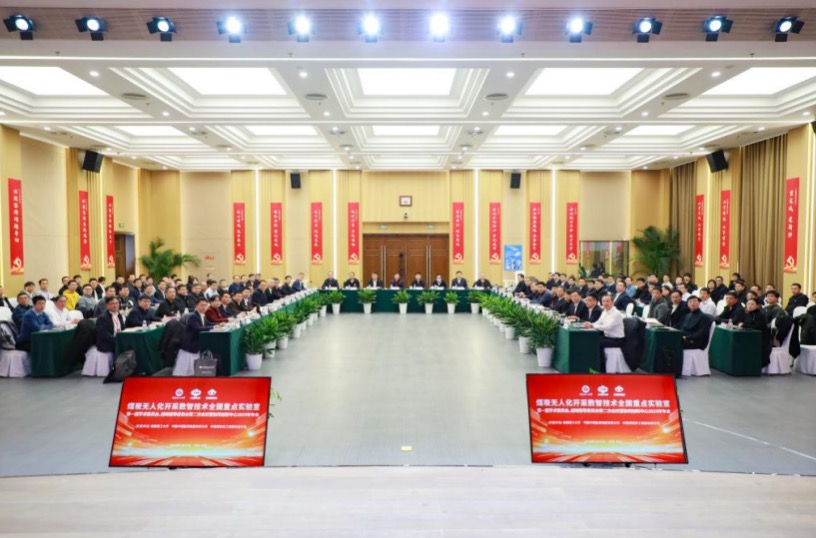
Core Insights - The meeting focused on the innovation and development of intelligent technology for unmanned coal mining, aiming to inject strong momentum into the high-quality development of the industry [1][15]. Group 1: Meeting Overview - The first academic committee and strategic advisory committee meeting of the National Key Laboratory for Intelligent Technology in Unmanned Coal Mining was held in Beijing, gathering leaders, experts, and scholars from various sectors [1][3]. - The meeting emphasized the importance of collaboration among government, industry, and academia to enhance innovation capabilities and transform them into industrial effectiveness [4][5]. Group 2: Key Contributions and Future Directions - The laboratory aims to become a leading source of innovation in unmanned coal mining technology, focusing on national strategic needs and advancing research in three major areas: energy security, deep resource development, and artificial intelligence [4][9]. - The laboratory has achieved significant results in the past year, including ten innovative outcomes, with three being landmark achievements [9][15]. Group 3: Expert Insights - Academicians highlighted the need for deep collaboration between human and machine in the entire process of coal mining, emphasizing the importance of intelligent reconstruction from perception to support [6][7]. - The laboratory's approach to talent cultivation through interdisciplinary training is seen as a solution to the challenges of recruitment and employment in the coal mining sector [6][13]. Group 4: Technological Innovations - The meeting discussed advancements in intelligent mining technologies, including smart sorting techniques that enhance coal quality and support the dual carbon strategy [8][12]. - The laboratory's collaborative model among universities, research institutes, and enterprises is designed to create a seamless connection between fundamental research, technology development, and practical application [7][14]. Group 5: Strategic Goals - The laboratory aims to strengthen its international cooperation and focus on green and low-carbon development, contributing to global coal safety and efficiency [6][7]. - Future plans include enhancing the operational mechanisms of the laboratory and focusing on key research directions to ensure sustainable development and continuous breakthroughs in core technologies [11][15].

信达证券:电力板块有望迎来盈利改善和价值重估
Xin Lang Cai Jing· 2026-01-12 08:44
Core Viewpoint - The domestic power sector is expected to see profit improvement and value reassessment following multiple rounds of power supply-demand tensions, driven by rapid growth in new energy installations and a focus on security in energy supply policies [1] Group 1: Market Dynamics - The peak value of coal power is likely to continue to stand out due to ongoing rapid growth in new energy installations and the emphasis on safe energy supply policies [1] - The introduction of a capacity pricing mechanism is expected to clarify the foundational role of coal power, while the promotion of electricity spot markets and ancillary service market mechanisms will likely continue [1] Group 2: Future Outlook - With the ongoing market reform in the electricity sector, electricity prices are expected to achieve a stable upward trend [1] - The National Development and Reform Commission's increased efforts in ensuring long-term coal supply contracts are likely to lead to a marginal increase in the actual performance rate of these contracts [1] - Coal power integrated companies, leveraging their own coal resources or high proportions of long-term coal contracts, are expected to maintain stable profits while achieving performance growth [1] Group 3: Performance Expectations - The performance of power operators is anticipated to improve significantly in the future [1]

沪指站上4100点,两市成交超3万亿
British Securities· 2026-01-12 07:38
Core Views - The A-share market experienced a strong upward trend, with the Shanghai Composite Index breaking through the 4100-point mark, reaching a recent high [3][17] - The trading volume exceeded 3 trillion yuan, indicating a significant increase in market activity and a strong willingness for new capital to enter [3][17] - A positive feedback loop has formed, where increased trading volume supports further index gains, attracting more investors [3][17] Market Overview - On the last trading day, the Shanghai Composite Index closed at 4120.43 points, up 37.45 points, with a gain of 0.92% [6] - The Shenzhen Component Index rose by 160.67 points, or 1.15%, closing at 14120.15 points [6] - The ChiNext Index increased by 25.50 points, or 0.77%, ending at 3327.81 points [6] - The market saw a collective rise in major indices, with the Shanghai Composite Index gaining 3.82% for the week, and the ChiNext Index up 3.89% [7] Sector Performance - AI-related stocks surged, with significant activity in companies like Kimi and Sora, reflecting the ongoing investment opportunities in the AI sector [8][10] - The cultural media sector also saw substantial gains, driven by advancements in AI applications in gaming and content production [10] - Precious metals, including gold and silver, experienced price increases due to factors such as geopolitical tensions and increased demand from central banks [11] - The insurance sector reported a 7.6% year-on-year increase in premium income, indicating a stable growth trajectory [12] - Aerospace and military stocks rose sharply, supported by government spending proposals and ongoing geopolitical tensions [13][14] - The semiconductor sector is witnessing a trend of domestic substitution, with opportunities for investment in companies that can adapt to industry changes [15] - New energy stocks, particularly in lithium batteries and solar energy, are expected to continue their upward momentum due to ongoing demand and supportive government policies [16] Future Market Outlook - The current market sentiment is positive, but caution is advised due to potential volatility associated with high trading volumes [4][18] - Investors are encouraged to hold onto positions that have already been established while waiting for potential buying opportunities during market pullbacks [4][18] - Focus should be on selecting stocks with strong earnings support across various sectors, including technology and cyclical industries [4][18]
实控人控股超7成,负债率曾达91.59%!江松科技IPO闯关
Xin Lang Cai Jing· 2026-01-12 06:46
Core Viewpoint - Jiangsong Technology's IPO status has shifted from suspension to inquiry, marking a critical phase for the company in the photovoltaic equipment sector, which has been deeply affected by industry cycles and current market conditions [2][17]. Company Overview - Jiangsong Technology, established in 2007, specializes in high-end intelligent equipment for photovoltaic cells and has become a leading manufacturer in the field, serving major clients like Longi Green Energy and Tongwei Co [3][18]. - The company has shown significant revenue growth from 807 million yuan in 2022 to 2.019 billion yuan in 2024, representing a 150% increase over three years [3][18]. Financial Performance - Net profit has also increased, with figures of 88.35 million yuan, 131 million yuan, and 184 million yuan for the years 2022 to 2024, indicating a steady improvement in profitability [3][18]. - Accounts receivable have risen significantly, with balances of 297 million yuan, 407 million yuan, 601 million yuan, and 823 million yuan, which accounted for 36.86%, 32.91%, 29.75%, and 69.68% of revenue respectively [3][18][19]. Order and Inventory Trends - Despite revenue growth, the company's order backlog has decreased, with figures of 1.767 billion yuan, 5.175 billion yuan, 3.613 billion yuan, and 2.491 billion yuan over the same period, reflecting a decline due to accelerated capacity clearance in the photovoltaic sector [5][20]. - Inventory levels have fluctuated, with amounts of 921 million yuan, 3.066 billion yuan, 2.146 billion yuan, and 1.371 billion yuan, indicating potential risks associated with inventory management [26]. Cash Flow and Debt Concerns - The company reported negative net cash flow from operating activities in 2024, primarily due to increased procurement and a decline in new orders, which could lead to liquidity issues [22][23]. - The debt-to-asset ratio has been high, with figures of 81.95%, 91.59%, 82.33%, and 75.37%, raising concerns about financial stability and investor confidence [23][24]. Governance and Control Risks - The company's ownership structure is highly concentrated, with the controlling shareholder holding 71.28% of the shares, which may raise governance concerns during the IPO review process [27][28]. - There is pressure from a performance-based agreement with investors, which could influence the urgency of the IPO process [28][29]. Industry Context - The photovoltaic industry is experiencing rapid growth, with an expected global installation of approximately 530 GW in 2024, but also faces challenges such as overcapacity and supply-demand imbalances [29]. - Technological advancements in solar cell technology present both opportunities and risks, as the company must adapt to potential shifts in technology to maintain its competitive edge [29].
氢能首个核证自愿减排量方法学问世
中国能源报· 2026-01-12 05:55
Core Viewpoint - The article discusses the issuance of the "Voluntary Greenhouse Gas Emission Reduction Project Methodology for Renewable Energy Electrolytic Hydrogen (CCER-01-004-V01)", which is China's first certified voluntary emission reduction methodology in the hydrogen energy sector, aimed at providing a unified standard for emission reduction accounting for eligible electrolytic hydrogen projects [3][5]. Group 1: Methodology Overview - The methodology aims to transform the emission reductions from clean and low-carbon hydrogen production into tradable carbon assets, thereby promoting the non-electric utilization and consumption of renewable energy [5][6]. - It is specifically applicable to new renewable energy electrolytic hydrogen projects and does not cover existing projects undergoing modifications or upgrades [6][8]. - The methodology simplifies monitoring parameters while ensuring that all data is verifiable and traceable, using conservative estimates to prevent overestimation of emission reductions [5][6]. Group 2: Industry Development and Potential - China's hydrogen production capacity is projected to exceed 50 million tons per year by the end of 2024, with over 600 planned renewable energy electrolytic hydrogen projects, positioning the country as a leader in the global renewable hydrogen sector [8]. - Currently, fossil fuel-based hydrogen production accounts for 98% of China's hydrogen output, with renewable electrolytic hydrogen making up only about 1%, indicating significant potential for scaling up renewable hydrogen applications [8][9]. - The estimated annual emission reduction from existing eligible projects is approximately 1.57 million tons of CO2 equivalent, with potential growth to 6 million tons by 2030 as renewable hydrogen production increases [8][9]. Group 3: Economic Impact and Commercialization - The implementation of the methodology is expected to create a second core revenue stream from carbon asset income for green hydrogen projects, significantly improving their economic models and accelerating commercialization [11][12]. - Current renewable hydrogen projects are generally unprofitable, with costs typically 2 to 3 times higher than fossil fuel hydrogen, and the average internal rate of return is below industry benchmarks [11][12]. - The methodology allows projects to participate in the voluntary emission reduction market, which is seen as the most effective way to enhance project economics, as demonstrated by a case study of a wind-powered hydrogen project [11][12]. Group 4: Broader Industry Benefits - The methodology will benefit the entire hydrogen industry chain, particularly project owners in resource-rich areas, and will indirectly benefit renewable energy plants due to increased market demand [12]. - It is expected to stimulate the release of green hydrogen capacity, providing stable sources for downstream industries such as steel, ammonia synthesis, and refining, thus supporting their decarbonization efforts [12].

实控人控股超7成,负债率曾达91.59%!江松科技IPO闯关,订单下滑胜算几何?|透市
Hua Xia Shi Bao· 2026-01-12 04:53
Core Viewpoint - Jiangsong Technology's IPO status has transitioned from suspension to inquiry, marking a critical phase for the company in the photovoltaic equipment sector, which is experiencing challenges such as overcapacity and declining orders [2] Company Overview - Jiangsong Technology, established in 2007, specializes in high-end intelligent equipment for photovoltaic cells and has become a leading manufacturer in this field, serving major clients like Longi Green Energy and Tongwei Co [3] - The company has shown rapid revenue and profit growth from 2022 to 2024, with revenues increasing from 807 million to 2.019 billion yuan, a growth of 150%, and net profits rising from 88.35 million to 184 million yuan [3] Financial Performance - Despite revenue growth, accounts receivable have increased significantly, with balances rising from 297 million to 823 million yuan, representing 36.86% to 69.68% of revenue during the reporting periods [3][4] - The company’s backlog of orders has decreased from 1.767 billion to 249.1 million yuan, indicating a decline in demand amid industry challenges [5] Cash Flow and Liquidity - Jiangsong Technology reported negative net cash flow from operating activities in 2024, primarily due to increased procurement and reduced customer prepayments [7] - The company's liquidity ratios, including current and quick ratios, are below industry averages, raising concerns about short-term debt repayment capabilities [11] Debt and Financial Risks - The company’s debt-to-asset ratio has been high, peaking at 91.59%, which may raise regulatory scrutiny during the IPO process [9][10] - High levels of inventory and accounts receivable also pose risks to the company's financial stability, with inventory fluctuating significantly over the reporting periods [11] Governance and Control - The company has a concentrated ownership structure, with the controlling shareholder holding 71.28% of the voting rights, which may raise governance concerns during the IPO review [12] - There are pressures related to a performance-based agreement with investors, which may influence the urgency of the IPO process [13] Industry Context - The photovoltaic industry is experiencing rapid growth, with global installations projected to reach approximately 530 GW in 2024, but also faces challenges such as overcapacity and supply-demand imbalances [14] - Technological changes in solar cell production, particularly the emergence of new technologies, present risks for Jiangsong Technology if it cannot adapt [14]

干在前与马上干(评论员观察)
Xin Lang Cai Jing· 2026-01-12 04:33
来源:人民日报 在蓄力与发力、谋划与执行之间,快是因为准备充分,稳是因为目光长远 每个平凡个体,都在用自己的方式融入时代大潮。发展不是抽象的概念,而是亿万次具体而微的行动叠 加 开年就要开动,开局就要开跑。即刻出发、奋力赶路,是为了给明天一个交代 每到年初,很多人会给自己写一份新年寄语、列一张心愿清单。2026年来了,在"想要"与"得到"之间, 如何"做到"? 那就是:想在前,就要干在前;干在前,最好马上干。这恰是立行立办的即时感。 今天的中国,给人很强的即时感。清晨,第一班高铁早早地发车鸣笛;日间,各类数据信息、人员物资 在高效流动;深夜,高校院所的实验室里,闪烁着未熄的灯光。线下,企业费尽心思把新的科研成果转 化应用;网上,直播间里回响着"农"字号产品热销的乡音。 即时即干,就在眼前;实干奋斗,为了明天。都说中国发展的速度快,这个速度不仅体现在日新月异的 变化中,更在"看准了就抓紧干"的决心里。 2025年中央经济工作会议上,习近平总书记强调:"党中央关于明年经济工作的思路、任务、政策,是 经过充分论证、反复研究提出的。定了就要落实。" "定了就要落实",需要更好统筹方向感与紧迫感。真正的效率,不是低头抢 ...
新疆昌吉:2025年新增新能源装机全疆第一 总规模超3300万千瓦占比过半
Zhong Guo Dian Li Bao· 2026-01-12 02:31
Core Viewpoint - The company is focused on leveraging the unique wind and solar resources in Changji Prefecture, Xinjiang, to support the development of a large-scale renewable energy base, contributing to China's modernization efforts and energy transition [1][4]. Group 1: Project Development and Planning - Changji Power Supply is actively involved in the planning and construction of the first county-level "double ten million kilowatt" renewable energy base in Mule County, emphasizing the importance of scientific planning and efficient approval processes for project success [1]. - The company has incorporated 31 projects of 110 kV and above into the "14th Five-Year" power development plan, with a total of 738 projects planned for the "15th Five-Year" period, aimed at supporting high-quality economic development in Changji Prefecture [2]. Group 2: Infrastructure and Capacity Building - During the "14th Five-Year" period, Changji Power Supply plans to commission three 750 kV substations and two 220 kV substations, establishing a robust grid structure to support the high-quality development of renewable energy in the region [2]. - A leadership group has been established to oversee the construction of renewable energy transmission projects, with a goal to complete 24 supporting projects by 2025, accounting for 59% of the total planned projects [2]. Group 3: Service Optimization and Efficiency - The company is implementing a streamlined process to enhance service efficiency, including a "parallel work, time-limited completion" acceptance mechanism and a seamless connection model for construction, acceptance, and operation [3]. - By 2025, the company aims to add 18 million kilowatts of new renewable energy projects to the grid, making it the largest in the region, with a cumulative installed capacity exceeding 33 million kilowatts, representing over half of the total installed capacity [3]. Group 4: Environmental Impact and Future Goals - The renewable energy projects in Changji are expected to generate over 40 billion kWh of clean electricity annually, equivalent to saving 13.2 million tons of standard coal and reducing carbon dioxide emissions by 35.2 million tons [3]. - The company is committed to enhancing grid support, optimizing service measures, and driving innovation to contribute to the construction of a new power system and the achievement of carbon neutrality goals [4].
2025年中国废铜回收行业发展历程、市场政策、产业链图谱、回收量、回收价值、竞争格局及发展趋势分析:行业呈现量价齐升的局面[图]
Chan Ye Xin Xi Wang· 2026-01-12 01:26
Core Viewpoint - The copper recycling industry in China is experiencing rapid growth driven by strong demand in strategic sectors and government policies aimed at promoting circular economy and carbon neutrality goals. The recycling of waste copper is becoming a key channel to bridge the supply-demand gap, with significant increases in recycling volume, average price, and total value projected for 2024 [1][5]. Overview - Waste copper recycling refers to the process of collecting, sorting, processing, and purifying discarded copper and copper alloy products to convert them back into usable industrial copper materials (recycled copper). This process reduces resource consumption and environmental damage from copper mining and lowers energy consumption and pollutant emissions from copper smelting [2]. Development History - The waste copper recycling industry in China has evolved from state monopoly during the planned economy to market-oriented growth post-reform, and is now entering a high-quality development phase driven by dual carbon goals and environmental policies. The industry is shaped by policy drivers, technological innovations, and changing market demands [3]. Market Policies - The Chinese government has issued numerous policies to support the development of the recycling industry, including guidelines for establishing recycling systems for various waste materials and promoting green development in manufacturing. These policies create a favorable environment for the growth of the waste copper recycling sector [4]. Industry Chain - The waste copper recycling industry in China has formed a complete closed loop consisting of upstream recycling, midstream processing, and downstream application. The midstream segment, which focuses on the smelting and processing of recycled copper, is the core of value transformation within the industry [6]. Current Development - The demand for copper in key sectors such as new energy vehicles, photovoltaics, and electronic information is strong. The recycling market is projected to reach 2.6 million tons in 2024, with an average price of 68,564.9 yuan per ton and a total value of 178.27 billion yuan, reflecting year-on-year growth of 8.3%, 10.4%, and 19.6% respectively [1][8]. Competitive Landscape - The waste copper recycling market in China is becoming increasingly competitive, with many companies entering the sector. Major players include Anhui Chuangjiang Technology New Materials Co., Ltd., Ningbo Jintian Investment Holdings Co., Ltd., and Zhejiang Fu Holdings Co., Ltd., which are implementing integrated strategies to stabilize raw material supply and enhance product value [10]. Development Trends - The waste copper recycling industry is expected to see more standardized and compliant development driven by ongoing policy support. The focus will be on enhancing environmental qualifications and technological advantages among enterprises, while also promoting the use of intelligent and green technologies to improve efficiency and reduce emissions [12][13]. - The industry is likely to shift towards a more integrated and collaborative structure, with leading companies consolidating resources and establishing long-term partnerships across the supply chain to create a closed-loop system for recycling, processing, and reuse [14].

碳排放大户的绿色突围 山西省钢铁焦化行业低碳转型的金融实践
Jin Rong Shi Bao· 2026-01-12 01:20
Group 1 - The core viewpoint of the articles highlights the transformation of traditional high-carbon industries, particularly steel and coking, in Shanxi Province towards greener practices, supported by innovative financial products [1][2][3] - The Jin Ding Steel Group is implementing a project that converts by-products like coke oven gas into high-purity hydrogen and liquid ammonia, with an annual production capacity of 36 million cubic meters of hydrogen and 48,000 tons of ammonia, generating an estimated annual revenue of 110 million yuan from ammonia alone [1] - Shanxi Province faces significant emission reduction pressures, with projected transformation funding needs of 148.3 billion yuan for the steel industry and 120 billion yuan for the coking industry over the next decade [2] Group 2 - A specialized transformation financial system is deemed necessary to meet the funding demands of large enterprises undergoing transformation, as traditional financing models are insufficient [4] - The People's Bank of China and other local authorities have issued guidelines to support financial institutions in providing targeted loans for companies with clear transformation goals, enhancing the financial support framework [4] - The "Shanxi Steel and Coking Enterprise Transformation Financial Operation Manual" aims to guide enterprises in their transformation and assist financial institutions in identifying quality projects, thereby improving funding allocation efficiency [5] Group 3 - Market competition and regulatory pressures are driving companies to adopt low-carbon production lines, with financial incentives playing a crucial role in facilitating this transition [6] - Financial institutions are developing diverse products tailored to the long transformation cycles and substantial funding needs of steel and coking enterprises, such as sustainable development-linked loans that adjust interest rates based on energy consumption levels [6] - The case of Shanxi Yuwang Coal Gasification Co., which received tailored financial support for its transformation plan, exemplifies the effective implementation of transformation finance [7] Group 4 - Despite the progress, challenges remain in the implementation of transformation finance, including rapid technological changes and the need for improved risk assessment capabilities among financial institutions [8] - Experts suggest enhancing policy incentives and establishing technology-sharing platforms to lower costs for enterprises, while also emphasizing the importance of clear standards for identifying genuinely transformative companies [8] - Accurate carbon emission accounting and disclosure are essential for the effective use of transformation financial tools, with current practices needing improvement to ensure transparency and reliability [8] Group 5 - The essence of transformation finance is to provide the necessary financial support for the transition of traditional energy provinces towards low-carbon futures, with ongoing practices in Shanxi expected to reshape the industrial landscape and offer replicable pathways for high-carbon regions across China [9]