AI

Search documents
人类已经不再是地球上最聪明的存在了
虎嗅APP· 2026-02-15 09:39
Group 1 - The article discusses the emergence of AI as a dominant intelligence, suggesting that humans are no longer the smartest beings on Earth, which raises concerns about the future of human roles and value in society [5][12][27] - It highlights the rapid evolution of AI capabilities, indicating that AI models are doubling in task complexity approximately every six months, surpassing human performance in various fields [14][16][19] - The article draws parallels between the current AI revolution and historical events, suggesting that the societal impact of AI will be more profound and rapid than previous technological revolutions [19][24][27] Group 2 - The text emphasizes the psychological impact of AI on human identity and value, noting that as AI becomes more capable, human intelligence may lose its status as a valuable asset, leading to feelings of deprivation and anxiety [30][31][32] - It argues that the relationship between humans and AI could resemble that of colonizers and indigenous peoples, where humans may lose control over their destiny and resources to a more powerful AI [24][25][27] - The article concludes with a call for individuals to adapt to the changing landscape by actively engaging with AI technologies while acknowledging the potential loss of human supremacy [42][43][46]


千问总裁回应千问爆火
证券时报· 2026-02-15 09:14
Core Viewpoint - The primary intention of Qianwen is to integrate AI into everyday life rather than competing with others, as stated by Wu Jia, the president of Qianwen C-end business group [1]. Group 1: Qianwen's Recent Activities - On February 6, Qianwen launched a major promotional event during the Spring Festival, resulting in over 10 million orders within 9 hours, leading to system limitations that prevented users from placing orders [1]. - Following the initial success, Qianwen initiated a second wave of promotional activities on February 14, further escalating the AI competition [1]. Group 2: AI Integration and Ecosystem - The first promotional event served as a capability validation, testing whether AI could effectively manage the complete process from understanding to decision-making, ordering, and payment in real-life scenarios [1]. - The second promotional phase incorporated Alibaba's entire ecosystem, including services from Fliggy (hotel and train tickets), Damai (movie tickets), and upcoming integrations with Gaode (group buying and ride-hailing) [1]. - AI is evolving from a mere chat tool into a functional assistant capable of performing tasks [1].


深度|黄仁勋对话Cisco CEO:未来十年算力将提升100万倍;写代码只是打字,领域知识才是你的“超级力量”
Sou Hu Cai Jing· 2026-02-15 09:00
Core Insights - The conversation at the Cisco AI Summit highlighted the transformation from explicit programming to implicit programming, emphasizing the need for companies to adapt to AI technologies and integrate them into their processes [4][5][15]. Group 1: AI Transformation - The shift from explicit programming to implicit programming allows computers to understand intentions and solve problems autonomously, marking a significant change in computing paradigms [4][5]. - Companies should assume that computational power is infinite and act accordingly to tackle their most impactful challenges [4][5]. - The ROI of new technologies is often difficult to quantify initially, and companies should encourage experimentation in a safe environment to foster innovation [4][16][17]. Group 2: AI Integration in Business - Companies must integrate AI into their workflows rather than treating it merely as a tool, as this will enhance organizational knowledge and efficiency [4][45]. - The concept of "AI in the loop" is proposed as a more effective approach than "Human in the loop," suggesting that AI should be embedded in processes to continuously improve company value [45]. Group 3: Future of Computing - The computing stack is being reinvented, with a focus on creating a new architecture that combines AI capabilities with networking and security [15][42]. - The advancements in AI are leading to a "bounty" of intelligence, where tasks that previously took a year can now be completed in a day, fundamentally changing decision-making processes [20][39]. Group 4: Industry Opportunities - The potential for AI to enhance labor and create new opportunities is significant, with the IT industry poised to tap into a much larger economic scale [39]. - Companies are encouraged to leverage their domain expertise and understanding of customer needs, as this is where true value lies, rather than focusing solely on coding [40].



千问总裁:免单效果远超预期
Di Yi Cai Jing Zi Xun· 2026-02-15 08:36
Group 1 - The core idea of the article is that Qianwen's initiative during the Spring Festival aims to integrate AI into everyday life rather than compete with others, with a strong belief that China will lead in AI applications globally [1] - Qianwen's promotional event on February 6 resulted in an unexpected success, achieving 15 million orders on the first day, which is 15 times the initial expectation [1] - The investment from Alibaba for this initiative significantly exceeded 3 billion [1]
Village Farms International, Inc. (VFF) Introduces Ten New Product Offerings in the Netherlands
Yahoo Finance· 2026-02-15 08:36
Core Insights - Village Farms International, Inc. (NASDAQ:VFF) is recognized as one of the best cannabis stocks to invest in currently [1][2] Product Development - The company, through its subsidiary Leli Holland, has launched ten new cannabis product lines in the Netherlands, focusing on consumer insights and operational expertise from global legal cannabis markets [3] - The new product portfolio emphasizes competitive distinctiveness, specific consumption occasions, and innovative formats, tailored to the Dutch legacy market [3] Export Growth - Village Farms has been awarded the 2026 BC Export Awards in the Consumer Products category, reflecting its significant growth in export sales, which increased by 758% year over year as of September 30, 2025 [4] - The company's export operations are supported by EU GMP-certified facilities covering 4.8 million square feet, catering to highly regulated global medical markets [4] Operational Segments - Village Farms operates agricultural greenhouse facilities across the United States and Canada, with key segments including Canadian Cannabis, U.S. Cannabis, Produce, Energy, and Leli [5]

千问第二波免单恰逢情人节,县城钟点房帮订量暴增约300%
Xin Lang Cai Jing· 2026-02-15 08:31
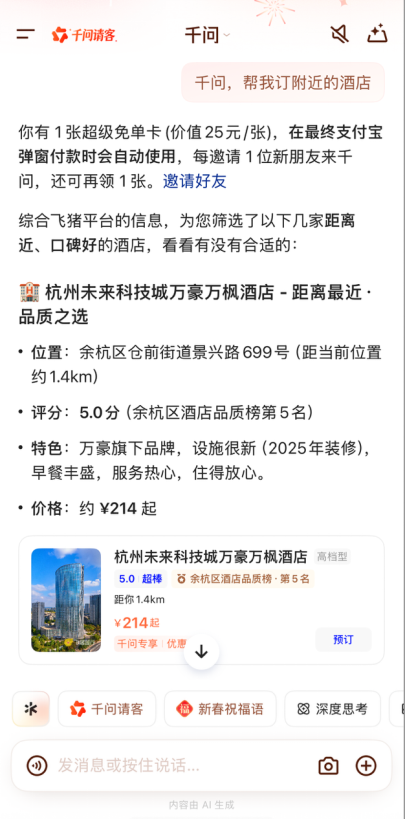
Core Insights - The "Qianwen Help Me Book Hotel" service has rapidly gained popularity, driven by festive atmosphere and AI benefits, with a significant increase in orders for hourly rooms in county towns by approximately 300% [1] Group 1: Service Overview - The newly launched "Super Invitation Card" is priced at 25 yuan and covers a wide range of services including dining, New Year goods, movie tickets, hotels, flight tickets, and scenic area tickets [1] - Users can simply request "Help me book a nearby hotel" in the Qianwen app, which will automatically filter options, allowing users to confirm details and make payment without leaving the app [1] Group 2: Market Impact - Following the introduction of the "Super Invitation Card," there has been a notable increase in demand for hotel bookings through Qianwen, particularly for hourly rooms in county towns, with the booking ratio surging by about 300% [1] - The average booking price for hourly rooms in county towns, after using the 25 yuan card, ranges from approximately 15 yuan to 30 yuan [1] - Data from the "Spring Festival 3 Billion Big Free Order" campaign indicates that nearly half of Qianwen's orders were placed in county towns, highlighting the platform's growing influence in these markets [1]
千问总裁吴嘉:春节大免单投入远超30亿,会持续上线AI打车等新功能
Xin Lang Cai Jing· 2026-02-15 08:20
Core Insights - The launch of the "Spring Festival Free Order" by Qianwen App, a subsidiary of Alibaba, resulted in over 15 million orders on February 6, far exceeding the initial expectation of 1 million orders, marking a 1500% increase in user engagement [1][2][3] Group 1: User Engagement and Performance - The initial free order event saw 5,000 free order cards distributed within 8 minutes, indicating high user enthusiasm [2][3] - The daily active users (DAU) of Qianwen approached that of Doubao, although the company prioritizes user feedback and experience over DAU metrics [4] Group 2: Future Developments and AI Integration - Qianwen is developing new features such as AI ticket purchasing for movies, flights, and hotels, aiming to validate AI service capabilities through real-life scenarios [4] - The company has invested over 3 billion in AI development, emphasizing that AI maturity is achieved through continuous real-world testing and user interaction [4]
订单与股价齐飞!AI引爆需求,这个传统板块成了“香馍馍”
券商中国· 2026-02-15 08:18
Core Viewpoint - The gas turbine industry is experiencing significant growth driven by the increasing power demand from AI applications, particularly in the North American market [2][6]. Group 1: Market Demand and Growth - The global demand for gas turbines is expected to rise, with a forecasted additional requirement of 31GW of power for AI data centers in the U.S. over the next five years [6]. - The electricity consumption of global data centers is projected to increase from 415TWh in 2024 to 945TWh by 2030, with the U.S. accounting for 45% of this demand [6]. - The North American market is focusing on traditional power generation equipment such as gas turbines, gas internal combustion engines, and diesel generators to meet the surging electricity needs [2]. Group 2: Company Performance - Companies like Jerry Holdings and Yingliu Technology have seen their stock prices soar, with Jerry Holdings' stock increasing by 96% in 2025 and an additional 38.94% in the first two months of this year [5]. - Yingliu Technology's stock has risen over 50% this year, while Dongfang Electric's stock has increased by more than 30% [5]. - Jerry Holdings has secured four contracts in North America since November 2025, with a total contract value of approximately 34 billion yuan [5]. Group 3: Advantages of Gas Turbines - Gas turbines are favored for their quick startup, easy deployment, stable power generation, energy efficiency, low maintenance, and cost-effectiveness, making them an optimal choice for AI data center power supply [7]. - The efficiency of gas turbine combined cycles can exceed 60%, and they have the lowest cost per kilowatt-hour [7]. Group 4: Future Projections - The global gas turbine sales are expected to increase, with the number of MW orders projected to rise from 58GW in 2024 to 71GW in 2025, and the number of units ordered expected to grow from 471 to 964 [8]. - Major manufacturers like GE, Siemens, and Mitsubishi Heavy Industries have their order deliveries scheduled until 2029, indicating strong future demand [7].



逆势“扫货”!南向资金为何“勇闯”港股?后市关注三大因素
券商中国· 2026-02-15 08:18
Core Viewpoint - The Hong Kong stock market, particularly technology stocks, has been experiencing a price correction, yet southbound funds have been actively buying, with a notable net purchase of 17.893 billion yuan on the last trading day before the holiday, indicating strong investor confidence despite market adjustments [1][4]. Group 1: Market Performance and Investor Behavior - Southbound funds have shown resilience, with a cumulative net purchase amount of 136.151 billion yuan year-to-date, nearly matching the same period last year [4]. - On February 5, southbound funds recorded a single-day net purchase of 22.206 billion yuan, the highest for the year, with several days of net purchases exceeding 10 billion yuan [5]. - Despite the Hang Seng Index closing lower at 26,567.12 points, southbound funds continued to buy, reflecting a contrarian investment strategy [4]. Group 2: Reasons for Market Weakness - Analysts attribute the weak performance of the Hong Kong stock market to liquidity shocks, particularly influenced by the nomination of a hawkish Federal Reserve chair, which has raised concerns about tightening global liquidity [2][7]. - There is a divergence in investor sentiment regarding AI capital expenditures, with concerns that increased spending may negatively impact cash flow and investment returns for major tech companies [8]. - The overall fundamentals of the Hong Kong market are perceived to be weaker than those of the A-share market, although the structural advantages of Hong Kong stocks remain [8]. Group 3: Future Outlook - Analysts believe that the fundamentals supporting the Hong Kong technology sector have not changed, and the current price discount relative to A-shares is near historical highs, suggesting a potential rebound [2][9]. - The Hong Kong technology index is characterized by a combination of oversold valuations, contrarian buying, and positive AI fundamentals, indicating a favorable risk-reward ratio for medium to long-term strategic allocation [9]. - The market adjustment is viewed as a short-term emotional disturbance rather than a fundamental trend reversal, with expectations for a gradual recovery as sentiment stabilizes and leading companies resume buybacks [9].

Organigram Global Inc. (OGI) Reports Q1 Revenue of $97.3 Million, with a Consensus of $73.15 Million
Yahoo Finance· 2026-02-15 08:17
Core Insights - Organigram Global Inc. (NASDAQ:OGI) is recognized as one of the top cannabis stocks to invest in currently [1] - The company reported Q1 revenue of $97.3 million, surpassing the consensus estimate of $73.15 million, with an adjusted EBITDA of $5.3 million, up from $1.4 million year-over-year [2] - The growth in revenue and profits is attributed to higher flower yields, synergies from the Motif integration, increased international sales, and improved operational efficiency [2] - Canaccord initiated coverage of OGI with a price target of C$3 and a Buy rating, highlighting the Canadian cannabis market as a global benchmark despite existing challenges [3] Financial Performance - Q1 revenue reached $97.3 million, exceeding the consensus of $73.15 million [2][7] - Adjusted EBITDA increased to $5.3 million from $1.4 million in the previous year, indicating significant profit growth [2] Market Position and Strategy - Organigram is a market leader in pre-rolls, extracts, and milled flower, and is transitioning to a globally integrated, vertically integrated cannabis corporation [3] - The company aims to expand its global presence through international business alliances [4]