
生物医药

Search documents
闻泰科技回应“系统被全面切断”;“中国天眼”首次捕获恒星黑子区射电暴信号;库克:正推动苹果智能进入中国丨每经早参
Mei Ri Jing Ji Xin Wen· 2025-10-19 00:50
Group 1 - On October 18, a representative from Wentech Technology responded to the complete interruption of system access for employees of its subsidiary, Anshi Semiconductor (China), stating that the accounts of the Anshi China team were blocked without a clear reason, and partial recovery is underway [1][11] - Wentech Technology emphasized the need for independent actions to ensure domestic supply chains and customer support due to potential system and funding cuts from Europe [1][11] - There are unconfirmed reports regarding Anshi Semiconductor's cessation of salary payments to Chinese employees, to which Wentech Technology has not directly responded [1][11] Group 2 - Apple CEO Tim Cook announced efforts to enter the Chinese market with Apple Intelligence during a dialogue at the Global Wealth Management Forum in Shanghai, highlighting the transformative potential of artificial intelligence [2][9] - The Shanghai Stock Exchange's Vice Chairman, Huo Rirong, discussed the importance of enhancing the quality of listed companies and creating a favorable environment for long-term capital inflow, particularly in light of rapid advancements in technology such as AI and biomedicine [4][5] - Huawei has taken disciplinary actions against several executives, including the CEO of Huawei Cloud, Zhang Pingan, due to issues related to cloud business fraud and economic misconduct [10]



“中国天眼”首次捕获恒星黑子区射电暴信号;库克:正推动苹果智能进入中国;闻泰科技回应“系统被全面切断”;标普下调法国主权信用评级丨每经早参
Sou Hu Cai Jing· 2025-10-18 23:12
Group 1 - The People's Bank of China Governor Pan Gongsheng met with IMF President Kristalina Georgieva, emphasizing the need to oppose protectionism and promote multilateralism amid significant global economic changes influenced by geopolitical and technological factors [4] - Shanghai Stock Exchange Vice Chairman Huo Ruirong highlighted the importance of enhancing the quality of listed companies and creating a favorable environment for long-term capital inflow, driven by advancements in AI and biotechnology [5] - Apple CEO Tim Cook announced efforts to enter the Chinese market with Apple Intelligence, indicating a significant impact on China's tech industry and accelerating AI technology application [10] Group 2 - Huawei's cloud business faced accountability issues, with multiple executives, including CEO Zhang Pingan, receiving disciplinary actions due to allegations of fraud and economic misconduct [11] - Wentech Technology responded to a system access issue affecting its subsidiary, emphasizing the need to strengthen domestic supply chains to mitigate external risks [11] - Tesla faced complaints in South Korea regarding battery management system failures across multiple models, leading to investigations and potential recalls, highlighting weaknesses in its service infrastructure [14][15]


上交所,最新发声!
券商中国· 2025-10-18 15:04
Core Viewpoint - The Shanghai Stock Exchange (SSE) aims to enhance the quality of listed companies and create a favorable ecosystem for long-term capital investment, aligning with national strategies and promoting high-quality development in response to the accelerating technological revolution [1][2]. Group 1: Stability in Listed Companies - SSE focuses on solidifying the long-term positive trajectory of listed companies through the "Three-Year Action Plan to Improve the Quality of Listed Companies," which aims to enhance operational conditions and strengthen collaboration with various departments [1][2]. - In the first half of the year, the net profit attributable to shareholders of listed companies in Shanghai reached 2.39 trillion yuan, showing positive growth, with emerging industries like electronics and biomedicine experiencing a revenue growth rate of 7.5% [1]. - Traditional consumer sectors such as food and beverage and home appliances saw a revenue growth rate of 12%, contributing significantly to overall stability [1]. Group 2: Governance and Value Enhancement - SSE promotes standardized operations and governance among listed companies by revising rules and guidelines, enhancing the protection of minority shareholders, and providing training for sustainable development capabilities [2]. - Over 60% of listed companies in Shanghai participated in a special initiative to improve quality and returns, leading to a record mid-year dividend payout of 555.2 billion yuan [2]. - The total amount of share repurchase and increase plans disclosed by listed companies has exceeded 100 billion yuan this year, with 500 billion yuan already implemented [2]. Group 3: Innovation and Transformation - SSE supports innovation-driven development by establishing the Sci-Tech Innovation Board and enhancing services for technological innovation and new productivity [3]. - In the first half of the year, companies on the Sci-Tech Innovation Board invested 84.1 billion yuan in R&D, which is 2.8 times their net profit, indicating a strong commitment to innovation [3]. - Traditional industries like steel and machinery have seen significant profit increases of 235% and 21%, respectively, driven by technological innovation [3]. Group 4: Coordinated Development of Investment and Financing - SSE is focused on diversifying products and improving the market ecosystem to support long-term capital investment, with the ETF market growing from less than 1 trillion yuan in 2020 to over 4 trillion yuan currently [4]. - The exchange has released 272 indices this year to provide a rich product support for long-term capital entry [4]. - SSE has engaged with institutional investors over a hundred times this year to better understand their needs and enhance the willingness and sustainability of long-term capital investment [5].
研报10万篇、分析师5628人、佣金率5.19‰……中证协最新发布!
券商中国· 2025-10-18 11:39
Core Viewpoint - The report highlights the challenges and transformations in the securities research industry, emphasizing the need for diversification in revenue sources and the impact of regulatory changes on commission income [2][8][10]. Group 1: Analyst Workforce - As of the end of 2024, there are 5,628 analysts in the industry, marking a 20.69% increase despite an overall decline in securities personnel [3][4]. - The number of analysts in research departments has decreased slightly to 9,619, with a median of 51 analysts per department [3]. - The turnover rate for analysts has increased, with 988 departures in 2024, a rise of 29.66% from 2023, while new hires decreased by 29.01% [4]. Group 2: Commission Income - Institutional client commission income reached 19.865 billion yuan in 2024, down 22.48% year-on-year, primarily due to a significant drop in public fund commissions [2][8]. - The average commission rate for public funds fell from 7.37‰ in 2023 to 5.19‰ in 2024, contributing to a 20.12% decline in public fund commissions [8]. Group 3: Research Reports - A total of 96,156 research reports were published in 2024, a decrease of 5% from the previous year, with 83 securities firms participating [6]. - The number of reports on Hong Kong and other overseas listed companies increased by 5.37% to 14,732, indicating a growing focus on international markets [7]. Group 4: Industry Trends and Recommendations - The report suggests that securities firms should enhance the independence and professionalism of their research, focusing on sectors like technology and innovation [11]. - Firms are encouraged to diversify revenue sources beyond commissions, exploring consulting and data product fees [11][12]. - There is a call for a more integrated approach to research across A-shares, Hong Kong, and U.S. markets to better serve international investment needs [10][12].

千余投资人现场“抢项目” 全球创业者峰会“创新浓度”飙升
Yang Shi Xin Wen· 2025-10-18 08:30
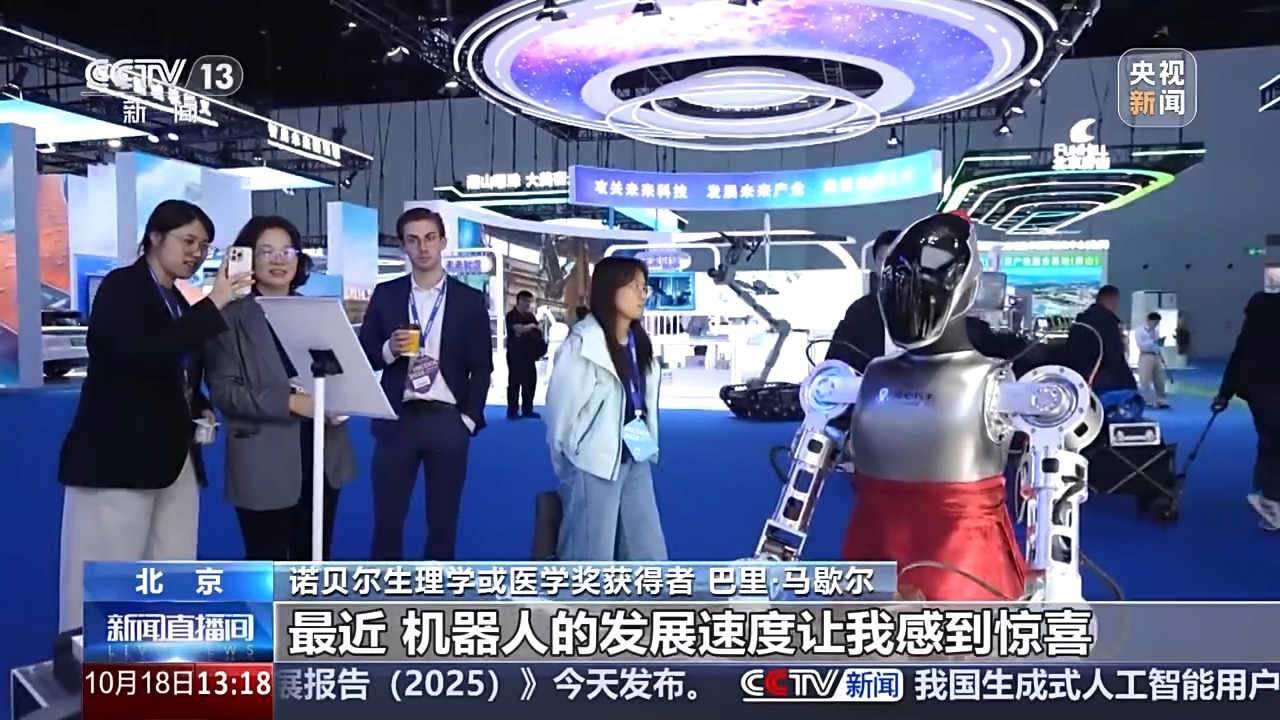
Group 1 - The 2025 Global Entrepreneur Summit is being held in Beijing, attracting over 30,000 tech talents and more than 1,000 global investors from nearly 100 countries and regions, highlighting China's increasing appeal to innovative enterprises and talents [1] - The summit spans three days and showcases the latest achievements in cutting-edge fields such as artificial intelligence, biomedicine, integrated circuits, and new energy, further consolidating international innovation and technology resources [1] - The Global Entrepreneurship Competition held concurrently attracted over 10,000 entrepreneurial projects from 139 countries and regions, with 56% of the projects being overseas, indicating a growing international participation [7] Group 2 - Barry Marshall, a Nobel Prize winner in Physiology or Medicine, expressed excitement about the rapid development of robots, particularly those with advanced dexterous hands and mechanical arms, showcasing the advancements in robotics [3] - Dai Wei, a recipient of the Chinese Government Friendship Award, emphasized China's leading contributions in research and the successful transformation of basic research into socially beneficial products, indicating a robust innovation ecosystem [5] - Sun Yuhan, Secretary for Labour and Welfare of the Hong Kong SAR Government, highlighted the significant collaboration potential between Hong Kong and Beijing, particularly in attracting international high-end talent, aiming for synergistic effects [9]

上交所,最新发声!
Zheng Quan Shi Bao· 2025-10-18 07:27
Core Insights - The Shanghai Stock Exchange (SSE) aims to enhance the quality of listed companies and create a favorable environment for long-term capital inflow, aligning with national strategies and promoting high-quality development [1] Group 1: Stability in Listed Companies - SSE is focused on solidifying the long-term positive trajectory of listed companies through the "Three-Year Action Plan to Improve the Quality of Listed Companies," which aims to enhance operational conditions and strengthen collaboration with various departments [1][2] - In the first half of the year, the net profit of listed companies in Shanghai reached 2.39 trillion yuan, showing positive growth, with emerging industries like electronics and biomedicine experiencing a revenue growth rate of 7.5% [1] - Traditional consumer sectors such as food and beverage saw a revenue growth rate of 12%, contributing significantly to overall stability [1] Group 2: Governance and Value Enhancement - SSE is promoting standardized operations and governance among listed companies by revising listing rules and enhancing the protection of minority shareholders' rights [2] - Over 60% of listed companies in Shanghai are participating in a special initiative to improve quality and returns, with more than 400 companies announcing interim dividends totaling 555.2 billion yuan, a historical high [2][3] - Share buyback and increase plans from listed companies have exceeded 100 billion yuan this year, with 500 billion yuan already implemented [2] Group 3: Innovation and Transformation - SSE is supporting innovation-driven development by establishing the Sci-Tech Innovation Board and enhancing services for technological innovation and new productivity [2][3] - In the first half of the year, companies on the Sci-Tech Innovation Board invested 84.1 billion yuan in R&D, exceeding their net profits by 2.8 times, leading the A-share market in R&D investment [2] - Traditional industries like steel and machinery have seen net profit increases of 235% and 21%, respectively, driven by technological innovation [3] Group 4: Coordinated Development of Investment and Financing - SSE is focusing on diversifying products and improving the market ecosystem to support long-term capital inflow, with the ETF market growing from less than 1 trillion yuan in 2020 to over 4 trillion yuan currently [3][4] - The exchange has released 272 indices this year to provide a rich product support for long-term capital investment [4] - SSE has engaged with institutional investors over a hundred times this year to understand their needs better, enhancing the willingness and sustainability of long-term capital inflow [4]
上交所,最新发声!
证券时报· 2025-10-18 07:24
Core Viewpoint - The Shanghai Stock Exchange (SSE) aims to enhance the quality of listed companies and create a favorable environment for long-term capital investment, driven by the rapid development of technologies such as artificial intelligence and biomedicine [1][2]. Group 1: Stability - SSE focuses on consolidating the long-term positive trend of listed companies through the "Three-Year Action Plan to Improve the Quality of Listed Companies," which aims to enhance operational conditions and strengthen collaboration with various departments [1][2]. - In the first half of the year, the net profit of listed companies in Shanghai reached 2.39 trillion yuan, showing positive growth, with emerging industries like electronics and biomedicine experiencing a revenue growth rate of 7.5% [1][2]. - Traditional consumer sectors such as food and beverage saw a revenue growth rate of 12%, contributing significantly to overall stability [1][2]. Group 2: Progress - SSE promotes innovation-driven development by leveraging major reforms like the establishment of the Sci-Tech Innovation Board, enhancing services for technological innovation and new productivity [2][3]. - In the first half of the year, companies on the Sci-Tech Innovation Board invested 84.1 billion yuan in R&D, exceeding 2.8 times their net profits, indicating a strong commitment to innovation [2][3]. - Traditional industries such as steel and machinery have seen net profit increases of 235% and 21%, respectively, driven by technological innovation [3]. Group 3: Investment and Financing Coordination - SSE is focused on diversifying products and improving the market ecosystem to support long-term capital inflow, enhancing the investment landscape [3][4]. - The ETF market has grown significantly, with the scale increasing from less than 1 trillion yuan in 2020 to over 4 trillion yuan currently, reflecting a rise in institutional investor participation [3][4]. - SSE has released 272 indices this year to provide a rich product support for long-term capital investment, aiming to create a comprehensive ecosystem for index-based investments [4].

北京发布十条措施支持青年人才创新创业
Zhong Guo Xin Wen Wang· 2025-10-18 02:14
Core Points - Beijing has introduced ten measures to support youth talent in innovation and entrepreneurship, aiming to enhance housing security, entrepreneurial space, and government services for young people [1][2] Group 1: Housing Support - The measures include the collection of youth apartments, increasing housing support for young talents, and implementing pilot programs for youth apartments with plans to gradually expand coverage [1] - Beijing aims to provide around 30,000 youth talent apartments that are conveniently located and well-equipped, offering rent reductions or subsidies [1] Group 2: Entrepreneurial Support - The initiative plans to activate idle space resources in technology parks, business buildings, and old factory buildings, providing approximately 3 million square meters of office space for youth startups at low or no cost [1] - A focus on creating a more cost-effective, comprehensive, professional, and open public service platform for young entrepreneurs is emphasized [1] Group 3: Talent Development - Beijing will establish training bases in key sectors such as artificial intelligence, biomedicine, and robotics to facilitate practical training for young talents [2] - The plan includes assigning 3,000 dedicated service managers to youth startups, offering one-on-one policy consultation and government service assistance [2]
中国经济圆桌会|中国是世界经济发展最稳定最可靠的动力源
Xin Hua Wang· 2025-10-18 00:38
Core Insights - China is expected to contribute approximately 30% to global economic growth from 2021 to 2024, positioning itself as a stable and reliable driver of world economic development [1][2] - Despite facing complex external challenges, including the impact of the COVID-19 pandemic, China's economy has maintained a steady growth trajectory, providing continuous momentum for the uncertain global economy [1] - During the 14th Five-Year Plan period, China's energy consumption has supported an average economic growth of 5.5% per year, with energy intensity decreasing by 11.6%, making it one of the fastest countries in reducing energy intensity globally [1] - China's ecological civilization practices have broken the traditional path of "pollution first, governance later," contributing significantly to global climate change responses and green transitions [1] - China has emerged as a source of global innovation breakthroughs, with its innovation index ranking among the top ten globally, marking it as one of the fastest-growing economies in terms of innovation over the past decade [1] - Rapid development of new industries such as artificial intelligence, robotics, and biomedicine is driving China's industrial upgrade towards the mid-to-high end of the value chain, providing technical references and market paradigms for global emerging industries [1]

中国是世界经济发展最稳定最可靠的动力源
Xin Hua She· 2025-10-17 13:59
Core Insights - China's average contribution to global economic growth from 2021 to 2024 is expected to remain around 30%, making it a stable and reliable driving force for world economic development [1][2] - Despite facing complex external environments and the impact of the COVID-19 pandemic, China's economy has maintained a steady development trend, continuously providing momentum for the uncertain global economy [1] - During the "14th Five-Year Plan" period, China's energy consumption supported an average economic growth of 5.5% with an average energy consumption growth of 4.7%, resulting in an 11.6% cumulative decrease in energy intensity, making it one of the fastest countries in the world to reduce energy intensity [1] - China's ecological civilization practices have broken the traditional path of "pollute first, control later," contributing significantly to global climate change response and green transformation [1] - China is increasingly becoming a source of global innovation breakthroughs, with its innovation index entering the global top ten for the first time, marking it as one of the fastest economies in terms of innovation improvement over the past decade [1] - Rapid development of new industries such as artificial intelligence, robotics, and biomedicine is driving China's industrial upgrade towards the mid-to-high end of the value chain, providing technical references and market paradigms for the development of emerging industries globally [1]