区块链技术

Search documents
稳定币为何会引起市场轰动?
Sou Hu Cai Jing· 2025-06-01 14:47
Core Insights - Stablecoins stand out in the cryptocurrency market primarily due to their price stability, which is achieved by pegging them to fiat currencies or other stable assets, providing a safe haven for investors during market volatility [2] - The efficiency and cost-effectiveness of transactions using stablecoins are significant advantages, allowing for accurate pricing and settlement while reducing risks associated with price fluctuations [4] - The diverse applications of stablecoins, from payment settlements to risk management, are driving their mainstream adoption, with notable brands beginning to accept stablecoin payments [6] - The rise of stablecoins poses challenges to traditional financial systems and international monetary frameworks, prompting governments to explore the issuance of their own stablecoins and enhance regulatory measures [6] - Stablecoins leverage blockchain technology, offering decentralization, immutability, and transparency, which enhance their security and credibility in financial markets [8] Industry Developments - The rapid growth of the stablecoin market has led to increased regulatory scrutiny from governments and financial authorities, aiming to establish a more structured development of the market [6] - As technology and financial markets evolve, stablecoins are expected to play a more significant role, although investors should remain aware of potential risks and challenges [10]


朗新集团20250529
2025-05-29 15:25
Summary of the Conference Call for Langxin Group Industry Overview - The conference call discusses the **charging infrastructure industry** in China, highlighting its rapid development with approximately **8.6 million charging stations** built by the end of 2023, achieving a vehicle-to-charging station ratio of **2.37:1** [10][11]. - The industry faces challenges such as **heavy asset investment** and **cash flow pressure**, with **85% of public charging stations** operated by private enterprises, many of which have limited resources [12]. Key Points and Arguments - **RWA Project**: Langxin Group's **RWA (Real World Asset)** project, in collaboration with Ant Group and UBS Hong Kong, aims to tokenize the revenue rights of charging stations, providing a new financing path for traditional enterprises [2][3]. - **Global Economic Impact**: The global economic downturn has led to tightened financing conditions, particularly in Southeast Asia, where financing transaction volumes have significantly decreased [6]. This has created funding challenges for Chinese automotive companies looking to expand internationally [6]. - **Innovative Financing Model**: The RWA project, despite its small scale of **100 million yuan**, represents a significant innovation in financing, allowing traditional companies to achieve cross-border credit and financing through physical assets [7]. - **New Electric Map Platform**: The **New Electric Map** platform connects charging station companies with end-users without building its own charging stations, instead partnering with major electric vehicle manufacturers [8]. This platform operates on a light asset model, leveraging digital technology to enhance user experience [8]. - **Diverse Revenue Models**: The charging service industry is innovating its revenue models through methods such as charging revenue sharing, membership card sales, and exploring energy storage markets and data services to compensate for insufficient revenue scale [9]. Additional Important Insights - **Ant Group's Blockchain Exploration**: Ant Group has been exploring blockchain technology since 2015, launching the Ant Chain Master module and the Web3 brand ZAN, which has empowered over **12 million terminal devices** in various sectors, including electric vehicles [2][5]. - **Strategic Initiatives**: Langxin Group's RWA strategy includes data assetization, carbon asset tokenization, and payment ecosystem integration, with practical applications such as green electricity asset trading and virtual power plant revenue tokenization [13][14]. - **Impact on Small and Medium Enterprises**: The RWA financing model could provide a promising financing channel for small and medium-sized energy storage companies, enhancing liquidity and fostering a positive investment cycle within the industry [15].

知名外媒报道:波场 TRON 与 Rumble Cloud 达成战略合作
Sou Hu Wang· 2025-05-29 09:05
Group 1 - Rumble has announced a strategic partnership with TRON to enhance decentralized infrastructure through cloud services [1][3] - Rumble Cloud aims to provide solutions that help businesses avoid unfair pricing and vendor lock-in from traditional cloud giants [3][4] - TRON has recently become the largest issuance network for Tether (USDT), which holds over 63% of the stablecoin market share with a circulation exceeding $150 billion [3] Group 2 - The collaboration will leverage Rumble Cloud's infrastructure to reduce single points of failure and enhance censorship resistance for enterprise clients [4] - Rumble Cloud is built on Rumble.com’s video streaming technology, which has a stable user base of millions and offers excellent scalability [4] - The partnership aligns with both companies' missions to promote a decentralized and open internet ecosystem [3][4]
查重系统数据库构成:核心文献库与互联网资源覆盖范围
Sou Hu Cai Jing· 2025-05-29 07:18
Core Insights - The article emphasizes the importance of understanding the structure and functionality of plagiarism detection systems in academia to enhance paper quality and reduce plagiarism rates [1] Group 1: Core Literature Database - The core literature database of plagiarism detection systems is likened to an "academic gene pool," directly influencing the authority of detection results [2] - Major detection platforms collaborate with academic journals, university thesis repositories, and conference proceedings to create a vast data network covering global academic achievements [2] - The update frequency of the literature database is a key indicator of system timeliness, with some platforms using real-time capture technology to include newly published papers within 24 hours [2] Group 2: Internet Resources - Internet resources have become a significant data source for detection systems, utilizing customized crawling technology to capture content from academic forums, blogs, and online document platforms [3] - The system faces challenges in data timeliness and semantic understanding, employing NLP technology to differentiate between direct citations and reasonable borrowing [3] - A platform's technical white paper reveals that its semantic model, trained using Transformer architecture, can accurately identify the boundary between paraphrasing and plagiarism with a misjudgment rate below 3% [3] Group 3: Detection Technology - Modern detection systems have evolved from simple keyword matching to a multi-dimensional detection framework [4] - The current mainstream technologies include basic layer (MD5 algorithm for text fingerprint comparison), advanced layer (sliding window technique for detecting similar segments), and intelligent layer (semantic mapping using BERT and other pre-trained models) [4] - A case study showed that a paper, despite altering word order and using synonyms to evade traditional detection, was identified by the semantic network model for logical similarities with three core arguments from other papers [4] Group 4: User Experience - The value of plagiarism detection systems extends beyond data coverage to the operability of reports, with quality platforms offering three main services [5] - These services include visual tracing of sources, contextual modification suggestions, and the ability for users to upload unpublished manuscripts to create personalized detection barriers [5] - A study indicated that using a self-built library feature in detection systems could reduce average duplication rates by 8.7%, particularly beneficial for specialized fields like patent technology or ethnographic research [5] Group 5: Technical Boundaries - Despite advancements, plagiarism detection systems still face limitations in database coverage, often overlooking non-public literature, multilingual resources, and dynamic data [6] - Leading platforms are exploring blockchain technology to address these challenges, such as establishing decentralized literature sharing alliances or collaborating with academic social platforms to access preprint data [6] Group 6: Future Outlook - With the rise of AI-generated content (AIGC), plagiarism detection systems are evolving to take on new roles [7] - A platform has developed an AIGC recognition algorithm that analyzes the "fingerprint features" of text generation models to distinguish between human-created and machine-generated content [7] - This technological evolution positions plagiarism detection systems as guardians of academic integrity rather than mere detection tools [7] Group 7: Understanding Detection Systems - For researchers, grasping the operational logic of plagiarism detection systems is essential for understanding the boundaries of academic expression [9] - As detection technologies become increasingly intelligent, returning to original value and reinforcing academic norms is fundamental to addressing plagiarism [9]

BitradeX人工智能AI算法和区块链技术驱动的金融交易新纪元
Sou Hu Cai Jing· 2025-05-28 18:58
Group 1: Company Overview - BitradeX, established in 2023, is a one-stop digital asset trading platform centered around artificial intelligence (AI) technology [1] - The company aims to enhance cryptocurrency trading experiences through AI models and blockchain technology, with headquarters in the British Virgin Islands and global operations in Japan, Europe, and the Middle East [1] Group 2: Origin and Development - The BitradeX DAO was initially established in 2020, focusing on exploring cryptocurrency and AI quantitative trading [3] - The founding team, composed of experts in quantitative finance and AI, developed an advanced AI quantitative trading system for real-time market analysis and precise trading strategies [3] - In 2022, the team began developing the exchange, integrating years of AI quantitative trading technology, leading to the official launch in 2023 [3] - A global expansion plan is set to launch in April 2025, targeting countries such as France, Germany, the UK, Portugal, Dubai, Russia, and Australia [3] Group 3: Core Technology and Advantages - The ARK Trading Model is a self-developed large model with hundreds of billions of parameters, capable of monitoring over 1,000 stocks and 150 cryptocurrencies [4] - The system achieves order execution latency of under 200 milliseconds and reduces backend construction time from six months to less than 60 days through advanced open-source distributed computing frameworks [4] - Integration with DeepSeek enhances computational power to trillions of parameters, leveraging three technological breakthroughs: "integration of specialized and general knowledge," "fast and slow thinking," and "lightweight design" [5] Group 4: Key Technologies - The top-tier quantitative strategy platform integrates factor mining, strategy backtesting, and real-time risk control, extracting valuable trading signals from vast market data [5] - A comprehensive API integration supports connections with over a hundred global cryptocurrency platforms, enabling one-stop trading services and capturing cross-platform arbitrage opportunities [5] - The high-frequency asynchronous trading framework allows for 24/7 uninterrupted trading and simultaneous order placement across multiple exchanges [5] Group 5: Core Team - The CEO, Adam, is a former marketing expert from TokenInsight and Xiaomi, specializing in the integration of AI technology with digital asset trading [5] - The CTO, Alexander, is an expert in AI and quantitative finance, focusing on millisecond-level trading models and smart algorithm optimization [5] - Alvaro, with 10 years of Web3 trading experience, serves as CMO, driving global market expansion and institutional client services in DeFi applications [5] - The COO, Adel, is a seasoned quantitative trading expert overseeing AI risk control and multi-asset strategies to ensure fund safety and operational efficiency [5]

稳定币即将“颠覆”银行业?美债市场也要变天?
Hua Er Jie Jian Wen· 2025-05-28 11:00
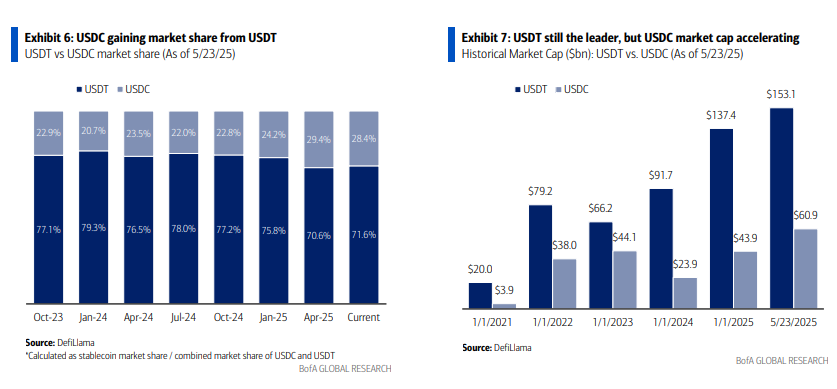
Group 1: Core Insights - The rise of stablecoins is expected to disrupt the U.S. Treasury market and the traditional banking sector, with significant structural changes in demand for U.S. Treasuries and a risk of capital outflow from banks amounting to trillions of dollars [1][7] - Two key stablecoin bills are advancing in Congress: the GENIUS Act and the STABLE Act, which could provide a clear regulatory framework for stablecoin development [2][4] - The adoption of stablecoins may lead to an increase in demand for short-term U.S. Treasuries, exacerbating the steepening of the yield curve and increasing volatility in the Treasury market [4][9] Group 2: Impact on Banking Sector - Approximately $6.6 trillion in bank deposits are at risk of being diverted to stablecoins, with decentralized finance (DeFi) reshaping lending models [7][9] - The GENIUS Act prohibits interest-bearing stablecoins, but alternative methods to earn yields are emerging in the market [7] - Major U.S. banks are exploring the issuance of joint stablecoins and developing blockchain-based payment infrastructures to adapt to the changing landscape [9] Group 3: Market Dynamics - Each $1 flowing from banks to stablecoins generates an additional $0.90 in demand for U.S. Treasuries, indicating a significant impact on the Treasury market [4][6] - The reserve requirements for stablecoin issuers will necessitate holding short-term U.S. Treasuries, further influencing the yield curve [4][6] - Current market shares of major stablecoins include USDT with a market cap of $153.1 billion and USDC with $60.9 billion, together accounting for approximately 87% of the stablecoin market [4]
RWA项目完整落地手册1.0版本(一):RWA介绍
Sou Hu Cai Jing· 2025-05-28 03:15
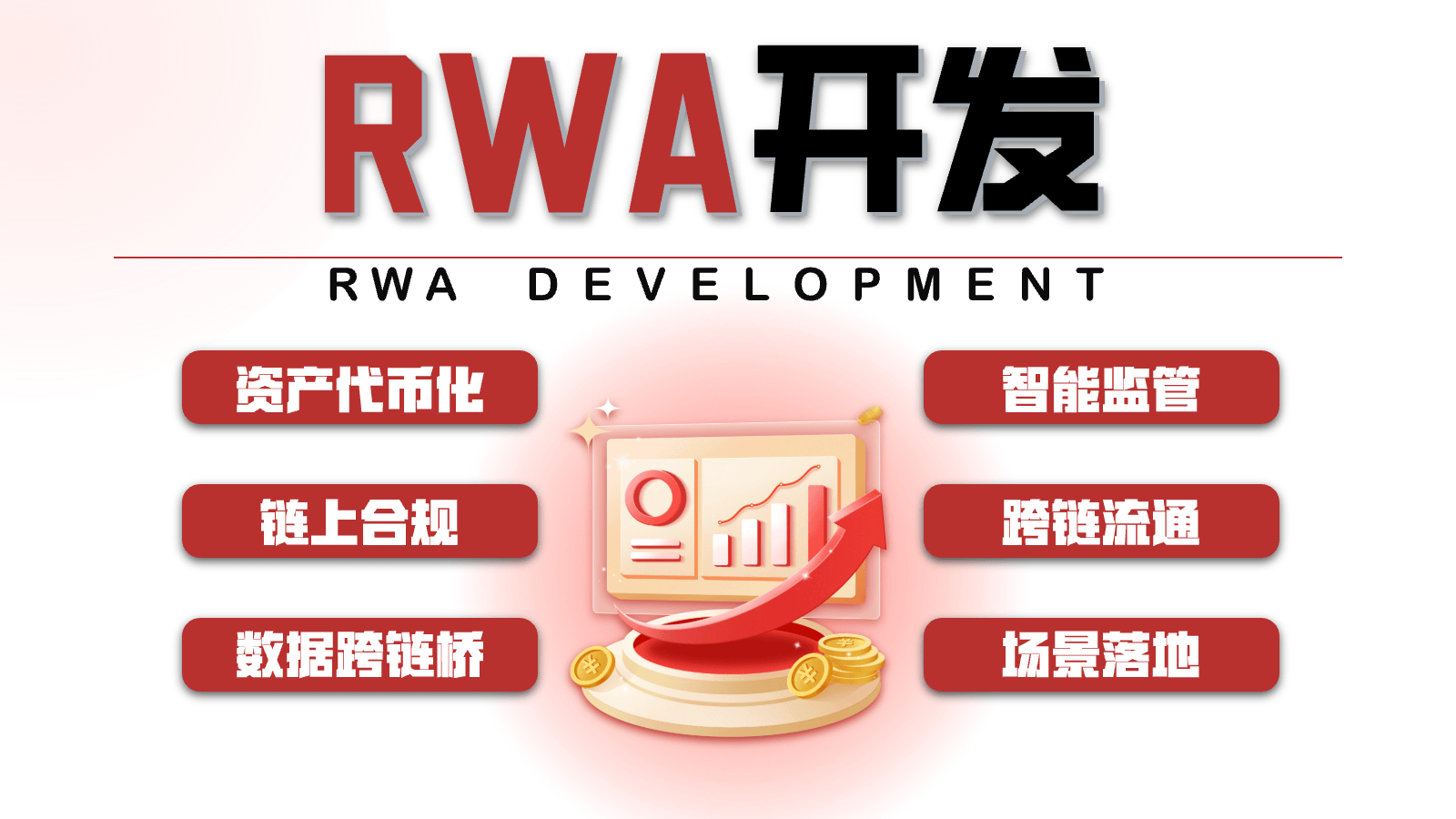
Group 1: Introduction to RWA - RWA stands for Real World Assets, which refers to tangible or intangible assets from the real world [1] Group 2: Background and Development of RWA - Traditional asset markets face pain points such as low liquidity, lack of transparency, high entry barriers, and high intermediary costs [2] - The rise of blockchain technology provides a decentralized, immutable, and smart contract-based foundation for the digitization and circulation of traditional assets [3] Group 3: Value and Significance of RWA - RWA enhances liquidity by tokenizing large assets into smaller units, thus lowering transaction barriers and increasing market liquidity [3] - It improves transparency by ensuring asset information and transaction records are traceable, reducing information asymmetry [3] - RWA lowers transaction costs through automated execution of trades via smart contracts, minimizing intermediary involvement [3] - It facilitates global investment by enabling cross-border asset circulation, attracting international investors [3] - RWA contributes to the digital transformation of the global economy, providing more financing and investment opportunities for SMEs and individuals [3] Group 4: Integration of RWA and Blockchain - The core role of blockchain in RWA includes asset confirmation, segmentation of large assets into smaller tokens, management through smart contracts, and ensuring data transparency and security [3] Group 5: Challenges and Future Outlook for RWA - Current challenges include legal and regulatory compliance, technical limitations of blockchain, market acceptance of new technologies, and reliance on stablecoins for settlement [4][6] - The future outlook suggests that as blockchain technology matures and policies improve, RWA will become a significant growth area in the blockchain sector, accelerating the transition from traditional to digital finance [6]
版权要素交易服务平台亮相文博会,解码版权交易“未来式”
2 1 Shi Ji Jing Ji Bao Dao· 2025-05-26 06:32
Group 1 - The event "Digital Bay Area Blockchain Future" focused on the national cultural digitalization strategy, featuring discussions, platform launches, and signing ceremonies [1] - The Southern Cultural Property Exchange launched a copyright trading service platform, including "Digital Version Easy Trading Platform (South China)", "Digital Intangible Cultural Heritage Trading Center", and "Greater Bay Area Copyright Ecological Digital Service Platform" [1] - The platform aims to empower the real economy, promote intangible cultural heritage, and develop IP through blockchain technology for copyright confirmation, trading, and value transfer [1] Group 2 - The event included a keynote speech by Sun Baolin, emphasizing that copyright protection is essential for cultural innovation and requires institutional innovation and ecological cultivation [2] - Industry representatives shared insights on how blockchain technology can activate dormant IP and facilitate collaboration between copyright assets and the real economy [2] - The Southern Cultural Property Exchange aims to deepen the integration of copyright, technology, and finance, enhancing the copyright trading ecosystem to help the Chinese cultural industry seize opportunities in the global digital wave [2]
唐纳德·特朗普的生意经
财富FORTUNE· 2025-05-25 13:07
Core Viewpoint - Donald Trump's brand has evolved significantly, transitioning from real estate to technology and digital assets, with a focus on leveraging his personal brand for business ventures [1][2][6]. Group 1: Trump's Brand and Wealth - Trump's personal brand has become a significant asset, with his net worth estimated at approximately $4.8 billion as of March 2023, excluding potential earnings from his digital currency projects [2][5]. - The Trump Organization's real estate holdings are valued at around $2.65 billion, constituting about half of his estimated net worth [8]. - Trump's media ventures, including Trump Media & Technology Group, have expanded into digital platforms, with Truth Social being a key product [9][10]. Group 2: Digital Currency Ventures - Trump has entered the digital currency space with projects like World Liberty Financial and the meme coin "Trump Coin," indicating a shift in his business strategy [2][14]. - The World Liberty Financial project has been criticized for its lack of clear utility, with its tokens primarily seen as a way to connect with the Trump brand [17][20]. - Trump's NFT ventures have generated approximately $7 million in revenue, marking his initial foray into digital assets [14]. Group 3: Financial Performance and Market Position - Trump Media & Technology Group reported revenues of only $3.6 million for 2024, with an operating loss of $400 million, highlighting a significant gap between its market valuation and financial performance [11]. - Despite the underwhelming performance, the company holds $777 million in cash and short-term investments, indicating a relatively healthy balance sheet [12]. - The popularity of Truth Social remains low compared to competitors, with only 304,000 daily active users as of February 2024 [11]. Group 4: Regulatory and Market Challenges - Trump's business operations are characterized by a complex structure of LLCs, making it difficult to trace the sources and scale of his wealth [5][8]. - The lack of transparency in Trump's digital currency projects raises concerns about potential regulatory scrutiny and the implications for investors [15][22]. - Critics argue that Trump's ventures in the digital currency space may provide opportunities for foreign entities to invest in his businesses without public oversight [22].

高合汽车,要被黎巴嫩金主救活了
阿尔法工场研究院· 2025-05-25 05:12
Core Viewpoint - HiPhi, an electric vehicle company, is undergoing a significant restructuring with the involvement of EV Electra, which plans to invest $1 billion and commit to annual orders of at least 100,000 vehicles over the next three years [1][3]. Group 1: Company Restructuring - EV Electra has committed to a $1 billion investment in HiPhi's restructuring and aims to secure a controlling stake [1]. - HiPhi's Yancheng factory has resumed operations, maintaining a production capacity of 150,000 units [1]. - The company is processing refunds for customers who paid deposits but have not received their vehicles [1]. - Employees who did not sign voluntary resignation agreements are allowed to return, but their salaries will be reduced to 80% [1]. Group 2: Ownership and Management Changes - EV Electra holds a 69.8% stake in HiPhi, while Huaren Yuntong (Jiangsu) Technology Co., Ltd. owns 30.2% [7]. - Jihad Mohammad is the CEO of EV Electra, which was founded in 2007 and aims to be a leader in the electric vehicle industry [20][25]. - The restructuring follows the bankruptcy application of Huaren Yuntong, HiPhi's parent company, which is undergoing a substantial merger and reorganization process [7]. Group 3: Market Position and Future Plans - EV Electra plans to launch multiple vehicle models, with its first model, QuDS Rise, targeting a production of 10,000 units [10]. - The company aims to expand its market presence globally, with offices in countries such as Canada, Cyprus, Germany, and Norway [10]. - EV Electra's mission includes promoting sustainable energy and transitioning the Middle East and Arab world from a consumer market to an industrial base [20]. Group 4: Strategic Communications and Marketing - Jihad Mohammad has been actively communicating about HiPhi's restructuring and has previously conducted a poll regarding which Chinese electric vehicle company should be saved, with HiPhi receiving 77% of the votes [27]. - The marketing strategy appears to involve leveraging social media and public engagement to build interest and support for HiPhi's revival [28].