
因城施策

Search documents
深夜!深圳,突发利好
Zhong Guo Ji Jin Bao· 2025-09-05 16:09
第四,企事业单位可在本市范围内购买商品住房,用于解决员工住房等需求。 (原标题:深夜!深圳,突发利好) 【导读】深圳放出地产利好! 中国基金报记者 泰勒 深夜重磅消息,深圳放出地产利好! 深圳分区优化调整限购 9月5日深夜,深圳市住房和建设局、中国人民银行深圳市分行发布关于进一步优化调整本市房地产政策 措施的通知。 以下是重点内容。 第一,符合深圳市商品住房购买条件的居民家庭(包括本市户籍居民家庭、自购房之日前在本市连续缴 纳社会保险或个人所得税满1年及以上的非本市户籍居民家庭),在罗湖区、宝安区(不含新安街 道)、龙岗区、龙华区、坪山区、光明区范围内购买商品住房不限套数。 第二,无法提供自购房之日前在本市连续缴纳社会保险或个人所得税满1年及以上证明的非本市户籍居 民家庭,在罗湖区、宝安区(不含新安街道)、龙岗区、龙华区、坪山区、光明区范围内购买商品住房 限购2套。 第三,在盐田区、大鹏新区购买商品住房,不再审核购房资格。 其中,在福田区、南山区和宝安区新安街道范围内购买商品住房,需同时满足设立年限满1年、在本市 累计缴纳税款金额达100万元人民币、员工人数10名及以上条件;在本市其他区域购买商品住房,不再 ...
深夜!深圳,突发利好
中国基金报· 2025-09-05 15:39
【导读】 深圳放出地产利好! 中国基金报记者 泰勒 深夜重磅消息,深圳放出地产利好! 深圳分区优化调整限购 9月5日深夜, 深圳市住房和建设局、中国人民银行深圳市分行发布关于进一步优化调整本市房地产政策措施的通知。 | | | 以下是重点内容。 以下是通知全文。 深圳市住房和建设局、中国人民银行深圳市分行发布关于进一步优化调整本市房地产政策措施的通知。 一、分区优化调整居民购买商品住房政策 (一)符合本市商品住房购买条件的居民家庭(包括本市户籍居民家庭、自购房之日前在本市连续缴纳社会保险或个人所得税满1年及以上的非本市户籍 第一,符合深圳市商品住房购买条件的居民家庭(包括本市户籍居民家庭、自购房之日前在本市连续缴纳社会保险或个人所得税满1年及以 上的非本市户籍居民家庭),在罗湖区、宝安区(不含新安街道)、龙岗区、龙华区、坪山区、光明区范围内购买商品住房不限套数。 第二,无法提供自购房之日前在本市连续缴纳社会保险或个人所得税满1年及以上证明的非本市户籍居民家庭,在罗湖区、宝安区(不含新 安街道)、龙岗区、龙华区、坪山区、光明区范围内购买商品住房限购2套。 第三,在盐田区、大鹏新区购买商品住房,不再审核购房资格。 ...


2025年楼市逆转:还在观望的人,已被市场远远甩开
Sou Hu Cai Jing· 2025-08-25 04:09
Core Viewpoint - The Chinese real estate market is experiencing a significant rebound, moving away from a prolonged downturn and entering a phase of steady recovery [1][4]. Market Recovery - In Q2 2025, new residential prices in 70 major cities rose by 3.7% month-on-month, with first-tier cities seeing a 5.2% increase and second-tier cities 4.6% [2]. - The total sales area of commercial housing in the first half of 2025 reached 728 million square meters, a year-on-year increase of 15.6%, while sales revenue hit 7.53 trillion yuan, up 18.2% [4]. Policy Impact - The market turnaround is attributed to a series of effective policy adjustments, including reduced down payment ratios and lower mortgage rates, particularly in first-tier cities where rates have fallen below 4% [5][8]. - The "housing is for living, not for speculation" policy introduced at the end of 2024 marked a significant shift in real estate policy [5]. Supply and Demand Dynamics - The urbanization rate in China reached 67.3% in 2024 and is expected to exceed 68% in 2025, indicating a stable demand for housing as approximately 12 million people migrate to cities annually [8]. - The new housing supply has significantly decreased due to strict regulations over the past three years, with new construction area dropping by 38.6% from its peak in 2021 [8]. Regional Disparities - The recovery is characterized by notable regional differences, with first and second-tier cities like Shenzhen and Shanghai experiencing price increases exceeding 8% year-on-year [9]. - Conversely, third and fourth-tier cities are lagging in recovery, facing inventory pressures due to population outflows [11]. Investor Sentiment - A survey indicated that 43.7% of respondents in Q2 2025 are considering purchasing investment properties, a significant increase of 18.6 percentage points from the previous year [11]. - Funds that previously flowed into stock markets are returning to real estate, reflecting a shift in investor sentiment [11]. Fiscal Health - Land sales revenue in the first half of 2025 reached 2.17 trillion yuan, a year-on-year increase of 23.5%, marking the first significant growth since 2021 [11]. Macroeconomic Context - The real estate sector contributes approximately 25% to GDP and over 15% to employment, underscoring its critical role in stabilizing the economy amid downward pressures [12]. Future Outlook - Experts predict a more rational market moving forward, with housing price growth aligning with income growth, and speculative demand being curtailed [12]. - The forecast for 2025 suggests a potential price increase of 6%, with a more moderate growth rate of around 5% in 2026 [12]. Market Characteristics - The current market is marked by increased regional differentiation, scarcity of quality assets, and a return to the fundamental purpose of housing [14]. - Investors are advised to focus on location, quality, and amenities, as the market matures and the importance of informed decision-making grows [14].
北京优化调整限购政策释放哪些信号?
Sou Hu Cai Jing· 2025-08-13 15:20
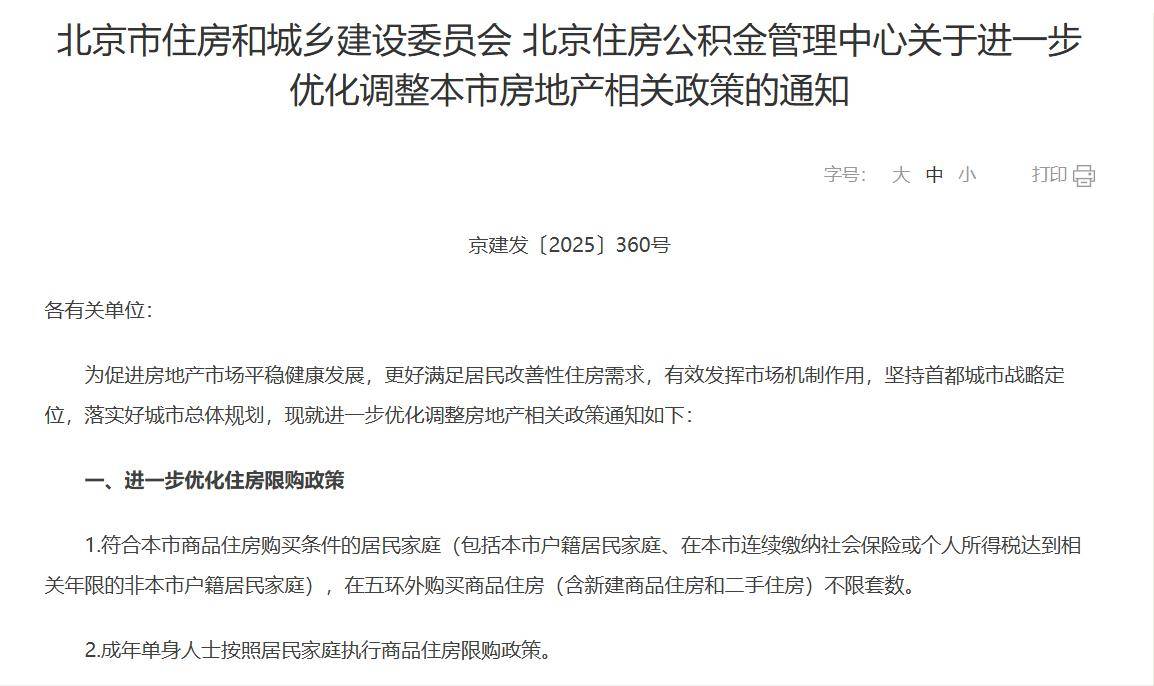
Core Viewpoint - Beijing's new real estate policy, effective from August 8, allows unlimited purchases of commodity housing outside the Fifth Ring Road, while still maintaining certain qualification requirements for buyers [1][3]. Group 1: Policy Adjustments - The new policy primarily focuses on the area outside the Fifth Ring Road, where a significant portion of the housing inventory is located. Current statistics show that 81.4% of new residential inventory and about 50% of second-hand homes are situated outside this area [3]. - The policy aims to accelerate the market absorption in the Fifth Ring Road area by allowing more families with the ability and willingness to buy homes to enter the market, thereby optimizing inventory structure [3][5]. Group 2: Housing Fund Support - The policy includes measures to enhance housing fund loan support, broadening the definition of first-time homebuyers. Individuals without housing in the city or those who have previously used their housing fund loans can now qualify for first-time homebuyer benefits [5]. - The maximum loan amount for second homes has been increased to 1 million yuan, with a minimum down payment ratio of 30%. Additionally, for every year of housing fund contributions, the loan limit increases by 15,000 yuan [5]. Group 3: Market Impact - The new policy is expected to attract more buyers to the Fifth Ring Road area, leading to an increase in project construction and the availability of second-hand homes in the market [3][7]. - The adjustments are anticipated to alleviate inventory pressure, stimulate economic activity, facilitate population dispersal, and promote regional collaboration, contributing to the stable and healthy development of the real estate market and sustainable urban growth [7].
经济日报:北京优化调整限购释放哪些信号
Jing Ji Ri Bao· 2025-08-13 00:20
Core Viewpoint - Beijing's recent policy adjustments aim to promote a stable and healthy real estate market, better meet residents' housing improvement needs, and effectively utilize market mechanisms while adhering to the city's strategic positioning and overall planning [1][2]. Group 1: Policy Adjustments - The most notable change allows residents to purchase an unlimited number of properties outside the Fifth Ring Road, provided they meet certain conditions [1]. - The policy targets both new and second-hand housing, indicating a focus on increasing market activity in these areas [2]. Group 2: Market Dynamics - The current inventory shows that 81.4% of new residential properties and about 50% of second-hand homes are located outside the Fifth Ring Road, highlighting the need for policy adjustments in this region [2]. - Over 80% of new residential sales and more than 50% of second-hand transactions in the first seven months of the year occurred outside the Fifth Ring Road, indicating a shift in market demand [2]. Group 3: Housing Fund Support - The new policy enhances housing fund loan support, broadening the definition of first-time homebuyers and increasing the maximum loan amount for second homes to 1 million yuan, with a minimum down payment of 30% [3]. - Families previously classified as second-home buyers may now qualify for first-home loans, effectively lowering the barriers to homeownership [3]. Group 4: Economic and Urban Impact - The adjustments are expected to alleviate inventory pressure, stimulate economic growth, relieve population density in central areas, and promote regional collaboration [3].
北京优化调整限购释放哪些信号
Jing Ji Ri Bao· 2025-08-12 22:16
Core Viewpoint - The recent policy adjustment in Beijing's real estate market aims to promote stable and healthy development while better meeting residents' housing improvement needs and effectively utilizing market mechanisms [1][2][3] Group 1: Policy Adjustments - The most notable change allows residents to purchase an unlimited number of properties outside the Fifth Ring Road, provided they meet certain conditions [1][2] - The policy reflects a targeted approach to real estate regulation, differentiating between areas inside and outside the Fifth Ring Road to facilitate market entry for capable and willing families [2] Group 2: Market Dynamics - Current statistics indicate that 81.4% of new residential properties and approximately 50% of second-hand homes are located outside the Fifth Ring Road, highlighting the need for policy adjustments in this area [2] - In the first seven months of this year, over 80% of new residential sales and more than 50% of second-hand home transactions occurred outside the Fifth Ring Road, indicating a shift in market activity [2] Group 3: Financial Support Measures - The new policy includes increased support for housing provident fund loans, broadening the definition of first-time homebuyers and raising the maximum loan limit for second homes to 1 million yuan [3] - The policy allows for a lower down payment for families previously classified as second-home buyers, effectively reducing the barriers to homeownership [3] Group 4: Expected Outcomes - The adjustments are expected to alleviate inventory pressure, stimulate economic growth, relieve population density in central areas, and promote regional collaboration [3]
上半年,全国新房和二手房交易总量同比增长——房地产市场活跃度有所提升
Ren Min Ri Bao Hai Wai Ban· 2025-08-12 00:34
政策出台不到一周,北京市五环外多个楼盘迎来看房高峰。业内人士分析,此次政策调整有利于提振市 场预期,进一步推动房地产市场止跌回稳。 今年以来,随着国家和地方层面的各项政策加快落实,各线城市房地产市场出现积极变化。上半年,全 国新房和二手房交易总量同比增长,房地产市场总体保持稳定态势。 各地政策持续显效 8月8日,北京市宣布,符合条件的家庭在北京市五环外不再限制购房套数,并从四方面加大住房公积金 支持力度,包括优化首套房认定标准、提高二套房贷款额度、降低二套房贷款首付比例、提高年度缴存 公积金可贷额度等,降低购房者置业成本和购房门槛。 北京放开五环外住房限购,从四个方面调整住房公积金政策;多地出台举措激活住房消费潜力,大力推 进"好房子"建设;部分城市扩大住房公积金使用范围,支持购房者使用公积金账户支付购房首付款…… 近期,政策利好不断,房地产市场活跃度有所提升,出现一系列积极变化。 巩固市场稳定态势 如何进一步提升稳楼市政策的精准性? 一线城市中,深圳市上半年二手房市场月均成交量超过5000套,整体保持较好运行状态;广州市二手住 宅网签套数和面积同比分别增长12.98%和13.31%。部分重点二线城市如杭州、 ...
北京楼市新政释放购房需求 更多城市有望跟进
Zheng Quan Ri Bao· 2025-08-10 16:44
Core Viewpoint - The recent optimization of housing purchase restrictions in major cities like Beijing signals a potential trend for other cities to follow, indicating a shift in real estate policies across China [1][3]. Group 1: Policy Changes - Beijing's recent notification allows eligible families to purchase an unlimited number of properties outside the Fifth Ring Road, while maintaining existing restrictions for properties within the Fifth Ring Road [2][4]. - Guangzhou has already lifted its purchase restrictions, leading to a notable increase in the real estate market activity, with a 9.03% increase in second-hand residential transactions from January to July 2025 [2]. - Shanghai and Shenzhen have also made adjustments to their purchase restrictions, with Shanghai easing requirements for non-local residents and Shenzhen maintaining certain conditions for non-local buyers [2][3]. Group 2: Market Impact - The adjustments in Beijing's policies are expected to stimulate the market, particularly in areas outside the Fifth Ring Road, which accounted for over 80% of new residential sales in the first half of the year [4][5]. - The easing of restrictions is anticipated to alleviate inventory pressure in high-stock areas, supporting the overall market recovery and aligning with population distribution strategies [5]. - Analysts predict that the differentiated strategy of strict controls in core areas while relaxing restrictions in suburban regions will cater to genuine housing needs and help balance supply and demand in the real estate market [5].
快评|北京五环外购房不限套数,下一个就看上海了
克而瑞地产研究· 2025-08-08 12:59
Core Viewpoint - The recent adjustment of housing purchase restrictions in Beijing aims to stimulate demand and support the real estate market by allowing eligible families to purchase unlimited properties outside the Fifth Ring Road starting from August 9, 2025 [2][4]. Group 1: Policy Adjustments - The new policy allows eligible families (Beijing residents and non-residents with two years of social insurance or tax payments) to buy unlimited properties outside the Fifth Ring Road, while restrictions within the Fifth Ring remain unchanged [2][7]. - The housing provident fund loan policy has been optimized, including a relaxed definition of first-time homebuyers and a unified down payment ratio of 30% for second homes [4][9]. Group 2: Market Impact - The adjustment is expected to alleviate inventory pressure in high-stock areas, with a projected 33% year-on-year increase in second-hand home transactions outside the Fifth Ring following the policy change [4]. - Approximately 80% of new housing projects are anticipated to benefit from the new policy, particularly those aimed at improving living conditions [4]. Group 3: Broader Implications - The adjustments in Beijing's housing policies may serve as a model for other cities like Shanghai, which could further relax restrictions, promoting a differentiated strategy of strict controls in core areas while loosening regulations in suburban regions [5]. - This approach aims to balance the need to curb speculation while meeting genuine housing demands, thereby supporting economic recovery and regional development goals [5].
房地产调控须保持定力 咬定“长效”不放松
Jing Ji Ri Bao· 2025-08-08 06:59
Core Viewpoint - The real estate market has shown signs of overheating in certain cities since the second quarter of this year, prompting the central government to reiterate the principle that housing is for living, not for speculation, and to implement regulatory measures to cool down the market [1][2][3]. Group 1: Market Trends - Since the second quarter of this year, the real estate market has seen a significant increase in activity, with some cities experiencing rapid price increases and signs of overheating [1][2]. - In July, over ten cities, including Shenzhen, Hangzhou, and Zhengzhou, introduced regulatory policies aimed at cooling the real estate market [3]. - Data shows that in the 70 major cities, the prices of new residential properties increased in April (50 cities), May (57 cities), June (61 cities), and July (59 cities) compared to the previous month [2]. Group 2: Regulatory Measures - The central government emphasizes the need to maintain stable land prices, housing prices, and market expectations, avoiding large fluctuations in the real estate market [4][5]. - Local governments are encouraged to adopt differentiated regulatory measures based on the specific conditions of each city, rather than implementing a one-size-fits-all approach [6]. - Recent policies in cities like Haikou and Shenzhen target speculative behaviors such as "fake divorces" and "fake talent" purchases to stabilize the market [7]. Group 3: Economic Implications - The real estate sector is crucial for urban development and economic stability, but rapid price increases can lead to negative consequences for the economy and social development [4][5]. - The government is committed to preventing real estate from being used as a short-term economic stimulus, which could lead to significant long-term repercussions [5].