资本充足率

Search documents
农业银行: 农业银行2025年半年度第三支柱信息披露报告
Zheng Quan Zhi Xing· 2025-08-29 11:22
Core Points - The report is prepared in accordance with the Capital Management Measures for Commercial Banks and includes disclosures on risk management, key prudential regulatory indicators, and risk-weighted asset overview [1][2] - The bank has established a comprehensive governance structure for information disclosure, ensuring that the disclosed information is true and reliable [1] Capital Adequacy - As of June 30, 2025, the bank's core Tier 1 capital adequacy ratio is reported at 8% [1] - The minimum capital requirement is calculated as 8% of risk-weighted assets, with the bank meeting this requirement [2] Risk Management - The report details various risks including credit risk, market risk, and liquidity risk, with specific metrics provided for each category [1][2] - The liquidity coverage ratio is reported at an average of 133.92% for the second quarter of 2025, indicating strong liquidity management [6][7] Risk-Weighted Assets - The report outlines the risk-weighted assets and their corresponding capital requirements, with a focus on credit risk and operational risk [1][2] - The bank employs advanced internal rating methods to measure credit risk-weighted assets [1] TLAC Requirements - The bank is classified as a global systemically important bank and is required to meet total loss-absorbing capacity (TLAC) requirements starting January 1, 2025 [1][2] Financial Performance - The report includes a detailed breakdown of financial performance metrics, including the leverage ratio and net stable funding ratio [5][6] - The bank's financial statements reflect a robust capital structure, with significant core capital available after meeting minimum requirements [2][5]

江苏银行下半年资产规模是否继续秉持高速扩张思路?行长首度回应
Bei Ke Cai Jing· 2025-08-29 08:41
Core Viewpoint - Jiangsu Bank is focused on high-quality development and aims to optimize its asset structure while maintaining stable profits and ensuring capital adequacy in the second half of 2025 [4][6]. Financial Performance - As of June 30, 2025, Jiangsu Bank's core Tier 1 capital adequacy ratio is 8.49%, which reflects a 0.13 percentage point increase from the first quarter of 2025 due to healthy business growth and dividend payouts to investors [5]. Strategic Focus - The bank's management emphasizes internal growth and aims to continue expanding its asset scale while ensuring that the capital adequacy ratio meets regulatory requirements [4][5].


渝农商行(601077):存贷快速扩张 资产质量稳健 资本实力夯实
Xin Lang Cai Jing· 2025-08-29 04:28
投资建议:公司2025E、2026E、2027E PB 0.55X/ 0.52X/ 0.48X;公司深耕重庆,实现存贷款规模快速 扩张,同时在负债端拥有低成本优势,资产质量保持稳健,业绩整体向好,建议关注。预测公司2025- 2027 年营收分别同比增长0.6%、1.8%、2.0%,归母净利润分别同比增长5.4%、4.8%、4.0%,对应每股 收益分别为1.07、1.12、1.16元,维持"买入"评级。 从期限结构来看,定期存款、活期存款分别增长12.1%、0.1%,定期存款占比较年初提升2.2 个百分点 至75.7%。 资产质量稳定。1H25 银行不良贷款率为1.17%,环比年初下降1bp,其中公司贷款、个人贷款不良率分 别为0.68%、2.04%,分别较年初-0.36、+0.43 个百分点。细分对公行业来看,批发和零售业、建筑业不 良率相对较高,1H25 分别为1.8%、1.4%。不良生成0.78%,同比下降6bp。逾期率为1.41%,较年初提 升8bp。1H25 银行拨备覆盖率为355.58%,环比一季度下降7.8 个百分点;拨贷比4.16%,环比下降 11bp。 资本充足率环比上行。1H25 银行核心 ...

杭州银行(600926):营收环比改善 资本实力增强
Xin Lang Cai Jing· 2025-08-28 06:28
Core Viewpoint - Hangzhou Bank reported a solid performance in the first half of 2025, with a year-on-year increase in operating income and net profit, indicating resilience in its business fundamentals [1][2][8]. Financial Performance - The bank achieved operating income of 20.09 billion, up 3.9% year-on-year, and net profit attributable to shareholders of 11.66 billion, up 16.7% year-on-year [1][2]. - The annualized weighted average return on equity was 19%, a decrease of 0.48 percentage points year-on-year [1]. Revenue Composition - Net interest income grew by 9.4% year-on-year, with a 2.5 percentage point increase compared to Q1 [2]. - Non-interest income decreased by 5% year-on-year, but the decline was less severe than in Q1 [5]. Loan and Deposit Structure - The loan-to-asset ratio slightly increased to 45.2%, with total loans growing by 12% year-on-year [2][3]. - New loans in Q2 were primarily driven by corporate loans, while retail loans saw a slight decline [3]. Asset Quality - The non-performing loan (NPL) ratio remained stable at 0.76%, with a corporate loan NPL ratio of 0.65% [6]. - The bank's provision coverage ratio was 520.9%, maintaining a strong risk mitigation capacity [7]. Capital Adequacy - The bank's capital adequacy ratios improved significantly, with the core Tier 1 capital ratio reaching 9.74% [7]. - The conversion of convertible bonds has strengthened the bank's capital base, alleviating refinancing pressures [8]. Future Outlook - The bank's EPS forecasts for 2025-2027 are 2.72, 3.18, and 3.71 respectively, with current PB valuations of 0.91, 0.80, and 0.69 times [8].

重庆银行换帅后营收增速加快 地产不良率创上市来新高
Zhong Guo Jing Ji Wang· 2025-08-27 23:35
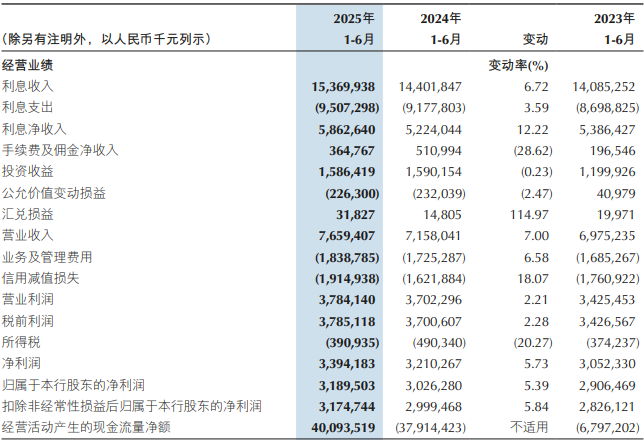
Core Viewpoint - Chongqing Bank reported a revenue of 7.659 billion yuan for the first half of 2025, marking a 7.00% increase year-on-year, alongside a net profit of 3.394 billion yuan, which is a 5.73% increase compared to the same period last year [1][3]. Financial Performance - In the first half of 2025, Chongqing Bank achieved an operating income of 7.659 billion yuan, a net profit of 3.394 billion yuan, and a net profit attributable to shareholders of 3.190 billion yuan, reflecting increases of 7.00%, 5.73%, and 5.39% respectively compared to the previous year [1][3][4]. - The bank's cash flow from operating activities was 40.094 billion yuan, a significant improvement from -37.914 billion yuan in the same period last year [4][8]. - Interest income for the first half of 2025 was 15.370 billion yuan, up 6.72% from the previous year, while interest expenses increased by 3.59% to 9.507 billion yuan [4]. Loan Quality - As of June 30, 2025, the non-performing loan (NPL) balance stood at 5.840 billion yuan, an increase of 377 million yuan from the end of the previous year, with an NPL ratio of 1.17%, down 0.08 percentage points [1][8][9]. - The real estate sector's NPL ratio reached 7.19%, the highest since the bank's listing in 2013 [1][9]. Capital Adequacy - As of June 30, 2025, Chongqing Bank's core Tier 1 capital adequacy ratio was 8.80%, down 1.08 percentage points from the end of the previous year, and the overall capital adequacy ratio was 12.93%, down 1.53 percentage points [10][11][12]. - These capital adequacy ratios are below the average levels for commercial banks in China, which reported a core Tier 1 capital adequacy ratio of 10.93% [11][12]. Business Segments - The personal banking segment reported a revenue of 1.297 billion yuan in the first half of 2025, down from 1.495 billion yuan in the same period last year, resulting in a pre-tax loss of 42.707 million yuan [7][8]. - The corporate banking segment generated a revenue of 5.752 billion yuan with a pre-tax profit of 3.751 billion yuan, showing growth compared to the previous year [8].
【成都银行(601838.SH)】规模扩张强度加大,营收盈利增长提速——2025年半年报点评(王一峰/赵晨阳)
光大证券研究· 2025-08-27 23:05
Core Viewpoint - Chengdu Bank reported a revenue of 12.27 billion and a net profit of 6.62 billion for the first half of 2025, showing year-on-year growth of 5.9% and 7.3% respectively, indicating a positive trend in financial performance despite a slight decline in return on average equity [7][8]. Financial Performance - Revenue, pre-provision profit, and net profit growth rates for Chengdu Bank in the first half of 2025 were 5.9%, 6.8%, and 7.3% respectively, with improvements compared to Q1 [8]. - The net interest income and non-interest income growth rates were 7.6% and -0.2%, showing a positive shift in net interest income while non-interest income faced a decline [8]. - The cost-to-income ratio and credit impairment losses as a percentage of revenue were 23.2% and 11.5%, both showing a slight decrease year-on-year, indicating stable cost management [8]. Asset and Loan Growth - As of the end of Q2 2025, Chengdu Bank's interest-earning assets and loans grew by 12.2% and 18% year-on-year, reflecting an acceleration in scale expansion [9]. - New corporate loans and retail loans for Q2 were 24.4 billion and 2.8 billion respectively, with corporate loans showing a strong growth trend [9]. Deposit Trends - By the end of Q2 2025, the growth rates for interest-bearing liabilities and deposits were 13.7% and 14.7%, indicating steady deposit growth [10]. - The new deposit amount for Q2 was 18.8 billion, which was lower than the previous year, and the ratio of deposits to interest-bearing liabilities decreased slightly [10]. Interest Margin - The net interest margin (NIM) for the first half of 2025 was 1.62%, a slight decrease from the previous year, but the decline in margin has narrowed compared to earlier periods [11]. - The yield on interest-earning assets and loans decreased, influenced by factors such as LPR adjustments and weakened demand [11]. Non-Interest Income - Non-interest income for Chengdu Bank was 2.5 billion, reflecting a year-on-year decline of 0.2%, primarily due to reduced fees from wealth management services [12]. - Other non-interest income increased by 9.7%, supported by active trading and bond investment strategies [12]. Asset Quality - As of the end of Q2 2025, the non-performing loan (NPL) ratio was 0.66%, remaining stable, while the attention ratio slightly increased [13]. - The provision coverage ratio was 452.7%, indicating strong risk mitigation capabilities despite a slight decline [13].
“优等生”遇新烦恼 江苏银行“广种”而“薄收”
Shang Hai Zheng Quan Bao· 2025-08-27 18:32
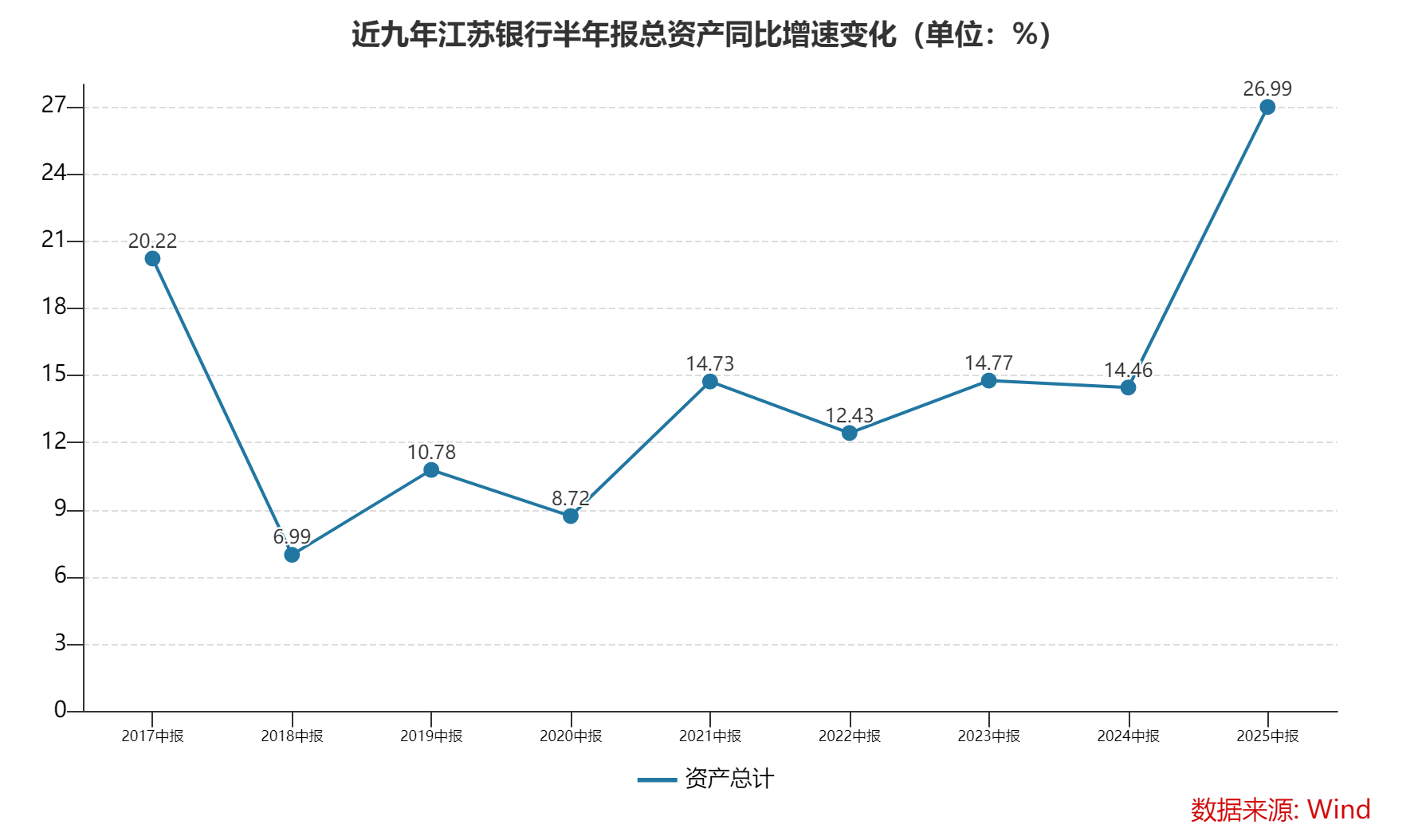
Core Viewpoint - Jiangsu Bank has demonstrated strong asset growth and improved asset quality in the first half of the year, but its revenue growth remains modest, indicating a "wide planting, thin harvest" situation [2][5][6]. Asset Growth - As of June 30, Jiangsu Bank's total assets reached 4.79 trillion yuan, a year-on-year increase of 21.16%, with a growth rate exceeding 26% [3]. - The bank's non-loan assets have significantly contributed to its asset expansion, with increases in derivative and financial investments, cash, and interbank assets of 23.1%, 37.8%, and 41.95% respectively [3]. - The bank's corporate loans grew by 23.30% year-on-year, with infrastructure loans up by 31% and manufacturing loans by 18.90% [4]. Revenue and Profitability - Jiangsu Bank reported operating income of 448.64 billion yuan, a year-on-year growth of 7.78%, and a net profit of 202.38 billion yuan, up 8.05% [6]. - Interest income increased significantly, with net interest income rising by 19.10% to 329.39 billion yuan, but the growth in loan interest income was only 0.55% [6][7]. - The bank's net interest margin decreased to 1.78%, down 12 basis points year-on-year, primarily due to a decline in asset yield [6][7]. Asset Quality - The non-performing loan (NPL) ratio fell to 0.84%, the lowest since the bank's listing, with a decrease in the proportion of special mention loans to 1.24% [8]. - The bank's NPL generation and write-off rates have decreased, with NPL net increase and write-off amounts at 116 billion yuan and 99 billion yuan respectively [8][9]. - The bank's provision coverage ratio stands at 331.02%, indicating strong risk mitigation capacity [8]. Capital Adequacy - Jiangsu Bank's capital adequacy ratios have declined, with total capital adequacy at 12.36%, down from 12.99% at the end of the previous year [9]. - To address capital pressure, the bank issued two perpetual bonds totaling 300 billion yuan in the first half of the year [10].
成都银行(601838):规模扩张强度加大 营收盈利增长提速
Xin Lang Cai Jing· 2025-08-27 10:28
Core Viewpoint - Chengdu Bank reported a revenue of 12.27 billion and a net profit of 6.62 billion for the first half of 2025, showing year-on-year growth of 5.9% and 7.3% respectively, indicating a positive trend in revenue and profit growth despite a slight decline in return on average equity [1][2] Financial Performance - Revenue, pre-provision profit, and net profit growth rates for Chengdu Bank in the first half of 2025 were 5.9%, 6.8%, and 7.3% respectively, with improvements compared to the first quarter [2] - The net interest income and non-interest income growth rates were 7.6% and -0.2%, showing a mixed performance in income sources [2] - The cost-to-income ratio and credit impairment losses as a percentage of revenue were 23.2% and 11.5%, both showing a slight decrease year-on-year, indicating stable cost management [2] Asset and Loan Growth - As of the end of Q2 2025, Chengdu Bank's interest-earning assets and loans grew by 12.2% and 18% year-on-year, reflecting an acceleration in asset expansion [3] - The bank's new loans and financial investments for Q2 were 27.2 billion and 11.4 billion respectively, with significant increases compared to the previous year [3] - Corporate loans showed a strong growth rate of 19.1%, while retail loans grew at a slower pace of 12.9% [4] Deposit Trends - By the end of Q2 2025, Chengdu Bank's interest-bearing liabilities and deposits grew by 13.7% and 14.7% year-on-year, with a slight decrease in the growth rate of deposits compared to Q1 [5] - The trend towards term deposits continued, with term deposits accounting for 70% of total deposits by the end of Q2 [5] Interest Margin and Non-Interest Income - The net interest margin (NIM) for the first half of 2025 was 1.62%, showing a slight decrease from the previous year, but the decline in margin pressure has eased [6] - Non-interest income for the first half of 2025 was 2.5 billion, reflecting a year-on-year decrease of 0.2%, primarily due to reduced fee income [7][8] Asset Quality and Risk Management - Chengdu Bank maintained a low non-performing loan (NPL) ratio of 0.66% and a slight increase in the attention ratio to 0.44% by the end of Q2 2025 [8][9] - The bank's credit impairment losses for the first half of 2025 were 1.4 billion, indicating a stable risk management environment [9] Capital Adequacy - By the end of Q2 2025, Chengdu Bank's capital adequacy ratios were 8.61%, 9.24%, and 13.13%, showing a slight decline due to seasonal factors [9] - The rapid expansion of risk-weighted assets (RWA) at a growth rate of 15.8% indicates a strong capital base supporting future growth [9] Future Outlook - Chengdu Bank is expected to benefit from strategic opportunities in the Chengdu metropolitan area, with a strong asset quality and a high provision coverage ratio supporting its risk management capabilities [10]
平安银行股份有限公司2025年半年度报告摘要
Shang Hai Zheng Quan Bao· 2025-08-22 23:15
Core Viewpoint - The company has approved its 2025 semi-annual report and profit distribution plan, highlighting its financial performance and commitment to shareholder returns [17][20][36]. Financial Performance - The company reported an unaudited net profit of RMB 241.70 billion for the first half of 2025, with a distributable profit of RMB 2,541.05 billion [36]. - The net profit attributable to ordinary shareholders after deducting preferred stock dividends and perpetual bond interest was RMB 228.41 billion [36]. Profit Distribution Plan - The board approved a cash dividend of RMB 2.36 per 10 shares, totaling RMB 45.80 billion, which represents 20.05% of the net profit attributable to ordinary shareholders [21][36]. - The distribution plan considers shareholder returns, regulatory capital requirements, and sustainable business development [37]. Corporate Governance - The board and supervisory committee confirmed the accuracy and completeness of the semi-annual report, ensuring compliance with legal and regulatory standards [30][32]. - The board meeting held on August 22, 2025, had full attendance, with all resolutions passed unanimously [19][22].

万亿成都银行迎来“75后”董事长,零售短板怎么补?
Sou Hu Cai Jing· 2025-08-18 12:27
作者 | 郑理 来源 | 独角金融 地处西部地区首家资产规模超过万亿的城商行,成都银行(601838.SH)迎来重要人事变动。 成都银行8月17日公告显示,董事长王晖已提交辞职报告,原因为"组织工作调动另有任用"。成都银行 还在公告中对王晖近20年来的成绩进行了梳理和肯定,披露千字长文表达感谢。 新任董事长也在同日确定。根据该行公告,成都市委决定由成都农商行董事长黄建军担任成都银行委员 会委员、书记,并提名为董事长一职。 王晖任期内,实现了成都银行从一家区域城商行跨越到A股上市银行第一梯队。经营业绩方面,2024年 成都银行实现营业收入229.82亿元,同比增长5.89%,归母净利润128.58亿元,同比增长10.17%,继续 位列上市银行前列。 图源:罐头图库 然而成都银行2024年四季度的资本充足率为13.88%,低于商业银行平均水平15.74%。2025年一季度, 成都银行资本充足率继续下滑至13.45%。 新董事长黄建军1975年11月出生,四川大学政治经济学专业毕业,在职博士研究生学历,正高级经济师 职称。 截至8月18日收盘,成都银行股价18.03元/股,较前一交易日下跌1.04%,总市值763. ...