轻资产

Search documents
《深圳证券交易所股票发行上市审核业务指引第8号——轻资产、高研发投入认定标准》发布
news flash· 2025-06-30 08:30
Core Viewpoint - The Shenzhen Stock Exchange has released guidelines for recognizing "light asset, high R&D investment" companies, detailing the applicable scope, specific recognition standards, negative scenarios, information disclosure requirements, verification requirements, and fundraising supervision [1][2]. Group 1: Applicable Scope - The guidelines specify that the recognition standards for "light asset, high R&D investment" companies apply to growth enterprises on the ChiNext board [1]. Group 2: Recognition Standards - The guidelines further clarify the recognition standards for "light asset, high R&D investment" companies, defining "light asset" as having fixed assets and other physical assets accounting for no more than 20% of total assets at the end of the most recent year [1] - "High R&D investment" is defined as an average R&D investment accounting for no less than 15% of operating income over the last three years, or cumulative R&D investment of no less than 300 million yuan with an average R&D investment accounting for no less than 3% of operating income over the same period [1]. Group 3: Negative Scenarios - The guidelines state that if a listed company's stock is subject to delisting risk warnings or other risk warnings, the proportion of funds raised for supplementing working capital and repaying debts must not exceed 30% of the total amount raised [1]. Group 4: Information Disclosure Requirements - Companies are required to disclose in the fundraising prospectus their compliance with "light asset, high R&D investment" requirements, the rationale for exceeding 30% of funds raised for working capital and debt repayment, and enhance disclosure related to R&D expenditures, content, and risks [2]. Group 5: Responsibilities of Intermediary Institutions - The guidelines emphasize that sponsors and reporting accountants must focus on and verify matters related to the recognition of "light asset, high R&D investment" companies and are required to provide special verification opinions [2]. Group 6: Fundraising Supervision - Companies must disclose the use of raised funds and the progress of R&D projects in their annual reports and pre-fund verification reports, with increased supervision over the use of funds exceeding 30% for working capital and debt repayment [2].
深交所发布创业板“轻资产、高研发投入” 认定标准
news flash· 2025-06-30 08:26
Core Viewpoint - The Shenzhen Stock Exchange has issued guidelines to define "light asset" and "high R&D investment" standards for companies listed on the ChiNext board, aimed at better supporting technological innovation and new productive forces in the market [1] Group 1: Light Asset Definition - A company can be recognized as having light asset characteristics if the total of fixed assets, construction in progress, land use rights, rights to use assets, long-term deferred expenses, and other physical assets formed through capital expenditures does not exceed 20% of total assets at the end of the most recent fiscal year [1] Group 2: High R&D Investment Definition - Companies are considered to have high R&D investment characteristics if their average R&D expenditure over the last three years accounts for at least 15% of operating income, or if their cumulative R&D expenditure over the last three years is no less than 300 million and the average R&D expenditure over the last three years accounts for at least 3% of operating income [1] Group 3: Negative Conditions - The guidelines specify that if a company's stock is under risk warning, the proportion of funds raised through securities issuance that can be used for supplementing working capital and repaying debts must not exceed 30% of the total amount raised [1]

制度创新助科创企业“乘风破浪”
Zheng Quan Ri Bao· 2025-06-18 16:22
Group 1 - The core idea of the "Eight Measures for Deepening the Reform of the Sci-Tech Innovation Board" is to create a comprehensive support system for technology innovation enterprises throughout their lifecycle, from startup to growth and maturity [1] - The measures aim to break down barriers for high-quality unprofitable companies to go public, particularly in the hard technology sector, which often faces long investment cycles and high uncertainty [2] - The introduction of a "light asset, high R&D investment" recognition standard allows for better identification of high-growth tech companies, facilitating policy support and financial backing [3] Group 2 - The measures encourage mergers and acquisitions (M&A) as a means for companies to achieve rapid scale expansion and industry upgrades, providing flexible valuation systems and various payment methods [4] - Since the implementation of the measures, there have been 106 newly disclosed M&A transactions, indicating a significant increase in activity within the sector [4] - The measures are positioned as a driving force for high-quality economic development and the cultivation of new productive forces in the context of a rapidly evolving technological landscape [4]
“轻资产高研发投入”标准提升科创板企业融资便利度
Zhong Guo Zheng Quan Bao· 2025-06-06 21:00
Core Insights - The introduction of the "light asset, high R&D investment" recognition standard has led to a significant increase in the number of companies applying for refinancing on the Sci-Tech Innovation Board, with 9 companies submitting applications totaling 24.796 billion yuan [1][2] - This policy effectively addresses the financing bottleneck for "light asset, high R&D investment" enterprises, promoting resource allocation towards technological innovation [1][2] - The policy is expected to further establish the Sci-Tech Innovation Board as a core platform for nurturing new productive forces and supporting technological self-reliance [1] Group 1: Company Actions - Cambrian Technology announced a plan to raise 4.98 billion yuan through a specific issuance of A-shares, with over 30% of the funds allocated for non-capital expenditures related to R&D [1][2] - The company indicated that 87.25% of the raised funds would be used for personnel salaries and product trial costs, emphasizing its commitment to R&D [2] - Dize Pharmaceutical became the first company to complete refinancing under the new standard, adjusting its financing scale to focus on core projects, thereby accelerating its clinical and industrialization processes [3] Group 2: Industry Impact - The "light asset, high R&D investment" standard enhances the financing convenience for tech-driven companies, allowing them to increase R&D investments and improve their R&D capabilities [2][4] - The policy has improved the transparency and efficiency of refinancing reviews, providing greater flexibility for companies in need of funding [4] - It is estimated that over a hundred companies on the Sci-Tech Innovation Board may meet the "light asset, high R&D investment" criteria, although only a few have submitted refinancing applications so far [4] Group 3: Recommendations - Industry experts suggest that regulatory bodies should continue to strengthen policy promotion and provide operational guidance to help companies and intermediaries better understand and apply the new standards [5]
科创板精准激活上市公司创新活力
Shang Hai Zheng Quan Bao· 2025-06-06 19:07
Group 1 - The core viewpoint is that the "light asset, high R&D investment" recognition standard is beneficial for semiconductor companies like Chip Origin Technology, allowing them to allocate funds more flexibly towards IP development projects, which aligns with their focus on high R&D investment in semiconductor IP technology [1][2] - Chip Origin Technology plans to use 64.89% of the raised funds for uncertain R&D expenditures, including salaries for IP R&D personnel and IP acquisition costs, highlighting the company's commitment to continuous investment in semiconductor technology [1] - The introduction of the "light asset, high R&D investment" standard is expected to alleviate financing difficulties for technology innovation enterprises, enabling them to better plan their financing methods and scales according to their development strategies and funding needs [1][2] Group 2 - Since 2025, there has been a significant increase in the acceptance of refinancing applications across the market, creating a positive cycle of "policy dividend release - case demonstration driving - market heat rising" [2] - More companies on the Sci-Tech Innovation Board are considering utilizing the "light asset, high R&D investment" recognition standard, which is particularly applicable to sectors like biomedicine, semiconductors, software, and some high-end equipment manufacturing [2] - Currently, over 100 companies on the Sci-Tech Innovation Board meet the "light asset, high R&D investment" criteria, but only 9 companies have attempted to utilize this new refinancing regulation, indicating a cautious approach among enterprises regarding their financing plans [2]
回眸“科八条” 改革再出发 | “轻资产、高研发投入”再融资案例渐次落地 科创板精准激活上市公司创新活力
Shang Hai Zheng Quan Bao· 2025-06-06 19:00
Core Viewpoint - The "Eight Measures for Deepening the Reform of the Sci-Tech Innovation Board" (referred to as "Eight Measures") released by the China Securities Regulatory Commission marks the beginning of a new round of reforms aimed at supporting technological innovation and new productivity development in the past year [1] Group 1: Reform Implementation and Impact - The implementation of the "light asset, high R&D investment" recognition standard has led to a surge in refinancing activities among companies on the Sci-Tech Innovation Board, with nine companies applying for refinancing totaling nearly 25 billion yuan since the standard was introduced [1][2] - The standard allows companies to use funds more flexibly, as they are no longer restricted by the previous 30% limit on supplementary working capital and debt repayment ratios [2][4] - Companies such as Cambrian and Dize Pharmaceutical have initiated significant projects in semiconductor and biopharmaceutical sectors, showcasing the vibrant innovation activity spurred by the new standard [1][2] Group 2: Company-Specific Financing Activities - Cambrian's recent fundraising of 4.98 billion yuan is the largest in its five-year history, aimed at developing chip platforms and software projects [2] - Dize Pharmaceutical's fundraising of 1.796 billion yuan is directed towards core product development and international standard innovative drug industrialization projects, with a significant portion allocated to high-uncertainty R&D expenditures [3][4] - Chip Origin's refinancing is focused on IP development, with a high percentage of funds allocated to uncertain R&D expenses, aligning with the company's strategy of maintaining high R&D investment in semiconductor technology [3][4] Group 3: Market Trends and Future Outlook - The overall market for refinancing applications has seen a notable increase since 2025, indicating a positive cycle of policy benefits leading to more active market participation [6] - The recognition standard is expected to effectively alleviate financing bottlenecks for light asset companies, enabling them to focus more on technological innovation and core competencies [6] - Over a hundred companies on the Sci-Tech Innovation Board meet the "light asset, high R&D investment" criteria, but only nine have actively pursued refinancing under the new regulations, suggesting a gradual adaptation to the new policy [6]


适用“轻资产、高研发投入”标准 多家科创板公司再融资加大研发投入
Zheng Quan Shi Bao· 2025-06-06 13:23
6月4日,寒武纪再融资申请获得上交所受理,这是又一家适用"轻资产、高研发投入"企业认定标准的再 融资案例。证券时报记者获悉,自去年10月11日上交所发布《发行上市审核规则适用指引第6号——轻 资产、高研发投入认定标准(试行)》(以下简称《指引》)以来,已有9家科创板公司按照"轻资产、 高研发投入"认定标准申请再融资,合计拟融资247.96亿元, 科创板公司再融资便利度大幅提升 "轻资产、高研发投入"认定标准的适用,有效提升了科创板公司再融资的便利度,进一步支持科技型企 业加大研发投入和提升研发水平。 此前,《证券期货法律适用意见第18号》等相关规定中虽对"轻资产、高研发投入"特点的企业做出"可 以突破补充流动资金和偿还债务比例限制"的规定,但具体认定标准未明确,实际中以个案方式推进。 《指引》对"轻资产、高研发投入"特点企业的认定标准进行了细化,符合"轻资产、高研发投入"认定标 准的企业可直接适用相关标准规划募投项目并申报再融资,进一步提高了透明度和可预期性。 此举得益于《指引》对"轻资产、高研发投入"特点企业的认定标准进行了量化。《指引》指出,具有轻 资产特点的企业,要求公司最近一年末固定资产、在建工程、土 ...
科创板“轻资产、高研发投入”企业融资破局:新规落地8个月后的期待与挑战
2 1 Shi Ji Jing Ji Bao Dao· 2025-06-06 13:03
21世纪经济报道记者 张赛男 上海报道 科创板在制度设计上进一步支持企业科技创新。 去年10月,为鼓励科创板上市公司加大研发投入、提升科技创新能力,"科创板八条"提出的再融资适 用"轻资产、高研发投入"企业认定标准正式落地。 时隔8个月,已有多家科创板企业享受到这一政策红利。6月4日晚间,上交所官网显示,寒武纪 (688256.SH)49.8亿元再融资申请获上交所受理,适用科创板"轻资产、高研发投入"企业认定标准。 这是上市五年以来,寒武纪进行的第二次定增,也是公司目前金额最大的一笔融资。 在此之前,迪哲医药(688192.SH)完成17.96亿元定增,成为"科八条"发布以来,再融资获得证监会注 册的首家上交所未盈利企业。芯原股份(688521.SH)18.07亿元定增项目获批,适用上述标准,融资用 于多个研发项目。 据记者统计,截至目前,共有9家科创板上市公司按照"轻资产、高研发投入"认定标准申请再融资,合 计拟融资金额接近250亿元,生物医药、半导体行业是集中领域。 "根据当前的市场观察,越来越多的科创板上市公司正积极考虑利用'轻资产、高研发投入'再融资标 准。这一政策的实施为企业提供了更大的融资灵活性, ...
刚刚!世界500强突然集体转向,这一行业正重塑全球经济版图
Sou Hu Cai Jing· 2025-05-26 02:22
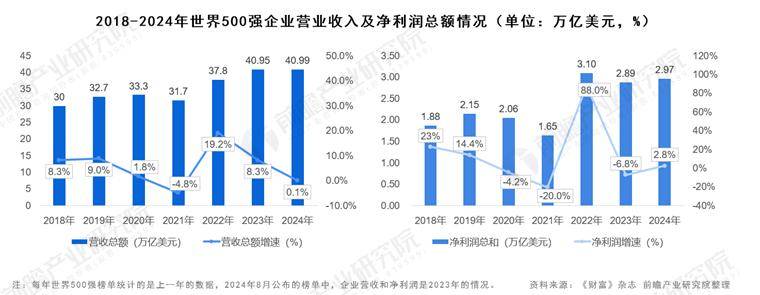
Core Insights - The report highlights the shift of the world's top 500 companies towards "light asset, high value-added" sectors, reflecting a broader trend in global economic structure transformation and technological revolution [5][21] - The investment decisions of these companies are increasingly based on a deep understanding of macroeconomic environments and future trends, serving as a critical window into global economic trends and industrial changes [1][22] Group 1: Financial Performance - From 2018 to 2024, total revenue of the world's top 500 companies is projected to grow from $30 trillion to $41 trillion, with a compound annual growth rate (CAGR) of 5.3%. Net profit is expected to increase from $1.88 trillion to $2.97 trillion, with a CAGR of 7.9% [2] - The financial sector shows the strongest overall profitability, with total profits of $934.2 billion, accounting for 31.5% of the total [3] Group 2: Investment Trends - Investment events among the world's top 500 companies peaked in 2021 with 2,339 events, a 71% increase year-on-year, but are projected to decline to 941 events by 2024 [13][21] - The focus of investments has shifted from financial services to AI, with AI becoming the top investment sector in 2024, reflecting a broader trend towards technology-driven investments [19][21] Group 3: Regional Investment Preferences - The United States and China dominate the investment landscape, with the two countries accounting for 54.4% of the top 500 companies. The U.S. leads in foundational innovation, while China excels in application innovation and supply chain integration [7][29] - India has emerged as a significant investment destination in East Asia, benefiting from demographic dividends and policy reforms, with 43% of investment events in the region [38] Group 4: Sectoral Shifts - The energy sector is undergoing structural adjustments, with traditional fossil fuel companies facing challenges from carbon taxes and energy transitions, leading to a shift towards digital capital and consumer scale [12][27] - Investment in AI, semiconductors, and renewable energy is on the rise, with AI expected to exceed $15 trillion in market size by 2029, growing at a CAGR of 18.9% from 2024 to 2029 [23][41] Group 5: Strategic Insights - The investment logic of the world's top 500 companies has transitioned from "scale competition" to "quality competition," emphasizing technology barriers and long-term value creation [14][22] - Major players like Tencent and SoftBank are leading the charge in investments, focusing on AI and technology-driven sectors, while traditional industries are seeing a decline in investment attractiveness [16][43]

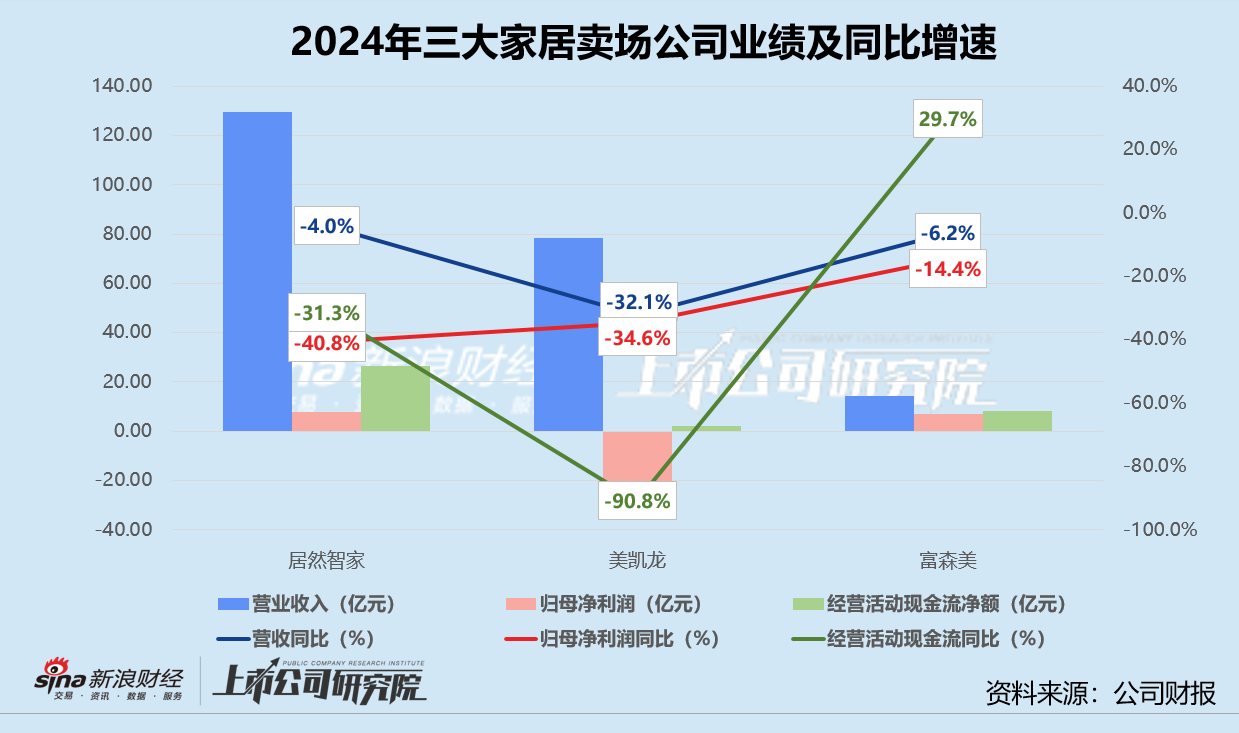
家居卖场年报 | 三大公司业绩齐降 居然智家盈利承压、美凯龙亏损加剧 富森美靠轻资产突围
Xin Lang Zheng Quan· 2025-05-23 11:02
Group 1: Real Estate Market Overview - In 2024, the new residential property sales area decreased by 12.9% to 97.385 million square meters, and sales revenue fell by 17.1% to 967.5 billion yuan compared to 2023 [1] - The sales area and revenue for residential properties dropped by 14.1% and 17.6% respectively, indicating a continued decline in the new housing market [1] - The building materials and home furnishing market also faced challenges, with sales down 3.9% to 1.49 trillion yuan and market area down 9.6%, marking the third consecutive year of negative growth [1] Group 2: Company Performance - The total revenue for the three major home furnishing companies (Juran Zhijia, Meikailong, and Fusenmei) in 2024 was 22.217 billion yuan, a decrease of 16.3% from 2023 [3] - Juran Zhijia led in revenue with 12.966 billion yuan, contributing nearly 60% of total revenue, while Meikailong's revenue dropped 32.1% to 7.821 billion yuan, marking its first time below 10 billion since 2017 [3][4] - Fusenmei reported the lowest revenue at 1.44 billion yuan, a slight decrease of 6.2% compared to 2023 [3] Group 3: Financial Metrics - Juran Zhijia's net profit was 835 million yuan, with a significant decline of 37.7%, while Meikailong faced a net loss of approximately 3.19 billion yuan, an increase of 34.6% in losses [3][4] - Fusenmei was the only company to see an increase in operating cash flow, up 29.7% to 816 million yuan, while Juran Zhijia and Meikailong experienced declines [4] Group 4: Market Dynamics - The number of franchise stores and operational area for Juran Zhijia and Meikailong decreased, with Juran Zhijia's direct stores down by 3 to 83 [6][7] - Meikailong's direct store count remained stable, but the composition changed significantly, with a 21.6% increase in self-owned stores [7] - The average rental rate for Meikailong's stores fell to 82.5%, a decline of nearly 3 percentage points from 2023 [7] Group 5: Cost Management and Profitability - Juran Zhijia's operating costs increased by 1.6% to 12.610 billion yuan, while Meikailong managed to reduce its operating costs by nearly 26% [12] - Meikailong's gross margin improved by 1.5% to 58.3%, but its net margin remained negative, worsening by 20.6% to -40.8% [18] - Fusenmei maintained the highest gross and net margins among the three companies, despite slight declines [18] Group 6: Asset Management - Meikailong's investment properties reached 91.042 billion yuan, accounting for 78.3% of total assets, while Juran Zhijia's investment properties were valued at 23.260 billion yuan [20][21] - The average debt-to-asset ratio for the three companies was approximately 43.1%, with Meikailong and Juran Zhijia around 57% [21]