
新型工业化

Search documents
东杰智能跌2.24%,成交额5.31亿元,主力资金净流出3783.94万元
Xin Lang Cai Jing· 2025-09-02 01:58
Company Overview - Dongjie Intelligent Technology Group Co., Ltd. is located in Taiyuan, Shanxi Province, established on December 14, 1995, and listed on June 30, 2015 [2] - The company's main business includes the research, design, production, and sales of intelligent logistics conveying systems, intelligent logistics storage systems, intelligent parking garages, and automotive intelligent coating production lines [2] - Revenue composition: Intelligent logistics storage systems account for 79.11%, intelligent production systems 18.51%, spare parts and others 1.67%, and intelligent three-dimensional parking systems 0.70% [2] - The company belongs to the machinery equipment industry, specifically in automation equipment, and is associated with concepts such as smart logistics, robotics, specialized and innovative enterprises, new industrialization, and Industry 4.0 [2] Financial Performance - As of August 20, 2025, the number of shareholders is 46,100, an increase of 94.14% compared to the previous period, with an average of 9,519 circulating shares per person, a decrease of 42.97% [2] - For the first half of 2025, the company achieved operating revenue of 539 million yuan, a year-on-year increase of 24.90%, and a net profit attributable to the parent company of 5.95 million yuan, a year-on-year increase of 113.96% [2] Stock Performance - On September 2, the stock price of Dongjie Intelligent fell by 2.24%, trading at 23.60 yuan per share, with a total transaction volume of 531 million yuan and a turnover rate of 4.86%, resulting in a total market value of 10.758 billion yuan [1] - Year-to-date, the stock price has increased by 245.03%, with a 2.48% increase over the last five trading days, 133.20% over the last 20 days, and 212.58% over the last 60 days [1] - The company has appeared on the "Dragon and Tiger List" four times this year, with the most recent appearance on September 1, where it recorded a net purchase of 200 million yuan [1] Shareholder Information - As of June 30, 2025, the top ten circulating shareholders include Huaxia CSI Robotics ETF, holding 6.3982 million shares (an increase of 378,900 shares), and Tianhong CSI Robotics ETF, holding 2.5875 million shares (an increase of 179,500 shares) [3] - The company has distributed a total of 58.9238 million yuan in dividends since its A-share listing, with 4.8771 million yuan distributed in the last three years [3]

第七届“新博会”:打造新材料“创想盛宴” 吸引投资超700亿元
Zhong Guo Xin Wen Wang· 2025-09-01 17:40
Core Viewpoint - The 7th China International New Materials Industry Expo concluded in Harbin, Heilongjiang Province, highlighting the province's commitment to developing the new materials industry as a key component of its modernization strategy [1][3]. Group 1: Event Overview - The expo featured three exhibition areas: thematic, professional, and application exhibitions, showcasing the entire lifecycle and innovation process of new materials [5]. - The event attracted 44 exhibitors from 11 countries and regions, including Russia, the UK, Canada, and South Korea, along with 480 exhibitors from 23 provinces, 10 universities, and 22 industrial parks in China [5][7]. - Over 4,000 exhibits were displayed, marking the largest scale and level in the history of the expo [5]. Group 2: Focus Areas and Activities - The expo focused on key technological innovations and industry transformations, including AI-driven material technology changes, construction of new material big data centers, efficient utilization of non-grain biomass resources, and transformation of new material achievements [5]. - Six major national and provincial meetings were organized, along with nearly 20 technical exchange and collaborative research activities, featuring over 100 important guests, including academicians and industry experts [5][7]. Group 3: Investment and Collaboration - The event facilitated 15 industry collaboration activities, including investment cooperation discussions, which helped attract over 70 billion RMB in new materials industry investments to Heilongjiang Province [7].

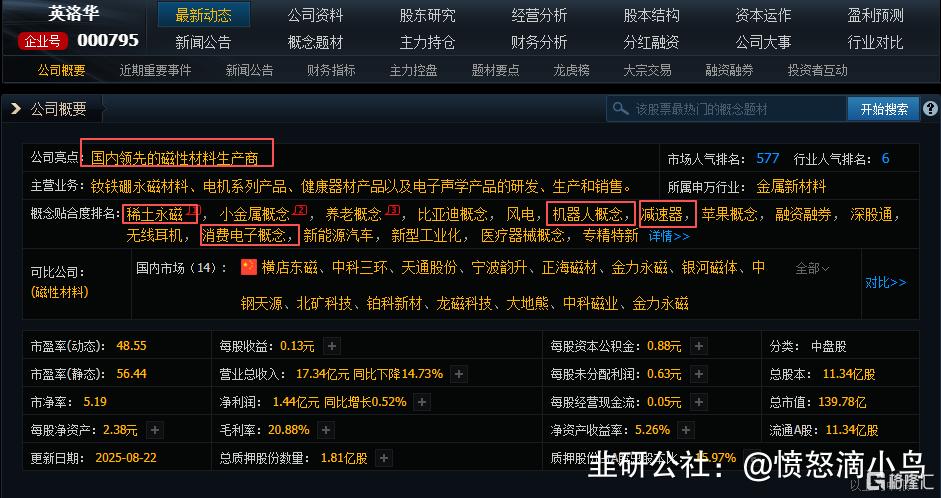
英洛华(000795):国内领先的磁性材料生产商+出口许可+机器人
Ge Long Hui· 2025-09-01 15:24
Core Viewpoint - Yingluohua (000795) is a leading domestic manufacturer of magnetic materials, specializing in rare earth permanent magnetic materials and devices, with products widely used in high-growth sectors such as new energy vehicles, wind power generation, and energy-efficient home appliances [1][2]. Group 1: Company Overview - The company has been recognized as a national "specialized and innovative" small giant enterprise, indicating its strong position in the industry [1]. - Yingluohua's main business includes the research, production, and sales of sintered and bonded NdFeB permanent magnetic materials, motor series products, health equipment, and electronic acoustic products [2]. - The company has a production capacity of approximately 13,000 tons of magnetic materials, with a utilization rate of around 80% [2][3]. Group 2: Financial Performance - In 2024, the company achieved sales of over 6,200 tons of magnetic materials, maintaining a significant market position [2]. - The company's total revenue was 1.734 billion yuan, showing a year-on-year decline of 14.73%, while net profit reached 144 million yuan, reflecting a slight increase of 0.52% [2]. Group 3: Market Position and Strategy - Yingluohua has established long-term partnerships with leading suppliers such as Northern Rare Earth and China Rare Earth, employing a combination of long-term agreements and flexible procurement strategies to manage raw material costs [3]. - The company has a strong export presence, with 60-70% of its motor products exported, primarily to Europe and Asia, and has begun to receive export licenses for European clients [3][6]. Group 4: Product Applications and Innovations - The company's magnetic materials are utilized in various applications, including smart consumer electronics, wind power generation, smart home appliances, new energy vehicles, industrial robots, and critical components in UPS systems and server hard drives [5][6]. - Yingluohua is also expanding into the humanoid robot sector, with ongoing development and testing of joint modules and small-scale applications of its reducers in industrial robots [5].

工信部:积极参与数字经济、人工智能等领域全球治理
Zheng Quan Shi Bao Wang· 2025-09-01 13:57
Core Viewpoint - The Ministry of Industry and Information Technology emphasizes the importance of open sharing in advancing new industrialization, advocating for high-level openness and the utilization of both domestic and international markets and resources [1] Group 1: High-Level Openness - The government aims to expand high-level openness and promote mutual reinforcement of domestic and international dual circulation [1] - There is a focus on attracting foreign investment by creating a market-oriented, law-based, and international first-class business environment [1] Group 2: International Cooperation - Companies are encouraged to diversify their layouts and pursue international development, particularly in collaboration with countries involved in the Belt and Road Initiative [1] - The government seeks to enhance participation in global governance in areas such as digital economy, artificial intelligence, and communication infrastructure [1] Group 3: Global Supply Chain - The initiative aims to build a secure, stable, efficient, open, and mutually beneficial global industrial and supply chain system [1]
近5年累计投资金额超450亿元 中国东方支持制造业高质量发展
Zhong Zheng Wang· 2025-09-01 12:48
Core Viewpoint - China Orient Asset Management Co., Ltd. has been focusing on financial support for the high-quality development of the manufacturing industry, emphasizing its role in financial rescue and counter-cyclical adjustment [1] Group 1: Financial Support and Investment - Over the past five years, China Orient has invested in 122 manufacturing projects, with a total investment exceeding 45 billion yuan [1] - The company addresses significant funding gaps in equipment upgrades and challenges in financing the commercialization of emerging technologies within the manufacturing sector [1] Group 2: Business Models and Services - China Orient employs various business models such as non-performing asset acquisition and market-oriented debt-to-equity swaps to provide comprehensive financial services across different stages of manufacturing enterprises [1] - The company aims to enhance its financial support for the manufacturing sector by optimizing service models and improving professional financial capabilities [1] Group 3: Future Plans - Moving forward, China Orient plans to prioritize support for high-quality manufacturing development and new industrialization, actively participating in revitalizing existing assets and assisting "specialized, refined, and innovative" enterprises in structural adjustments [1]
中力股份跌2.23%,成交额1.52亿元,近5日主力净流入-2875.43万
Xin Lang Cai Jing· 2025-09-01 08:05
Core Viewpoint - The company, Zhejiang Zhongli Machinery Co., Ltd., focuses on the research, development, and sales of electric forklifts and other industrial vehicles, aiming to lead the industry transformation towards greener and smarter logistics solutions [2][3][5]. Company Overview - Zhejiang Zhongli Machinery Co., Ltd. was established on September 20, 2007, and is located in Anji County, Huzhou City, Zhejiang Province. The company specializes in electric forklifts and other industrial vehicles, with 98.85% of its revenue coming from forklifts and related parts [9]. - The company is set to be listed on December 24, 2024, and operates within the machinery equipment sector, specifically in engineering machinery [5][9]. Financial Performance - For the first half of 2025, the company reported a revenue of 3.431 billion yuan, representing a year-on-year growth of 9.20%. The net profit attributable to shareholders was 448 million yuan, with a year-on-year increase of 6.64% [10]. - As of June 30, 2025, the company had 20,000 shareholders, a decrease of 36.39% from the previous period, while the average number of circulating shares per person increased by 62.35% [10]. Market Position and Trends - The company has a significant international presence, with overseas revenue accounting for 51.63%, benefiting from the depreciation of the Chinese yuan [4]. - The company is actively developing mobile handling robots and has launched the X-Mover series, which is designed to enhance automation and efficiency in logistics [2][3]. Stock Performance - On September 1, the company's stock price fell by 2.23%, with a trading volume of 152 million yuan and a turnover rate of 7.34%, resulting in a total market capitalization of 16.02 billion yuan [1]. - The average trading cost of the stock is 41.85 yuan, with the current price approaching a support level of 39.56 yuan [8].
拓邦股份跌2.04%,成交额6.11亿元,主力资金净流出8446.22万元
Xin Lang Cai Jing· 2025-09-01 06:23
Core Viewpoint - The stock of Topband Co., Ltd. has experienced fluctuations, with a recent decline of 2.04% on September 1, 2023, reflecting a total market capitalization of 18.565 billion yuan and a trading volume of 611 million yuan [1]. Group 1: Stock Performance - As of September 1, 2023, Topband's stock price is 14.89 yuan per share, with a year-to-date increase of 9.96% [1]. - Over the past five trading days, the stock has decreased by 1.59%, while it has increased by 4.42% over the last 20 days and 9.89% over the last 60 days [1]. Group 2: Financial Performance - For the first half of 2025, Topband reported a revenue of 5.502 billion yuan, representing a year-on-year growth of 9.70%, while the net profit attributable to shareholders decreased by 15.11% to 330 million yuan [2]. - Since its A-share listing, Topband has distributed a total of 838 million yuan in dividends, with 235 million yuan distributed over the past three years [2]. Group 3: Shareholder Structure - As of June 30, 2025, the number of shareholders for Topband is 103,900, a decrease of 2.17% from the previous period, with an average of 10,308 circulating shares per shareholder, an increase of 2.21% [2]. - The second-largest shareholder is the Huaxia CSI Robot ETF, holding 27.9166 million shares, an increase of 4.9724 million shares from the previous period [2].

数字金融赋能新型工业化战略路径
Jin Rong Shi Bao· 2025-09-01 04:04
Core Insights - Digital finance is a core driving force in the digital economy era, reshaping financial service paradigms and injecting strong momentum into new industrialization strategies, effectively addressing structural challenges in traditional financial services [1][14] - The integration of financial technology and industrial internet, along with an increasingly comprehensive multi-level policy support system, will deepen the integration of digital finance into the entire lifecycle of new industrialization [1][14] - Digital finance aims to facilitate China's transition from a "manufacturing giant" to a "manufacturing and financial powerhouse" [1][14] Group 1: Digital Finance as a Tool for New Industrialization - Digital finance utilizes data as a key production factor and technology as a core driving force, leveraging blockchain, artificial intelligence, and cloud computing to reshape the financial service ecosystem [2] - The People's Bank of China and seven other departments issued guidelines to accelerate the construction of a financial powerhouse and a manufacturing powerhouse, marking the improvement of top-level design for financial support in new industrialization [2] Group 2: Mechanisms of Digital Finance Empowerment - Digital finance evolves from a traditional "fund intermediary" role to an intelligent hub for the allocation of industrial factors, activating industrial data asset value and reconstructing credit generation and risk pricing mechanisms [3] - It addresses the challenges of financing information asymmetry, credit assessment difficulties, and low service efficiency faced by manufacturing enterprises [3] Group 3: Multi-layered Collaborative Mechanisms - Digital finance integrates multi-dimensional data to create precise credit profiles and establish dynamic risk control models, alleviating core obstacles of information asymmetry in traditional industrial financing [4] - It provides tailored financial solutions throughout the lifecycle of manufacturing enterprises, adapting to their developmental needs [5] Group 4: Challenges Facing Digital Finance - The presence of industrial data silos and algorithmic bias restricts the effectiveness of digital finance, leading to potential mislabeling of manufacturing enterprises as high-risk due to outdated parameters [7] - Regulatory frameworks are lagging behind the industrial data assetization process, creating legal uncertainties around data ownership and valuation [7] Group 5: Pathways for High-Quality Development - A comprehensive financial support system for innovation can be established, focusing on key technology breakthroughs and the transformation of results [8] - The development of a multi-credit financial model is essential to enhance the resilience of industrial chains, moving beyond traditional credit reliance [9] Group 6: Policy and Institutional Support - Establishing national standards for data sharing and improving regulations around data asset financialization are crucial for fostering innovation [13] - A balanced regulatory framework that encourages innovation while preventing discriminatory credit policies is necessary for the sustainable development of digital finance [13]
能科科技跌2.04%,成交额4.69亿元,主力资金净流出1917.12万元
Xin Lang Cai Jing· 2025-09-01 03:19
Core Viewpoint - Nengke Technology's stock has experienced fluctuations, with a year-to-date increase of 52.61% and a recent decline of 2.04% on September 1 [1] Financial Performance - For the first half of 2025, Nengke Technology achieved operating revenue of 738 million yuan, a year-on-year increase of 4.91%, and a net profit attributable to shareholders of 111 million yuan, up 18.75% year-on-year [2] - Cumulative cash dividends since the A-share listing amount to 79.65 million yuan, with 21.40 million yuan distributed over the past three years [3] Stock Market Activity - As of September 1, 2023, Nengke Technology's stock price was 45.60 yuan per share, with a total market capitalization of 11.158 billion yuan [1] - The stock has seen significant trading activity, with a turnover rate of 4.12% and a net outflow of 19.17 million yuan in principal funds on September 1 [1] - The company has appeared on the "Dragon and Tiger List" three times this year, with the most recent occurrence on August 27 [1] Shareholder Structure - As of June 30, 2025, the number of shareholders for Nengke Technology was 26,000, a decrease of 13.21% from the previous period, with an average of 9,413 circulating shares per person, an increase of 15.23% [2] - Notable institutional shareholders include Huaxia Industry Prosperity Mixed Fund and new entrants such as Jiangyin Advanced Manufacturing Mixed Fund [3]

2025年8月PMI数据解读:8月PMI:新动能或主要支撑经济修复
ZHESHANG SECURITIES· 2025-08-31 08:54
证券研究报告 | 宏观专题研究 | 中国宏观 8 月 PMI:新动能或主要支撑经济修复 —2025 年 8 月 PMI 数据解读 核心观点 8 月制造业采购经理指数(PMI)为 49.4%,较 7 月回升 0.1 个百分点,说明 经济维持修复态势,经济的主要支撑来自政策组合拳协同共振,内生动能尚 有一定改善空间。从结构上看,生产指数和供应商配送时间指数均高于临界 点,新订单指数、原材料库存指数和从业人员指数低于临界点,说明制造业 有效需求依然承压,供给侧的韧性主要来自工业稳增长政策效能释放。我们 认为,前期的"两重"和"两新"等政策稳步发力,新近推出的财政贴息、加 强全国碳市场建设、金融支持新型工业化、"人工智能+"行动等政策也更多 支撑新动能。 从重点行业来看,新动能加快扩张,传统产业边际改善。8 月高技术制造业和 装备制造业 PMI 分别为 51.9%和 50.5%,比上月上升 1.3 和 0.2 个百分点, 支撑引领作用持续增强;消费品行业 PMI 为 49.2%,比上月下降 0.3 个百分 点;高耗能行业 PMI 为 48.2%,比上月上升 0.2 个百分点,景气水平连续回 升。 大类资产方面,我们认 ...