习近平经济思想

Search documents
中国在新质生产力发展中抢占先机
Jing Ji Ri Bao· 2025-12-08 22:58
Group 1 - China has achieved unprecedented accomplishments during the "14th Five-Year Plan" period, becoming a technological leader in various important industries such as electric vehicles, drones, solar energy, wind energy, consumer internet, and artificial intelligence [1] - The transition to renewable energy and sustainable transportation is a key area for future economic growth, with China positioned as a global leader in new productive forces [1] - The integration of government and market roles in China's economic model allows for effective coordination in production and innovation, contrasting with the challenges faced by capitalist economies [3][5] Group 2 - China's R&D expenditure as a percentage of GDP reached 2.58% in 2023, significantly higher than other developing countries and surpassing some G7 nations, indicating a strong commitment to technological advancement [5] - The shift from a technology follower to a technology leader is attributed to substantial investment in science and technology, enabling rapid transformation of research outcomes into practical products [5] - China's leadership in renewable energy, particularly in solar and wind power, has led to a significant reduction in global energy costs, showcasing its role in the global energy revolution [6] Group 3 - The unique characteristics of China's socialist system, which combines large-scale production with deep integration of science and technology, provide a competitive advantage in achieving economic development [2][4] - Xi Jinping's economic thought emphasizes the importance of adapting Marxist political economy to China's specific conditions, offering insights for other countries seeking development [7] - The success of China's development model offers new choices for countries aiming for rapid growth while maintaining independence, contributing to global solutions [7]
话 规 律
Ren Min Ri Bao· 2025-12-08 22:10
Core Viewpoint - The year is significant for China's modernization process, with the economy operating steadily and achieving major development goals, marking a good start for the new journey towards the second centenary goal [1] Group 1: Economic Resilience and Development - China's economy demonstrates strong resilience and vitality, achieving historic leaps and transformations under the guidance of Xi Jinping's economic thought, which emphasizes understanding and applying economic laws [2][15] - The relationship between government and market is crucial, with Xi Jinping advocating for a balance between effective markets and proactive government roles to foster high-quality development [6][5] Group 2: Case Studies of Economic Development - Yiwu's global trade center has transformed local merchants from traditional to cloud-based businesses, with a total transaction volume of 291.37 billion yuan, reflecting a 14.4% increase [6] - Hangzhou has announced 47 "new force" enterprises, which have invested a total of 7.656 billion yuan in R&D over the past three years, averaging 163 million yuan per company [6] Group 3: Consumer Demand and Supply Dynamics - The sales of the 15th National Games mascots have exceeded 800 million yuan, showcasing the integration of new consumer demands with substantial supply capabilities [9][10] - The "Two New" policies have facilitated a significant increase in sales, with over 2.5 trillion yuan in related goods sold through trade-in programs, benefiting over 360 million people [10] Group 4: Industrial Transformation and Growth - Anhui's automotive industry has seen a transformation, with annual exports surpassing 1 million vehicles, driven by advancements in production quality and scale [13][14] - The rapid growth of China's new energy vehicle sales, which reached 1.715 million units in October, reflects the successful integration of market demand and industrial capabilities [14]
张军:推动学思践悟走深走实的精品力作
Jing Ji Ri Bao· 2025-12-04 23:57
Core Viewpoint - Xi Jinping's economic thought is a crucial component of Xi Jinping's new era of socialism with Chinese characteristics, serving as a fundamental guideline for economic work in the new era [1] Group 1: Theory and Practice - The integration of theory and practice is essential, with Xi Jinping's economic thought emerging from and guiding practical applications, reflecting a unique Chinese theoretical system [2] - The series of books aims to deepen the understanding of Xi Jinping's economic thought by exploring new ideas and strategies relevant to the current economic landscape [2] Group 2: Macro and Micro Perspectives - Xi Jinping's economic thought combines macro strategies with micro-level details, emphasizing the importance of both overarching planning and specific operational focus [3] - The series addresses major theoretical and practical issues regarding China's economic development while also providing detailed analyses of local and industry-specific challenges [3] Group 3: Goal and Problem Orientation - The combination of goal-oriented and problem-oriented approaches is a scientific methodology in governance, reflecting the core of Xi Jinping's economic thought [4] - The series explores the mission, objectives, and strategies of China's economic development, focusing on identifying and resolving key issues [4] Group 4: Continuous Development of Economic Thought - Xi Jinping's economic thought is a rich and evolving theoretical system that requires ongoing research and interpretation [5] - The series represents a continuation of previous theoretical and practical research efforts, showcasing the adaptability and relevance of Xi Jinping's economic thought in addressing contemporary challenges [5]
中国经济有底气有能力跑好新征程
Si Chuan Ri Bao· 2025-12-04 22:56
Core Insights - The high-tech manufacturing industry in China has shown significant growth, with a year-on-year increase of 9.6% in value added for the first three quarters, particularly in smart drone manufacturing (59.9% growth) and smart vehicle equipment manufacturing (25.1% growth) [1] - Renewable energy sectors, including wind and solar power, have also experienced double-digit growth, with waste resource utilization increasing by 14.4%, indicating a strong push towards green and low-carbon transformation [1] - Final consumption expenditure contributed over 50% to economic growth, highlighting its role as a primary engine for economic expansion [1] Industry Developments - The Chinese economy is undergoing a profound transformation, with a focus on high-quality development and the establishment of a new development pattern that emphasizes domestic circulation [1] - The number of newly established foreign-invested enterprises increased by 14.7% year-on-year, reflecting foreign confidence in China's vast consumer market and innovation capabilities [1] - A series of macroeconomic policies have been implemented to stimulate domestic demand and enhance capital market activity, contributing to a stable economic environment [1] Social Impact - Employment strategies have been prioritized, with 10.57 million new urban jobs created in the first three quarters, alongside initiatives to improve living conditions and support rural revitalization [1] - Policies aimed at enhancing public welfare, such as free preschool education for approximately 12 million children, demonstrate a commitment to improving the quality of life for citizens [1] - The focus on inclusive growth and consumer spending is expected to further stimulate domestic demand and economic resilience [1]
推动学思践悟走深走实的精品力作
Jing Ji Ri Bao· 2025-12-04 22:14
二是宏观和微观相结合。习近平经济思想既具宏观大视野又有微观精细度,把宏观战略与微观实践有机 贯通起来,既"操其要于上",加强战略谋划和顶层设计,也"分其详于下",把握工作着力点。习近平总 书记强调,"要强化精准思维,做到谋划时统揽大局、操作中细致精当,以绣花功夫把工作做扎实、做 到位"。丛书亦贯彻了这一要义,坚持"致广大而尽精微",既从宏观层面对新时代中国经济的发展方 向、发展道路、发展阶段、发展格局、发展质量、发展机制、发展安全等重大理论和实践问题进行深度 阐释,又从微观层面紧扣经济工作的重点任务,深入开展调查研究,运用解剖麻雀的方法对地方、产 业、企业发展中攻坚克难的具体案例进行多点位、多角度的细致分析总结。 三是目标导向和问题导向相结合。目标是指南针,问题是突破口。坚持目标导向和问题导向相结合,是 新时代以来以习近平同志为核心的党中央治国理政的科学方法论,也是习近平经济思想蕴含的科学方法 论。丛书深入研究阐释我国经济发展的使命任务和目标指向、理念原则和鲜明主题、重大战略和重大举 措等,把认识矛盾和化解矛盾作为推进工作的突破口,充分体现了发现问题、筛选问题、研究问题、解 决问题的理论和实践要求,回应了中国 ...
体系化学理化研究阐释 | 经济治理理论的创新和突破
Sou Hu Cai Jing· 2025-12-04 16:42
Group 1 - Economic governance is a key component of national governance, aiming to maximize national economic interests and public welfare while addressing market failures [1][2] - The relationship between the Party's leadership and economic work is crucial for enhancing economic governance efficiency, ensuring policy coherence and systematic governance [2][5] - The Chinese economy has shown resilience and vitality, with GDP expected to reach approximately 140 trillion yuan in 2024, reflecting the effectiveness of Xi Jinping's economic governance theory [8][9] Group 2 - The theory emphasizes the need for a balanced relationship between government and market forces, advocating for a combination of effective market mechanisms and proactive government intervention [5][6] - Macro-economic governance has evolved from mere control to a comprehensive governance approach, focusing on strategic planning and policy coherence [6][9] - The theory also highlights the importance of integrating development and security, ensuring that high-quality development is supported by a robust security framework [7][16] Group 3 - The governance model proposed by Xi Jinping contrasts with Western approaches, which have faced challenges such as economic stagnation and social inequality, indicating a shift towards a more integrated governance system [10][12] - The emphasis on a tailored governance approach based on national conditions and cultural traditions is crucial for sustainable development [13][14] - The need for continuous improvement in the Party's leadership mechanisms and the scientific management of economic policies is essential for enhancing governance effectiveness [14][15]

“习近平经济思想的江苏实践调研行”走进无锡
Xin Hua Ri Bao· 2025-12-03 21:34
本报讯(记者魏琳)12月3日,"习近平经济思想的江苏实践暨新华报业全媒体调研无锡行"启动。本次调 研由新华报业传媒集团与无锡市委宣传部联合主办,江苏经济报社和新华日报社无锡分社承办,旨在通 过全媒体调研,深入挖掘、系统呈现无锡在"十四五"期间,践行习近平经济思想过程中的创新实践与典 型经验,为全省高质量发展提供可借鉴、可推广的"无锡样本"。 仪式上,习近平经济思想无锡实践案例征集发布;新华报业传媒集团与无锡市委宣传部签署全面战略合 作协议,双方将在重大主题宣传、智库研究、融合传播等领域深化合作。当天,调研团先后走进湖心乌 托邦、上海交通大学无锡光子芯片研究院和锡西文化创意产业园调研采访,深入探寻无锡作为中国首 个"世界音乐之都"的文化活力、无锡量子科技产业的创新突破和影视产业的蓬勃发展之路。 本次全媒体调研是"习近平经济思想的江苏实践"年度主题调研的首站。此次调研活动成果将通过新华日 报、江苏经济报、交汇点新闻等全媒体平台集中呈现,推出系列深度报道和融媒体产品,全面展现习近 平经济思想在无锡的生动实践和丰硕成果。 ...
刘元春:以习近平经济思想助力推进中国式现代化|宏观经济
清华金融评论· 2025-12-03 09:48
Group 1 - The core viewpoint of the article emphasizes the significance of Xi Jinping's economic thought in guiding China's modernization and achieving the second centenary goal of building a modern socialist country [2][3]. - The article outlines that "Chinese-style modernization" is a new theoretical achievement that addresses the major issues of what kind of socialist modernization to build and how to achieve it, reflecting a comprehensive and high-quality development across various fields [4]. - It highlights five key characteristics of Chinese-style modernization: modernization with a large population, common prosperity for all, coordination between material and spiritual civilization, harmony between humanity and nature, and a path of peaceful development [4]. Group 2 - The article states that the strategic goal of Xi Jinping's economic thought is to promote Chinese-style modernization, with high-quality development being the primary task in building a modern socialist country [5]. - It emphasizes the importance of a new quality of productivity as a representative innovative theory within Xi Jinping's economic thought, which focuses on technological innovation and the optimization of production factors [6][7]. - The necessity of accelerating the development of new quality productivity is presented as an inevitable choice for advancing Chinese-style modernization, forming a theoretical foundation for the new development concepts and high-quality development [8]. Group 3 - The article discusses the pathways to promote Chinese-style modernization through Xi Jinping's economic thought, emphasizing the need for comprehensive deepening of reforms to enhance the internal driving force of economic and social development [10]. - It outlines the importance of developing new quality productivity, with specific paths including strengthening technological innovation, investing in strategic emerging industries, and promoting the digital transformation of traditional industries [10][11]. - The construction of a high-level socialist market economy system is highlighted as essential, focusing on enhancing market efficiency and ensuring a fair and vibrant market environment while balancing government and market roles [11].
《新时代县域经济学》智库报告发布
Sou Hu Cai Jing· 2025-11-21 10:03
Core Insights - The "Belt and Road" International Think Tank Cooperation Forum opened in Nanjing, focusing on the report "New Era County Economy" which explores how county economies in China can achieve high-quality development under Xi Jinping's economic thought [1][2] Group 1: Report Highlights - The report emphasizes that the vitality of county economies is crucial for the prosperity of cities, provinces, and the nation as a whole, indicating that understanding China's economic growth requires a focus on county economics [1] - It outlines various successful development models in county economies, including traditional industry upgrades, emerging industry tracks, agricultural industrialization, ecological value transformation, cultural tourism integration, and east-west cooperation [1] Group 2: Forum Context - The forum featured over 300 international guests from more than 30 countries, including officials from international organizations, think tank experts, and media representatives, fostering discussions on global cooperation [2] - The report is seen as a continuation and deepening of the research on Xi Jinping's economic thought, aligning with the spirit of openness and inclusivity promoted by the "Belt and Road" initiative [2]
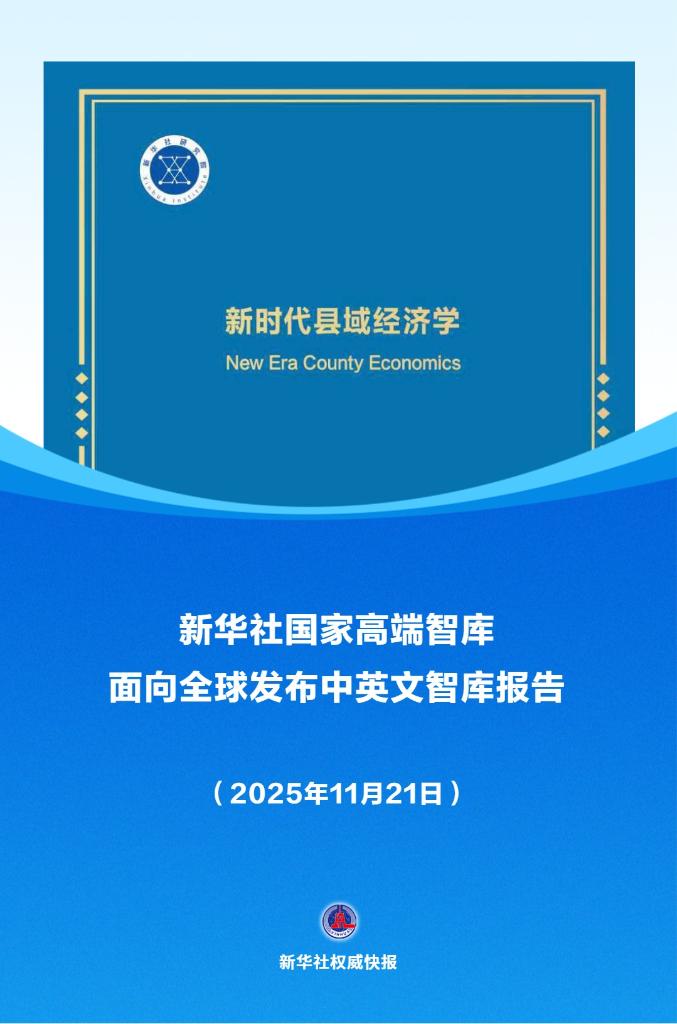
新华社权威快报丨新华社国家高端智库发布《新时代县域经济学》智库报告
Xin Hua She· 2025-11-21 07:44
Core Insights - The report titled "New Era County Economics" was released by the Xinhua News Agency's National High-end Think Tank during the 2025 "Belt and Road" International Think Tank Cooperation Forum in Nanjing, Jiangsu [4] - It emphasizes the importance of county-level economies as foundational units of Chinese modernization, exploring how these economies can achieve high-quality development under the guidance of Xi Jinping's economic thought [4] - The report highlights China's nearly 3,000-year-old tradition of county governance, asserting that counties serve as crucial hubs connecting urban and rural areas, as well as bridging different administrative levels [4] Summary by Sections - **Guiding Principles**: The report is guided by Marxist political economy and incorporates knowledge from regional economics, development economics, and urban economics, creating a unique and relatively complete knowledge system based on China's county economic development practices [4] - **Economic Models**: It identifies various successful development models in counties, including traditional industry upgrades, emerging industry tracks, agricultural industrialization, ecological value transformation, cultural tourism integration, and East-West cooperation [4] - **Strategic Importance**: The report posits that the vitality of counties directly influences the prosperity of cities, provinces, and the strength of the nation, indicating that understanding county economics is essential to grasping China's development miracle [4] - **Future Outlook**: As a key focus during the 14th Five-Year Plan period, the high-quality development of county economies is expected to propel China towards becoming a modernized strong nation [4]