
脱贫攻坚

Search documents
这名脱贫户的账本为何越记越详细(不掉队 赶上来)
Ren Min Ri Bao· 2025-11-11 22:40
Core Insights - The article highlights the transformation of a poverty-stricken household in Inner Mongolia, showcasing the impact of targeted poverty alleviation measures and diversified income sources [2][5]. Group 1: Economic Transformation - Baiyinbao's family income increased from less than 4,000 yuan per person in 2014 to over 10,000 yuan per person by 2020, marking a significant improvement in their economic status [2]. - The family now has multiple income streams, including livestock sales, agricultural subsidies, and participation in various projects, leading to a more detailed record-keeping practice [2][3]. Group 2: Livestock and Agriculture - Baiyinbao's livestock count has grown to 170 sheep and 32 cattle, with the family benefiting from subsidies and a centralized breeding facility established in 2022 [3]. - The introduction of the "borrow chicken, return chicken" project has allowed Baiyinbao to raise chickens at low costs, contributing to an additional income of over 10,000 yuan annually [3]. Group 3: Environmental Initiatives - The establishment of a 1,500-acre seabuckthorn forest has improved land conditions and generated collective income for the village, demonstrating the ecological and economic benefits of environmental restoration efforts [4]. - Baiyinbao's role as a forest ranger and participation in ecological compensation programs further illustrate the community's commitment to sustainable practices [4]. Group 4: Ongoing Support and Monitoring - The local government conducts regular monitoring of households at risk of falling back into poverty, with 1,676 households currently under observation and tailored support plans in place [5]. - New monitoring efforts have identified 367 households this year, ensuring that assistance is targeted and effective in preventing poverty recurrence [5].
财政部:积极培育新兴产业和未来产业 持续推动制造业转型升级
智通财经网· 2025-11-07 10:56
Core Viewpoint - The report emphasizes the acceleration of new growth momentum in China's economy through enhanced fiscal policies, support for innovation, and investment in key industries, while ensuring the stability of employment and market expectations [1][3]. Group 1: Fiscal Policy and Economic Growth - The fiscal policy is increasingly proactive, focusing on stabilizing employment, businesses, and market expectations, while promoting economic recovery [3][4]. - A total of 300 billion yuan in special bonds is allocated to support the replacement of consumer goods, which is expected to stimulate significant retail sales [4][15]. - The central government plans to increase its technology funding to 398.12 billion yuan in 2025, a 10% increase from the previous year, focusing on core technology and strategic industries [5][21]. Group 2: Investment and Consumption - The government aims to enhance domestic demand by boosting consumption and effective investment, with a focus on key sectors and weak links [13][16]. - The issuance of special bonds has accelerated, with 5.55 billion yuan issued in the first half of the year, completing 42.7% of the annual target [16]. - The manufacturing sector is expected to see a 10.3% increase in industrial investment, driven by government support for technological upgrades [17]. Group 3: Employment and Social Welfare - The central government allocated 667.4 billion yuan for employment support, with 6.95 million new urban jobs created in the first half of the year [27][28]. - Education spending increased by 5.9% to 2.15 trillion yuan, with a focus on improving quality and access to education [29][30]. - Basic public health service funding reached 804.35 billion yuan, enhancing health management and disease prevention efforts [32][33]. Group 4: Risk Management and Financial Stability - The government is implementing measures to mitigate financial risks, including the management of local government debt and the promotion of real estate market stability [7][9]. - A comprehensive approach to fiscal management is being adopted, including reforms in tax systems and budget execution to ensure effective use of resources [7][12]. Group 5: Innovation and Technology - The report highlights the importance of integrating technological innovation with industrial development, with a focus on enhancing research capabilities and supporting key technology projects [20][21]. - Funding for basic research is set to increase by 12.1%, emphasizing the need for original innovation and support for research institutions [21][22]. Group 6: Environmental and Social Development - The government is committed to ecological protection and sustainable development, with significant funding allocated for pollution control and ecosystem restoration [38][39]. - Social welfare programs are being expanded, with increased support for vulnerable populations and efforts to improve living standards [34][35].
廿三载帮扶路 绘就乡村振兴新画卷
Jin Rong Shi Bao· 2025-11-07 01:05
Core Viewpoint - The article highlights the successful development of the Bai Ma Lin Gu Homestay in Henan Province, which has become a popular destination and a model for rural revitalization supported by Minsheng Bank's financial assistance and community engagement [2][3][4]. Group 1: Development of Bai Ma Lin Gu Homestay - Bai Ma Lin Gu Homestay, located in Shixian County, has been operational for over two years and is known for its amenities and natural surroundings, attracting many visitors [2]. - The homestay has contributed to local tourism and economic growth, with full occupancy during holidays [2][4]. - The project was initiated with a donation of 20.5 million yuan from Minsheng Bank as part of the "Hundred Beautiful Villages" initiative, officially opening on May 31, 2023 [4]. Group 2: Financial Support and Impact - Over 23 years, Minsheng Bank has donated more than 260 million yuan and provided over 1.4 billion yuan in loans to support poverty alleviation and rural revitalization in Shixian and neighboring counties [3]. - The bank's efforts have included training nearly 98,000 individuals and facilitating over 200 million yuan in consumption assistance [3]. Group 3: Economic Growth and Community Engagement - The collective income of Shixian County has significantly increased, from 20,000 yuan in 2021 to 630,000 yuan in 2024, demonstrating the positive impact of community engagement and development initiatives [5]. - The introduction of the "Cultural and Tourism" development model has further enhanced local economic opportunities, leveraging the region's agricultural strengths [5][6]. Group 4: Educational Initiatives - Minsheng Bank has invested in educational infrastructure, including a vocational school in Shixian that offers various skill training programs, enhancing local employment opportunities [9][10]. - The bank's support has also extended to special education, providing resources and facilities for students with disabilities [11][12]. Group 5: Healthcare Support - Minsheng Bank has contributed to healthcare improvements in Shixian, including the donation of 25 medical examination vehicles to enhance health services for the elderly and chronic disease patients [13][14]. - These initiatives aim to provide equitable healthcare access and improve overall community health [14]. Group 6: Agricultural Development - The bank has supported agricultural projects, such as the establishment of a gold flower industry in nearby villages, which is expected to generate significant income and employment opportunities [16]. - The introduction of high-quality seed varieties and modern agricultural practices is projected to enhance productivity and profitability for local farmers [16].



“花儿临夏”经济社会发展背后的国库力量 中国人民银行临夏州分行经理国库40周年发展纪实
Jin Rong Shi Bao· 2025-11-06 03:33
Core Viewpoint - The article highlights the significant progress and achievements of the Linxia Prefecture Treasury in improving financial services, supporting local economic development, and enhancing the well-being of its residents over the past 40 years. Group 1: Historical Development - The treasury's operations began with manual bookkeeping and have evolved to a highly efficient electronic system, achieving over 99.5% electronic processing rate for non-tax revenue and refund transactions [2] - The implementation of the TIPS system in 2006 enabled 100% coverage of financial and tax connections across all 8 counties in Linxia Prefecture [2] Group 2: Poverty Alleviation and Social Welfare - Linxia Prefecture was once a deeply impoverished area, with a poverty rate of 32.5% in 2013. Collaborative efforts led to the successful eradication of absolute poverty in the region [3] - Since 2021, the treasury has facilitated the disbursement of 16.0584 million yuan in livelihood funds to support rural revitalization efforts [3] Group 3: Financial Services and Economic Support - The treasury has actively promoted savings bonds as a tool for rural revitalization, achieving sales of 16.0306 million yuan in 2024, a 51.7% increase year-on-year [4] - In 2022, the treasury processed a total of 652 million yuan in tax refunds, including 462 million yuan in VAT refunds, benefiting 696 enterprises [5] Group 4: Risk Management and Regulatory Oversight - The treasury has established a multi-faceted analysis system to enhance its role in macroeconomic decision-making, providing regular reports on treasury fund operations to local governments [7] - A proactive risk monitoring system has been implemented to track key financial indicators, aiding in the prevention of local fiscal and financial risks [7] Group 5: Future Outlook - The Linxia Prefecture Treasury aims to continue its commitment to serving the public and supporting local economic development, focusing on innovation and responsibility in its operations [8]
加快农业农村现代化
Ren Min Ri Bao· 2025-11-06 00:24
Core Viewpoint - The modernization of agriculture and rural areas is essential for the overall modernization of the country, as emphasized by General Secretary Xi Jinping [1][2]. Group 1: Significance of Accelerating Agricultural and Rural Modernization - The achievements in "three rural issues" since the 18th National Congress have been historic, with significant improvements in rural conditions and agricultural production capabilities [2]. - The comprehensive grain production capacity remains above 1.3 trillion jin, with expectations to exceed 1.4 trillion jin in 2024 [2]. - The contribution rate of agricultural science and technology has reached 63.2%, and the mechanization rate of crop farming exceeds 75% [2]. - The eradication of absolute poverty has been a historic achievement, with all farmers entering a moderately prosperous society [2]. - The per capita disposable income of rural residents is projected to reach 23,119 yuan in 2024, with the urban-rural income ratio decreasing to 2.34:1 [2]. Group 2: Relationship of Agricultural Modernization to National Goals - Agricultural modernization is a critical task for building a modern socialist country, addressing the imbalances and weaknesses in rural development [3]. - Strengthening the agricultural foundation is vital for national stability and food security, especially in the face of international uncertainties [3]. - Achieving agricultural modernization is essential for ensuring food security and providing a solid foundation for the modernization of China [3]. Group 3: Basic Requirements for Agricultural Modernization - Agricultural modernization is a major and urgent strategic task that requires prioritizing rural development and urban-rural integration [5]. - The relationship between setting goals and maintaining historical patience is crucial, as agricultural modernization is a systematic and dynamic process [6]. - Local conditions must be considered in the implementation of agricultural modernization, avoiding a one-size-fits-all approach [6]. - The integration of traditional agricultural practices with modern elements is necessary to preserve cultural heritage while advancing modernization [6]. Group 4: Strategic Deployment for Agricultural Modernization - The focus is on enhancing agricultural production capacity and quality, ensuring food security through modern agricultural practices [9]. - Establishing mechanisms to prevent poverty and ensure sustainable development in rural areas is essential [10]. - Building beautiful and livable rural areas is a priority, with an emphasis on improving infrastructure and public services [11]. - Strengthening policies that support farmers and enhance agricultural productivity is critical for achieving modernization goals [12].
这座宝藏车站让山乡居民搭上“幸福快车”
Xin Hua She· 2025-11-02 06:12
Core Viewpoint - The establishment of Xiaowan East Station in Yunnan Province aims to consolidate poverty alleviation efforts and promote rural revitalization, benefiting local communities and enhancing economic development [1] Summary by Relevant Sections Infrastructure Development - Xiaowan East Station is located in Xiaowan East Town, Nanjian Yi Autonomous County, Yunnan Province, over 80 kilometers from Nanjian County [1] - The station is designed using a half-tunnel, half-bridge structure due to geographical constraints, with part of it built within the Xinhua Tunnel and the other part on the Lancang River Grand Bridge [1] Economic Impact - The opening of Xiaowan East Station benefits hundreds of thousands of local residents by facilitating access to medical care, education, and employment [1] - The station accelerates the flow of passengers and goods between the surrounding areas and external markets, promoting local economic growth [1] Community Development Initiatives - Recent initiatives include targeted assistance and the development of cultural tourism projects like "Cloud Xiaowan," which aim to connect poverty alleviation with rural revitalization [1] - These efforts encourage tourism and the sale of local agricultural products such as ecological river fish, black-boned chickens, tea, and fruits, broadening the development prospects for local residents [1]
透过数据看前三季度“三农”成绩单 为经济社会高质量发展提供有力支撑
Yang Shi Wang· 2025-10-29 01:31
Core Insights - The agricultural and rural economy in China has shown strong development momentum this year, providing robust support for high-quality economic and social development [1] Group 1: Agricultural Production - Grain production is expected to achieve another bumper harvest this year, with summer grain stable and early rice increasing in yield. Most regions have favorable conditions for autumn grain production, particularly in Northeast China, Inner Mongolia, and Xinjiang [1] - As of now, over 85% of the autumn grain has been harvested, with efforts being made to mitigate the impact of continuous rainy weather in the Huang-Huai-Hai region [1] Group 2: Market Supply and Prices - The supply of "vegetable basket" products is sufficient, with increases in the production of pork, beef, lamb, poultry, milk, and eggs. The variety of vegetables, fruits, and aquatic products is rich, and prices remain stable [3] Group 3: Poverty Alleviation - The achievements in poverty alleviation are being consolidated, with over 7 million individuals identified for assistance to prevent poverty. More than 33 million people from impoverished backgrounds have found employment, exceeding annual targets [5] Group 4: Rural Industry and Investment - The quality and efficiency of rural industries are improving, with a 6.7% year-on-year increase in the value added of the agricultural and sideline food processing industry in the first three quarters [7] - Fixed asset investment in the primary industry reached 734.4 billion yuan in the first three quarters, growing by 4.6%, which is 5.1 percentage points higher than the national average [12] Group 5: Rural Income and Consumption - Rural residents' disposable income and consumption have both increased, with per capita disposable income at 17,686 yuan, reflecting a real growth of 6% year-on-year, and per capita consumption expenditure at 14,597 yuan, with a real growth of 5.8% [10]
粮食有望再获丰收 脱贫攻坚成果扎实巩固——农业农村部有关负责人谈前三季度农业农村经济走势
Xin Hua Wang· 2025-10-28 17:58
Group 1: Grain Production - Grain production in China is expected to achieve another bumper harvest this year, with summer grain output at 299.48 billion jin and early rice production increasing by 6.8 billion jin, a growth of 1.2% compared to last year [2] - The area for autumn grain has increased, particularly for high-yield crops like corn, with good production conditions reported in major agricultural regions [2] - The supply of "vegetable basket" products remains sufficient, with meat production at 73.12 million tons, a year-on-year increase of 3.8%, and stable prices for vegetables, fruits, and aquatic products [2] Group 2: Poverty Alleviation - As of September, over 7 million individuals at risk of falling back into poverty have been identified and assisted, with targeted measures implemented to prevent large-scale poverty [3] - More than 33 million people from the poverty alleviation population have found employment, exceeding the annual target [3] - Financial aid from eastern provinces to western provinces reached 22.48 billion yuan, with significant contributions from central units [3] Group 3: Rural Development - The construction of livable and workable beautiful villages is progressing, with a focus on rural industry development and governance [4] - The value added of the agricultural and sideline food processing industry increased by 6.7% year-on-year, and online retail sales of agricultural products are growing rapidly [4] - Investment in rural construction projects totaled 162.39 billion yuan, with improvements in rural infrastructure and living conditions [4]
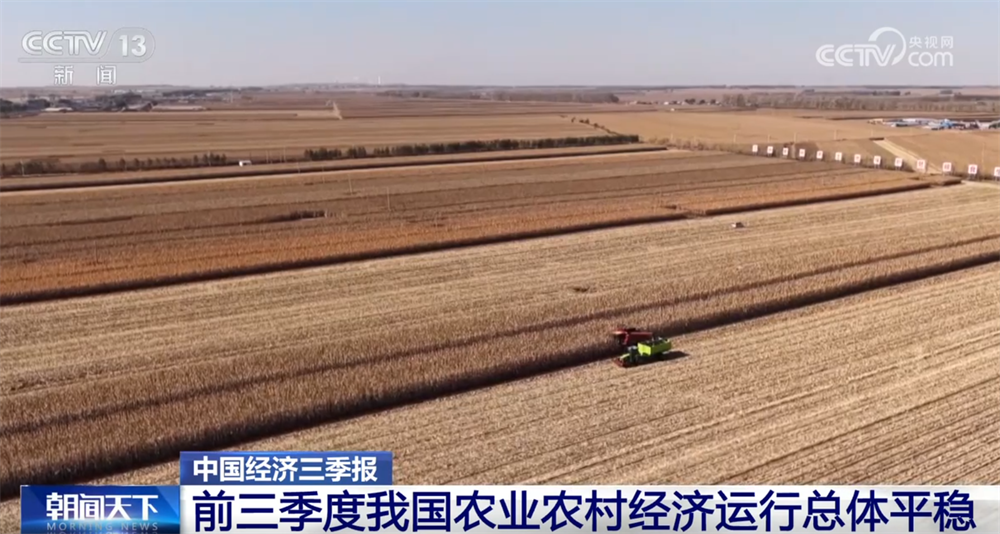
全年粮食有望再获丰收 前三季度农业农村经济运行总体平稳
Yang Shi Xin Wen· 2025-10-28 13:52
Group 1: Agricultural Production - The agricultural economy in China is showing strong growth, contributing significantly to high-quality economic development [1] - The total grain production is expected to achieve a bumper harvest, with summer grain output at 299.48 billion jin and early rice production at 57.03 billion jin, an increase of 6.8 million jin or 1.2% year-on-year [1] - The area for autumn grain has increased, particularly for high-yield crops like corn, with over 85% of the harvest already completed [1] Group 2: Livestock and Poultry Production - The supply of "vegetable basket" products is sufficient, with total meat production (pork, beef, lamb, and poultry) reaching 73.12 million tons, a year-on-year increase of 3.8% [2] - The national milk production is 29.21 million tons, up 0.7% year-on-year, while egg production is 26.46 million tons, reflecting a 0.2% increase [2] - The number of breeding sows has decreased by 450,000 compared to the peak at the end of last year, with a total of 40.35 million sows as of the end of September [2] Group 3: Poverty Alleviation and Employment - The achievements in poverty alleviation are being consolidated, with over 7 million individuals identified for assistance to prevent poverty [3] - More than 33 million people from impoverished backgrounds are employed, exceeding the annual target [3] - Financial aid from eastern provinces to western provinces reached 22.48 billion yuan in the first three quarters [3] Group 4: Agricultural Investment and Rural Development - Rural residents' disposable income increased to 17,686 yuan, a real growth of 6%, while per capita consumption expenditure rose to 14,597 yuan, a real increase of 5.8% [5] - Fixed asset investment in the primary industry reached 734.4 billion yuan, growing by 4.6%, which is 5.1 percentage points higher than the national average [5] - The number of farmer cooperatives has exceeded 2 million, and nearly 4 million family farms have been established [5] Group 5: Rural Infrastructure and Governance - The construction of livable and workable rural areas is progressing, with 324,000 new rural construction projects added in the first three quarters [4] - Investment in rural infrastructure reached 162.39 billion yuan, with improvements in roads, water supply, and electricity [4] - The effectiveness of rural governance is being enhanced through the promotion of typical cases of party-led governance [4]
下党乡有个“十八栋村”
Ren Min Ri Bao· 2025-10-22 12:55
Core Insights - The article highlights the transformation of rural areas in Fujian, particularly focusing on the development of "Shibadong Village" and "Shibadong Village" in Ningde, showcasing the journey from poverty alleviation to rural revitalization [1][4]. Group 1: Historical Context - The article references Xi Jinping's visits to the region, emphasizing his commitment to poverty alleviation and rural development, which laid the groundwork for current initiatives [1][3]. - The establishment of Xi Jinping's "weak bird first fly" concept in 1988 is noted, highlighting the initial challenges faced by the region, including lack of infrastructure and basic services [3][7]. Group 2: Infrastructure Development - Significant improvements in infrastructure, such as the construction of a 2.1-kilometer long, 6.5-meter wide cement road, have enhanced connectivity for the village, facilitating access to markets and resources [5][8]. - The article mentions that the journey from the county to the village has been reduced from a full day to under an hour, indicating substantial progress in transportation [8]. Group 3: Economic Transformation - The transformation of old houses into guesthouses has created new income streams for villagers, with some families reporting additional earnings of several thousand yuan per year [4][6]. - The article highlights the integration of tourism with local agriculture, showcasing various initiatives such as "wine reunion" experiences and local culinary offerings, contributing to the local economy [4][8]. Group 4: Community Engagement and Development - The article discusses the importance of building a strong community leadership and talent pool, with younger villagers returning to contribute to local development efforts [10][11]. - It emphasizes the need for comprehensive planning and project implementation to ensure sustainable growth, with a focus on developing diverse agricultural and tourism-related activities [11].