边缘AI

Search documents
倒计时1天!巨头纷纷加盟共同解码边缘AI
半导体芯闻· 2025-10-14 10:26
Core Viewpoint - The forum "Edge AI Empowering Hardware Future Innovation" aims to create a comprehensive communication platform that integrates policy, technology, implementation, and market, focusing on solving innovation challenges in edge AI hardware [1][34]. Event Overview - The forum will take place on October 15, 2025, at the Shenzhen Convention Center, featuring a series of expert presentations and discussions on topics related to edge AI and semiconductor technology [2][34]. Keynote Speakers and Topics - Professor Yu Hao from the Southern University of Science and Technology will discuss "End-side Large Model Chips for Personal Intelligent Agents," focusing on technological breakthroughs and research paths in the context of Shenzhen's subsidy policies [7]. - Arm China's Product Director Bao Minqi will present on "Releasing End-side AI Potential, NPU Empowering the Hardware Innovation Era," addressing how NPU can enhance AI computing efficiency in edge devices [10]. - Shenzhen Yuntian Lifa's Vice President Luo Yi will explore "AI Empowerment, Setting Sail Overseas," sharing insights on adapting AI hardware for international markets [14]. - Alibaba DAMO Academy's Business Development Head Li Jue will discuss the "Innovative RISC-V Architecture, Promoting the Future of AI Computing," focusing on how RISC-V can break traditional chip technology barriers [18]. Policy and Market Support - Shenzhen's policies for AI and semiconductor integration include financial support for AI research and development, with subsidies up to 2 million for technical breakthroughs and 300,000 for popular products [34]. - The forum aims to address the pain points of "policy not aligning with technology" and "technology not effectively utilizing policy," facilitating better collaboration between policymakers and industry [34]. Industry Trends and Innovations - The forum will cover advancements in edge AI applications, including smart manufacturing and intelligent transportation, showcasing real-world case studies to facilitate technology implementation [34]. - The event will also highlight the importance of cloud computing and AI applications in international markets, emphasizing the need for compliance and strategic market entry [34].


高通2025骁龙中国峰会:深耕三十年,以AI加速计划开启“智联”新篇
Sou Hu Cai Jing· 2025-10-14 02:24
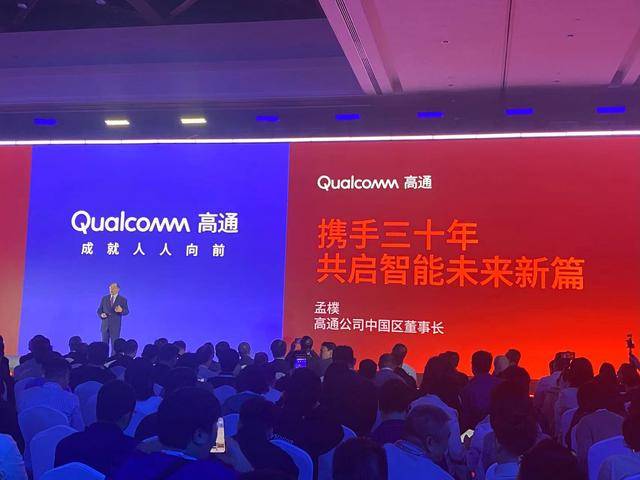
Core Insights - Qualcomm celebrates its 30th anniversary in China and launches the "AI Acceleration Plan" to promote edge AI across various sectors including personal devices, automotive, and IoT [1][4] Group 1: Qualcomm's Historical Collaboration with China - Qualcomm's partnership with the Chinese industry began in 1995 during the telecommunications transformation, supporting CDMA network testing and establishing a Beijing CDMA center in 2001 [3] - By 2024 fiscal year, Qualcomm's global revenue is projected to be $38.962 billion, with China contributing $17.826 billion (approximately 127.7 billion RMB), accounting for 46% of total revenue [3] - Xiaomi is Qualcomm's largest global customer, contributing over $3.9 billion, while OPPO and Vivo together contribute around $3 billion [3] Group 2: AI Acceleration Plan - The AI Acceleration Plan involves collaboration with major Chinese telecom operators and companies like Xiaomi, OPPO, Vivo, and others, focusing on personal AI, physical AI, and industrial AI [4] - In personal AI, the "personalized intelligent agent" based on the Snapdragon 8 Gen 2 will be implemented in flagship domestic smartphones [4] - Qualcomm aims to enhance collaboration with Chinese automotive companies to integrate Snapdragon digital chassis in smart cockpits and autonomous driving [4] Group 3: Future Market Predictions - Qualcomm predicts that the market for robotics and smart glasses (including AR/VR/AI glasses) will surpass that of smartphones within the next decade [5] - The Snapdragon XR platform supports various domestic products, including Xiaomi AI glasses and Vivo Vision MR terminal, with Vivo Vision achieving single-eye 4K resolution [5] Group 4: Commitment to Education and Community - Qualcomm's STEM initiatives have benefited over 300,000 Chinese teachers and students, while the "Wireless Care" program has implemented 20 sub-projects covering healthcare and education, impacting over 1.5 million people [6] - The company emphasizes its commitment to "rooting in China, sharing wisdom, and achieving innovation" as it looks forward to the next 30 years [6]

市场预计超70亿美元,四项技术颠覆物联网MCU市场
3 6 Ke· 2025-10-10 13:04
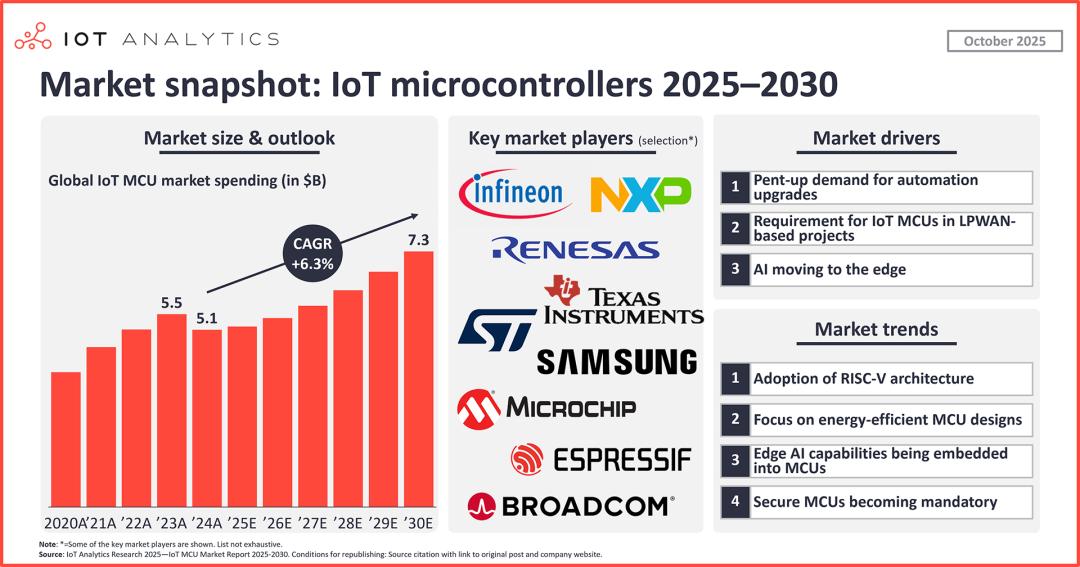
Core Insights - The global MCU spending is projected to reach $23.2 billion in 2024, with a compound annual growth rate (CAGR) of 3.9%, reaching $29.4 billion by 2030, driven by the rapid expansion of global connectivity technologies [1][6] - The IoT MCU market is expected to recover in 2025, with a projected revenue growth of 1.8% year-on-year, despite a 9% decline in 2024 due to supply chain inventory adjustments [6][7] - The market for IoT MCUs is anticipated to grow at a CAGR of approximately 6.3%, reaching $7.32 billion by 2030 [6] Market Dynamics - The demand for IoT MCUs is driven by the release of delayed automation upgrade needs, particularly in the industrial IoT sector, which is expected to see accelerated growth in 2025 [7] - The LPWAN projects are significantly boosting the demand for IoT MCUs, with nearly 1.3 billion LPWAN IoT connections expected to grow at a CAGR of 26% by 2027 [8] - The shift of AI processing to the edge is positioning MCUs as core components in IoT devices, enhancing local data processing capabilities and reducing reliance on cloud infrastructure [9][10] Technological Trends - The rise of RISC-V architecture is becoming a strategic necessity, particularly in China, which is promoting its widespread adoption to reduce dependency on Western technologies [12] - Energy efficiency is becoming a core design principle for MCUs, with advanced power management features being integrated to support long-lasting battery-powered IoT deployments [13] - Edge AI capabilities are being directly embedded into MCUs, transforming them into intelligent decision-making centers [15] Regional Insights - The IoT MCU market is shifting its geographical focus towards Asia, with China being a major growth driver due to significant investments in energy infrastructure projects [11] Security Considerations - The increasing scale of IoT deployments necessitates the integration of security MCUs and hardware root of trust solutions to protect sensitive data and ensure data integrity [17]
巨头解码边缘 AI ,重磅论坛即将举行
半导体芯闻· 2025-10-10 09:37
Core Viewpoint - The forum titled "Empowering Hardware Innovation with Edge AI" will be held on October 15, 2025, at the Shenzhen Convention and Exhibition Center, focusing on the integration of policies, technology, and market applications in the semiconductor and AI industries [1][30]. Event Overview - The forum is organized by Semiconductor Industry Observation and aims to create a closed-loop communication platform that addresses challenges in edge AI hardware innovation [1][30]. - It will feature a lineup of experts, including academicians and industry leaders, discussing topics such as optical computing, integrated processing, and practical applications of large models [1][30]. Agenda Highlights - The event will include presentations from various industry leaders, covering topics like edge model chips, NPU technology, AI applications in smart transportation, and RISC-V architecture [2][3][29]. - Notable speakers include: - Professor Yu Hao from the Shenzhen-Hong Kong Microelectronics Institute discussing edge model chips [8]. - Arm China's Product Director Bao Minqi sharing insights on NPU technology [9]. - Cloud and AI applications by China Unicom's Director Yang Cheng [12]. - Alibaba's Li Jue discussing RISC-V architecture [17]. Policy and Market Insights - The forum will address the integration of policies and technology, focusing on the challenges of aligning technical capabilities with available subsidies and support [29]. - Shenzhen's AI industry is set to accelerate with significant funding and support for AI and semiconductor integration, including subsidies for R&D and application scenarios [30]. Key Themes - The event will emphasize three critical linkages: - Policy and technology alignment to enhance R&D funding [29]. - Technical implementation in real-world applications to facilitate technology transfer [29]. - Market expansion strategies for AI hardware, particularly in international markets [29].

巨头解码边缘 AI ,重磅论坛即将举行
半导体行业观察· 2025-10-09 02:34
Core Viewpoint - The forum titled "Empowering Hardware Innovation with Edge AI" will be held on October 15, 2025, at the Shenzhen Convention Center, focusing on the integration of policies, technology, and market strategies to address challenges in edge AI hardware innovation [1][29]. Event Overview - The forum is organized by Semiconductor Industry Observation and will feature experts, industry leaders, and policymakers discussing topics such as optical computing, integrated processing, and practical applications of large models [1][2]. - The agenda includes various presentations from key figures in the semiconductor and AI sectors, covering topics from edge model chips to AI-enabled semiconductor manufacturing [2][3]. Keynote Speakers and Topics - Professor Yu Hao from the Shenzhen-Hong Kong Microelectronics Institute will discuss edge model chips for personal intelligent agents, focusing on technological breakthroughs and policy support [7]. - Arm China's Product Director Bao Minqi will present on NPU technology and its role in enhancing edge AI hardware performance [9]. - Luo Yi, Vice President of Yuntian Lifa Technology, will explore the new productivity in the intelligent computing era [10]. - Yang Cheng from China Unicom will share insights on AI hardware adapting to overseas markets [12]. - Zhang Shengbin from Inspur Cloud will discuss the international competitiveness of Chinese cloud computing and AI applications [14]. - Alibaba DAMO Academy's Li Jue will present on the innovative RISC-V architecture for the next generation of intelligent computing [15][16]. Policy and Market Integration - The forum aims to create a closed-loop system connecting policy, technology, implementation, and market expansion, addressing the pain points of aligning technology with policy support [29][30]. - Shenzhen's AI industry is set to accelerate with substantial funding and support for AI and semiconductor integration, including subsidies for R&D and application scenarios [31]. Conclusion - The event is positioned as a pivotal platform for discussing the future of edge AI and semiconductor innovation, leveraging policy advantages and technological advancements to foster a new era in the industry [1][31].

倒计时!边缘 AI 赋能硬件未来创新论坛重磅来袭,引领半导体新时代
半导体行业观察· 2025-10-08 02:09
Core Viewpoint - The article highlights the upcoming "Edge AI Empowering Hardware Future Innovation Forum" scheduled for October 15, 2025, in Shenzhen, which aims to explore technological breakthroughs and policy implementation in the context of Shenzhen's AI industry development plan [1][3]. Policy Support - Shenzhen has introduced several significant policies in the second half of 2025 to boost AI technology innovation and market application, including funding subsidies for AI research and development [3]. - The "2025 Shenzhen AI Corpus Voucher Special Fund Application Guide" offers up to 2 million yuan in subsidies for companies purchasing non-related party data for AI R&D, with additional rewards for compliant data [3]. - The "Smart Terminal Industry Development Support Plan" provides up to 20 million yuan for technical breakthroughs and 3 million yuan for popular product rewards, aimed at reducing costs and increasing efficiency for smart hardware companies [3]. Forum Highlights - The forum will feature prominent industry leaders discussing various topics, including the latest research on edge AI chips and the impact of policy incentives on industry challenges [4][5]. - Key discussions will focus on the integration of AI with advanced manufacturing and the role of policy in driving semiconductor factory upgrades [7][16]. Interactive Sessions - The forum will include interactive sessions designed to connect participants with industry experts and facilitate collaboration opportunities [9][12]. - A roundtable discussion will address practical issues related to policy subsidies and the challenges of implementing edge AI solutions [12]. Future Outlook - The event aims to provide insights into the intersection of policy, technology, and market trends, helping stakeholders navigate the evolving landscape of the AI and semiconductor industries [16]. - The forum is positioned as a platform for exploring new opportunities arising from policy incentives and technological advancements, particularly in the context of Shenzhen's ambition to become a leading AI city by 2026 [16].

FD-SOI,走向7纳米?
半导体行业观察· 2025-10-05 02:25
Core Viewpoint - The article discusses the transition of the global semiconductor industry towards low power consumption, high reliability, and strong integration, highlighting the emergence of FD-SOI technology as a key solution for low power challenges in various applications such as edge AI, automotive electronics, and IoT [2][26]. Technology Overview - FD-SOI technology, proposed in 2001, features a unique transistor structure with an ultra-thin buried oxide layer, enabling superior gate control, reduced leakage current, and static power consumption [2][4]. - The technology has evolved from a laboratory concept to a critical component in the semiconductor ecosystem, with significant advancements expected by 2024 [2][26]. Market Growth - The FD-SOI market is projected to grow from $930 million in 2022 to $4.09 billion by 2027, reflecting a compound annual growth rate (CAGR) of 34.5%, driven by demand in IoT, automotive electronics, and edge AI [7][19]. Development Timeline - **2012-2014**: STMicroelectronics launched the 28nm FD-SOI platform, marking the commercialization of the technology. Key breakthroughs in material supply and collaborations helped establish an initial ecosystem [8]. - **2015-2018**: GlobalFoundries introduced the 22nm FD-SOI platform, expanding the technology's application range and fostering partnerships to accelerate adoption [8]. - **2022-Present**: The EU supports the upgrade of the FD-SOI ecosystem, with advancements in 12nm and 18nm technologies, indicating ongoing progress towards more advanced nodes [8][26]. Major Players and Strategies - **Samsung**: Positions FD-SOI as a strategic differentiator in low-power applications, focusing on IoT and automotive markets while maintaining a dual-track strategy for advanced processes [10][11]. - **STMicroelectronics**: Utilizes an IDM model to integrate FD-SOI technology into automotive and industrial applications, emphasizing energy efficiency and reliability [12][16]. - **GlobalFoundries**: Targets edge AI with its 22FDX platform, enhancing connectivity, power efficiency, and integration capabilities [13][14]. Future Outlook - The FD-SOI technology is expected to extend to 10nm and 7nm nodes, enhancing performance and integration while maintaining low power consumption [20][22]. - The technology is seen as a strategic opportunity for the Chinese semiconductor industry, leveraging local production capabilities and market demand to build a complete FD-SOI ecosystem [27][28].


处理器市场,大洗牌
半导体行业观察· 2025-10-05 02:25
Core Insights - The processor market is experiencing significant growth driven by the rapid demand for generative AI applications, with the market size expected to nearly double from $288 billion to $554 billion between 2024 and 2030, primarily due to widespread adoption by enterprises, individuals, and governments [4] - 2024 is projected to be a turning point for the processor industry, as the GPU market is expected to surpass the APU market for the first time, driven by the demand for high computing power to run large language models like ChatGPT, Gemini, and Copilot [4] - The GPU market will face intense competition from hyperscale cloud providers like Google and AWS, which are developing their own AI ASICs to reduce capital expenditure costs [4] Market Dynamics - The processor market is highly concentrated, with three out of five segments dominated by single manufacturers holding over 50% market share; Intel controls 66% of the CPU market, while Nvidia holds over 90% of the GPU market [7] - The APU and AI ASIC & DPU markets are more fragmented, with active participation from companies like Apple, Qualcomm, MediaTek, Google, Samsung, Huawei, NXP, and Texas Instruments [7] - Emerging players from China, such as Xiaomi in the smartphone APU market and NIO in the automotive ADAS APU sector, are beginning to make their mark [7] Technological Advancements - Processor manufacturers share a common goal of launching the most powerful solutions faster than competitors, facing challenges related to cost pressures and technological limitations [11] - A trend towards advancing process nodes annually is evident, with advanced processes previously limited to smartphone APUs now being adopted in server CPUs and other processors [11] - Foundries play a crucial role in this technological race, with a significant reduction in the number of foundries capable of producing advanced process nodes over the past 20 years, and the transition to 2nm may further decrease this number [11]



Lantronix 边缘 AI 无人机解决方案集成 Gremsy 与 Teledyne FLIR 平台,实现更长续航与更高效飞行
Globenewswire· 2025-10-02 23:55
Core Insights - The strategic partnership between Lantronix and Gremsy aims to drive long-term, high-margin growth in the defense and commercial drone markets, which is projected to reach $57.8 billion by 2030 [1][7]. Company Overview - Lantronix Inc. is a global leader in edge AI and industrial IoT solutions, focusing on critical applications that require intelligent computing, secure connectivity, and remote management services [8]. - The company serves high-growth markets such as smart cities, enterprise IT, and defense unmanned systems, helping clients optimize operations and accelerate digital transformation [8]. Strategic Partnership - Lantronix's NDAA/TAA compliant solutions have been selected by Gremsy, a leading manufacturer of advanced camera gimbals for drones, enhancing Lantronix's momentum in the drone market [1][2]. - The collaboration is expected to shorten Gremsy's product time-to-market while creating long-term revenue opportunities for Lantronix in the rapidly growing commercial and defense drone sectors [2][7]. Technological Advancements - The solution is based on Lantronix's Open-Q™ 5165RB module system, powered by Qualcomm® Dragonwing™ processor, enabling seamless integration with Teledyne FLIR OEM's Hadron 640R dual thermal imaging-visible light camera [2][5]. - The edge AI processing capabilities allow for real-time object detection, scene recognition, and anomaly detection, enhancing operational decision-making in mapping, surveying, and defense [5]. Market Positioning - Lantronix's solutions are designed for high-value applications in government, energy, agriculture, and infrastructure sectors, providing a competitive edge in the defense and autonomous systems market [5][7]. - The company has established itself as a trusted provider of compliant solutions, expanding its global market reach through partnerships with Gremsy and other drone manufacturers [2][3]. Financial Highlights - Early revenue generation has begun as Lantronix confirms design wins, indicating a positive momentum in production shipments [5]. - The focus on high-margin opportunities and compliance with stringent regulations positions Lantronix favorably for future growth in the industrial IoT sector [5][7].

首个混合内存技术,实现片上AI学习和推理
半导体行业观察· 2025-09-28 01:05
Core Viewpoint - A French team has developed the first hybrid memory technology that supports adaptive local training and inference for artificial neural networks, addressing a long-standing technical bottleneck in edge AI efficiency [1][2]. Group 1: Research and Development - The research, led by CEA-Leti, demonstrates that on-chip training is feasible and can achieve competitive accuracy, eliminating the need for off-chip updates and complex external systems [2]. - The innovative technology enables edge systems and devices, such as autonomous vehicles and medical sensors, to learn from real-time data and adapt models on the fly while controlling energy consumption and hardware wear [2]. Group 2: Technical Challenges - Edge AI requires both inference (reading data to make decisions) and learning (updating models based on new data), but existing storage technologies excel at only one of these tasks [2][3]. - Memristors are efficient for inference due to their ability to store analog weights, while ferroelectric capacitors (FeCAPs) allow for quick, low-energy updates but are unsuitable for inference due to their destructive read operations [2]. Group 3: Hybrid Approach - The team proposes a hybrid method where forward and backward passes use low-precision analog weights stored in memristors, while updates are performed using higher precision FeCAPs [5]. - Memristors are periodically reprogrammed based on the most significant bits stored in FeCAPs to ensure efficient and accurate learning [5]. Group 4: Unified Memory Stack - A unified memory stack composed of silicon-doped hafnium oxide and a titanium scavenging layer has been designed, allowing the dual-mode device to operate as both FeCAPs and memristors [7]. - The same storage unit can be utilized for precise digital weight storage (training) and analog weight representation (inference) based on its state [7]. Group 5: Implementation and Testing - A digital-to-analog transfer method enables the conversion of hidden weights in FeCAPs to conductance levels in memristors without the need for formal digital-to-analog converters [8]. - The hardware was manufactured and tested using standard 130-nanometer CMOS technology, integrating both types of memory and their peripheral circuits into a single chip [8].