
ADC药物

Search documents
科伦博泰生物(06990) - 2025 Q2 - 业绩电话会
2025-08-18 13:02
Financial Data and Key Metrics Changes - The company reported a revenue of RMB950 million for the first half of 2025, with over RMB300 million coming from commercialized drugs, marking a significant achievement in its first year of commercialization [50][51] - Gross profit was RMB660 million, comparable to the previous year, while the net loss for the first half was RMB145 million, with an adjusted loss of RMB69 million after one-off budget adjustments [52][53] Business Line Data and Key Metrics Changes - The company has three main products ready for the market, with significant progress in approvals and commercialization efforts [12][21] - The commercialization team has expanded to nearly 400 personnel to support the increasing number of products [12] Market Data and Key Metrics Changes - The company has covered over 30 provinces, 300 cities, and over 1,000 hospitals across China, with partnerships established with over 400 pharmacies [28][32] - The company is actively working towards gaining medical insurance coverage for its products, which is expected to enhance market access [33][34] Company Strategy and Development Direction - The company aims to advance differentiated pipelines targeting significant medical needs, optimizing payload linker strategies, and exploring applications in non-oncology areas [26] - The focus is on expanding global partnerships and strengthening strategic collaborations to maximize the value of its pipelines [26] Management Comments on Operating Environment and Future Outlook - Management expressed optimism about the future income from sales revenue, anticipating continued cash flow generation from both R&D partnerships and commercialized drugs [51] - The company is preparing for the implementation of new medical insurance policies, which could significantly impact product sales strategies [97][100] Other Important Information - The company completed a follow-on financing of US$250 million and is included in several global equity indexes, enhancing its financial stability [25] - The company is involved in ongoing litigation regarding IP disputes with several founders, which has been accepted for review by the Sichuan Provincial High Court [101] Q&A Session Summary Question: What is the breakdown of sales revenue for breast cancer and lung cancer? - Lung cancer is the biggest contributor to sales revenue, consistent with patient numbers and indications. The sales expenses are expected to decrease once products are included in medical insurance coverage [62][63] Question: What is the focus for R&D going into the next stage? - The focus is on developing differentiated products targeting clinical demands, with an emphasis on bispecific targets and new payload strategies [68][70] Question: Can you provide guidelines on the sales trend for Q3? - The company expects quarter-over-quarter growth, with significant contributions anticipated from lung cancer indications [72] Question: What is the rationale behind the clinical trial design for PD L1 positive and negative patients? - The company is focusing on first-line treatment for wild-type non-small cell lung cancer, with ongoing projects in development [88] Question: How is the company planning to navigate the new medical insurance policy? - The company is prioritizing entry into the medical insurance catalog and is actively preparing to comply with the new policy [97][98]
科伦博泰生物(06990) - 2025 Q2 - 业绩电话会
2025-08-18 13:00
Financial Data and Key Metrics Changes - The company reported a revenue of RMB 950 million for the first half of 2025, with over RMB 300 million coming from commercialized drugs, marking a significant achievement in its first year of commercialization [52][53]. - The gross profit was RMB 660 million, comparable to the previous year, while the net loss for the first half was RMB 145 million, with an adjusted loss of RMB 69 million after one-off budget adjustments [54][55]. - Cash and financial assets totaled RMB 4.5 billion, indicating a healthy financial status to support upcoming R&D and innovation [58]. Business Line Data and Key Metrics Changes - The company has three main products ready for the market, with significant progress in commercialization, covering over 30 provinces and 300 cities, and engaging over 10,000 doctors [32][34]. - The commercialization team has expanded to nearly 400 personnel to support the increasing number of products ready for market [14][15]. Market Data and Key Metrics Changes - The company has successfully partnered with over 400 pharmacies across China, enhancing its market access and professional services [32][34]. - The company is actively pursuing medical insurance coverage for its products, with seven provinces already covered under specific affordable care programs [36][37]. Company Strategy and Development Direction - The company aims to advance differentiated pipelines targeting significant medical needs, optimizing payload linker strategies, and exploring applications in non-oncology areas [30]. - The focus is on developing ADCs and small molecules, with an emphasis on bi-specific targets and innovative payloads to replace traditional chemotherapy [70][72]. Management's Comments on Operating Environment and Future Outlook - Management expressed optimism about the future income from sales revenue, anticipating continued cash flow generation from both R&D partnerships and commercialized drugs [53]. - The company is preparing for the implementation of new medical insurance policies, which are expected to enhance market access and sales volume [100][101]. Other Important Information - The company has completed a follow-on financing of USD 250 million and is included in major global equity indexes, enhancing its market presence [29]. - The company has made significant advancements in clinical trials, with multiple pivotal trials initiated both domestically and globally [25][26]. Q&A Session Summary Question: What is the breakdown of sales revenue for breast cancer and lung cancer? - Lung cancer is the biggest contributor to sales revenue, consistent with patient numbers and indications. The sales expenses are expected to decrease once products are included in the national medical insurance catalog [60][64]. Question: What is the focus for R&D going into the next stage? - The focus is on developing differentiated products targeting clinical demands, with an emphasis on bi-specific targets and innovative payloads [70][72]. Question: Can you provide guidelines on the sales trend for Q3? - The company has recorded quarter-over-quarter growth of several dozen percentage points, indicating a positive sales trend [76]. Question: What is the rationale behind the clinical trial design for PD L1 positive and negative patients? - The company is focusing on developing effective treatments for both PD L1 positive and negative patients, with ongoing trials to assess efficacy [91]. Question: How does the company plan to navigate the new medical insurance policies? - The company is prioritizing entry into the medical insurance catalog and is actively preparing to comply with new policies to enhance market access [100][101].
科伦药业(002422) - 2025 Q2 - 业绩电话会
2025-08-18 02:32
Financial Data and Key Metrics Changes - The company reported a revenue of RMB 950 million for the first half of 2025, with over RMB 300 million coming from commercialized drugs, marking a significant achievement in its first year of commercialization [50][51] - Gross profit was RMB 660 million, comparable to the previous year, while the net loss for the first half was RMB 145 million, with an adjusted loss of RMB 69 million after one-off budget adjustments [52][53] - The company has a healthy financial status with cash and financial assets totaling RMB 4.5 billion and debts less than RMB 1 billion [56] Business Line Data and Key Metrics Changes - The company has three main products ready for the market, with significant progress in approvals and commercialization efforts [12][28] - The commercialization team has expanded to nearly 400 personnel to support the growing number of products [12] - The company has successfully partnered with over 400 pharmacies and covered over 1,000 hospitals across China [28][32] Market Data and Key Metrics Changes - The company has achieved coverage in 30 provinces and 300 cities, with over 10,000 doctors engaged [28] - The company is actively working on gaining medical insurance coverage for its products, with seven provinces already covered under specific affordable care programs [33][34] Company Strategy and Development Direction - The company aims to advance differentiated pipelines targeting significant medical needs and optimize payload linker strategies with novel ADC designs [26] - The focus is on expanding global partnerships and enhancing drug development and commercialization capabilities [26] - The company is committed to exploring applications in non-oncology areas while maintaining a strong emphasis on oncology [19][26] Management's Comments on Operating Environment and Future Outlook - Management expressed optimism about the future income from sales revenue, anticipating continued cash flow generation from both R&D partnerships and commercialized drugs [51] - The company is preparing for a significant increase in sales volume once products are included in the medical insurance catalog [94] - Management acknowledged the importance of educating clinical experts on ADC drugs to facilitate market adoption [65] Other Important Information - The company completed a follow-on financing of USD 250 million and is now included in several global equity indexes [25] - The company has initiated multiple pivotal trials globally, including for TNBC and HR-positive breast cancer [21][22] Q&A Session Summary Question: What is the breakdown of sales revenue for breast cancer and lung cancer? - Lung cancer is the biggest contributor to sales revenue, consistent with patient numbers and indications [62] Question: What is the company's sales expenses ratio going into medical insurance coverage next year? - Sales expenses are currently high due to the first year of commercialization, but costs are expected to decrease once products are included in the medical insurance catalog [63] Question: What is the focus for R&D going into the next stage? - The focus is on developing differentiated products targeting clinical demands, with an emphasis on bispecific targets and new payload strategies [68][70] Question: Can you provide guidelines on the sales trend for Q3? - The company expects quarter-over-quarter growth, with significant sales anticipated in the second half of the year [74] Question: What is the rationale behind the clinical trial design for PD L1 positive and negative patients? - The company is focusing on both PD L1 positive and negative patients to ensure comprehensive treatment coverage [89] Question: How is the company addressing IP disputes? - The company has initiated a lawsuit against several founders related to IP disputes, which is currently under review by the Sichuan Provincial High Court [101]

信达证券发布药石科技研报,后端CDMO业务增长亮眼,盈利能力有望开始边际改善
Mei Ri Jing Ji Xin Wen· 2025-08-13 01:21
Group 1 - The overall gross margin has started to improve on a quarter-on-quarter basis, with significant growth in the backend CDMO business [2] - Domestic demand is beginning to recover, and contributions from overseas major clients provide performance elasticity [2] - The company is comprehensively laying out high-growth emerging sectors such as targeted protein degradation drugs, peptides, oligonucleotide drugs, and ADC drugs [2]


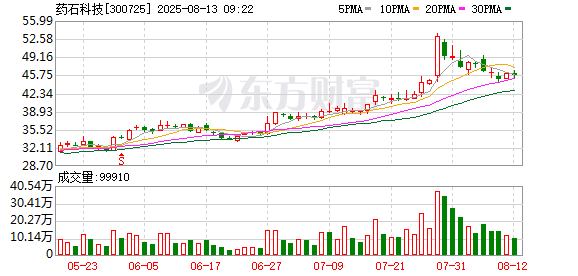
药石科技(300725):后端CDMO业务增长亮眼,盈利能力有望开始边际改善
Xinda Securities· 2025-08-13 01:02
Investment Rating - The report assigns a "Buy" rating for the stock of the company, indicating a strong performance relative to the benchmark index [14]. Core Insights - The company's revenue for H1 2025 reached 920 million yuan, a year-on-year increase of 23.48%, while the net profit attributable to the parent company was 72 million yuan, a decline of 26.54% [1]. - The overall gross margin for H1 2025 was 31.05%, down 9.82 percentage points year-on-year, primarily due to downward pressure on order prices and depreciation from new capacity [2]. - The CDMO (Contract Development and Manufacturing Organization) business showed significant growth, with revenue increasing by 60.92% year-on-year to 548 million yuan in H1 2025 [3]. - Domestic demand is beginning to recover, with revenue from Chinese clients growing by 25.00% to 261 million yuan in H1 2025 [4][5]. - The company is strategically expanding into high-growth areas such as targeted protein degradation drugs, peptides, and ADC (Antibody-Drug Conjugates) [6]. Financial Summary - The company is projected to achieve total revenue of 1.987 billion yuan in 2025, with a year-on-year growth rate of 17.6% [7]. - The estimated net profit attributable to the parent company for 2025 is 177 million yuan, reflecting a year-on-year decline of 19.5% [8]. - The gross margin is expected to be 33.4% in 2025, down from 42.5% in 2023 [7].
生物医药行业创新药动态更新:肺癌ADC药物:TROP2、EGFR×HER3、EGFR、PD-L1 ADC在NSCLC疗效突出,DLL3 ADC在SCLCORR优秀
Shanxi Securities· 2025-08-05 08:44
Investment Rating - The report maintains a rating of "B" for the biopharmaceutical industry, indicating expected volatility greater than the benchmark index [1]. Core Insights - The biopharmaceutical industry has shown significant market performance over the past year, with innovative drug developments, particularly in the area of ADCs (Antibody-Drug Conjugates) for lung cancer treatment [1]. - PD-1/L1 combined with ADCs is expected to overcome resistance and improve overall response rates (ORR), with promising results from various clinical trials [3][4]. - The report highlights specific drugs such as sac-TMT, HLX43, and SYS6010, which have demonstrated significant efficacy and tolerability in treating NSCLC and SCLC [3][5]. Summary by Sections Market Performance - The biopharmaceutical industry has outperformed the market, driven by advancements in innovative therapies [1]. Clinical Trials and Efficacy - In first-line treatment for non-squamous NSCLC, sac-TMT combined with PD-L1 showed an ORR of 59.3% and a median progression-free survival (mPFS) of 15.0 months, compared to 9-10 months for chemotherapy combined with PD-1 [4]. - In second-line EGFR wild-type NSCLC, the ORR for the drug iza-bren was 50.0%, while SYS6010 achieved an ORR of 88.9% in previously treated EGFR-mutant NSCLC [5]. Drug Tolerability - The report notes that the common grade 3 or higher treatment-related adverse events (TRAE) for the mentioned drugs were primarily hematological toxicities, with specific rates of treatment discontinuation due to TRAE being 2.4% for iza-bren [3][5].
科伦博泰20250720
2025-07-21 14:26
Summary of Key Points from the Conference Call Company Overview - **Company**: 科伦博泰 (Kalon Biotech) - **Industry**: Biopharmaceuticals, specifically focusing on Antibody-Drug Conjugates (ADCs) and small molecules Core Insights and Arguments - **Technology Platforms**: The company has developed approximately 20 drug candidates, including 11 ADCs, leveraging its ADC and small molecule technology platforms, highlighting its platform value through collaborations exceeding $10 billion with partners like Merck [2][3] - **Commercialization Progress**: The commercialization of SKB264 has accelerated, with approvals in China for second-line triple-negative breast cancer and third-line EGFR mutation lung cancer. The product is expected to generate revenues of CNY 1.78 billion, CNY 3.56 billion, and CNY 5.89 billion from 2025 to 2027 [2][4] - **Clinical Trials**: Merck has initiated 14 global registration clinical trials for SKB264, covering various tumor indications, which demonstrates the product's potential in the international market [6][10] Product Pipeline and Market Potential - **SKB264 Performance**: In clinical trials, SKB264 showed a median progression-free survival (PFS) of 6.7 months in triple-negative breast cancer and 11.1 months in hormone receptor-positive, HER2-negative breast cancer, indicating strong efficacy [12] - **HER2 ADC Product**: The HER2 ADC product, 博度曲妥珠单抗, is expected to be approved for third-line HER2-positive breast cancer, with an overall response rate (ORR) of 43.9% and a median PFS of 12.3 months, targeting a market of 8,201 patients who are resistant or price-sensitive [14] - **Other Pipeline Products**: The company is also developing a PDL1 monoclonal antibody for nasopharyngeal carcinoma and a RET inhibitor for later-line lung cancer, which has an ORR of 80%, showcasing competitive advantages [15] Management and Ownership Structure - **Management Team**: Led by founder Liu Gexin, with a team experienced in international pharmaceutical companies, including roles in quality management and clinical development [8] - **Ownership**: As of December 31, 2024, the controlling shareholder is 科伦药业 (Kalon Pharmaceutical) with a 54.28% stake, while Merck holds 10.23% [8] Collaborations and Strategic Partnerships - **Partnerships**: In addition to Merck, the company has expanded collaborations with other international firms, including Elifes and One World Bio, indicating a strategy to leverage its platform value [9] Market Valuation and Investment Potential - **Market Capitalization**: The estimated market capitalization of the company is approximately CNY 120 billion, primarily driven by SKB264 and other commercialized products, positioning it as a significant investment opportunity in the ADC sector [16]
海正药业20250720
2025-07-21 00:32
Summary of Key Points from the Conference Call Company and Industry Overview - **Company**: 海正药业 (Haizheng Pharmaceutical) and 博瑞生物 (Borui Biopharmaceutical) - **Industry**: Pharmaceutical and Biotechnology Core Insights and Arguments Haizheng Pharmaceutical 1. **Transformation and Innovation**: Haizheng is actively transforming by enhancing its innovative drug pipeline through internal R&D and external collaborations, focusing on products like HS387 and Haibo Maibu tablets, which saw a 100% annual sales growth after entering the medical insurance system [2][3] 2. **Leadership Changes**: The new leadership under CEO Xiao has brought significant changes, improving operational efficiency and achieving record high net profits [8][9] 3. **Product Strategy**: The company is implementing a "big product" strategy, aiming for substantial sales from key products, including Haibo Maibu, projected to reach sales of 800 to 1,000 million [9] Borui Biopharmaceutical 1. **Growth Since Spin-off**: Since its spin-off in 2019, Borui has expanded its commercial product line from 1 to 7.5 products, with revenue increasing from 200 million to 1.63 billion, reflecting a compound annual growth rate of approximately 35% [2][5] 2. **Innovative Drug Development**: Borui has made significant strides in innovative drugs, including the launch of Anruixin (Zebetomab), the first Class 1 innovative drug in China, and is focusing on autoimmune and tumor immunity fields [6][7] 3. **ADC Platform**: Borui's unique approach in the ADC (Antibody-Drug Conjugate) platform, utilizing dual payload toxins and stable linker technology, enhances efficacy and reduces toxicity, positioning it competitively in the market [12][13] Additional Important Insights 1. **Market Expansion**: Borui is exploring the pet economy and has established a leading position in veterinary medicine, while also expanding into medical aesthetics and e-commerce channels [10][9] 2. **Future Revenue Goals**: Borui aims to achieve over 7.5 billion in revenue by 2029-2030, with expectations of significant contributions from various product lines [27][28] 3. **IPO Plans**: Borui is actively pursuing an IPO on the Sci-Tech Innovation Board, with a pre-IPO valuation of 13 billion as of late 2022, and is expected to meet listing conditions by June 2023 [29][22] This summary encapsulates the key developments and strategic directions of Haizheng Pharmaceutical and Borui Biopharmaceutical, highlighting their growth trajectories, innovative strategies, and market positioning within the pharmaceutical industry.


两名“60后”海归女博士携手创业 20亿美元合作告吹,百力司康IPO前夕卫材为何撤退?
Mei Ri Jing Ji Xin Wen· 2025-07-10 09:25
Core Viewpoint - BlissBio Inc. is facing increased uncertainty regarding the global development and commercialization of its core drug BB-1701 after terminating its collaboration with Eisai, which was previously a significant partner in the drug's development [1][7][10]. Group 1: Collaboration with Eisai - Two years ago, BlissBio signed a business development agreement with Eisai worth up to $2 billion for the ADC candidate BB-1701 [2][3]. - In April 2023, a strategic clinical trial collaboration agreement was reached, allowing Eisai to retain rights for global development and commercialization outside Greater China [2][7]. - The collaboration has been pivotal for BlissBio, with Eisai being a major investor and shareholder, contributing significantly to the company's funding rounds [5][6]. Group 2: Clinical Trial Data - Recent clinical trial data revealed that Eisai's trial showed an objective response rate (ORR) of only 14.3%, while BlissBio's own trial reported an ORR of 21.4% [8][9]. - The disparity in trial results may have influenced Eisai's decision to terminate the collaboration, as the lower efficacy data did not demonstrate a competitive advantage [9][10]. Group 3: Financial Implications - The termination of the collaboration is expected to severely impact BlissBio's financial situation, with projected revenue from Eisai dropping by 87.65% in 2024 [10]. - The company's net loss is anticipated to widen significantly due to high R&D expenditures and the impact of redemption liabilities from previous funding agreements [10]. - BlissBio's ability to raise funds through its upcoming IPO is uncertain, as it now must independently manage the development and commercialization of BB-1701 [10].

创新药中期策略:加速全球化
2025-07-07 16:32
Summary of Key Points from Conference Call Records Industry Overview - The Chinese innovative pharmaceutical industry is experiencing a breakthrough in global competitiveness, with the Hong Kong innovative drug index valuation returning to historical median levels, although companies like Innovent and CanSino still have market values significantly lower than international peers, indicating substantial growth potential [1][2][3] - The proportion of clinical trials conducted by Chinese innovative drug companies globally is rapidly increasing, expected to reach 30% by 2024, with the number of new active substances approved surpassing Japan, showcasing enhanced R&D capabilities [1][4] Market Dynamics - The license-out transaction volume for Chinese innovative drugs has significantly increased, with upfront payments totaling $3.3 billion and total transaction amounts reaching $48 billion in the first half of 2025, with Chinese projects accounting for 42% of U.S. collaboration projects [1][4] - Multinational pharmaceutical companies (MNCs) are under pressure from patent cliffs and are keen to collaborate with Chinese companies, particularly in oncology, immunology, and metabolism sectors [1][5] Company-Specific Insights - Major Chinese companies like BeiGene and Innovent are expected to achieve profitability, with their market valuations currently low compared to their sales potential, which could reach billions of dollars [2][3] - The ADC (Antibody-Drug Conjugate) market is rapidly growing, with domestic ADC assets showing excellent potential, as multiple companies are launching new drugs targeting different indications [2][15] Future Outlook - A number of Chinese innovative drug companies are projected to enter the global top 30 within the next few years, with domestic sales currently at 11%, significantly lower than the U.S. market's 79% [3] - The innovative drug industry in China is entering a new development cycle driven by policy support, technological breakthroughs, and accelerated internationalization [2][24] Investment Opportunities - Investment focus should be on companies driven by overseas sales, those with significant upcoming data readouts, and those with potential blockbuster expectations [2][26] - The global ADC market is expected to grow from over $10 billion in 2023 to nearly $13 billion in 2024, with significant potential for replacing existing therapies [15] Additional Insights - The competitive landscape in the metabolism sector is evolving, with Chinese companies transitioning from followers to leaders due to their speed and chemical advantages [14] - Companies like Innovent and CanSino are making strides in the dual antibody and GLP-1 weight loss fields, with promising data emerging from their clinical trials [13][14] Conclusion - The Chinese innovative drug sector is poised for significant growth, driven by increasing global competitiveness, supportive policies, and a strong pipeline of innovative products. Investors are encouraged to focus on companies with strong international collaboration potential and those that are well-positioned to capitalize on emerging market trends [2][24][26]