
人民币汇率

Search documents
人民币市场汇价(11月11日)
Xin Hua She· 2025-11-11 03:11
新华社北京11月11日电 中国外汇交易中心11月11日受权公布人民币对美元、欧元、日元、港元、 英镑、澳元、新西兰元、新加坡元、瑞士法郎、加元、澳门元、林吉特、卢布、兰特、韩元、迪拉姆、 里亚尔、福林、兹罗提、丹麦克朗、瑞典克朗、挪威克朗、里拉、墨西哥比索及泰铢的市场汇价。 11月11日人民币汇率中间价如下: 100美元 708.66人民币 100欧元 819.86人民币 100日元 4.6064人民币 100港元 91.16人民币 100人民币 58.597马来西亚林吉特 100英镑 934.65人民币 100澳元 463.71人民币 100新西兰元 401.01人民币 100新加坡元 544.68人民币 100瑞士法郎 880.91人民币 100加元 506.07人民币 100人民币 113.07澳门元 100人民币 1142.09俄罗斯卢布 100人民币 241.87南非兰特 100人民币 20522韩元 100人民币 51.741阿联酋迪拉姆 100人民币 52.839沙特里亚尔 100人民币 4675.18匈牙利福林 100人民币 51.613波兰兹罗提 100人民币 91.09丹麦克朗 100人民 ...
11月11日人民币兑美元中间价下调10个基点
Sou Hu Cai Jing· 2025-11-11 02:43
Core Points - The central bank of China has lowered the RMB to USD midpoint rate by 10 basis points, now at 7.0866 [1] - The People's Bank of China has authorized the foreign exchange trading center to publish the exchange rates for various currencies against the RMB, indicating a comprehensive update on the currency's performance [2] Exchange Rate Summary - 1 USD = 7.0866 RMB [2] - 1 EUR = 8.1986 RMB [2] - 100 JPY = 4.6064 RMB [2] - 1 HKD = 0.91160 RMB [2] - 1 GBP = 9.3465 RMB [2] - 1 AUD = 4.6371 RMB [2] - 1 NZD = 4.0101 RMB [2] - 1 SGD = 5.4468 RMB [2] - 1 CHF = 8.8091 RMB [2] - 1 CAD = 5.0607 RMB [2] - 1 MOP = 1.1307 RMB [2] - 1 MYR = 0.58597 RMB [2] - 1 RUB = 11.4209 RMB [2] - 1 ZAR = 2.4187 RMB [2] - 1 KRW = 205.22 RMB [2] - 1 AED = 0.51741 RMB [2] - 1 SAR = 0.52839 RMB [2] - 1 HUF = 46.7518 RMB [2] - 1 PLN = 0.51613 RMB [2] - 1 DKK = 0.9109 RMB [2] - 1 SEK = 1.3408 RMB [2] - 1 NOK = 1.4273 RMB [2] - 1 TRY = 5.94738 RMB [2] - 1 MXN = 2.5908 RMB [2] - 1 THB = 4.5511 RMB [2]
人民币对美元中间价报7.0866 调贬10个基点
Zhong Guo Jing Ji Wang· 2025-11-11 01:49
中国人民银行授权中国外汇交易中心公布,2025年11月11日银行间外汇市场人民币汇率中间价为: 1美元对人民币7.0866元,1欧元对人民币8.1986元,100日元对人民币4.6064元,1港元对人民币0.91160 元,1英镑对人民币9.3465元,1澳大利亚元对人民币4.6371元,1新西兰元对人民币4.0101元,1新加坡 元对人民币5.4468元,1瑞士法郎对人民币8.8091元,1加拿大元对人民币5.0607元,人民币1元对1.1307 澳门元,人民币1元对0.58597马来西亚林吉特,人民币1元对11.4209俄罗斯卢布,人民币1元对2.4187南 非兰特,人民币1元对205.22韩元,人民币1元对0.51741阿联酋迪拉姆,人民币1元对0.52839沙特里亚 尔,人民币1元对46.7518匈牙利福林,人民币1元对0.51613波兰兹罗提,人民币1元对0.9109丹麦克朗, 人民币1元对1.3408瑞典克朗,人民币1元对1.4273挪威克朗,人民币1元对5.94738土耳其里拉,人民币1 元对2.5908墨西哥比索,人民币1元对4.5511泰铢。 中国经济网北京11月11日讯 今日,人民币对美元 ...
避险情绪减弱,贵金属中期或分化
Ning Zheng Qi Huo· 2025-11-10 11:53
Group 1: Report Industry Investment Rating - Not provided Group 2: Core Viewpoints of the Report - After the meeting between Chinese and US leaders in Busan, the contradiction in the Sino-US trade field has been paused, and the economic risk aversion sentiment has slightly eased. The mid-term trends of gold and silver may diverge, with gold potentially oscillating at a high level and silver possibly having a catch-up rally [2][9][26] - The US government is still in a shutdown, making it difficult to obtain the latest economic data. The Fed's disagreement on a December interest rate cut has increased, adding uncertainty to the future interest rate cut rhythm and bringing volatility factors to the precious metal market [3][14] - The offshore RMB exchange rate mainly follows the US dollar index passively. Although the RMB has recently faced increased depreciation pressure, the trend of moderate appreciation remains unchanged. Currently, the exchange rate issue has not had a significant impact on the gold market [3] Group 3: Summary by Relevant Catalogs Chapter 1: Market Review - After the meeting between Chinese and US leaders, trade negotiations have slightly eased, and risk aversion sentiment has weakened. The market is currently pricing in two 25-basis-point interest rate cuts by the Fed this year. Gold and silver may rise again under the expectation of consecutive Fed interest rate cuts, but whether their trends will diverge needs continuous attention [9] Chapter 2: Overview of Important News - The US government shutdown has a greater-than-expected impact on the US economy, causing long-term damage to the government's efficient operation and slowing down Q4 GDP growth. The tourism and leisure industry is being hit hard [12] - China's Ministry of Commerce and General Administration of Customs announced the suspension of multiple export control measures from now until November 10, 2026, and the resumption of the soybean export qualification of three US enterprises and the import of US logs starting from November 10 [12] - Some Fed officials are worried about further interest rate cuts due to high inflation levels and the lack of key price data caused by the government shutdown [14] Chapter 3: Analysis of Important Influencing Factors 3.1 US Economy and Policy - Due to the US government shutdown, it is difficult to track the US economy. The preliminary values of the US manufacturing, service, and composite PMIs in October all rebounded from September and were better than expected. The market has fully priced in two 25-basis-point interest rate cuts by the Fed for the rest of the year [15] 3.2 International Economy and Geopolitics - Chinese and US leaders held a meeting, and both sides reached a consensus on important economic and trade issues. The EU listed Chinese enterprises in its 19th round of sanctions against Russia, and China urged the EU to stop this action [18] 3.3 Other Financial Markets - The US manufacturing, service, and composite PMIs in October all rebounded and were better than expected. OPEC+ agreed to increase production by 137,000 barrels per day in December and suspend production increases in Q1 next year. Crude oil prices rebounded, and copper prices rose due to supply shortages and Fed interest rate cut expectations [19] 3.4 RMB Exchange Rate - The RMB exchange rate mainly follows the US dollar index passively. The long-term weakening trend of the US dollar supports precious metals. The RMB is in a slow appreciation trend, and its impact on the gold market is limited [23] Chapter 4: Market Outlook and Investment Strategy - After the meeting between Chinese and US leaders, the Sino-US trade conflict has been paused, and risk aversion sentiment has eased. After COMEX gold reached a high of 4398, precious metals have corrected significantly. In the mid-term, the trends of gold and silver may diverge, with gold potentially oscillating at a high level and silver possibly having a catch-up rally [26]
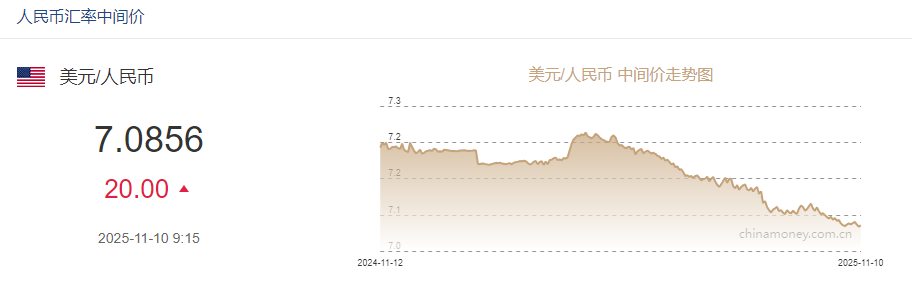
11月10日人民币对美元中间价报7.0856元 下调20个基点
Zhong Guo Xin Wen Wang· 2025-11-10 07:02
11月10日人民币对美元中间价报7.0856元 下调20个基点 中新网11月10日电 据中国外汇交易中心网站消息,中国人民银行授权中国外汇交易中心公布,2025年11月10日银行间外汇市场人 民币汇率中间价为:1美元对人民币7.0856元,下调20个基点。 图源:中国外汇交易中心网站截图 编辑:付健青 广告等商务合作,请点击这里 本文为转载内容,授权事宜请联系原著作权人 中新经纬版权所有,未经书面授权,任何单位及个人不得转载、摘编或以其它方式使用。 关注中新经纬微信公众号(微信搜索"中新经纬"或"jwview"),看更多精彩财经资讯。 来源:中国新闻网 ...

人民币市场汇价(11月10日)
Sou Hu Cai Jing· 2025-11-10 02:25
100美元 708.56人民币 100欧元 819.42人民币 100日元 4.6151人民币 100港元 91.113人民币 100英镑 932.87人民币 100澳元 461.37人民币 100新西兰元 399.66人民币 100新加坡元 544.76人民币 100瑞士法郎 879.27人民币 100加元 505.41人民币 100人民币113.11澳门元 100人民币58.795马来西亚林吉特 100人民币1136.82俄罗斯卢布 100人民币244.12南非兰特 100人民币20487韩元 100人民币51.747阿联酋迪拉姆 100人民币52.834沙特里亚尔 100人民币4694.06匈牙利福林 100人民币51.727波兰兹罗提 100人民币91.14丹麦克朗 100人民币134.42瑞典克朗 100人民币143.25挪威克朗 100人民币594.806土耳其里拉 100人民币260.0墨西哥比索 100人民币455.73泰铢(完) 新华社北京11月10日电 中国外汇交易中心11月10日受权公布人民币对美元、欧元、日元、港元、英 镑、澳元、新西兰元、新加坡元、瑞士法郎、加元、澳门元、林吉特、卢布 ...
11月10日人民币兑美元中间价下调20个基点
Sou Hu Cai Jing· 2025-11-10 02:07
中国人民银行授权中国外汇交易中心公布,2025年11月10日银行间外汇市场人民币汇率中间价为:1美 元对人民币7.0856元,1欧元对人民币8.1942元,100日元对人民币4.6151元,1港元对人民币0.91113元, 1英镑对人民币9.3287元,1澳大利亚元对人民币4.6137元,1新西兰元对人民币3.9966元,1新加坡元对 人民币5.4476元,1瑞士法郎对人民币8.7927元,1加拿大元对人民币5.0541元,人民币1元对1.1311澳门 元,人民币1元对0.58795马来西亚林吉特,人民币1元对11.3682俄罗斯卢布,人民币1元对2.4412南非兰 特,人民币1元对204.87韩元,人民币1元对0.51747阿联酋迪拉姆,人民币1元对0.52834沙特里亚尔,人 民币1元对46.9406匈牙利福林,人民币1元对0.51727波兰兹罗提,人民币1元对0.9114丹麦克朗,人民币 1元对1.3442瑞典克朗,人民币1元对1.4325挪威克朗,人民币1元对5.94806土耳其里拉,人民币1元对 2.6000墨西哥比索,人民币1元对4.5573泰铢。 11月10日,人民币兑美元中间价下调20个基点, ...
人民币中间价调贬20基点报7.0856
Sou Hu Cai Jing· 2025-11-10 02:07
同日,在岸人民币、离岸人民币对美元汇率盘中小幅升值。截至当日9时35分,在岸人民币对美元报 7.1181,日内升值幅度为0.06%;离岸人民币对美元报7.1217,日内升值幅度为0.05%。 北京商报讯(记者 廖蒙)11月10日,中国人民银行授权中国外汇交易中心公布,当日银行间外汇市场 人民币汇率中间价为1美元对人民币7.0856元,相较前一交易日中间价7.0836元,调贬20基点。 ...
滚动更新丨A股三大指数集体高开,锂电池、氟化工等板块走强
Di Yi Cai Jing· 2025-11-10 01:32
Group 1 - The A-share market opened with all three major indices rising, with the Shanghai Composite Index up by 0.11%, the Shenzhen Component Index up by 0.37%, and the ChiNext Index up by 0.43% [2][3] - Key sectors showing strength include lithium batteries, fluorine chemicals, memory storage, satellite navigation, phosphorus chemicals, and photovoltaic concepts, while sectors such as ice and snow tourism, nuclear fusion, reducers, and innovative pharmaceuticals are weakening [1][3] - The Hang Seng Index opened up by 0.3%, and the Hang Seng Technology Index rose by 0.36%, with similar trends observed in the lithium battery and photovoltaic sectors [4][5] Group 2 - The central bank conducted a 7-day reverse repurchase operation of 119.9 billion yuan at an interest rate of 1.40%, with 78.3 billion yuan reverse repos maturing today [5] - The onshore RMB against the US dollar was set at 7.0856, depreciating by 20 basis points from the previous trading day's midpoint of 7.0836 [5]

人民币对美元中间价报7.0856 调贬20个基点
Zhong Guo Jing Ji Wang· 2025-11-10 01:32
中国经济网北京11月10日讯 今日,人民币对美元汇率中间价报7.0856,较前一交易日调贬20个基 点。 (责任编辑:韩艺嘉) 中国人民银行授权中国外汇交易中心公布,2025年11月10日银行间外汇市场人民币汇率中间价为: 1美元对人民币7.0856元,1欧元对人民币8.1942元,100日元对人民币4.6151元,1港元对人民币0.91113 元,1英镑对人民币9.3287元,1澳大利亚元对人民币4.6137元,1新西兰元对人民币3.9966元,1新加坡 元对人民币5.4476元,1瑞士法郎对人民币8.7927元,1加拿大元对人民币5.0541元,人民币1元对1.1311 澳门元,人民币1元对0.58795马来西亚林吉特,人民币1元对11.3682俄罗斯卢布,人民币1元对2.4412南 非兰特,人民币1元对204.87韩元,人民币1元对0.51747阿联酋迪拉姆,人民币1元对0.52834沙特里亚 尔,人民币1元对46.9406匈牙利福林,人民币1元对0.51727波兰兹罗提,人民币1元对0.9114丹麦克朗, 人民币1元对1.3442瑞典克朗,人民币1元对1.4325挪威克朗,人民币1元对5.94806土 ...