业绩比较基准新规

Search documents
业绩比较基准新规落地,比较及影响
Huachuang Securities· 2026-01-29 02:50
Report Industry Investment Rating No information about the report industry investment rating is provided in the content. Core Viewpoints of the Report - The new regulations on performance comparison benchmarks drive the transformation of bond funds from "reference indicators" to "rigid constraints", leading to a standardized transformation of bond funds [7]. - The core orientation of benchmark adjustment is to "precisely match the underlying assets" rather than lower the return requirements. Since May 2025, the adjustment of bond fund benchmarks has shown the characteristics of "index refinement and element diversification", which essentially strengthens the representativeness of the benchmark [7]. - There is a significant differentiation in the ability of fund managers to achieve excess returns. Bond funds need to be vigilant against the risk of strategy - benchmark mismatch. In the past three years, 37% of bond funds have not outperformed the benchmark. Under the constraints of the new regulations, past mismatched strategies will be gradually rectified to avoid significant negative deviations during the bond market adjustment period [7]. - With the buffer of the transition period, the market impact is "gradual and structural". The regulatory authorities have set a one - year transition period, and funds will orderly promote benchmark revision and strategy adjustment, which will not cause systematic portfolio adjustment shocks. Attention should be focused on structural opportunities [7]. Summary According to the Directory 1. Performance Comparison Benchmark Formal Draft vs. Solicitation Draft (1) Performance Comparison Benchmark Guidelines - The "Guidelines" define regulatory red lines and core principles, including clarifying the selection criteria for benchmarks, strictly regulating benchmark changes, strengthening information disclosure of benchmarks, enhancing the binding effect of benchmarks, and highlighting the role of benchmarks in measuring performance [2][10]. - Compared with the solicitation draft, the formal draft focuses more on the "representativeness" of the performance comparison benchmark in terms of investment goals and styles, and further clarifies the content of "major adjustments" for benchmark changes. It also adds requirements for fund performance disclosure by fund evaluation institutions and expands the scope of responsible entities [10][11]. (2) Performance Comparison Benchmark Operation Rules - The "Operation Rules" are supporting practical documents for the "Guidelines", with three key points regarding the performance comparison benchmarks of bond funds: benchmark matching, benchmark information disclosure, and benchmark tracking. If there is a deviation between the fund performance and the benchmark, the fund manager needs to explain the difference, establish a risk - control model, and a sound internal accountability mechanism [3][14][15]. 2. Overview of Bond Fund Performance Comparison Benchmarks (1) Main Types of Bond Fund Performance Comparison Benchmarks - The performance comparison benchmarks of bond funds can be roughly classified into six categories: single bond index, bond index + benchmark interest rate, bond index + equity index, convertible bond index + bond/stock index, segmented target index, and composite benchmark index [3][18]. (2) Adjustment of Bond Fund Performance Comparison Benchmarks since May 2025 - Since the release of the "Action Plan" in May 2025, 23 bond - type funds have adjusted their performance comparison benchmarks. The adjustments mainly include more refined benchmark indexes to match the underlying asset allocation and the introduction of diversified factors such as current or fixed - deposit interest rates. The core purpose of the adjustment is to correct the previous benchmark indexes and make them more in line with the investment style and positioning of the products [4][22]. (3) Ability of Various Funds to Outperform the Benchmark Performance from a Historical Perspective - In the past three years, the proportion of funds that failed to outperform the benchmark index from high to low is: hybrid funds (56%) > bond funds (37%) > stock funds (23%). Most bond funds' excess returns are concentrated within ±5 percentage points. Passive index bond funds can usually effectively control tracking errors, and short - term bond funds are relatively more stable [4][26]. 3. Impact of the New Performance Comparison Benchmark Regulations on Bond Investment - Although the new regulations on performance comparison benchmarks are relatively mild in the details regarding bond funds, they may still impose constraints on bond investment. Fund managers are expected to make targeted adjustments in terms of benchmark setting and investment strategies. They will optimize benchmark indexes according to product styles and underlying assets and adjust the previous aggressive operations during the bond bull market. Considering the one - year transition period set by the regulatory authorities, the impact on the market will be gradual and structural [4][44].
从形式参考转变为投资“硬约束” 业绩比较基准新规改变公募生态
Shang Hai Zheng Quan Bao· 2026-01-26 19:16
Core Viewpoint - The recent release of the "Guidelines for Performance Benchmarking of Publicly Offered Securities Investment Funds" marks a significant shift in the public fund industry, transitioning performance benchmarks from mere references to "hard constraints" that enhance clarity in fund product profiles and promote a shift from a "scale-oriented" approach to one focused on "investor returns" [2][3] Group 1: Regulatory Changes - The new guidelines are the first specialized and systematic regulations for performance benchmarks, aiming to standardize industry behavior and enhance investment discipline, thereby supporting the high-quality development of public funds [3][4] - The guidelines emphasize the importance of selecting performance benchmarks that prioritize the interests of fund shareholders, ensuring they are representative, objective, sustainable, and constraining [5][6] Group 2: Industry Trends - Since 2025, over a hundred funds have changed their performance benchmarks, with a notable trend towards more precise representations of investment styles and strategies, moving away from a model that relied on benchmark deviations for returns [4][6] - The guidelines are expected to lead to a more transparent and stable fund market, better aligning with the wealth management needs of residents and enhancing investor trust [3][4] Group 3: Performance Evaluation and Incentives - Fund managers are required to establish a performance evaluation and compensation system centered on fund investment returns, which should reflect the performance of the fund products and the gains or losses of investors [7][8] - The integration of performance benchmarks into the performance evaluation system is anticipated to reshape the incentive mechanisms in the public fund industry, aligning fund managers' economic interests with the long-term creation of sustainable excess returns for investors [7][8] Group 4: Implementation Challenges - Despite the positive outlook, challenges remain in the implementation of these guidelines, particularly regarding funds that focus on narrow sectors, which may have performance benchmarks that do not accurately reflect their investment focus [8][9] - The industry faces a critical test in overcoming the temptation of short-term profits while effectively implementing the optimized assessment mechanisms to move away from a scale-oriented approach [9]


美联储将于1月29日公布利率决议
Sou Hu Cai Jing· 2026-01-25 13:33
Group 1: Monetary Policy and Economic Indicators - The Federal Reserve is expected to pause interest rate cuts during its upcoming meeting, with a 95.6% probability of maintaining current rates and only a 4.4% chance of a 25 basis point cut [1] - Beijing's economic development goals for 2026 include a GDP growth target of around 5%, a public budget revenue increase of about 4%, and a control of the urban unemployment rate within 5% [2] - Shandong Province's GDP surpassed 10 trillion yuan, reaching 10,319.7 billion yuan in 2025, marking a 5.5% increase from the previous year [3] Group 2: Financial Regulations and Market Developments - The China Securities Regulatory Commission (CSRC) has released new guidelines for public fund performance benchmarks, establishing a one-year transition period to minimize market impact [4] - The CSRC has expanded the range of futures and options available for domestic trading, adding 14 new products to attract foreign investors [5] - The CSRC imposed a record fine of over 28 million yuan on Zhejiang Ruifengda Asset Management Co., reflecting a zero-tolerance policy towards serious violations in the private fund sector [6] Group 3: Market Movements and Corporate Actions - Samsung Electronics has raised the price of NAND flash memory by over 100% in the first quarter, highlighting a significant supply-demand imbalance in the semiconductor market [9] - Two companies, Fenglong Co. and Jiamei Packaging, have announced stock suspensions for review due to significant price increases of 405.74% and 408.11%, respectively, indicating potential trading risks [10] - Zhongke Aerospace has completed its IPO counseling, marking progress in the commercial rocket sector [11] Group 4: Consumer Products and Promotions - Apple has launched a limited-time discount event on various products, including the iPhone 16 series and MacBook, with savings of up to 1,000 yuan on select items [12]
金融行业周报(2026、01、25):业绩比较基准新规正式落地,坚定保险中长期向好逻辑-20260125
Western Securities· 2026-01-25 10:30
Investment Rating - The report maintains a positive long-term outlook for the insurance sector, indicating a strong continuity in market performance despite recent fluctuations [2][12][16]. Core Insights - The financial sector experienced a mixed performance this week, with the non-bank financial index down by 1.45%, underperforming the CSI 300 index by 0.83 percentage points. The insurance sector saw a decline of 4.02%, while the brokerage sector decreased by 0.61% [1][10]. - The insurance sector's performance is driven by two main factors: policy support leading to economic recovery and liquidity easing combined with a strong stock market. The report suggests a shift from liquidity-driven growth to a focus on macro policy support and economic recovery expectations [2][13][16]. - The brokerage sector is expected to benefit from new regulations that enhance investment management quality, with a recommendation to focus on larger, undervalued firms and those involved in mergers and acquisitions [3][18]. - The banking sector is facing a slight decline, but there are signs of recovery in profitability for leading banks, with recommendations to focus on banks with high dividend yields and those expected to benefit from market conditions [19][21]. Summary by Sections Insurance Sector - The insurance sector's recent decline is attributed to short-term market sentiment and liquidity changes, but the long-term outlook remains positive due to strong support from both the liability and asset sides [2][12][16]. - Key recommendations include focusing on companies like China Pacific Insurance, China Ping An, China Life (H), and China Taiping, with a specific recommendation for New China Life [4][16]. Brokerage Sector - The brokerage sector's performance is slightly better than the overall market, with a focus on the new guidelines from the regulatory body that aim to improve fund management quality [3][17]. - Recommended firms include Guotai Junan, Huatai Securities, and others, particularly those with strong merger and acquisition prospects [4][18]. Banking Sector - The banking sector has shown a decline but is expected to stabilize, with recommendations to focus on banks with high earnings elasticity and strong dividend yields [19][21]. - Specific banks to watch include Hangzhou Bank, Ningbo Bank, and others, with a focus on those that have previously been undervalued [4][21].




业绩比较基准新规发布公募基金迎来投资之“锚”
Shang Hai Zheng Quan Bao· 2026-01-23 18:12
Core Viewpoint - The new regulations aim to enhance the role of performance benchmarks in fund management, ensuring accountability and transparency in investment practices. Group 1: Performance Benchmark Management - The new guidelines require fund managers to establish a comprehensive control mechanism covering the selection, disclosure, monitoring, correction, and accountability of performance benchmarks [1] - Decision-making regarding benchmark selection must be elevated to the management level, with the management team bearing primary responsibility for the chosen benchmarks [1] - Internal supervision will be strengthened, with independent departments monitoring deviations from benchmarks and investment decision committees providing oversight [1] Group 2: Performance Assessment and Compensation - Fund managers are required to create a performance assessment system centered on fund investment returns, linking compensation to fund performance and investor outcomes [2] - If a fund's long-term performance significantly lags behind its benchmark, the performance compensation for the relevant fund manager should decrease substantially [2] - The evaluation and award mechanisms for funds will be standardized, shifting away from market ranking to incorporate benchmarks as a key criterion for assessing fund management [2] Group 3: External Supervision and Disclosure - The new regulations enhance external supervision by requiring custodians to fulfill their responsibilities in reviewing fund contracts, monitoring investment styles, and verifying information disclosures [3] - Fund managers and sales institutions must display benchmark performance alongside fund performance during sales presentations, aiding investors in making informed comparisons [3] - Information disclosure requirements have been standardized to improve transparency regarding performance benchmarks in fund contracts and periodic reports [3]
中金:主动权益基金超额收益的“纵”与“横”
Xin Lang Cai Jing· 2025-12-18 00:02
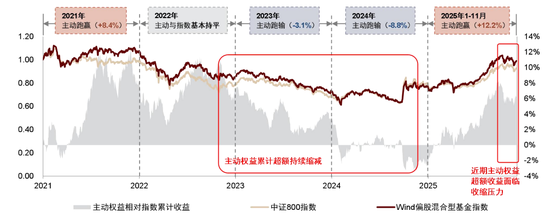
Core Insights - The active equity funds have shown significant outperformance compared to index products in 2025, achieving a return of +29.2% against the index's +17.0%, resulting in an excess return of over 12 percentage points [1][5][7] - Despite the positive performance, there are concerns regarding the sustainability of this outperformance as the market enters a volatile phase and new regulations are introduced [1][5][7] Vertical Analysis: Timing Predictions for Active Equity Outperformance - Six indicators have been identified to predict the excess return of active equity funds, including tracking error differentiation (TE-S) and tracking error concentration (HHI), which indicate stronger pricing power and potential for excess returns when concentrated [1][10][13] - A short-term timing model using TE-MDQ, MMT, and VIX has shown a 69% success rate in predicting active equity outperformance for Q4 2025, with an expected outperformance of 2.33% [2][24] - A long-term model using AMT and TE-S predicts underperformance for the period Q4 2025 to Q3 2026, with an expected shortfall of -6.49% [2][27] Horizontal Analysis: Fund Selection Using Excess Return Information - Two effective selection factors for predicting future performance of active equity funds have been identified: Long-term Information Ratio (INFO_LONG) and Tracking Error Change Level (TRACK_D) [1][31] - A composite indicator combining these factors has been developed for fund selection, showing improved predictive power and a backtested annualized return of 11.1% from Q1 2016 to Q3 2025, outperforming the benchmark [3][40][41]