中东地缘政治局势

Search documents
原油成品油早报-20260327
Yong An Qi Huo· 2026-03-27 11:12
Group 1: Report Industry Investment Rating - No information provided Group 2: Core View of the Report - This week, oil prices continued to rise. The traffic volume in the Strait of Hormuz remained low, with only 3 tankers passing through on March 18 and no crude oil tankers. The average daily tanker traffic in the past week was less than 2 vessels, resulting in a de facto paralysis of navigation. Trump threatened to attack and destroy various power plants in Iran if it did not restore the Strait of Hormuz passage within 48 hours. Iran responded that if its power plants were targeted, it would strike energy and oil facilities across the Middle East, leading to a long - term increase in oil prices. The premium of Oman crude oil rose to $60 per barrel, and the spread between Brent and WTI reached the highest level in nearly a decade due to the escalation of the Middle East situation. On March 20, the US approved a 30 - day authorization to conditionally relax sanctions on Iranian oil products. Recently, global floating storage has significantly reduced inventory by an average of 1.8 million barrels per day. Goldman Sachs estimated that there are about 131 million barrels of Russian oil and 105 million barrels of Iranian oil at sea, which can offset the supply interruption in the Strait of Hormuz for two weeks. In case of a de facto interruption of the strait, the price in the compliant market still faces an upward drive. Attention should be paid to whether Trump will have constructive dialogue with Iran regarding the strait's navigation and geopolitical situation next week. [7] Group 3: Summary by Relevant Catalogs 1. Daily News - Mediators revealed that Iran did not ask the US to suspend strikes on its energy facilities and has not made a final response to the 15 - point plan for ending the war. Trump postponed the strike on Iranian energy facilities until April 6. Mediators said the possibility of a cease - fire is still low as the tough demands of the US and Iran exceed what the other can accept. Iran has excluded the missile plan from the negotiation starting point and is unwilling to promise to stop uranium enrichment forever. [3] - The Iranian Revolutionary Guard said that Netanyahu can only fight for another two weeks. Iran has officially responded to the "15 - point plan", deeming the US negotiation statement as "the third deception". Trump postponed the strike on Iranian energy infrastructure to 8 p.m. on April 6, which provides a short - term breathing opportunity for the global energy market. However, the April 6 deadline is a binary catalyst, and the broader geopolitical background remains fragile. [4] 2. Weekly Inventory - In the week of March 20, US crude oil exports decreased by 1.576 million barrels per day to 3.322 million barrels per day [5]. - US domestic crude oil production decreased by 11,000 barrels to 13.657 million barrels per day in the week of March 20 [5]. - Commercial crude oil inventories excluding strategic reserves increased by 6.926 million barrels to 456 million barrels, a 1.54% increase [5]. - The four - week average supply of US crude oil products was 20.678 million barrels per day, a 2.37% increase compared to the same period last year [5]. - The US Strategic Petroleum Reserve (SPR) inventory remained unchanged at 415.4 million barrels in the week of March 20 [5]. - US imports of commercial crude oil excluding strategic reserves were 6.464 million barrels per day in the week of March 20, a decrease of 730,000 barrels per day from the previous week [6]. 3. Weekly View - Oil prices continued to rise this week. The Strait of Hormuz traffic was low. Trump's threat and Iran's response may lead to a long - term increase in oil prices. Oman crude premium rose, and the Brent - WTI spread reached a near - decade high. The US relaxed sanctions on Iranian oil conditionally. Global floating storage is de - stocking, and the compliant market price may still rise if the strait is interrupted. Attention should be paid to next week's dialogue between Trump and Iran. [7]
供给担忧持续发酵,油价重心持续走高
Guo Mao Qi Huo· 2026-03-16 09:47
1. Report Industry Investment Rating - The investment view is bullish [3] 2. Core View of the Report - Supply concerns continue to ferment, and the center of oil prices continues to rise. The current tense geopolitical situation in the Middle East, the interruption of transportation in the Strait of Hormuz, and limited impact of countries' strategic petroleum reserve releases make supply interruption concerns the main driver of short - term oil price increases [3][7] 3. Summary According to Relevant Catalogs 3.1 Main Views and Strategy Overview - **Supply (Medium - Long Term)**: EIA expects a 1.5657 million barrels per day increase in crude oil supply in 2026, mainly from non - OPEC+ regions. OPEC predicts a supply of 106.70 million barrels per day in 2026, and if OPEC+ maintains the December 2025 production level, the 2026 production will be 170,000 barrels per day lower than demand. IEA expects a 1.1 million barrels per day increase in oil supply in 2026, a significant downward revision, mainly due to the Middle East war causing the interruption of the Strait of Hormuz and production cuts in Gulf oil - producing countries. The oil supply in March is expected to drop to 98.8 million barrels per day, the lowest since 2022 [3] - **Demand (Medium - Long Term)**: EIA expects global crude oil demand in 2026 to be 104.79 million barrels per day, a 1.202 million barrels per day increase from 2025 and a 29,300 barrels per day downward revision from the previous month's forecast. OPEC expects global oil demand in 2026 to be 106.52 million barrels per day, a 1.3805 million barrels per day increase from 2025, and a 1.34 million barrels per day increase in 2027. IEA expects global oil consumption in 2026 to be 104.77 million barrels per day, an 849,400 barrels per day increase from 2025 but a 109,000 barrels per day downward revision from the previous month's forecast. Due to the Middle East crisis, the demand for aviation fuel and kerosene is revised down to 7.88 million barrels per day [3] - **Inventory (Short Term)**: In the week ending March 6, U.S. commercial crude oil inventories (excluding strategic reserves) increased by 3.824 million barrels, with an expected increase of 1.055 million barrels and a previous increase of 3.475 million barrels. Cushing crude oil in Oklahoma increased by 117,000 barrels, with a previous increase of 1.564 million barrels. In terms of refined products, refined oil inventories decreased by 1.349 million barrels, with an expected decrease of 692,000 barrels and a previous increase of 429,000 barrels; gasoline inventories decreased by 3.654 million barrels, with an expected decrease of 2.649 million barrels and a previous decrease of 1.704 million barrels [3] - **Oil - Producing Country Policies (Medium - Long Term)**: OPEC+ decided to increase production by 206,000 barrels per day starting from April as a small and flexible adjustment to deal with the U.S. - Iran conflict and stabilize oil prices. U.S. Energy Secretary Wright said that the oil supply in the Western Hemisphere is not really tight, and the tightness is mainly in Asia. The U.S. has released 172 million barrels of crude oil and will take back 200 million barrels within a year. He also reiterated that actions in Iran will take weeks rather than months, and the release of the Strategic Petroleum Reserve (SPR) will help the U.S. through a few weeks of supply interruption, and oil prices are unlikely to rise to $200 per barrel [3] - **Geopolitics (Short Term)**: The U.S. military launched an air strike on Iran's oil export hub, Kharg Island, targeting air defense systems, naval bases, and airport facilities, with more than 15 explosions reported. Iran said its oil infrastructure was not damaged, and the air defense system restarted after an hour. Trump claimed to have "completely destroyed all military targets," which was denied by Iran. The Iranian Armed Forces Command warned that if its energy facilities are attacked, it will destroy U.S. facilities of equal value. The U.S. Defense Secretary said that the U.S. plans to destroy all of Iran's threatening military capabilities, claiming that Iran's missile inventory has decreased by 90% and suicide drones by 95%. The U.S. military has sent an amphibious combat force (including 5,000 marines) to the Middle East, and the USS Tripoli amphibious assault ship has been dispatched from Japan. Trump said that the military action "will continue as long as necessary" and that a new round of fierce air strikes will be launched next week [3] - **Macro - Finance (Short Term)**: According to CME's "FedWatch," the probability of the Fed cutting interest rates by 25 basis points in March is 0.9%, and the probability of keeping interest rates unchanged is 99.1%. The probability of the Fed cutting interest rates by a cumulative 25 basis points by April is 3.9%, the probability of keeping interest rates unchanged is 96.0%, and the probability of a cumulative 50 - basis - point cut is 0%. The probability of a cumulative 25 - basis - point cut by June is 19.5%. Data released by the U.S. Bureau of Economic Analysis shows that the U.S. core personal consumption expenditure (PCE) price index in January increased by 3.1% year - on - year, basically in line with expectations, the highest since March 2024, and increased by 0.4% month - on - month, in line with expectations and the previous value. The overall PCE price index increased by 2.8% year - on - year, lower than the expected and previous value of 2.9%, and increased by 0.3% month - on - month, in line with expectations and slightly moderated compared with the previous month [3] - **Investment View**: Bullish. The current tense geopolitical situation in the Middle East, the interruption of transportation in the Strait of Hormuz, and limited impact of countries' strategic petroleum reserve releases make supply interruption concerns the main driver of short - term oil price increases [3] - **Trading Strategy**: Unilateral: Wait and see; Arbitrage: Wait and see [3] 3.2 Main Weekly Data Changes Review - **Main Oil Product Prices**: SC crude oil increased from 664.8 yuan/barrel to 750.8 yuan/barrel, a 12.94% increase; Brent crude oil increased from $93.32/barrel to $103.89/barrel, an 11.33% increase; WTI crude oil increased from $91.27/barrel to $99.31/barrel, an 8.81% increase [5] - **Futures Warehouse Receipt Quantity**: SC crude oil increased from 2.557 million barrels to 3.511 million barrels, a 37.31% increase; FU high - sulfur fuel oil decreased from 43,340 tons to 29,340 tons, a 32.30% decrease; LU low - sulfur fuel oil decreased from 41,830 tons to 25,620 tons, a 38.75% decrease [5] - **Inventory and Refinery Operating Rate**: U.S. + European + Singapore oil product inventories: gasoline decreased by 1.30%, diesel decreased by 0.76%, fuel oil decreased by 0.90%, and aviation kerosene decreased by 2.00%. Chinese oil product inventories: gasoline commercial inventory decreased by 0.58%, diesel commercial inventory increased by 0.30%. Chinese refinery operating rates: the main refineries decreased by 1.46%, independent refineries increased by 0.82%, the U.S. increased by 1.60%, and Japan decreased by 5.30%. U.S. crude oil production decreased by 0.13% [5] 3.3 Futures Market Data - **Market Review**: Supply concerns continue to ferment, and oil prices continue to rise. This week, oil prices fluctuated significantly. On the supply side, shipping in the Strait of Hormuz was severely blocked, the traffic volume dropped sharply, the crude oil supply in the Persian Gulf suffered significant losses, and Gulf oil - producing countries were forced to cut production, with no spare capacity to fill the gap, intensifying supply concerns. Policy - wise, the IEA led the release of 400 million barrels of emergency oil reserves, the largest in history, but due to the slow release rhythm and limited market entry rate, it was difficult to alleviate the short - term shortage. As of March 13, the closing price of the WTI crude oil main contract was $99.31/barrel, a weekly increase of $8.04/barrel (+8.81%); the closing price of the Brent crude oil main contract was $103.89/barrel, a weekly increase of $10.57/barrel (+11.33%); the closing price of the SC crude oil main contract was 750.8 yuan/barrel, a weekly increase of 86 yuan/barrel (+12.94%) [7] - **Monthly Spread and Internal - External Spread**: The near - month spread strengthened significantly, and the internal - external spread expanded sharply [10] - **Forward Curve**: The monthly spread strengthened significantly [23] - **Crack Spread**: The crack spreads of gasoline and diesel strengthened [26] 3.4 Crude Oil Supply - Demand Fundamental Data - **Production**: - EIA expects a 1.566 million barrels per day increase in oil supply in 2026, mainly from the Americas such as the U.S. and Canada, but due to geopolitical influence, the supply growth is lower than previously expected. - OPEC expects the oil supply and demand in 2026 to be basically balanced. If OPEC+ maintains the December 2025 production level, the 2026 production will be 170,000 barrels per day lower than demand. - IEA expects a 1.1 million barrels per day increase in oil supply in 2026, a significant downward revision from the previous forecast, mainly due to the Middle East war causing the interruption of the Strait of Hormuz and production cuts in Gulf oil - producing countries. The oil supply in March is expected to drop to 98.8 million barrels per day, the lowest since the first quarter of 2022 [52] - U.S. production decreased slightly. As of the week ending March 6, U.S. domestic crude oil production decreased by 22,000 barrels to 13.678 million barrels per day; crude oil imports increased by 661,000 barrels per day, and exports decreased by 563,000 barrels per day. The total number of active drilling rigs in the U.S. in the week ending March 13 was 553, compared with 551 in the previous week [67] - **Inventory**: - U.S. commercial crude oil inventories (excluding strategic reserves) increased by 3.824 million barrels, and Cushing crude oil increased by 117,000 barrels [78] - Northwest European crude oil inventories increased, and Singapore fuel oil inventories decreased [85] - **Demand**: - In the U.S., the implied demand for gasoline and diesel rebounded, and the refinery operating rate increased slightly. The refinery operating rate increased by 1.60% to 90.80%, and the crude oil processing volume increased by 290,000 barrels per day to 16.37 million barrels per day. The implied demand for gasoline was 10.1204 million barrels per day, a week - on - week increase of 761,800 barrels per day; the implied demand for distillates was 5.3157 million barrels per day, a week - on - week increase of 391,000 barrels per day [106][116] - In China, the refinery capacity utilization rate decreased. In the week of 20260306 - 20260312, the average weekly capacity utilization rate of Shandong local refineries' atmospheric and vacuum distillation units was 54.81%, a week - on - week increase of 0.23% and a year - on - year increase of 9.85%. In the 11th week of 2026 (20260306 - 0312), the capacity utilization rate of China's independent refineries' atmospheric and vacuum distillation units was 58.99%, a week - on - week decrease of 2.28 percentage points [118][128] - **Macro - Finance**: U.S. Treasury yields increased, and the U.S. dollar index rose [142] - **CFTC Positioning**: The speculative net long position of WTI crude oil increased [152]
机构:黄金价格可能在5,000美元上方盘整
Sou Hu Cai Jing· 2026-02-24 05:16
Core Viewpoint - Recent reports suggest that gold prices may stabilize above the $5,000 per ounce mark due to rising geopolitical tensions in the Middle East [1] Group 1: Geopolitical Impact - The escalation of geopolitical tensions in the Middle East is likely to keep gold prices above the critical level of $5,000 per ounce [1] - Ongoing negotiations in the region could quickly influence the price movements of gold [1] Group 2: Market Dynamics - A genuine de-escalation of tensions may weaken safe-haven demand for gold, while renewed friction could drive investors to establish defensive positions in gold [1] - Other macroeconomic factors such as real yields, dollar movements, and Federal Reserve interest rate expectations may also impact the price of gold [1]
2026年首次油价上调:机制解密与国际因素拆解
Sou Hu Cai Jing· 2026-01-20 06:49
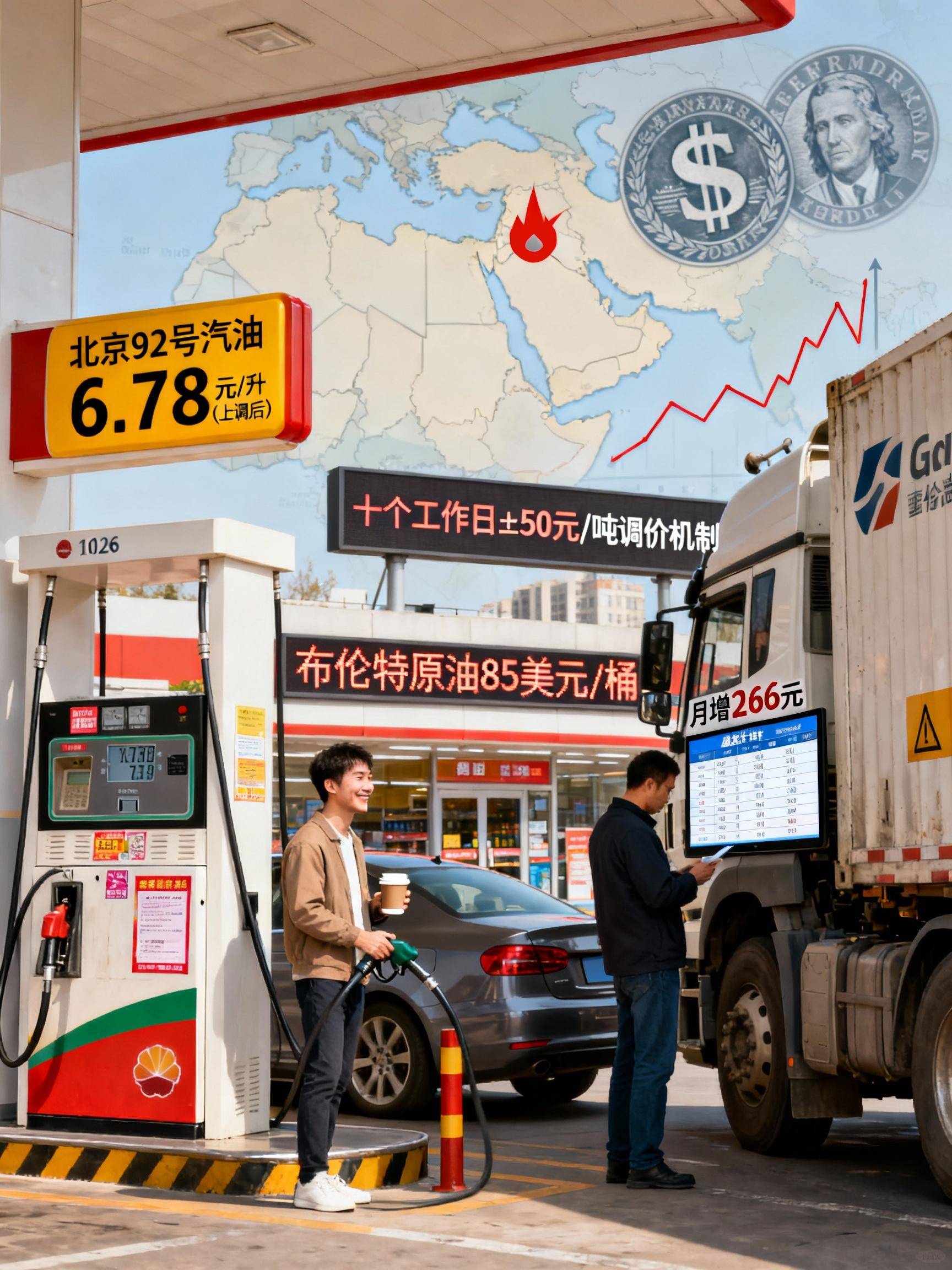
Core Viewpoint - The domestic refined oil prices in China will see their first increase of the year on January 20, 2026, with gasoline and diesel prices expected to rise by 90 yuan per ton, translating to an increase of 0.07 to 0.08 yuan per liter [1] Group 1: Price Adjustment Details - The price adjustment ends a trend of three consecutive decreases and one suspension at the end of 2025 [1] - In Beijing, the price of 92-octane gasoline will increase from 6.70 yuan per liter, resulting in an additional cost of 3.5 to 4 yuan for filling a 50-liter tank [1] Group 2: Market Influences - The increase is attributed to complex fluctuations in the international crude oil market, influenced by ongoing geopolitical tensions in the Middle East and expectations of a rate cut by the Federal Reserve [1] - The Brent crude oil futures price has surpassed 85 dollars per barrel, with the domestic reference crude oil change rate reaching 1.39%, triggering this price adjustment [1]

俄罗斯-阿拉伯峰会延期举行
Xin Hua She· 2025-10-10 03:07
Core Points - The first Russia-Arab summit scheduled for October 15 in Moscow has been postponed due to the ongoing conflict and recent ceasefire agreement between Israel and Hamas [1] Group 1 - Russian President Putin and Iraqi Prime Minister Sudani agreed to delay the summit as many Arab leaders invited to attend would find it difficult to participate under the current circumstances [1] - The ceasefire negotiations between Israel and Hamas, facilitated by Egypt and Qatar, have led to a new agreement announced on October 9 [1] - Iraq holds the rotating presidency of the Arab League summit, which adds significance to its role in the postponement decision [1]
金荣中国:现货黄金延续弱势并一度刷新近一个月低点,目前交投于3296美元附近
Sou Hu Cai Jing· 2025-06-27 06:18
Fundamental Analysis - Gold prices continued to weaken, reaching a near one-month low of approximately $3,291, with current trading around $3,296. The price closed at $3,327.60 on Thursday, reflecting a decline of about 0.13% [1] - The easing of geopolitical tensions in the Middle East has diminished gold's appeal as a safe-haven asset, contributing to the recent price drop. Market expectations suggest that the Federal Reserve may initiate rate cuts in September, potentially lowering rates by a total of 50 basis points this year, which could support gold prices in a low-interest-rate environment [1][3] - Mixed economic data has cast a shadow over market outlooks, with Q1 GDP revised down to a contraction of 0.5% and consumer spending growth adjusted from 1.2% to 0.5%. Additionally, initial jobless claims have risen to the highest level since November 2021, indicating a slowdown in hiring due to tariff policies and economic uncertainty [3] - The yield on U.S. Treasury bonds has decreased, with the 10-year yield falling to 4.25% and the 30-year yield to 4.811%. The steepening yield curve reflects concerns about long-term inflation pressures and is linked to a weak labor market and rate cut expectations [3] - Federal Reserve Chairman Jerome Powell reiterated a wait-and-see approach regarding the impact of tariffs on inflation. Market expectations for a September rate cut exceed 90%, while July's cut probability stands at only 20%, highlighting the importance of upcoming PCE data as a potential catalyst for gold price fluctuations [3][4] Technical Analysis - On the daily chart, gold prices recorded a small-bodied close, indicating a potential challenge below the $3,290 level, with risks of testing around $3,250 if this support is breached [5] - The short-term trend has seen prices retreat from a high of $3,450, with recent trading showing weakness as prices tested $3,350 before declining to current levels around $3,291 [5] - Traders are advised to monitor the $3,310 level for potential short positions, with support levels noted at $3,290 and $3,255 [5]

【成品油】国际原油收盘大跌 汽柴行情承压下行
Sou Hu Cai Jing· 2025-06-25 02:52
Core Viewpoint - Recent fluctuations in international crude oil prices are primarily driven by changes in the geopolitical situation in the Middle East, with significant volatility observed following U.S. military actions against Iranian nuclear facilities [1] Group 1: Price Movements - On June 23, oil prices surged to a high of $76.74 per barrel due to supply concerns, but subsequently fell over 7% as President Trump called for lower prices and investor sentiment shifted to a wait-and-see approach [1] - As of June 24, the average price of reference crude oil was $74.91 per barrel, with a change rate of 11.12%, indicating a potential domestic price increase of 520 yuan per ton for gasoline and diesel [1] Group 2: Domestic Market Dynamics - Domestic gasoline and diesel prices showed a cautious decline, with the 92 gasoline index at 8730 and the 0 diesel index at 7632, reflecting decreases of 26 and 17 respectively from the previous trading day [1] - The market is characterized by a mixed response, with some regions experiencing slight price increases while others maintain stable pricing amid expectations of future price adjustments [2] Group 3: Future Outlook - The market remains cautious as it observes the Middle East situation, with expectations that the current change rate may continue to narrow, and support from news sources is diminishing [4] - Despite potential downward trends in gasoline and diesel prices, the overall decline is expected to be limited due to basic market support, with gasoline demand anticipated to improve during the summer season, while diesel demand remains weak due to adverse weather conditions [4]

博时市场点评6月19日:风险偏好收敛,沪深两市调整
Sou Hu Cai Jing· 2025-06-19 08:59
Market Overview - The A-share market experienced fluctuations, with a trading volume of 1.28 trillion yuan, and major indices such as the Shenzhen Component and ChiNext Index falling over 1% [1] - The only sector that saw an increase was oil and petrochemicals, which rose by 0.86% [4] Federal Reserve Insights - The Federal Reserve maintained the interest rate at 4.25%-4.50%, marking the fourth consecutive meeting without changes, aligning with market expectations [2] - The Fed's economic outlook has shown reduced uncertainty, but it remains at a high level, with GDP growth forecast for 2025 revised down to 1.4% and inflation expectations raised to 3% [2] - The dot plot indicates two expected rate cuts in 2025, totaling 50 basis points, consistent with previous forecasts [2][3] Policy Developments - The China Securities Regulatory Commission (CSRC) announced the "1+6" policy measures to deepen the reform of the Sci-Tech Innovation Board, including the establishment of a growth tier for unprofitable companies [2] - This initiative aims to support high-quality unprofitable enterprises during their R&D phase, allowing them to transition to the main board once they achieve profitability, thereby enhancing confidence in the development of tech enterprises [2] Market Performance - As of June 19, the Shanghai Composite Index closed at 3362.11 points, down 0.79%, while the Shenzhen Component and ChiNext Index fell by 1.21% and 1.36%, respectively [4] - A total of 699 stocks rose, while 4471 stocks declined, indicating a bearish market sentiment [4] Fund Tracking - The market's trading volume reached 12,810.23 billion yuan, showing an increase from the previous trading day, while the margin financing balance rose to 18,286.52 billion yuan [5]
冯德莱恩:与特朗普进行了良好的通话
news flash· 2025-06-14 19:30
Group 1 - The core point of the article is the positive communication between the President of the European Commission, Ursula von der Leyen, and U.S. President Donald Trump regarding geopolitical tensions in the Middle East and their impact on energy markets [1] - Discussion included the necessity of coordinating closely on the geopolitical situation in the Middle East and its implications for energy markets [1] - The conversation also covered the situation in Ukraine, emphasizing the need for a ceasefire and continued pressure on Russia [1] - Trade negotiations were assessed, with a commitment to reach a good agreement by July 9 [1]
MSCI新兴市场指数双线走强 外汇指数五连阳助推股市创9个月新高
Huan Qiu Wang· 2025-05-18 02:21
Core Insights - Emerging market assets are experiencing a strong recovery, with the MSCI Emerging Markets Currency Index rising for five consecutive weeks, marking the longest streak in 2023 [1] - The MSCI Emerging Markets Stock Index increased by 3% to 3,278 points, reaching its highest level since October 2024, indicating a significant return of global capital to emerging economies [1] Currency Performance - The five-week rise in the currency index is attributed to the Federal Reserve's pause in interest rate hikes, leading to a decline in the US dollar index [3] - Currencies such as the Brazilian real, Indian rupee, and South African rand have appreciated over 2% against the dollar in the past month, with the Indonesian rupiah rising 1.8% in one week due to increased commodity exports [3] - Emerging market central banks have seen foreign exchange reserves grow for three consecutive months, enhancing their currency defense capabilities [3] Stock Market Dynamics - The stock index's performance is driven by structural opportunities, particularly in the semiconductor sector in Asia, which has benefited from surging demand for AI hardware, with tech stocks in South Korea and Taiwan averaging a 5.3% increase [3] - The consumer sector in Latin America has seen significant institutional investment following a decline in inflation in Brazil, leading to increased allocations [3] - Recent data indicates that emerging market equity funds saw a net inflow of $4.7 billion over the past two weeks, the highest level since Q3 2024 [3] Market Drivers - The current market rally is supported by three main drivers: expectations of a Fed rate cut in June, easing geopolitical tensions in the Middle East leading to lower oil prices, and confirmed policy continuity in countries like India and Mexico post-elections, boosting infrastructure and manufacturing investments [4] - The yield premium of emerging market local currency bonds over developed countries has widened to 400 basis points, attracting sovereign funds and pension funds for rebalancing [4] Regional Disparities - There are notable regional disparities, with Eastern European markets facing pressure from EU carbon tax regulations, and Argentina experiencing high currency volatility, indicating a need for deeper structural reforms [4] - Investors are advised to monitor Vietnam's GDP data, as its export-driven economy's ability to maintain recovery momentum could be crucial for the sustainability of emerging market growth [4] Valuation Metrics - As of the report, the forward P/E ratio for the MSCI Emerging Markets Index stands at 12.7 times, with a narrowing discount rate to developed countries at 18%, aligning with the five-year average [4] - If the US dollar index remains weak, emerging market assets are expected to continue generating excess returns in Q3 [4]