
中国式长牛

Search documents
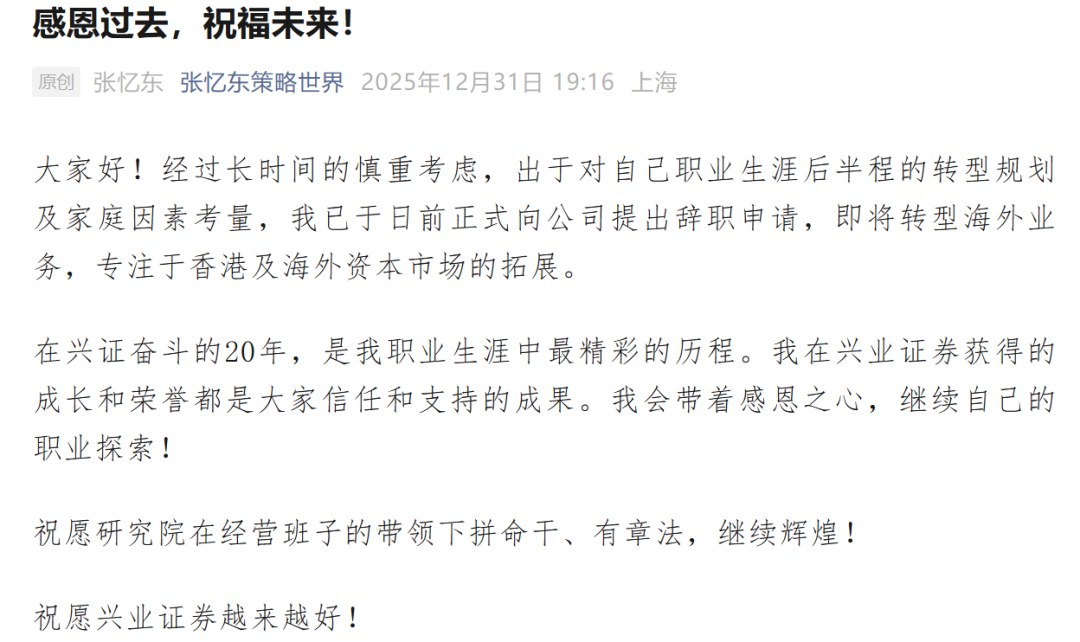
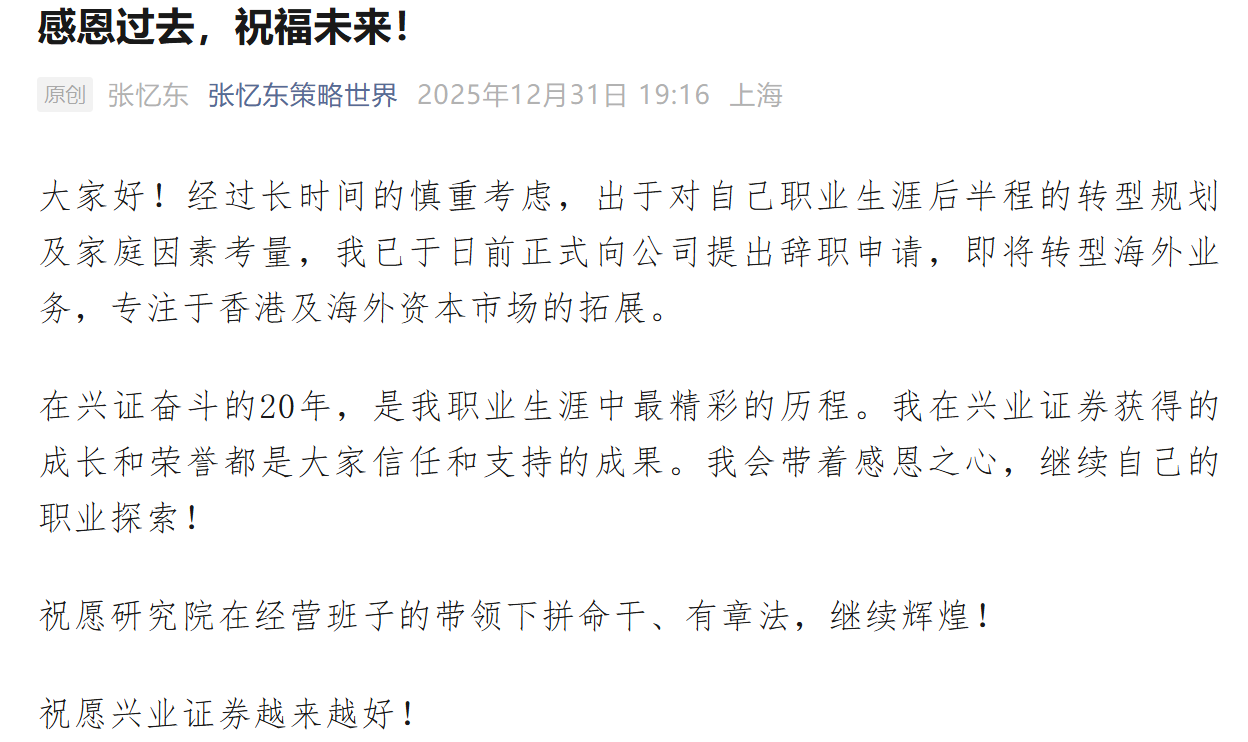
知名分析师张忆东履新
2 1 Shi Ji Jing Ji Bao Dao· 2026-02-05 09:17
Group 1 - Zhang Yidong, a prominent strategist and chief economist, has officially joined Guotai Junan Securities, taking on roles in the executive committee and as head of the equity research department [1][4] - His departure from Industrial Securities was motivated by a desire to focus on overseas markets, particularly in Hong Kong, as part of his career transition [3][4] - Zhang has a strong academic background and extensive experience in the industry, having worked for nearly 20 years at Industrial Securities and received numerous awards for his research [4] Group 2 - Zhang Yidong maintains a positive outlook for the Chinese stock market in 2026, emphasizing the importance of structural opportunities and long-term growth over short-term economic fluctuations [5] - He identifies four key areas for investment in 2026: AI and technology, dividend assets in a low-interest environment, value discovery in traditional industries, and strategic assets like gold and rare earths [5] - Zhang highlights the return of foreign capital to China, particularly through passive ETFs and active management strategies, indicating an increased allocation towards Chinese assets [7]


知名分析师张忆东履新
21世纪经济报道· 2026-02-05 09:13
Group 1 - Zhang Yidong, a prominent strategist and former chief strategist at Industrial Securities, has officially joined Guotai Junan as a member of the executive committee and head of the equity research department [1][4] - Zhang has over 24 years of experience in the industry and has received numerous awards, making him one of the most influential analysts in the sell-side research field [4] - His recent focus is on transitioning to overseas business, particularly in Hong Kong and international capital markets [3] Group 2 - Zhang maintains a strong confidence in China's macro economy and the A-share and Hong Kong stock markets for 2026, emphasizing the importance of structural opportunities [6] - He suggests that the investment strategy for 2026 should focus on four key areas: high-level technological self-reliance, domestic demand especially in service consumption, and the transformation of traditional industries [6][9] - Zhang highlights the return of passive ETF funds and the increasing allocation of foreign capital to China, particularly in a strengthening RMB environment [7] Group 3 - The investment themes for 2026 include focusing on AI investments, military technology, energy technology, and new consumption sectors [9] - There is an emphasis on discovering value in traditional industries through supply chain restructuring and international expansion [9] - Strategic assets such as gold and rare earths are recommended for investment in the context of global order restructuring [9]

转型海外业务!张忆东履新海通国际
2 1 Shi Ji Jing Ji Bao Dao· 2026-02-05 08:31
Group 1 - Zhang Yidong, a prominent strategist and chief economist, has officially joined Guotai Junan and will serve as a member of the executive committee of Haitong International Securities and head of the equity research department [1][2][3] - Zhang has over 24 years of experience in the industry and has been recognized multiple times as a leading analyst in overseas awards, making significant contributions to the development of sell-side research and overseas research business [3] - His recent research outlook for 2026 indicates strong confidence in China's macro economy, A-shares, and Hong Kong stocks, emphasizing the importance of structural opportunities and long-term development over short-term economic perceptions [4][6] Group 2 - Zhang's investment strategy for 2026 includes focusing on four key areas: AI investments, low-interest-rate opportunities in traditional sectors, value discovery in traditional industries, and strategic assets like gold and rare earths [5] - He highlights the importance of structural opportunities in China's economy, particularly in high-level technological self-reliance, domestic consumption, and the transformation of traditional industries [6] - Zhang notes a shift in capital flows, with passive ETF funds returning to China and an increase in foreign investment allocation, particularly in the context of the renminbi's appreciation [6]
登高稳行!张忆东最新分享:2026年从海外看中国、从美国看全球,聚焦三大结构性热点……
聪明投资者· 2026-01-26 07:04
Group 1 - The core viewpoint emphasizes that the U.S. midterm elections are a critical variable affecting global dynamics, particularly in relation to monetary policy and economic confidence [2][10][13] - The U.S. dollar is expected to weaken overall, but the rate of depreciation will slow compared to 2025 [23][31] - The current AI wave in the U.S. is compared to significant historical initiatives, indicating its potential impact on the economy and stock market [33][37] Group 2 - China's economic challenges from old growth drivers are diminishing, but structural issues remain, necessitating a focus on structural opportunities [42][50] - The real estate market is highlighted as a key area of concern, with the potential for stabilization and recovery in property values [44][48] - Investment opportunities in China are expected to arise from government guidance on wealth allocation, particularly in emerging sectors outlined in the 15th Five-Year Plan [50][52] Group 3 - The focus for investment in 2026 should be on stability rather than speculation, with an emphasis on company value rather than market hype [4][60] - The return of foreign capital, particularly through passive ETFs and active management funds, indicates a positive shift in investment sentiment towards China [61][63] - The restructuring of supply chains and industries presents new opportunities, especially in less prominent sectors like steel and chemicals [56][58]
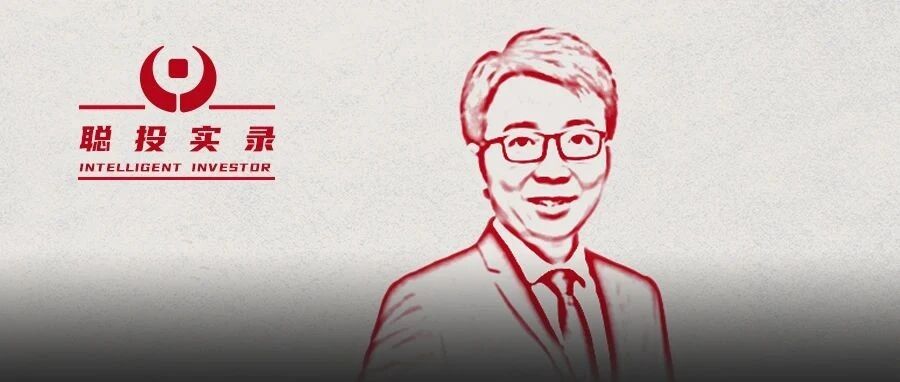
张忆东:中国式长牛是“小白兔式” 并非一蹴而就 投资者应聚焦资产价值本身
Xin Lang Zheng Quan· 2025-09-04 03:36
Group 1 - The core viewpoint emphasizes the importance of the Chinese capital market in enhancing national welfare and driving economic development through active participation and feedback loops with the real economy and technological innovation [1][2] - The concept of a "long bull market" in China is characterized as a "little rabbit-style" long bull, which involves gradual progress with phases of rapid increases and timely adjustments, aligning well with China's national conditions [1] - The Chinese capital market is not suited for a purely Western market model or short-selling mechanisms; instead, it has developed its own unique short-selling mechanisms through mergers, asset injections, refinancing, and IPOs to support socialist construction and the real economy [1] Group 2 - Investors are advised not to focus excessively on short-term market trends or the performance of others, as the current bull market may last for up to 20 years, highlighting the importance of understanding the intrinsic value of assets [2] - Two key factors driving the macro trend are identified: the era dividend and the guiding role of visible hands, which apply to both A-share and Hong Kong markets [2]