
中小企业

Search documents
透过数据看2025年中国中小企业经济运行总体平稳 展现出较强发展韧性
Yang Shi Wang· 2026-02-25 03:39
Group 1 - The overall economic operation of small and medium-sized enterprises (SMEs) in China is stable in 2025, demonstrating strong development resilience and becoming an important support for industrial economic growth [1] - The added value of industrial SMEs above designated size increased by 6.9% year-on-year, surpassing the growth rate of all industrial enterprises by 1.0 percentage points, marking three consecutive years of higher growth [1] - Revenue reached 83.8 trillion yuan, with a year-on-year growth of 2.6%, and total profits increased by 1.4%, particularly in the equipment manufacturing sector, which saw a profit growth of 11.4% [1] Group 2 - Specialized and innovative SMEs showed remarkable performance, with the added value of "little giant" enterprises increasing by 9.0% year-on-year and total profits rising by 7.0%, achieving a profit margin of 7.9% [3] - The comprehensive competitiveness of these specialized SMEs has further strengthened, outperforming the overall industrial sector [3] Group 3 - The export sector remains robust, with the SME export index at 52.4% in December 2025, indicating expansion for 21 consecutive months [5] - The export delivery value of specialized "little giant" enterprises increased by 13.3% year-on-year, exceeding the overall industrial growth by 11.1 percentage points, significantly contributing to export performance [5] Group 4 - The next steps include the formulation of the "14th Five-Year" plan to promote SME development, enhancing the cultivation system for characteristic industrial clusters, and providing targeted services in market expansion and digital empowerment [7]

中小企业数量超6000万户,广东江苏山东占比近三成
第一财经· 2025-12-12 08:30
Core Viewpoint - The development of small and medium-sized enterprises (SMEs) in China has entered a new stage, with significant increases in quantity, efficiency, and quality during the 14th Five-Year Plan period, contributing over 60% of GDP, over 70% of technological innovation, and over 80% of urban employment [3][5]. Group 1: Growth and Contribution of SMEs - As of the end of 2024, the number of registered SMEs in China is expected to exceed 60 million, with an average annual increase of over 4 million since 2021 [5][3]. - In 2023, the employment from large-scale SMEs surpassed 128 million, with their value-added, operating income, and total profit growth rates averaging 6.4%, 7.4%, and 5.4% respectively, all exceeding those of large enterprises [5][3]. - By September 2025, the total number of registered SMEs is projected to reach 63.49 million, with micro-enterprises making up 79.4%, small enterprises 18.7%, and medium enterprises 1.9% [5][8]. Group 2: Regional and Sectoral Distribution - The top five provinces for SME numbers are Guangdong, Jiangsu, Shandong, Zhejiang, and Henan, collectively accounting for 40.9% of the total [6]. - The wholesale and retail, rental and business services, scientific research and technical services, manufacturing, and construction sectors represent the largest shares of SMEs, totaling 75.8% [6]. Group 3: Financing and Support for SMEs - The financing scale for SMEs in various sectors, particularly in wholesale and manufacturing, has shown an upward trend, with significant increases in investment amounts and events in Guangdong, Beijing, Shanghai, Jiangsu, and Zhejiang [15]. - Since 2014, the balance of loans to small and micro enterprises has increased over 30 times, reaching 65 trillion yuan by mid-2025, with their share of total enterprise loans rising from 30.4% to 38.2% [19][20]. - The government has implemented various policies to support the high-quality development of SMEs, including investments from the National SME Development Fund exceeding 69 billion yuan and initiatives for digital transformation [17][19].
稳经济稳预期关键在稳企业
Jing Ji Ri Bao· 2025-12-05 00:22
Core Viewpoint - Stabilizing enterprises is essential for maintaining economic growth and serves as the "foundation" for economic stability [1][2] Group 1: Economic Indicators - In November, the manufacturing Purchasing Managers' Index (PMI) showed signs of improvement, with the small enterprise PMI reaching a six-month high [1] - From January to October, the cumulative profit growth of industrial enterprises was 1.9%, indicating a recovery in the profitability of enterprises [2] Group 2: Employment and Consumption - Enterprises are crucial for job creation, with small and medium-sized enterprises providing over 80% of urban employment in China [2] - A stable enterprise environment leads to increased consumer confidence and spending, creating a positive cycle of "enterprise stability - employment stability - income stability - consumption growth" [2] Group 3: Market Confidence - The production and business activity expectation index in the November manufacturing PMI was 53.1%, reflecting increased confidence among manufacturers due to effective economic policies [3] - Positive expectations from enterprises can lead to increased investments, market expansion, and research and development efforts [3] Group 4: Challenges and Policy Recommendations - Despite positive signs, challenges such as insufficient demand, cost pressures, and weak expectations remain, necessitating continuous efforts to stabilize enterprises [4] - Future policies will focus on optimizing the business environment, ensuring fair competition, and supporting the development of small and medium-sized enterprises [4][5] - Addressing financing difficulties, high costs, and overdue payments is critical for alleviating burdens on enterprises [5] - Expanding domestic demand and improving the consumption environment are essential for creating a conducive market space for enterprises [5]
促进民间投资,国办最新发声!
券商中国· 2025-11-10 10:48
Core Viewpoint - The article discusses the recent measures introduced by the State Council to stimulate private investment and promote its development, outlining 13 specific policy initiatives aimed at enhancing the participation of private capital in various sectors [1][3]. Group 1: Policy Measures - The government will conduct special feasibility studies for private capital participation in projects requiring national approval, allowing private capital to hold more than 10% in certain projects [3]. - Local authorities are encouraged to detail specific requirements for private capital involvement in project construction, particularly in smaller urban infrastructure projects [3]. - Private capital will be guided to participate in low-altitude economy infrastructure construction, with equal treatment in commercial space projects [3]. Group 2: Service Sector and Government Cooperation - The article emphasizes the removal of unreasonable entry barriers in the service industry, particularly in sectors like environmental protection and quality certification, to encourage private investment [4]. - It outlines the need for a new mechanism for public-private partnerships, ensuring fair conditions for private capital participation in concession projects [4]. - The government will increase procurement support for small and medium-sized enterprises (SMEs), mandating that at least 40% of budgets for projects over 4 million yuan be reserved for SMEs [4][5]. Group 3: Infrastructure and Digital Transformation - There will be enhanced regulation of network infrastructure operations to protect the rights of private enterprises in energy and transportation sectors [5]. - The government will support the establishment of major pilot platforms by private enterprises in key industries, facilitating market-oriented trial services from state-owned enterprises and research institutions [6]. - Initiatives will be taken to promote digital transformation among SMEs, including the development of comprehensive digital empowerment platforms [6]. Group 4: Financial Support and Investment - The central government will increase budgetary investments in eligible private investment projects, utilizing new policy financial tools to support key sectors [6][7]. - Financial institutions are encouraged to set annual service targets for private enterprises, ensuring access to credit and promoting innovative financing mechanisms [7]. - The article highlights the importance of supporting technology-driven enterprises in accessing public markets and investment trusts [7]. Group 5: Monitoring and Compliance - There is a call for improved services and guidance for private investment, including the establishment of a monitoring system for private investment statistics [7]. - The article stresses the need for private enterprises to operate legally and responsibly, emphasizing the importance of risk prevention and high-quality development in private investment [7].
韩公布“新政府经济增长战略”
Shang Wu Bu Wang Zhan· 2025-08-30 01:33
Group 1 - The South Korean government has announced a "New Government Economic Growth Strategy" focusing on three major areas: advanced materials and components, climate energy future response, and revitalization of the K (Korean) industry, with a total of 15 innovative projects planned [1] - A national growth fund exceeding 100 trillion KRW is proposed to support strategic industries such as AI and small to medium-sized enterprises [1] - In the advanced sector, the government aims to increase the domestic production share of SiC power semiconductors from below 5% to 10% by 2030, and the technology self-sufficiency rate from 10% to 20% [1] Group 2 - The K industry aims to boost exports of K cultural products from 13.2 billion USD in 2022 to 25 billion USD by 2030, with a goal for small to medium-sized beauty enterprises to achieve 10 billion USD in exports [1] - In the biopharmaceutical sector, plans include the development of four new drug candidates and the cultivation of three global pharmaceutical companies [1] Group 3 - In the energy sector, the government plans to advance the standard design certification for Korean small modular reactors (SMR) by 2028 and establish regional bases [1] - The green hydrogen project will be expanded, with the goal of constructing the "West Coast Energy Highway" by 2030 [1] - In agriculture and fisheries, AI smart farming trials will be initiated, along with the development of 10-centimeter-level ultra-high-definition satellites [1]
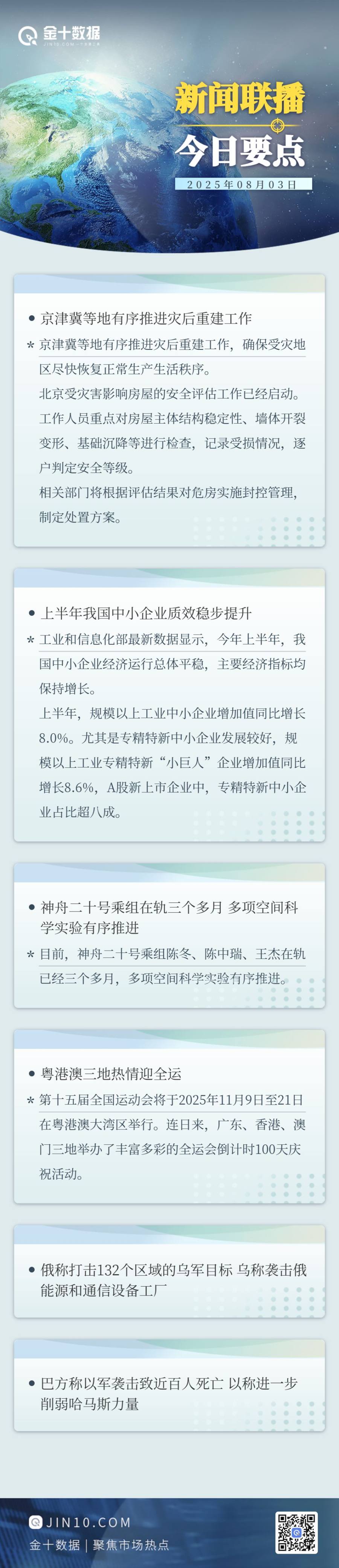
金十图示:2025年08月03日(周日)新闻联播今日要点
news flash· 2025-08-03 12:53
Group 1 - The overall economic operation of small and medium-sized enterprises (SMEs) in China has remained stable in the first half of the year, with key economic indicators showing growth [3] - The added value of industrial SMEs above designated size increased by 8.0% year-on-year in the first half of the year [3] - The "little giant" enterprises, which are specialized and innovative SMEs, saw an added value growth of 8.6% year-on-year [3] - Over 80% of newly listed companies on the A-share market are specialized and innovative SMEs [3] Group 2 - The 15th National Games will be held in the Guangdong-Hong Kong-Macao Greater Bay Area from November 9 to 21, 2025, with various celebratory activities taking place [4]
央行:对中小企业的信贷支持力度明显增强
news flash· 2025-06-05 03:42
Core Viewpoint - Recent financial policies introduced by regulatory authorities signal strong support for stabilizing the market and expectations, with a focus on increasing funding to the real economy and enhancing credit support for small and medium-sized enterprises [1] Financial Policy Measures - The People's Bank of China has reduced the reserve requirement ratio by 0.5 percentage points, lowered the policy interest rate by 0.1 percentage points, and decreased the rates on structural monetary policy tools by 0.25 percentage points [1] - These measures aim to expand the scale of funds directed by financial institutions to the real economy, reduce financing costs for enterprises, and improve the stability of their production and operations [1]