中美息差

Search documents
张瑜:汇率的叙事——张瑜旬度会议纪要No.129
一瑜中的· 2025-12-30 13:55
Core Viewpoint - The article focuses on the recent appreciation of the Renminbi (RMB) and challenges the prevailing narrative that links the Federal Reserve's interest rate cuts to RMB appreciation and subsequent damage to export competitiveness [2][3]. Group 1: Current RMB Exchange Rate Narrative - The popular narrative suggests that the Federal Reserve's likely interest rate cuts will lead to a weaker USD, thus causing the RMB to appreciate and harming China's export competitiveness. This narrative is based on several assumptions that require validation [3]. - The relationship between the Federal Reserve's interest rate cuts and the USD's weakness is not necessarily direct, as historical data shows a low correlation between the two [4]. - The assumption that narrowing interest rate differentials between China and the US will lead to RMB appreciation is flawed, as the correlation between funding rate differentials and the USD/CNY exchange rate is weak [5]. Group 2: RMB Appreciation Analysis - The article divides the RMB appreciation observed this year into two phases: the first phase from mid-April to November, driven primarily by policy support, and the second phase from late November to the present, driven by market supply and demand [9][10]. - In the first phase, the RMB middle rate appreciated from 7.21 to 7.08, largely due to policy interventions, while in the second phase, market dynamics took over, leading to a different adjustment mechanism [14]. - Factors contributing to the recent market-driven appreciation include the release of previously held foreign exchange reserves and seasonal trends in net settlement of foreign exchange by enterprises [16]. Group 3: Future Outlook for RMB Exchange Rate - The article anticipates that the RMB will maintain stable fluctuations against the USD through 2026, with limited potential for significant appreciation [17]. - Current valuation metrics indicate that the RMB is reasonably priced, with deviations from expected levels being minimal [18]. - The central bank's policy appears to be aimed at preventing excessive appreciation of the RMB, as indicated by recent trends in the counter-cyclical factor [22]. - The supply-demand dynamics suggest that while there may be short-term volatility, the underlying support for sustained appreciation is not strong enough at this time [24][27]. - External factors, particularly the USD index, are expected to limit the pressure for a prolonged decline in the USD [28]. - Overall, the RMB's future trajectory will depend on complex factors, with a preference for stable two-way fluctuations rather than significant appreciation [29].


美联储降息≠人民币升值≠出口承压——汇率升值叙事的三重纠偏
Sou Hu Cai Jing· 2025-12-29 02:56
Group 1 - The core narrative regarding the recent appreciation of the RMB is linked to the Federal Reserve's interest rate cuts leading to a weaker dollar, which in turn may harm China's export competitiveness [3][16] - The logic of this narrative is questioned, as a Fed rate cut does not necessarily equate to a weaker dollar, and RMB appreciation does not automatically imply a loss of export competitiveness [1][4] - The RMB exchange rate is currently viewed as fairly valued, with no significant overvaluation or undervaluation issues, supported by internal resilience in exports and policy measures [9][42] Group 2 - The narrative surrounding the RMB's appreciation can be divided into two segments: the first driven by policy support from mid-April to November, and the second driven by market supply and demand from late November to the present [8][34] - In the first segment, the RMB middle rate appreciated from approximately 7.21 to around 7.08, with a monthly average appreciation of about 186 basis points [32] - In the second segment, the RMB middle rate further appreciated to just above 7.04, with a notable increase of over 450 basis points in a month, indicating a shift from policy-driven to market-driven appreciation [34][35] Group 3 - Future RMB exchange rate trends will depend on several factors, including valuation factors, policy direction, internal supply and demand, and external responses [42][58] - The valuation perspective indicates that the RMB is not significantly overvalued or undervalued, remaining within a reasonable pricing range [42][43] - The policy direction has shifted from supporting a stable appreciation to preventing excessive appreciation volatility, reflecting a focus on maintaining stability rather than encouraging a one-sided RMB exchange rate trend [45][47] Group 4 - The internal supply and demand dynamics are crucial, with the flow logic indicating that net settlement depends on trade surplus and corporate settlement intentions, while the stock logic highlights the potential release of accumulated foreign exchange positions [51][53] - The accumulated foreign exchange positions, estimated to be between $737 billion and $1.1 trillion, could significantly impact net settlement if released [53][54] - The external response, particularly the behavior of the US dollar, is also a key factor, with expectations that the dollar may not experience sustained weakness due to underlying economic conditions [58][62]
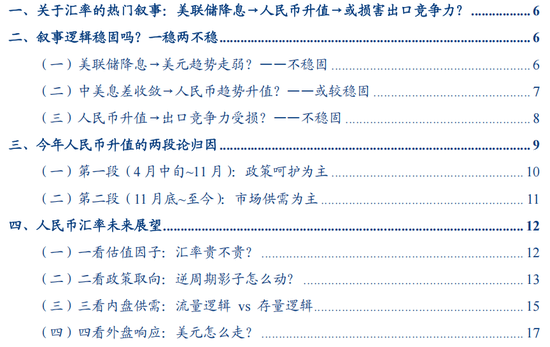
张瑜:美联储降息≠人民币升值≠出口承压
Xin Lang Cai Jing· 2025-12-29 01:52
Group 1 - The core narrative is that the Federal Reserve's interest rate cuts lead to a weaker dollar, which in turn causes the renminbi to appreciate, potentially harming export competitiveness [1][3][69] - The logic of this narrative is questioned, as a Fed rate cut does not necessarily equate to a weaker dollar, and an appreciation of the renminbi does not automatically imply a loss of export competitiveness [1][3][69] - The outlook for the renminbi exchange rate suggests that it is currently fairly valued, with no significant overvaluation or undervaluation issues. The internal stability of the renminbi is supported by export resilience and policy support, but substantial upward momentum may require further accumulation [1][3][64] Group 2 - The relationship between the Fed's rate cuts and the dollar's trend is unstable, with a historical correlation coefficient of only 0.04 between Fed rate adjustments and dollar index movements since October 1982 [4][15][70] - The convergence of interest rate differentials between China and the U.S. has shown a strong correlation with the renminbi's appreciation, with a correlation coefficient of 0.88 since January 2022 [5][18][71] - The assertion that renminbi appreciation harms export competitiveness is not strongly supported, as only the real exchange rate shows a potential impact on exports, while nominal rates do not correlate with export performance [6][21][72] Group 3 - The renminbi's appreciation this year can be divided into two phases: the first phase from mid-April to November, driven primarily by policy support, and the second phase from late November to the present, driven by market supply and demand [7][25][73] - In the first phase, the renminbi's central parity appreciated from approximately 7.21 to around 7.08, with a monthly average appreciation of about 186 basis points [29][31] - In the second phase, the renminbi's central parity further appreciated to just above 7.04, with a significant increase in market-driven factors influencing this change [31][32] Group 4 - Future exchange rate trends will be influenced by four key factors: valuation factors, policy orientation, internal supply and demand, and external responses [39][74] - The valuation of the renminbi is currently within a reasonable range, with deviations from the "value center" being only 0% to 2% [39][74] - The policy orientation has shifted from supporting a stable appreciation of the renminbi to preventing excessive appreciation volatility, indicating a focus on maintaining stability rather than encouraging a one-sided market trend [42][75]
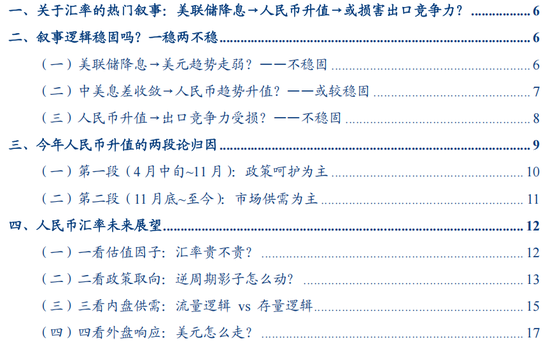
张瑜:美联储降息≠人民币升值≠出口承压——汇率升值叙事的三重纠偏
一瑜中的· 2025-12-28 16:03
Core Viewpoint - The article discusses the narrative that the Federal Reserve's interest rate cuts lead to the appreciation of the Renminbi (RMB), which may harm export competitiveness. However, this narrative is questioned for its logical consistency [2][5]. Group 1: Popular Narrative and Core Logic - The core narrative is that the Federal Reserve's interest rate cuts lead to a weaker dollar, resulting in RMB appreciation, which could negatively impact China's export competitiveness [5]. - The narrative's logical inconsistencies include: 1) The relationship between Federal Reserve rate cuts and a weaker dollar is not guaranteed; 2) RMB appreciation does not necessarily equate to a loss of export competitiveness [2][3]. Group 2: Assessment of RMB Exchange Rate Outlook - The RMB exchange rate is currently considered fairly valued, with no significant overvaluation or undervaluation issues. The deviation from the "value center" is around 0% to 2% [10][61]. - Internally, the RMB's stability is supported by export resilience and policy support, but significant upward momentum for appreciation may require further accumulation of fundamental support [10][89]. - Externally, the Federal Reserve's preventive rate cuts may help sustain economic growth and relative asset price advantages, limiting the pressure for a continuous decline of the dollar [10][79]. Group 3: Analysis of RMB Appreciation in 2023 - The RMB's appreciation in 2023 can be divided into two phases: 1) From mid-April to November, where policy support was the main driver, with the RMB middle price rising from approximately 7.21 to around 7.08 [38][44]. 2) From late November to the present, where market supply and demand became the primary driver, with the RMB middle price further appreciating to just above 7.04 [39][47]. Group 4: Factors Influencing Future RMB Exchange Rate - Four key factors to consider for future RMB exchange rate trends include: 1) Valuation factors indicate that the RMB is not significantly overvalued or undervalued [10][61]. 2) Policy orientation has shifted from guiding stable appreciation to preventing excessive appreciation volatility [64][67]. 3) Internal supply and demand dynamics, particularly the flow logic of trade surplus and net settlement rates, are crucial for understanding RMB trends [72][73]. 4) External responses, particularly the behavior of the dollar index, suggest limited potential for sustained dollar weakness due to the current economic context [79][80].

美国经济数据造假实锤?中国等这一刻太久了,降息窗口终于到来!
Sou Hu Cai Jing· 2025-08-06 04:05
Group 1 - The core point of the article highlights the revelation of data manipulation in the U.S. employment report, undermining the myth of the "American exceptionalism" and signaling a potential strategic turning point for China as the interest rate cut window opens [1][3][11] - The July non-farm payroll data showed only 73,000 new jobs added, significantly below the market expectation of 180,000, marking the lowest figure in nine months. The unemployment rate rose from 4.1% to 4.2%, indicating a deteriorating job market [3][9] - Historical data revisions for May and June were drastic, with May's figures revised down from 144,000 to 19,000 and June's from 147,000 to 14,000, resulting in a total reduction of 258,000 jobs, raising concerns about the reliability of U.S. economic data [3][9][11] Group 2 - The market reacted sharply, with major U.S. stock indices falling, the Nasdaq dropping over 2%, and the Euro Stoxx 600 index experiencing its largest single-day decline in four months at 1.9%. The U.S. dollar fell by 1.3%, and international oil prices dropped by 3% [6][11] - The trust in U.S. economic data has been severely shaken, leading to questions about the integrity of other economic indicators such as CPI, GDP, and corporate earnings, which could also be subject to manipulation [9][11][16] - The potential for the Federal Reserve to reconsider its high interest rate policy is now on the table, as the previous decisions were based on distorted data, which could lead to a shift in monetary policy and provide China with more room to maneuver [11][14][16] Group 3 - For China, this situation presents an opportunity to shift from a defensive to an offensive stance in economic policy, as the U.S. interest rate environment becomes more favorable for easing [11][14] - The anticipated U.S. interest rate cuts could allow for quicker adjustments in China's Loan Prime Rate (LPR), reduced corporate financing costs, and improved credit conditions in the real estate sector, ultimately boosting market sentiment [14][16] - The article suggests that the erosion of U.S. financial credibility could lead to a shift in global financial power dynamics, providing China with a strategic opportunity to enhance its monetary policy and promote the internationalization of the renminbi [16][18]

节后或延续普涨行情,5月1日,凌晨的三大重要消息持续发酵!
Sou Hu Cai Jing· 2025-04-30 19:45
Group 1 - The core viewpoint is that certain incremental policies will be introduced by the end of June, with the timing dependent on the Federal Reserve's interest rate decisions [1] - The current interest rate differential between China and the US is significant, and if the Federal Reserve does not lower rates, China may have to maintain its current stance to prevent capital outflow [1] - The expectation is that the Federal Reserve may lower rates in May, which would likely prompt the Chinese central bank to take action around mid-May [1] Group 2 - Short-term pressure exists on bank stocks due to disappointing earnings, but long-term investment interest remains focused on dividend yields [3] - A decline in bank stocks often leads to a shift in market dynamics, with growth stocks performing better when bank stocks fall [3] - The performance of bank stocks has been lackluster, with growth rates declining from around 5% to stagnation or even decreases [4] Group 3 - The first quarter reports from the six major banks have been collectively disclosed [5] - The market may be entering a phase characterized by a focus on individual stocks rather than overall index performance, with large-cap stocks like banks dragging down indices while small-cap stocks thrive [7] - After a month of volatility, market sentiment is improving, and if no significant negative news arises during the upcoming holiday, positive sentiment may continue [7]