
出口竞争力

Search documents
《求是》杂志特约评论员:积极推动物价合理回升
Xin Lang Cai Jing· 2026-02-02 02:01
Core Viewpoint - The article emphasizes the importance of maintaining a reasonable price level for economic stability and social harmony, highlighting the need for proactive macroeconomic policies to promote a gradual recovery of prices to a reasonable range [2][9]. Group 1: Understanding Price Dynamics - The public often perceives low prices as beneficial, equating them with increased purchasing power and reduced production costs, but this view overlooks the negative impacts of prolonged low prices on consumption and economic expectations [3][4]. - A cycle of low prices leading to weak consumer expectations and reduced spending can create a detrimental feedback loop, affecting corporate profits and household incomes [4][5]. - Low prices can also suppress long-term investment intentions, as declining sales prices may narrow profit margins and increase debt pressures on companies [4][6]. Group 2: Factors Influencing Low Prices - The current low price environment is influenced by both cyclical factors, such as post-pandemic income stagnation and global commodity price fluctuations, and structural factors, including demographic changes and shifts in supply and demand dynamics [6][16]. - The real estate market's adjustment and the maturation of emerging industries have contributed to a mismatch between supply and demand, further suppressing price increases [6][16]. - Institutional factors, such as inadequate market mechanisms for resource allocation and rigid pricing in essential services, hinder the ability of prices to reflect true supply and demand [6][16]. Group 3: International Context - There is a notable price disparity between China and other economies, with many developed countries experiencing high inflation while China maintains low price levels [7][17]. - The contrasting macroeconomic policies adopted by China and Western economies, particularly in response to the pandemic, have led to different inflationary outcomes, with China opting for a more restrained monetary policy [7][17]. Group 4: Recent Economic Indicators - Recent data indicates that the core consumer price index, excluding food and energy, has shown a year-on-year increase of over 1%, suggesting that the current low price situation may be temporary [8][18]. - The broad money supply has also maintained a growth rate of over 8%, indicating a stable economic environment that supports price recovery [8][18]. Group 5: Policy Recommendations - A systematic approach is necessary to promote a reasonable price recovery, relying on market-oriented strategies rather than direct administrative interventions [9][19]. - Policies should focus on stabilizing employment and income, enhancing market competition, and reforming pricing mechanisms to facilitate a gradual return to reasonable price levels [9][20]. - The government should implement proactive fiscal and monetary policies, including targeted spending and liquidity measures, to support economic stability and price recovery [10][20].


韩2025年出口竞争力明显下降
Ke Ji Ri Bao· 2026-01-20 00:33
Core Insights - South Korea's export market share is significantly declining compared to countries like China, Vietnam, and India, despite projections of exceeding $700 billion in exports by 2025, marking a historical high [1] - The structural polarization of export categories is worsening, indicating a gradual degradation of export competitiveness in the medium to long term [1] - The semiconductor sector is expected to see growth in 2026 due to a favorable cycle, but non-IT categories are likely to continue underperforming, exacerbating the polarization [1] Group 1: Export Competitiveness - South Korea's export competitiveness is deteriorating, with a notable decline in market share in key sectors such as steel and machinery [1] - The implementation of the EU's Carbon Border Adjustment Mechanism (CBAM) in 2026 may further weaken the competitiveness of South Korean firms in the European market due to increased trade costs [1] - The automotive industry is facing declining competitiveness as rivals expand overseas production, with South Korea's market share in the U.S. dropping by 0.4% from 2018 to 2024, while Mexico's increased by 4.2% [1] Group 2: Semiconductor Industry - South Korea maintains a technological edge in semiconductors by rapidly developing high-bandwidth memory and other high-value products, leading competitors by approximately one year in mass production of the latest generation storage chips [2] - Recent competition from China and Southeast Asia has weakened South Korea's market position, posing a risk to its semiconductor industry [2] - Unlike the previous semiconductor boom in 2017-2018, China has enhanced its mass production capabilities, replacing some imports of generic products [2]
集运指数(欧线)期货周报-20260116
Rui Da Qi Huo· 2026-01-16 09:29
1. Report Industry Investment Rating - Not available in the provided content 2. Core Viewpoints of the Report - This week, the futures prices of the Container Shipping Index (European Line) declined collectively. The main contract EC2602 closed down 2.59%, and the far - month contracts fell between 3% and 8%. The latest SCFIS European Line settlement freight rate index was 1956.39, up 160.56 points from last week, a month - on - month increase of 8.9% [6][39]. - The cancellation of the full - refund of value - added tax on photovoltaic products is expected to lead to a rush of shipments, boosting long - term contract cargo volume. However, after the trading sentiment stabilizes, the price increase fades, and the support from the spot side weakens, causing the futures price to decline [6][39]. - China's foreign trade level in December 2026 rebounded beyond expectations, with significant improvements in both imports and exports, possibly related to the cancellation of value - added tax export rebates for some commodities and pre - holiday rush exports. China's exports are expected to maintain a high growth rate in 2026 [6][39]. - Spot freight rates for the fourth week were between $2600 - $3200 for large containers. Maersk's large container price in the fourth week was $2700, up $100 from the third week [6][39]. - Geopolitically, there are expectations of an end to the conflict between Russia and Ukraine in the first half of 2026, and the expectation of the Red Sea's resumption of navigation has improved. Eurozone inflation pressure has eased, weakening the market's expectation of an interest rate hike by the European Central Bank before the end of the year [6][39]. - Overall, the announced freight rate increase has not been implemented, many shipping companies have successively lowered prices, weakening the support for futures prices. The effect of the photovoltaic tax - refund policy on rush exports has also quickly weakened after the trading sentiment cooled. Attention should be paid to the actual implementation of shipping companies' announced price increases. Although trade relations are gradually improving, China's exports to the US are still under pressure, and the boost from the traditional peak season may be weaker than expected. Investors are advised to be cautious [7][40]. 3. Summary According to the Table of Contents 3.1. Market Review - Futures contracts: EC2602 fell 1.13%, EC2604 fell 2.59%, EC2606 fell 7.67%, EC2608 fell 3.61%, EC2610 fell 4.69%, and EC2612 fell 4.22%. The SCFIS index rose 8.9% [10]. - The price of the main contract of the Container Shipping Index (European Line) futures first rose and then fell this week. The trading volume and open interest of the EC2604 contract showed differentiation [13][15]. 3.2. News Review and Analysis - The central bank took measures to support high - quality economic development, including lowering re - loan and re - discount rates, increasing various loan quotas, and adjusting the minimum down - payment ratio for commercial housing mortgages. The central bank said there is still room for reserve requirement ratio and interest rate cuts this year [19]. - The US will impose a 25% import ad - valorem tariff on some imported semiconductors, semiconductor manufacturing equipment, and derivatives starting from January 15 [19]. - The World Bank raised its 2026 global economic growth forecast to 2.6%, 0.2 percentage points higher than the previous forecast. It predicted that the US GDP growth rate will reach 2.2% in 2026, while the economic growth rates of the Eurozone and Japan will slow down [19]. - The EU will issue a guidance document on price commitment applications for the China - EU electric vehicle case, and China's electromechanical chamber of commerce will encourage and support relevant enterprises to apply for price commitments [19]. 3.3. Weekly Market Data - The basis and price difference of the Container Shipping Index (European Line) futures contracts shrank this week [26]. - The export container freight rate index rebounded slightly this week [27]. - Global container shipping capacity continued to grow, and the shipping capacity on the European line rebounded slightly. The BDI and BPI declined this week, and freight rates fluctuated slightly [31]. - The charter price of Panamax ships declined this week, and the spread between the offshore and on - shore RMB against the US dollar narrowed [34]. 3.4. Market Outlook and Strategy - The futures prices of the Container Shipping Index (European Line) declined this week. The cancellation of the full - refund of value - added tax on photovoltaic products led to short - term price increases, but the effect weakened later. China's foreign trade improved in December, and spot freight rates increased slightly. Geopolitical factors improved the expectation of the Red Sea's resumption of navigation, and Eurozone inflation pressure eased [39]. - The announced freight rate increase has not been implemented, and the support for futures prices has weakened. The boost from the traditional peak season may be weaker than expected. Investors are advised to be cautious and pay attention to geopolitical, shipping capacity, and cargo volume data [40].

张瑜:汇率的叙事——张瑜旬度会议纪要No.129
一瑜中的· 2025-12-30 13:55
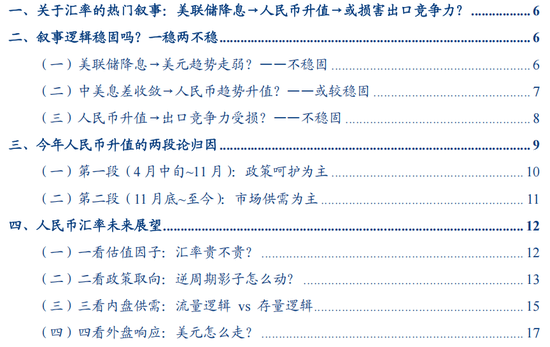
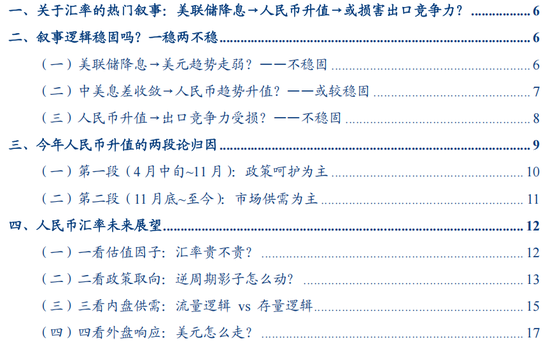
Core Viewpoint - The article focuses on the recent appreciation of the Renminbi (RMB) and challenges the prevailing narrative that links the Federal Reserve's interest rate cuts to RMB appreciation and subsequent damage to export competitiveness [2][3]. Group 1: Current RMB Exchange Rate Narrative - The popular narrative suggests that the Federal Reserve's likely interest rate cuts will lead to a weaker USD, thus causing the RMB to appreciate and harming China's export competitiveness. This narrative is based on several assumptions that require validation [3]. - The relationship between the Federal Reserve's interest rate cuts and the USD's weakness is not necessarily direct, as historical data shows a low correlation between the two [4]. - The assumption that narrowing interest rate differentials between China and the US will lead to RMB appreciation is flawed, as the correlation between funding rate differentials and the USD/CNY exchange rate is weak [5]. Group 2: RMB Appreciation Analysis - The article divides the RMB appreciation observed this year into two phases: the first phase from mid-April to November, driven primarily by policy support, and the second phase from late November to the present, driven by market supply and demand [9][10]. - In the first phase, the RMB middle rate appreciated from 7.21 to 7.08, largely due to policy interventions, while in the second phase, market dynamics took over, leading to a different adjustment mechanism [14]. - Factors contributing to the recent market-driven appreciation include the release of previously held foreign exchange reserves and seasonal trends in net settlement of foreign exchange by enterprises [16]. Group 3: Future Outlook for RMB Exchange Rate - The article anticipates that the RMB will maintain stable fluctuations against the USD through 2026, with limited potential for significant appreciation [17]. - Current valuation metrics indicate that the RMB is reasonably priced, with deviations from expected levels being minimal [18]. - The central bank's policy appears to be aimed at preventing excessive appreciation of the RMB, as indicated by recent trends in the counter-cyclical factor [22]. - The supply-demand dynamics suggest that while there may be short-term volatility, the underlying support for sustained appreciation is not strong enough at this time [24][27]. - External factors, particularly the USD index, are expected to limit the pressure for a prolonged decline in the USD [28]. - Overall, the RMB's future trajectory will depend on complex factors, with a preference for stable two-way fluctuations rather than significant appreciation [29].

美联储降息≠人民币升值≠出口承压——汇率升值叙事的三重纠偏
Sou Hu Cai Jing· 2025-12-29 02:56
Group 1 - The core narrative regarding the recent appreciation of the RMB is linked to the Federal Reserve's interest rate cuts leading to a weaker dollar, which in turn may harm China's export competitiveness [3][16] - The logic of this narrative is questioned, as a Fed rate cut does not necessarily equate to a weaker dollar, and RMB appreciation does not automatically imply a loss of export competitiveness [1][4] - The RMB exchange rate is currently viewed as fairly valued, with no significant overvaluation or undervaluation issues, supported by internal resilience in exports and policy measures [9][42] Group 2 - The narrative surrounding the RMB's appreciation can be divided into two segments: the first driven by policy support from mid-April to November, and the second driven by market supply and demand from late November to the present [8][34] - In the first segment, the RMB middle rate appreciated from approximately 7.21 to around 7.08, with a monthly average appreciation of about 186 basis points [32] - In the second segment, the RMB middle rate further appreciated to just above 7.04, with a notable increase of over 450 basis points in a month, indicating a shift from policy-driven to market-driven appreciation [34][35] Group 3 - Future RMB exchange rate trends will depend on several factors, including valuation factors, policy direction, internal supply and demand, and external responses [42][58] - The valuation perspective indicates that the RMB is not significantly overvalued or undervalued, remaining within a reasonable pricing range [42][43] - The policy direction has shifted from supporting a stable appreciation to preventing excessive appreciation volatility, reflecting a focus on maintaining stability rather than encouraging a one-sided RMB exchange rate trend [45][47] Group 4 - The internal supply and demand dynamics are crucial, with the flow logic indicating that net settlement depends on trade surplus and corporate settlement intentions, while the stock logic highlights the potential release of accumulated foreign exchange positions [51][53] - The accumulated foreign exchange positions, estimated to be between $737 billion and $1.1 trillion, could significantly impact net settlement if released [53][54] - The external response, particularly the behavior of the US dollar, is also a key factor, with expectations that the dollar may not experience sustained weakness due to underlying economic conditions [58][62]
张瑜:美联储降息≠人民币升值≠出口承压
Xin Lang Cai Jing· 2025-12-29 01:52
Group 1 - The core narrative is that the Federal Reserve's interest rate cuts lead to a weaker dollar, which in turn causes the renminbi to appreciate, potentially harming export competitiveness [1][3][69] - The logic of this narrative is questioned, as a Fed rate cut does not necessarily equate to a weaker dollar, and an appreciation of the renminbi does not automatically imply a loss of export competitiveness [1][3][69] - The outlook for the renminbi exchange rate suggests that it is currently fairly valued, with no significant overvaluation or undervaluation issues. The internal stability of the renminbi is supported by export resilience and policy support, but substantial upward momentum may require further accumulation [1][3][64] Group 2 - The relationship between the Fed's rate cuts and the dollar's trend is unstable, with a historical correlation coefficient of only 0.04 between Fed rate adjustments and dollar index movements since October 1982 [4][15][70] - The convergence of interest rate differentials between China and the U.S. has shown a strong correlation with the renminbi's appreciation, with a correlation coefficient of 0.88 since January 2022 [5][18][71] - The assertion that renminbi appreciation harms export competitiveness is not strongly supported, as only the real exchange rate shows a potential impact on exports, while nominal rates do not correlate with export performance [6][21][72] Group 3 - The renminbi's appreciation this year can be divided into two phases: the first phase from mid-April to November, driven primarily by policy support, and the second phase from late November to the present, driven by market supply and demand [7][25][73] - In the first phase, the renminbi's central parity appreciated from approximately 7.21 to around 7.08, with a monthly average appreciation of about 186 basis points [29][31] - In the second phase, the renminbi's central parity further appreciated to just above 7.04, with a significant increase in market-driven factors influencing this change [31][32] Group 4 - Future exchange rate trends will be influenced by four key factors: valuation factors, policy orientation, internal supply and demand, and external responses [39][74] - The valuation of the renminbi is currently within a reasonable range, with deviations from the "value center" being only 0% to 2% [39][74] - The policy orientation has shifted from supporting a stable appreciation of the renminbi to preventing excessive appreciation volatility, indicating a focus on maintaining stability rather than encouraging a one-sided market trend [42][75]
张瑜:美联储降息≠人民币升值≠出口承压——汇率升值叙事的三重纠偏
一瑜中的· 2025-12-28 16:03
Core Viewpoint - The article discusses the narrative that the Federal Reserve's interest rate cuts lead to the appreciation of the Renminbi (RMB), which may harm export competitiveness. However, this narrative is questioned for its logical consistency [2][5]. Group 1: Popular Narrative and Core Logic - The core narrative is that the Federal Reserve's interest rate cuts lead to a weaker dollar, resulting in RMB appreciation, which could negatively impact China's export competitiveness [5]. - The narrative's logical inconsistencies include: 1) The relationship between Federal Reserve rate cuts and a weaker dollar is not guaranteed; 2) RMB appreciation does not necessarily equate to a loss of export competitiveness [2][3]. Group 2: Assessment of RMB Exchange Rate Outlook - The RMB exchange rate is currently considered fairly valued, with no significant overvaluation or undervaluation issues. The deviation from the "value center" is around 0% to 2% [10][61]. - Internally, the RMB's stability is supported by export resilience and policy support, but significant upward momentum for appreciation may require further accumulation of fundamental support [10][89]. - Externally, the Federal Reserve's preventive rate cuts may help sustain economic growth and relative asset price advantages, limiting the pressure for a continuous decline of the dollar [10][79]. Group 3: Analysis of RMB Appreciation in 2023 - The RMB's appreciation in 2023 can be divided into two phases: 1) From mid-April to November, where policy support was the main driver, with the RMB middle price rising from approximately 7.21 to around 7.08 [38][44]. 2) From late November to the present, where market supply and demand became the primary driver, with the RMB middle price further appreciating to just above 7.04 [39][47]. Group 4: Factors Influencing Future RMB Exchange Rate - Four key factors to consider for future RMB exchange rate trends include: 1) Valuation factors indicate that the RMB is not significantly overvalued or undervalued [10][61]. 2) Policy orientation has shifted from guiding stable appreciation to preventing excessive appreciation volatility [64][67]. 3) Internal supply and demand dynamics, particularly the flow logic of trade surplus and net settlement rates, are crucial for understanding RMB trends [72][73]. 4) External responses, particularly the behavior of the dollar index, suggest limited potential for sustained dollar weakness due to the current economic context [79][80].

汇率升值叙事的三重纠偏:美联储降息≠人民币升值≠出口承压
Huachuang Securities· 2025-12-28 10:45
Group 1: Core Narrative and Logic - The popular narrative suggests that the Federal Reserve's interest rate cuts lead to a weaker dollar, which in turn causes the renminbi to appreciate, potentially harming export competitiveness[1] - The logic of this narrative is questioned on two fronts: 1) Federal Reserve rate cuts do not necessarily equate to a weakening dollar; 2) Renminbi appreciation does not necessarily harm export competitiveness[1] - The correlation between the Federal Reserve's policy rate adjustments and the dollar index is weak, with a monthly correlation coefficient of only 0.04 since October 1982[3] Group 2: Renminbi Exchange Rate Analysis - The renminbi's exchange rate is currently considered fairly valued, with deviations from the "value center" ranging from 0% to 2%[7] - The renminbi's appreciation since May has released some corporate foreign exchange positions, widening the potential volatility range of the exchange rate[1] - The exchange rate's future trajectory will depend on several factors, including valuation, policy direction, internal supply and demand, and external responses[11]
2025年9月外贸数据点评:中国出口韧性再彰显
Ping An Securities· 2025-10-14 03:24
Export Performance - In September 2025, China's exports increased by 8.3% year-on-year, up from 4.4% in the previous month[1] - The trade surplus for September 2025 was $90.45 billion, down from $102.33 billion in the previous month[1] - Exports to the EU contributed 1.9 percentage points to the overall growth, an increase of 0.3 percentage points from the previous month[3] Import Performance - Imports grew by 7.4% year-on-year in September 2025, a significant increase from 1.3% in the previous month[1] - The contribution of raw materials to import growth was a drag of 3.0 percentage points, which decreased by 0.3 percentage points from the previous month[3] - High-tech products contributed 2.7 percentage points to import growth, up by 0.2 percentage points from the previous month[3] Product and Regional Insights - Mechanical and high-tech products significantly boosted export growth, contributing 5.1 and 1.7 percentage points respectively[3] - Labor-intensive products slightly weakened their contribution, dragging by 0.3 percentage points, which is a slight increase in the drag compared to the previous month[3] - Exports to ASEAN showed a marginal decline, contributing 2.4 percentage points, down by 1.0 percentage points from the previous month[3]
上海财经大学商学院讲席教授鲍晓华:中国将继续深化外贸体制改革 持续提升出口竞争力
Shang Hai Zheng Quan Bao· 2025-07-30 14:33
Core Viewpoint - The meeting of the Political Bureau of the Central Committee emphasizes the need to expand high-level opening-up and stabilize the fundamentals of foreign trade and foreign investment, particularly supporting foreign trade enterprises that have been significantly impacted [1] Group 1: Key Signals from the Meeting - The overall tone remains focused on stability while seeking progress, balancing the expansion of high-level opening-up with the need to prevent external shocks and stabilize foreign trade and investment fundamentals [1] - A differentiated financing support strategy will be more targeted to assist impacted enterprises in overcoming difficulties and achieving integrated development of domestic and foreign trade [1] - The emphasis on "optimizing export tax rebate policies" and "high-level construction of free trade pilot zones and other open platforms" indicates a commitment to deepening foreign trade system reforms and enhancing export competitiveness [1] Group 2: Short-term and Long-term Implications - In the short term, government measures to stabilize the fundamentals of foreign trade and foreign investment, along with differentiated financing support, will effectively alleviate pressure on foreign trade enterprises, especially small and medium-sized enterprises sensitive to external uncertainties [1] - In the long term, the policies of "optimizing export tax rebate policies" and "high-level construction of free trade pilot zones and other open platforms" will further deepen foreign trade system reforms and accelerate Chinese enterprises' participation in global value chain division and competition, enhancing the long-term growth potential of foreign trade [1]