
结售汇

Search documents
结汇退潮后,春节后人民币汇率会出现拐点吗?
Bei Ke Cai Jing· 2026-02-14 03:37
Group 1 - The recent appreciation of the Renminbi (RMB) against the US dollar has been a hot topic, with the RMB/USD central parity rate reaching a 33-month high of 6.9398 on February 13, 2023, an increase of 59 basis points [1] - On February 13, the onshore and offshore RMB/USD exchange rates briefly surpassed the 6.9 mark before experiencing a slight adjustment, ending a five-day appreciation streak [1] - The trading volume in the spot market decreased by $2.7 billion to $28.9 billion compared to the previous trading day [1] Group 2 - Market analysts believe that corporate demand for currency settlement has been a key factor in the recent strength of the RMB, with seasonal factors contributing to increased settlement activity at year-end [2] - Data from January shows that banks settled 20,048 billion RMB and sold 14,457 billion RMB, with the corresponding values in USD being $2,863 billion and $2,065 billion [4] - The State Administration of Foreign Exchange noted a slowdown in corporate settlement and receipt growth as demand is gradually released [4] Group 3 - The People's Bank of China has been signaling a commitment to stabilize the exchange rate, emphasizing a managed floating exchange rate system based on market supply and demand [6] - Analysts predict a seasonal weakening of the RMB exchange rate in February and March, with a slowdown in appreciation rates [7] - Historical data indicates that the offshore RMB exchange rate tends to show little directional bias during the Spring Festival period, with an average volatility of 1.2% from 2013 to 2025 [8] Group 4 - The upcoming Spring Festival holiday, lasting nine days, may increase uncertainty in RMB exchange rate fluctuations due to reduced market trading volume [8] - For individuals, the recent appreciation of the RMB provides benefits for overseas travel and cross-border consumption, presenting a favorable opportunity for asset allocation [9] - During the holiday, the domestic interbank foreign exchange market will be closed, and some banks may adjust their settlement prices based on the last working day's closing rates [9]
张瑜:美联储降息≠人民币升值≠出口承压
Xin Lang Cai Jing· 2025-12-29 01:52
Group 1 - The core narrative is that the Federal Reserve's interest rate cuts lead to a weaker dollar, which in turn causes the renminbi to appreciate, potentially harming export competitiveness [1][3][69] - The logic of this narrative is questioned, as a Fed rate cut does not necessarily equate to a weaker dollar, and an appreciation of the renminbi does not automatically imply a loss of export competitiveness [1][3][69] - The outlook for the renminbi exchange rate suggests that it is currently fairly valued, with no significant overvaluation or undervaluation issues. The internal stability of the renminbi is supported by export resilience and policy support, but substantial upward momentum may require further accumulation [1][3][64] Group 2 - The relationship between the Fed's rate cuts and the dollar's trend is unstable, with a historical correlation coefficient of only 0.04 between Fed rate adjustments and dollar index movements since October 1982 [4][15][70] - The convergence of interest rate differentials between China and the U.S. has shown a strong correlation with the renminbi's appreciation, with a correlation coefficient of 0.88 since January 2022 [5][18][71] - The assertion that renminbi appreciation harms export competitiveness is not strongly supported, as only the real exchange rate shows a potential impact on exports, while nominal rates do not correlate with export performance [6][21][72] Group 3 - The renminbi's appreciation this year can be divided into two phases: the first phase from mid-April to November, driven primarily by policy support, and the second phase from late November to the present, driven by market supply and demand [7][25][73] - In the first phase, the renminbi's central parity appreciated from approximately 7.21 to around 7.08, with a monthly average appreciation of about 186 basis points [29][31] - In the second phase, the renminbi's central parity further appreciated to just above 7.04, with a significant increase in market-driven factors influencing this change [31][32] Group 4 - Future exchange rate trends will be influenced by four key factors: valuation factors, policy orientation, internal supply and demand, and external responses [39][74] - The valuation of the renminbi is currently within a reasonable range, with deviations from the "value center" being only 0% to 2% [39][74] - The policy orientation has shifted from supporting a stable appreciation of the renminbi to preventing excessive appreciation volatility, indicating a focus on maintaining stability rather than encouraging a one-sided market trend [42][75]

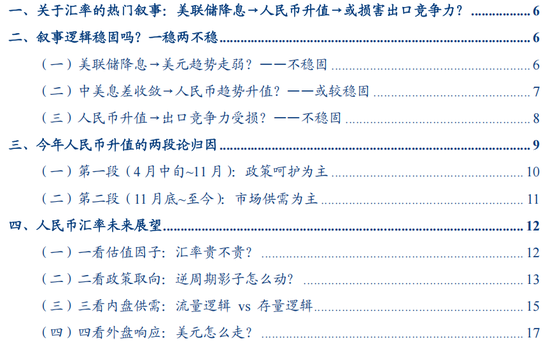
汇率升值叙事的三重纠偏:美联储降息≠人民币升值≠出口承压
Huachuang Securities· 2025-12-28 10:45
Group 1: Core Narrative and Logic - The popular narrative suggests that the Federal Reserve's interest rate cuts lead to a weaker dollar, which in turn causes the renminbi to appreciate, potentially harming export competitiveness[1] - The logic of this narrative is questioned on two fronts: 1) Federal Reserve rate cuts do not necessarily equate to a weakening dollar; 2) Renminbi appreciation does not necessarily harm export competitiveness[1] - The correlation between the Federal Reserve's policy rate adjustments and the dollar index is weak, with a monthly correlation coefficient of only 0.04 since October 1982[3] Group 2: Renminbi Exchange Rate Analysis - The renminbi's exchange rate is currently considered fairly valued, with deviations from the "value center" ranging from 0% to 2%[7] - The renminbi's appreciation since May has released some corporate foreign exchange positions, widening the potential volatility range of the exchange rate[1] - The exchange rate's future trajectory will depend on several factors, including valuation, policy direction, internal supply and demand, and external responses[11]
外汇专题报告:规模收敛但未转向,结售汇格局依旧平衡
Hua Tai Qi Huo· 2025-12-23 03:10
Group 1: Report's Investment Rating - No information provided on the industry investment rating. Group 2: Core Views - The narrowing of the surplus in November's foreign exchange settlement and sales and cross - border receipts and payments mainly reflects structural and rhythm adjustments. Enterprises' foreign exchange settlement and sales and hedging behaviors tend to be rational, and cross - border capital flows remain stable without a directional change. The US dollar is still in the stage of repricing within a range, lacking a trend driver in the short term. Affected by this, the USD/CNY rate generally maintains a range - bound movement, mainly fluctuating around 7.0 - 7.1 in the short term, and a directional breakthrough still awaits new macro variables [2]. Group 3: Summary by Directory Market Supply - Demand Relationship Analysis - In November, the surplus in bank foreign exchange settlement and sales fell to $15.65 billion, showing a continuation of the surplus but a marginal slowdown. The overall foreign exchange supply - demand remains in a relatively balanced state. The scale of foreign exchange settlement and sales did not show a significant increase or decrease, indicating that cross - border capital flows are still mainly for regular receipts and payments. The narrowing of the surplus mainly reflects a rhythm change rather than a directional reversal. Against the backdrop of dull US dollar pricing and neutral corporate exchange - rate expectations, the marginal guidance of single - month foreign exchange settlement and sales data on the exchange rate has declined [9]. Foreign Exchange Market Supply - Demand Balance - The change in the surplus structure mainly comes from the cooling of the foreign exchange settlement momentum at the client - service end, while the deficit in banks' own foreign exchange settlement and sales narrows simultaneously, offsetting some of the pressure from the narrowing surplus. The surplus in client - service foreign exchange settlement and sales narrowed from $21.426 billion to $16.423 billion, indicating that enterprises at the end of the year prefer to disperse foreign exchange settlement and focus on operating cash - flow management rather than releasing foreign exchange settlement demand in a concentrated manner. At the same time, the deficit at the bank's self - operating end narrowed significantly, reflecting a phased relief of the pressure on financial institutions in matchmaking and position management, making the surplus structure of foreign exchange settlement and sales smoother and helping to stabilize the market's expectations of short - term exchange - rate fluctuations [10]. Forward Foreign Exchange Settlement and Purchase Intentions - In November, the RMB exchange rate strengthened moderately, and market trading activity rebounded. The average spot value of the USD/CNY rate decreased by 0.48% month - on - month, still operating in a moderately volatile range. Meanwhile, the spot inquiry trading volume in the inter - bank market rose to $40.342 billion, reflecting a recovery in market trading willingness. In this context, enterprises' spot - end operations became more rational. After excluding forward performance, the foreign exchange settlement rate of received funds fell to 51.99%, and the foreign exchange purchase rate of payment funds decreased to 60.30%, indicating that enterprises did not adjust their foreign exchange settlement and sales rhythm in a concentrated manner due to short - term exchange - rate fluctuations but maintained a relatively balanced receipt and payment management. On the forward end, the overall performance was a cooling of new hedging demand and a differentiated performance structure, indicating that enterprises are adjusting their focus on managing short - to - medium - term exchange - rate risks. In November, both the forward foreign exchange sales and settlement contract amounts declined, and the new hedging demand decreased compared with the previous period. The change at the performance end was more notable, with a reduction in forward foreign exchange settlement performance and a significant increase in forward foreign exchange purchase performance, reflecting that some enterprises chose to perform contracts after locking in exchange rates previously but did not simultaneously expand new forward exposures. The unexpired forward net foreign exchange settlement scale is still rising, and the forward foreign exchange settlement and purchase hedging ratios are basically the same, indicating that the forward hedging structure of enterprises tends to be stable, mainly reflecting "stock adjustment" in risk management rather than an active bet on the exchange - rate direction [12]. Foreign Exchange Settlement and Sales Structure Analysis Banks' Own Foreign Exchange Settlement and Sales - In the macro - data analysis of bank foreign exchange settlement and sales, banks' internal foreign exchange settlement and sales activities are not the key focus. These activities mainly include external dividend and profit payments, repatriation of overseas profits, and capital injection. The funds involved are small in scale and seasonal, having a limited impact on the overall trend of foreign exchange settlement and sales [17]. Banks' Client - Service Foreign Exchange Settlement and Sales - In November, the surplus in domestic banks' client - service cross - border receipts and payments narrowed significantly, with both the current account and the capital and financial account declining. The current - account surplus decreased from $74.66 billion to $55.238 billion. The surplus in goods trade fell to $72.666 billion, mainly reflecting a structural adjustment under the stable export rhythm and enhanced marginal import recovery, rather than a reversal of the foreign - trade fundamentals. The deficit in service trade expanded to - $6.421 billion, mainly related to the slow recovery of outbound - related consumption and the incomplete recovery of cross - border service receipts and payments. At the same time, the deficit in the income and current transfer items expanded, weakening the support of the current account for the surplus in cross - border receipts and payments, but the overall current account still maintained a relatively solid surplus foundation. The deficit in the capital and financial account further expanded, indicating that cross - border capital flows are still mainly "structurally outflowing", but the internal composition shows differentiation. In November, the deficit in the capital and financial account expanded to - $38.605 billion. Among them, the deficit in securities investment narrowed to $34.599 billion, showing a significant improvement compared with the previous period, reflecting a marginal relief of the pressure of foreign - capital outflow. The deficit in direct investment narrowed slightly, indicating that cross - border capital flows at the entity level are becoming stable. Other investments changed from a small surplus to a slight deficit, with overall controllable fluctuations. Overall, the capital account still drags down cross - border receipts and payments, but there is no concentrated outflow through a single channel [21]. Deconstruction of November's Foreign Exchange Settlement and Sales Securities Investment - In November, the trading activity in the cross - border equity market declined simultaneously, reflecting a phased weakening of risk preferences at home and abroad. The trading volumes of the Shanghai - Hong Kong Stock Connect and the Shenzhen - Hong Kong Stock Connect decreased to 4424.844 billion yuan and 1791.246 billion yuan respectively, indicating that both north - bound and south - bound funds were mainly in a wait - and - see mode in that month, and the trading willingness decreased significantly. Compared with the equity end, the foreign - capital allocation in the bond end remained relatively stable, but there was a slight decline in November. The overall fluctuation of the overseas bond custody volume was not large, indicating that long - term allocation funds have not undergone a trend adjustment, but the slight decline in that month also reflects that when both the yield and the exchange rate are in a range - bound oscillation, the power for incremental allocation is insufficient. Overall, the impact of cross - border asset flows on the foreign - exchange market in November was mainly reflected in the slowdown of trading and foreign exchange settlement and sales rhythms, rather than a directional capital - flow shock [27]. Goods Trade - In November, the global manufacturing PMI declined marginally but remained near the boom - bust line, with major economies showing differentiation around the expansion - contraction critical point. Specifically, the global manufacturing PMI decreased slightly from 50.9 in October to 50.5; China's manufacturing PMI rebounded to 49.2, showing that the marginal effect of domestic - demand recovery offsetting external - demand slowdown. The US PMI fell to 52.2, the eurozone's to 49.6, and continued to weaken slightly in December, while Japan and South Korea remained below 50. Overall, the global manufacturing boom is in a high - level slowdown stage. External demand has not weakened significantly, but the expansion slope has decreased, making enterprises' foreign - exchange receipts and payments more likely to follow the order and delivery rhythm smoothly rather than adjusting their foreign - exchange settlement and sales strategies in a concentrated manner due to single - month boom fluctuations. In November, China's export data improved significantly, and the trade surplus widened again, indicating that foreign trade still has resilience in supporting foreign - exchange receipts and payments. In US dollars, exports increased by 5.9% year - on - year in November, a significant rebound from the previous month, and imports increased slightly to 1.9% year - on - year. The single - month trade surplus expanded to $111.68 billion. From January to November, exports increased by 5.4% year - on - year, imports decreased by 0.6% year - on - year, and the trade surplus exceeded $1 trillion for the first time. Structurally, the import and export to countries participating in the Belt and Road Initiative increased by 6%, effectively offsetting the drag of a 16.9% year - on - year decrease in imports and exports to the US. Mechanical and electrical products accounted for more than 60% of exports, among which the exports of integrated circuits and automobiles maintained rapid growth, and the general decline in commodity import prices also increased the surplus level. Overall, the stable volume and good price of foreign trade, as well as the diversified regional and product structures, help to enhance the long - term support of the current account for foreign exchange settlement and sales and the exchange rate, but in the short term, it mainly plays a "bottom - supporting" role rather than a trend - driving force [32].
外汇专题报告:结售汇双边放量,汇率区间波动
Hua Tai Qi Huo· 2025-05-21 09:42
Report Summary Core Views - In April, both sides of foreign exchange settlement and sales volume increased, with the scale of settlement and sales rising simultaneously, and the overall deficit slightly expanding. The significant growth of forward net settlement reflects the improvement of enterprises' settlement expectations and more proactive hedging behavior [3]. - The US dollar index fluctuated weakly, and the Federal Reserve maintained a wait - and - see stance. After the withdrawal of the counter - cyclical factor, the fluctuation range of the RMB exchange rate increased [3]. Data Core Highlights Foreign Exchange Market Supply - Demand Structure - In April 2025, the bank foreign exchange settlement and sales deficit was $4.257 billion, slightly expanding from the previous value of - $1.967 billion. The scale of both settlement and sales increased, indicating higher activity in enterprises' foreign exchange transactions. The surplus of bank customer - related foreign exchange settlement and sales expanded from $96 million to $589.3 million, while the deficit of banks' own foreign exchange settlement and sales expanded from - $2.063 billion to - $10.15 billion [4]. - The spot exchange rate of the US dollar against the RMB rose 0.34% month - on - month, and the market trading activity declined slightly, with the average spot inquiry trading volume falling to $42.234 billion [4]. Forward Transaction Structure - In April, the forward market continued to recover. The forward settlement signing amount increased by $4.358 billion month - on - month, and the forward sales signing amount decreased by $2.193 billion, driving the cumulative outstanding forward net settlement amount to expand from $903 million to $5.231 billion. The forward purchase performance amount increased by $7.519 billion, much higher than the increase in settlement performance [5]. - The forward settlement hedging ratio rose to 8.59%, the highest point this year, while the forward purchase hedging ratio dropped to 4.3% [5]. Securities Investment - In April, the foreign - related receipts and payments under securities investment changed from a surplus of $7.37 billion to a deficit of $12.493 billion. The trading volumes of both the Shanghai - Hong Kong Stock Connect and the Shenzhen - Hong Kong Stock Connect decreased, and the two - way difference narrowed. However, the bond custody volume of overseas investors in RMB bonds rose to 29,781.5 billion yuan [6]. Goods Trade - In April, the goods trade surplus narrowed, dragging down the foreign exchange settlement and sales surplus. The global manufacturing PMI fell from 52 in March to 50.8 in April, and China's manufacturing PMI dropped to 49, returning to the contraction range. The US manufacturing PMI remained at 51.2, while Japan and the Eurozone were still in the contraction range [6]. Exchange Rate Views - The US inflation shows an initial slowdown trend, but the Fed maintains a cautious policy stance. The US core CPI in April fell to 2.8% year - on - year, and the PPI also declined month - on - month. However, the Fed did not adjust its policy, and the US dollar index fell to around 100 [8]. - The easing of tariffs boosted expectations, and the exchange rate fluctuated more after the withdrawal of the counter - cyclical factor. In May, the RMB exchange rate fluctuated around 7.20. After the withdrawal of the counter - cyclical factor, the exchange rate was more driven by market supply and demand, and the short - term fluctuation range increased. The 1 - year USDCNY swap point dropped to - 2160, and the RMB exchange rate may show a two - way shock pattern in the short term [8].
外汇月报:预期扰动增强,美元短暂偏弱-20250506
Hua Tai Qi Huo· 2025-05-06 07:19
Group 1: Report Investment Rating - There is no information about the industry investment rating provided in the report. Group 2: Core Views - The USD/CNY exchange rate showed a weak and volatile trend from late April to early May, with the stage high around 7.35 and then falling back to 7.27. The offshore RMB appreciated rapidly during the May Day holiday due to multiple factors such as improved Sino - US trade expectations, a callback in the US dollar index, and a warming of market risk appetite. The US dollar index fell about 4.5% in April, a relatively large monthly decline in recent years. The implied volatility of options first rose and then fell, and the implied volatility of call options declined, making the RMB exchange rate more two - way fluctuating [4]. - In April, China's macro data weakened month - on - month but was better than expected overall, while US growth data fell short of expectations. China's manufacturing PMI dropped to 49.0, indicating short - term pressure on the manufacturing industry, but the high - tech manufacturing PMI remained in the expansion range of 51.5, and the non - manufacturing business activity index was 50.4, with the service industry's recovery momentum continuing. In the US, the ISM manufacturing PMI in April slipped to 48.7, and the first - quarter GDP was - 0.3%, driving the Citigroup Economic Surprise Index significantly lower; during the same period, China's CESI continued to rise and was higher than that of the US at the end of April [4]. - The Sino - US interest rate spread remained inverted, the short - end interest rate spread became more stable in its fluctuations, and more statements on trade policies brought short - term disturbances to the exchange rate. The better - than - expected non - farm payrolls in April slightly pushed up the short - end yield of US Treasuries, while the yield of Chinese government bonds remained low due to policy expectations, pushing the spread structure to stabilize at a high level. The basis and swap points of USD/CNY rose simultaneously, indicating that the market was re - evaluating the exchange rate path. Sino - US frequent statements on tariff issues from April to May, although no clear policies were implemented, strengthened the policy game signal and affected market pricing and trading behavior [5]. - The deficit in foreign exchange settlement and sales narrowed, and the capital flow improved. In March 2025, the deficit in bank foreign exchange settlement and sales dropped to $2 billion, a significant reduction from February. The willingness to settle and purchase foreign exchange in the forward market both increased, with the settlement rate of foreign exchange receipts rising to 50.51% and the purchase rate of foreign exchange payments rising to 58.88%. The surplus in banks' foreign - related payments and receipts on behalf of customers reached $49.2 billion, and the net inflow of funds under the goods trade increased 1.2 times year - on - year, still being the main supporting force. The capital account deficit narrowed to $13 billion, with foreign investors continuously net - buying RMB bonds, and the allocation of bonds and equities improved simultaneously, indicating that foreign funds' preference for RMB assets had recovered [5]. - The RMB is expected to be relatively strong in the short term, and the USD/CNY exchange rate is expected to enter a period of shock consolidation. Against the background of the callback of the US dollar index, the repair of the Sino - US expectation gap, and the warming of market risk appetite, the RMB has been relatively stable. Looking ahead, the exchange rate direction will still be comprehensively affected by Sino - US trade policies, signs of a slowdown in the US economy, and related policy expectations, and the stage - by - stage fluctuations may intensify. Short - term trend judgment still needs to closely monitor event evolution and data feedback [6]. Group 3: Summary by Directory 1. USD/CNY Exchange Rate - General Situation - From late April to early May, the USD/CNY exchange rate was generally weak and volatile, falling from a high of around 7.35 in mid - April to around 7.27 in early May, with the RMB strengthening intermittently. The offshore RMB appreciated rapidly during the May Day holiday, reflecting the combined effects of Sino - US trade easing expectations, US dollar adjustment, and a warming of market risk appetite. The US dollar index continued to decline in April, with a monthly decline of about 4.5%, one of the larger monthly declines in recent years. The decline was mainly affected by the weak economic growth in the first quarter of the US and the market's uncertain expectations about the Fed's interest - rate cut path this year [10]. 2. Volume - Price Observation - From April to early May 2025, the volatility of the USD/CNY options market generally increased, but signs of a local decline began to appear. Compared with March, the implied volatility from April to early May was generally stronger, indicating that the market's expectation of exchange - rate fluctuations had increased. However, in early May, the implied volatility of the call side of USD/CNY options declined, narrowing the gap with the put side, suggesting that the market's expectation of the US dollar's unilateral appreciation had weakened [17]. - The RMB counter - cyclical factor has been running below 10% steadily, indicating a stable exchange - rate operation. The 3 - month interest rates of offshore and onshore RMB have remained inverted, indicating a tight supply of offshore funds. However, in May, the inversion margin narrowed slightly, reflecting a marginal easing of cross - border liquidity tension [17]. - In early May, the yield of US Treasuries was generally higher than the average in April, especially at the short end, and the market's bet on the Fed's short - term policy shift has weakened. Nevertheless, the yield of 10 - year US Treasuries has fallen from the high in April, indicating that long - term interest rates are still in an adjustment channel. The yield of Chinese government bonds was weaker than last week and last quarter, and the market's expectation of further flexible adjustment of domestic policies has increased [17]. - The basis and swap points of USD/CNY generally showed an upward trend, reflecting the market's need to re - price the exchange - rate fluctuation direction in the short term under the influence of the Sino - US interest - rate spread and market risk - aversion demand. The change in the exchange - rate price is still coupled with the macro - expectation, but the directional signal is not clear, and it mainly shows structural adjustment and defensive pricing for event catalysis in the short term [18]. 3. Macroeconomic - Chinese Macroeconomic Data - In April 2025, China's economic sentiment indicators generally declined, but domestic demand, high - tech manufacturing, and the service industry maintained a certain degree of resilience. The official manufacturing PMI fell to 49.0%, down 1.5 percentage points from the previous month, falling back into the contraction range, indicating a phased decline in the manufacturing industry's prosperity level. However, the high - tech manufacturing PMI was 51.5%, significantly higher than the overall manufacturing level, reflecting the continued structural optimization trend [32]. - The non - manufacturing business activity index was 50.4%, slightly lower than the previous month but still in the expansion range, indicating that the service and construction industries generally maintained a recovery momentum. The new order and business expectation indicators increased month - on - month, indicating an improvement in market demand and business confidence. However, the employment index remained below the critical point, indicating that the recovery of business employment was still slow. In general, the composite PMI output index in April was 50.1%, lower than the previous month, indicating that the economy generally maintained expansion but with a slowdown in momentum [32]. 4. Macroeconomic - US Macroeconomic Data - In April 2025, the US macro data presented a combination of "stable employment, declining manufacturing, and policy wait - and - see", and the market's expectation of the Fed's policy path has been adjusted. The non - farm payroll data in April showed that the US added 177,000 non - farm jobs, higher than the expected 138,000, indicating that the labor market remained resilient. The unemployment rate remained at 4.2%, the same as the previous value, and the labor - force participation rate rose to 62.6%, with the participation rate of the core labor - force group aged 25 - 54 reaching a seven - month high, reflecting a solid employment foundation. However, the non - farm payroll data for March and February were revised down by a total of 58,000, indicating that the previous employment growth may have been overestimated [35]. - In terms of manufacturing, the ISM manufacturing PMI in April dropped to 48.7, back into the contraction range, the largest monthly decline this year. Detailed data showed that the new order and output indicators both weakened significantly, and the employment index declined for the third consecutive month. The increase in input costs and order uncertainty caused by tariff policies are weakening enterprises' willingness to replenish inventory and expand production. The final value of the Markit manufacturing PMI was 50.2, also lower than the initial value and expectations, further verifying the lack of growth momentum in the manufacturing industry [36]. 5. RMB Three - Factor Fitting - As of early May, the Sino - US Treasury yield spread generally remained inverted. Recently, the short - end yield of US Treasuries rebounded rapidly due to better - than - expected non - farm payrolls, while the yield of Chinese government bonds remained low under the influence of policy expectations, leading to a slight stabilization after an increase in the short - end spread inversion margin [38]. - From April to early May 2025, there were more statements related to Sino - US trade policies, and the market's attention to tariff - policy changes increased. As of early May, neither side had announced a specific negotiation schedule or clear policy documents, but both had shown a willingness to communicate. The market generally believed that there was still uncertainty about the pace of policy implementation. Under this background, the external - demand sub - index of China's manufacturing industry weakened in April, and the US ISM manufacturing survey also showed that tariffs had an impact on the cost side and delivery rhythm [45][46]. - In April 2025, the Citigroup Economic Surprise Index (CESI) showed an expanding difference in Sino - US macro - expectations. China's CESI rebounded and turned positive, reflecting that the domestic macro data were generally better than expected, mainly due to the improvement in high - tech manufacturing, non - manufacturing business activities, and export data, which drove the market's expectation of short - term domestic - demand repair and policy support to improve. In contrast, the US CESI fell from a high in March and continued to decline in April, falling into negative territory, mainly dragged down by lower - than - expected first - quarter GDP, weak retail, and ISM manufacturing data, indicating a significant adjustment in the market's expectation of US growth momentum [47]. 6. Capital Flows from the Perspective of Foreign - Exchange Settlement and Sales - Foreign - Exchange Market Supply - Demand Balance - The deficit in foreign - exchange settlement and sales narrowed significantly, and market expectations became more stable. In March 2025, the bank's foreign - exchange settlement was $189.6 billion, and sales were $191.6 billion, with the deficit narrowing to $2 billion from $10.4 billion in February. This change reflects the phased stabilization of the RMB exchange rate, the rationalization of enterprises' and residents' foreign - exchange purchase behavior, and the alleviation of the market's concern about the RMB's unilateral depreciation [49]. - The behavior of forward foreign - exchange settlement and sales was adjusted, and the demand for hedging increased. In March, the willingness for forward foreign - exchange settlement and sales in the market adjusted structurally. After excluding the performance factor, the settlement rate of foreign - exchange receipts increased to 50.51% month - on - month, indicating an enhanced willingness of export enterprises to lock in exchange rates. At the same time, the purchase rate of foreign - exchange payments increased to 58.88% month - on - month, indicating that enterprises actively increased their foreign - exchange purchase exposure to strengthen the hedging of US - dollar risks in the context of increasing trade and macro uncertainties [49]. - In March 2025, the bank's foreign - related income on behalf of customers was $692 billion, and payments were $642.8 billion, with a foreign - related payment - receipt surplus of $49.2 billion, further expanding from $29 billion in February. By item, the net inflow of cross - border funds under the goods trade in the first quarter reached $206.3 billion, a 1.2 - fold increase year - on - year, still being the main source of funds. The net outflow of cross - border funds in the service trade increased 25% year - on - year, with the outflow under travel increasing 12%, but the overall situation remained controllable. The stability of the cross - border payment - receipt structure has been enhanced, providing a basic support for the foreign - exchange market [50]. - The capital account deficit continued to narrow, and the deficit in March narrowed to $300 million from $13 billion in February. The securities investment account turned into a surplus, and foreign investors' willingness to allocate bonds increased significantly. Data showed that from February to March, foreign investors cumulatively net - bought $26.9 billion of domestic bonds, an 84% increase year - on - year; from April 1 to 18, they further net - bought $33.2 billion, maintaining a high - speed allocation rhythm. The allocation of equities also stabilized, indicating that foreign investors' confidence in RMB assets had recovered [52].